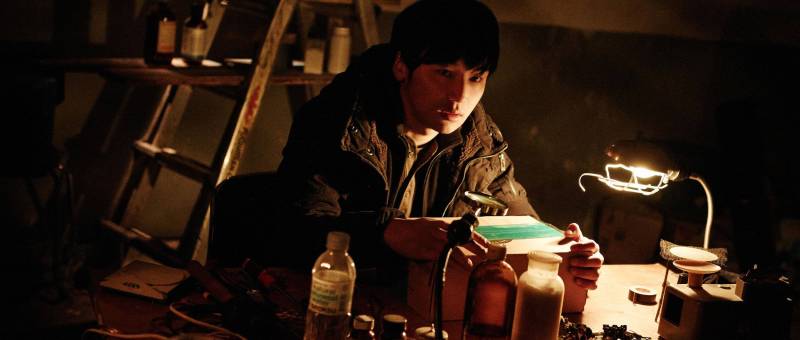
INGtoogi: The Battle of Internet Trolls (잉투기, Um Tae-hwa, 2013)

A keyboard warrior enters a masculinity crisis after being ambushed in real life and taking a beating from an online rival in Um Tae-hwa’s graduation film, Ingtoogi: The Battle of the Internet Trolls (잉투기, Ingtoogi). Though the title may promise something more like a slacker comedy, Um subtly hints at the loserville of the contemporary Korean society which is, as the hero’s mother suggests, “only for the select few” leaving men like Tae-sik (Uhm Tae-goo), in contrast to the film’s title, losing the will to fight.

20-something and unemployed, Tae-sik still lives at home with his mother and fills his life with online fighting games. Lured to a park on the pretext of selling an online game item, Tae-sik is unexpectedly attacked by fellow gamer ManBoobs and becomes a laughing stock for getting beaten up in the street. Vowing revenge, Tae-sik makes his way to a mixed martial arts gym named Ingtoogi which as the coach explains means “we’re still fighting” and begins training in preparation to publicly call out Man Boobs for a fair fight on safer ground.

But Tae-sik is now traumatised and has become frightened of everything, hallucinating being punched in the face and in fact afraid of getting hit. It’s this sense of fear along with his wounded masculinity that he’s trying to avenge through violence and male dominance, but in order to do so has to resort to carrying around a kitchen knife as rather phallic replacement for his fractured manhood while otherwise trained by an equally disaffected teenage girl herself a former mixed martial arts champion.

Young-ja’s (Ryu Hye-young) high school class is perhaps surprisingly asked to debate capitalism in broadly positive terms only for her best friend to shock her by giving a detailed, text book answer about the loss of individuality later explaining that her nagging mother bribed the teacher to get the topic in advance so she could prepare. Young-ja is an orphan living alone though watched over by her martial arts expert uncle, Wook, but Tae-sik too has a nagging mother who is particularly disappointed in him for embarrassing himself by getting beaten up and going viral online. She wants to emigrate to Costa Rica vowing that it’s too hard to live in Korean society which is only for the elites. Tae-sik has no desire to move and in a pointed criticism states that though he and his mother live in the same space he does not feel as if they “live together” suggesting that the demands of contemporary capitalism and her job as an estate agent have placed a divide between them.

Indeed, when she suggests that Tae-sik learn the trade from her she in fact ends up in a physical altercation with a homeowner that is observed by the entire neighbourhood just standing and watching much as they’d watched Tae-sik getting beaten up online. The film seems keen to present his generation as one already beaten into submission and retreating behind the shield of their computer screens rather than taking risks in real life while those like Man Boobs who is later revealed to have been suffering with poor mental health are perhaps looking for something more “real” offline but have few ways to express themselves outside of violence. Even Man Boobs’ friend who set up the attack and filmed it is revealed to be a failed boy band star whose bid for fame in a capitalist society has crashed and burned leaving him with nothing. 

Yet for all that Tae-sik and his friend Hee-jun (Kwon Yul) who learns to take his knocks faster are fairly skeevy each attempting to ask out the teenage Young-ja despite being in their 20s, Hee-jun following up on a tip off from one of the other “loser” fighters about how to set up a date to take advantage of girl. Far from overcoming his powerlessness, what Tae-sik has to get used to is being beaten and effectively accept his “loserdom” if continuing a futile attempt to fight his dismal circumstances by less than productive means in simply not giving in and grinning through the blood no matter how many knocks he takes. The inane insults of online commenters present themselves as a kind of Greek chorus enshrouding Tae-sik in his self-loathing and powerlessness but do so only as a means of masking their own, ranting against the darkness from the comparative safety of their anonymous online personas. Though underlined by a quiet irony, Um paints a bleak picture of the contemporary city in which masochistic violence has become the only escape from an oppressive society.


INGtoogi: The Battle of Internet Trolls screened as part of this year’s London Korean Film Festival.

Trailer (English subtitles)

Concrete Utopia (콘크리트 유토피아, Um Tae-hwa, 2023)

“They were just ordinary people” the heroine of Um Tae-hwa’s Concrete Utopia (콘크리트 유토피아) replies when asked about those who once lived in her apartment block. Considering what happened there, her words have a chilling quality hinting at the ways society breaks down and doesn’t in the wake of disaster and fear brings out our worst instincts. Yet on the other hand, perhaps it’s not so far from where we are now as Um’s housing crisis satire makes plain in a patriarchal and status-obsessed society.

“There’s no high and now low now. Everyone is equal,” according to Keum-ai (Kim Sun-young), head of the women’s association at the Hwang Gung apartment block, but of course that’s not true. An opening sequence featuring stock footage hints at the aspirational nature of post-war high rises that as one woman said were designed to give regular people a chance at homeownership though what most people enjoy is the convenience. The irony is that this is quite literally hierarchal living, though there are hierarchies even within hierarchies. When disaster strikes the city, Hwang Gung is inexplicably the only apartment complex left standing in what was previously a forest of concrete. Refugees from other other apartment blocks have made their way into the building, but some want to evict them and not least because they come from “Dream Palace” a more expensive and snooty complex across the way the residents of Hwang Gun believed looked down on them. 

With all these “outsiders” in the building, tensions begin to bubble. One couple wants to evict the non-residents because it took them 23 years to buy an apartment so they’re incredibly resentful that someone might usurp their privilege. Chaired by Keum-ai, a debate develops as what to what residency means with some firmly believing only home ownership is good enough, questioning the rights of civil servant Min-sung (Park Seo-joon) because he is still repaying his mortgage and therefore isn’t technically the owner of this home. In any case, most are unwilling to share despite knowing that many of the non-residents will die if left out in the post-disaster sub-zero temperatures. 

It’s also telling that when pressed to elect a leader, someone says that it has to be a man. Within the new system that emerges, the residents are divided along strict gender lines with the men serving in a kind of militia under the increasingly authoritarian rule of “Delegate” Young-tak (Lee Byung-hun) and women remaining in the building doing stereotypical female tasks. The rules state that the apartments are for residents only, while rations are awarded in proportion the perceived contribution to the community and it is forbidden to go outside. The residents develop a sense of themselves as chosen people, but are also feared by those around them for their cruelty with the rumour that their raiding parties are practicing cannibalism. 

The moral centre of the film, Min-sung’s wife Myeong-hwa (Park Bo-young) was against evicting the non-residents but largely goes along with the status quo until noticing the ways in which Young-tak’s authoritarianism is changing her husband, destroying his humanity and turning him into an obsequious lackey too afraid to resist. Then again, Min-sung was already a little more selfish and conservative than she may have been, secretly wanting to evict the non-residents in the hope of holding on to his property while unwilling to share the spoils with them. It’s this fear, their fear of displacement on losing the social status that comes with homeownership, that drives some towards cruelty even though in a world like this things like property values and job titles are obviously no longer relevant. 

This is may also explain Young-tak’s short term thinking, sending raiding parties out to find more food in the ruins and rubble rather than exploring options for growing new crops or securing water supplies. Flashbacks to conversations with his family reveal that this may have been a longterm problem for him with his wife criticising that he “never solved anything”. Her criticism undermines his sense of manhood in his inability to protect his family, not only unable to provide financial stability but even to keep a roof over their heads having apparently been swindled out of a house purchase. Male failure and insecurity by turns fuel his need for authoritarian power while the men under him, like Min-sung, mistakenly look to him as a leader and seek to emulate his code of masculinity in the desire to claim their own role as patriarchs protecting their families. 

As another member of the apartment block points out, no matter how bad the situation is there are things you should do and things you shouldn’t. Myeong-hwa does her best to maintain her humanity and is perhaps rewarded for it on encountering another group of good people much like herself while others find only more violence and misery. If they had only agreed to share in the beginning, come together and thought seriously about solutions for a better future all this could have been avoided but in the end traditional social values prove hard to abandon with homeownership still afforded special status amid the ruins of society even as Young-tak institutes a mini authoritarian fiefdom complete with secret police and public self-criticism sessions. Darkly comic in its satirical absurdity, Um’s drama is keen to point out what a crisis can do to “ordinary people” but also offers a ray of hope that there will in the end always be those less inclined to selfish cruelty than to an altruistic desire to find solutions that work for everyone.


Concrete Utopia screened as part of this year’s London East Asia Film Festival.

International trailer (English subtitles)

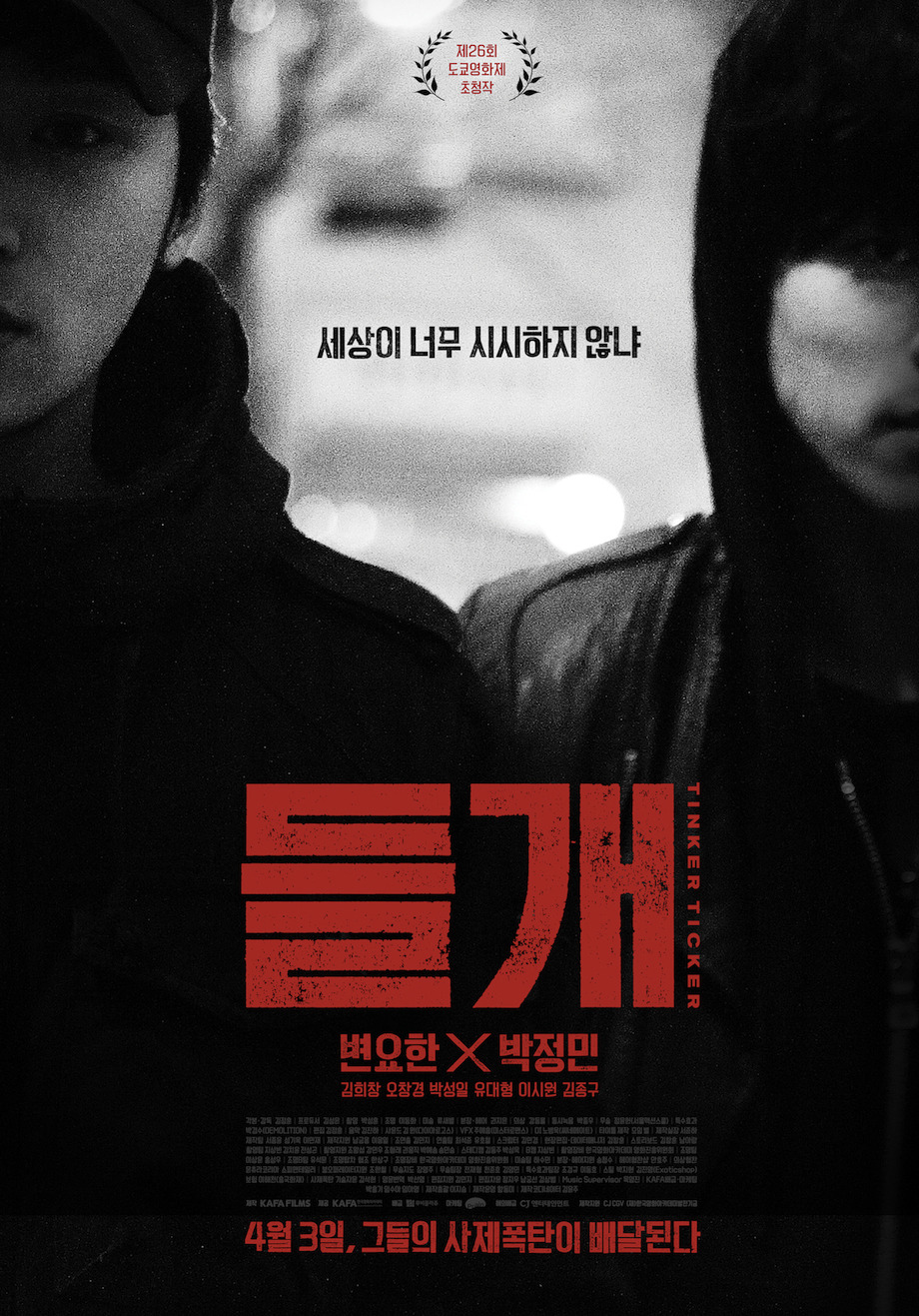
Tinker Ticker (들개, Kim Jung-hoon, 2013)

A jaded young man finds himself torn between continuing to fight the system and a total capitulation to it in Kim Jung-hoon’s explosive debut feature Tinker Ticker (들개, Deul-gae). Fit to explode, Jung-gu (Byun Yo-han) takes his revenge on a bullying culture by literally blowing it to hell but after a spell in juvenile detention emerges meek and mild, lacking in resistance and apparently willing to undergo whatever degradations are asked of him in order to achieve conventional success. 

Having placed a bomb in the car of a teacher who was abusive towards him, Jung-gu was caught and sent to prison with the unfortunate consequence that he can no longer study chemistry as he’s been banned from using dangerous substances. He repeatedly attends job interviews where he is asked bizarre and invasive questions, but can only find work as a post-graduate teaching assistant to a marketing professor who, like his teacher, largely abuses his position to humiliate him. To ease his frustrations, Jung-gu makes bombs at home but offers to send them out on the internet for free on the condition that the recipient actually use them.

His life changes when he runs into rebellious drop out Hyo-min (Park Jung-min) who is done with capitulation and fully committed to bucking the system. Seemingly from a wealthy family, he’s cut ties with his parents and lives a squalid life in a bedsit while continuing to attend university lectures despite having been expelled. Jun-gu sends one of the bombs to him to see what would happen and though Hyo-min seemed like he was going to simply throw it away he ends up blowing up a van which ironically has the CJ Films logo on the side.

Hyo-min in a sense represents Jung-gu’s rage and resentment towards the system that oppresses him along with a desire for anarchic autonomy while he conversely leans closer to a conventional corporate existence by willingly debasing himself before his sleazy boss Professor Baek (Kim Hee-chang) who asks him to act unethically by “revising” the results of his research so they can secure funding and do a back door deal with his long-standing contact Mr. Kim. Baek also forces him to drink beer that’s been drained through his sock as part of a bizarre hazing ritual while otherwise running him down or insulting him at the office. 

Hyo-min tries to goad Jun-gu into blowing up his attempts at conventionality by taking out Baek, but he continues to vacillate apparently still interested in becoming a corporate drone whatever the personal cost. “I don’t want you to become dull,” a slightly spruced up Hyo-min later insists in trying to push Jung-gu into killing Baek, while Jung-gu isn’t sure which life he wants torpedo. In any case, he seems incredibly ashamed of his criminal past and wary of others finding out about it not just because of its practical consequences for his employment but on a personal level. If he wants to transition fully to the life of a soulless salaryman he’ll need to kill the Hyo-min within him and remove all traces of resistance and individuality.

Despite having promised to do so, none of the other men who request the bombs actually use them perhaps like Jung-gu lacking the ability to follow through but enjoying the power of having the ability to burn the world even if they’ll never use it. Jung-gu’s bombing fixation is indeed in its way passive, a vicarious thrill in the ability to cause havoc for no real purpose but not really doing anything with it all while his resentment grows in parallel with his desire to be accepted by mainstream society. Hyo-min eventually comes to the conclusion that nothing really changes, and it both and doesn’t for Jung-gu who finds himself succumbing to the consumerist desires of a capitalistic society willing to debase himself, and later humiliate others, to claim his rightful place on the corporate ladder. Kim takes aim at the pressure cooker society, implying that these young men are in themselves almost ready to explode in their twin resentments and jealousies while ultimately complicit in their own oppression in wilfully stepping in to a corporate straitjacket even at the cost of their freedom and individuality. 


Tinker Ticker screened as part of this year’s London Korean Film Festival.

International trailer (English subtitles)