The Three Sisters of Tenmasou Inn (天間荘の三姉妹, Ryuhei Kitamura, 2022)

Caught in a space of existential limbo, a young woman struggles with the uncertain nature of life. What’s the point of living in a world that might end, she asks herself, seemingly not having realised that it’s as it always was, the world is always ending and may blink out at any given second. Ryuhei Kitamura’s adaptation of the manga by Tsutomu Takahashi The Three Sisters of Tenmasou Inn (天間荘の三姉妹, Tenma so no San Shimai) plays out a little like a mashup of Hirokazu Korea’s Afterlife and Our Little Sister, but ultimately meditates on how to live on in the shadow of loss.

After all, as the relentlessly cheerful heroine Tamae (Non) later says, life is hard but the world is not so bad and everyone has their part to play. That’s something she discovers for herself after falling into a coma following a traffic accident and arriving at Tenmasou Inn in the picturesque seaside town of Mitsuse. As is explained to her, the inn exists in a liminal space between Heaven and Earth where those caught between life and death are expected to make a choice on their direction of travel. 

But Tamae begins to enjoy her time at Tenmasou in part after learning that the owner’s daughters, Nozomi (Yuko Oshima) and Kanae (Mugi Kadowaki), are her half-sisters. They are fully aware of their liminal status and that unlike Tamae they can never return to the mortal world or make any kind of life for themselves in Mitsuse where time stands still. Nevertheless, Tamae’s relentless cheerfulness and knack for human empathy prove key assets, beginning to return an energy and warmth that has those around her giving new thought to their cosmic inertia and if it’s really possible to go on living in a constant state of timelessness. 

Tamae might want to stay, experiencing for the first time the sense of family that she’s searched for all her life. She considers giving up the rest of her time to stay with them, but is reminded that no one can stay in this transient place forever while this version of Mitsuse which seems to hang over the “real life” town may soon disappear. Those who live there describe it as like living in a dream, a confusing simulacrum of life in which no time passes. There are those who make the eventual decision to pass on towards rebirth while others opt to stay, still having unfinished business or perhaps just not quite yet ready. 

Recalling the 2011 tsunami, the film touches on the difficult subject of survivor’s guilt and how to come to terms with loss on a mass scale while Tamae tries to process what it means to live and to not to. She resolves that “people don’t end when they die” but live on in the memories of those who remember them, though her conviction that she must live on as a kind of conduit for the souls of others may also rob her of a degree of her selfhood in her own right to live simply as herself.

Even so as she admits life is hard. An old woman suffering with liver cancer who had been blind for many years looks for beauty in the afterlife only to be reminded that there are beautiful things everywhere if you take the time to look. She too has had a life of sadness, but discovers that it might not be too late to make up for lost time, while a very young woman who felt herself to be alone learns that she has a friend and there are those who care for her even she did nearly burn the inn down in a fit of temper. Unabashedly sentimental, the film is as much about moving on as it is about learning to live in the present as the various guests contemplate whether to return to the world of the living with all of its pain and loneliness, or proceed to that of the dead knowing that there’s no guarantee the next life will be any better. Melancholy but also in its way uplifting, Kitamura’s empathetic drama eventually settles on a note of poignancy in which the act of living becomes its own memorial and defiant act of remembrance in the face of constant and unexpected loss.


The Three Sisters of Tenmasou Inn screens in New York Aug. 6 as part of this year’s JAPAN CUTS.

Original trailer (English subtitles)

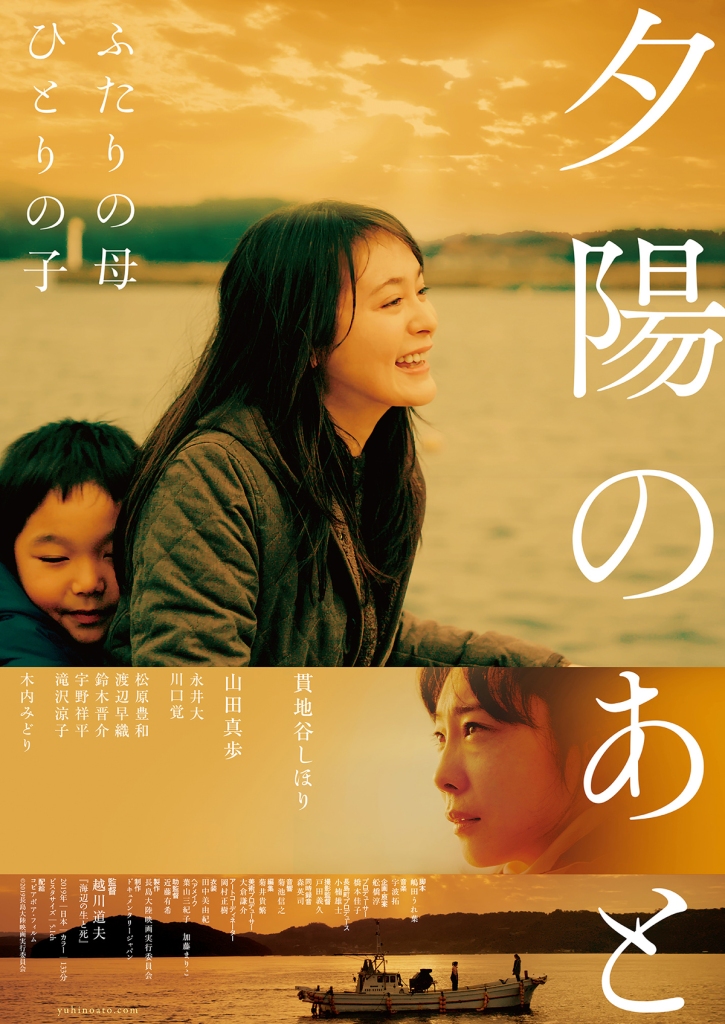
After the Sunset (夕陽のあと, Michio Koshikawa, 2019)

Two women find themselves caught up in an impossible situation in Michio Koshikawa’s sensitive maternal drama After the Sunset (夕陽のあと, Yuhi No Ato). Though both want the best for the child, they have to acknowledge that someone is going to end up desperately hurt while perhaps no one is at fault other than the insensitive and austere society which saw fit to punish a young woman already in the depths of despair rather than come to her aid. 

7-year-old Towa (Towa Matsubara) lives in a cheerful island village with his mother Satsuki (Maho Yamada), fisherman father Yuichi (Masaru Nagai), and compassionate grandma Mie (Midori Kiuchi). What he doesn’t know is that Satsuki and Yuichi are not his birth parents. Unable to have children of their own they decided to pursue adoption after years of unsuccessful fertility treatments and now that they have everything else sorted are hoping to finalise Towa’s legal status as a member of their family. What they don’t know is that Towa’s birth mother, Akane (Shihori Kanjiya), has been living on the island for the past year to be close to her son but is conflicted and at something of a loss as to what to do. Matters come to a head when they need the birth mother’s signature on the adoption forms to confirm her renunciation of parental rights and Akane’s true identity is exposed. 

The first and most obvious problem is that both women believe themselves to be the rightful mother. Satsuki has been raising Towa since he was a baby and her feelings for him are no different than if she had given birth to him herself. Akane meanwhile gave birth to Towa in difficult circumstances and was then separated from him. She has spent the past four years searching and wants nothing more than to be reunited with her son. Though she can see that he is very happy with with Satsuki and Yuichi and is grateful that he has found such a loving family in such a beautiful place, she cannot bear the thought of losing Towa while Satsuki cannot help but fear that this other woman who was able to do what she was not in giving birth has come to take her child away. 

It is of course an impossible situation with no good or right answers. Satsuki begins by resenting Akane, discovering that Towa was abandoned as an infant in an internet cafe and regarding her as having lost the right to call herself his mother but on investigating more begins to understand the kind of despair she must have been in to have taken such a drastic step. A victim of domestic violence left all alone with an infant child and no means of support, she considered suicide but rather than help her the authorities criminalised her actions and took her child away, dangling the false hope of a reunion in return for “rehabilitation” while Satsuki and Yuichi gave him a happy family home she knew nothing about. Towa has lived all his life on the island, he thinks Satsuki and Yuichi are his mother and father, how could you explain to him that he has to leave his second mother to return to the first that he never really knew?

Where one might expect there to be fear and anger, the two women eventually come to an understanding of one another as mothers who each want the best for the child even if that means they may end up hurt. As grandma puts it, the island is a welcoming place. It accepts all those who come, and does not pursue those who choose to leave but is always willing receive them when they return. Towa points out that that it takes a village, to him everyone on the island, including Akane, is his mother because they all raised him together though his father holds that the best mother of all is the sea. There is perhaps room for more than one if only in an ideological sense, no true mothers and no false only people who love their children and struggle against themselves to do what they know in their hearts is best. A gentle exploration of everyday life on a tranquil island, Michio Koshikawa’s sensitive drama finds people at their best in the extremities of emotional difficulty, finding their way through mutual compassion and understanding in an acknowledgement that there is no right answer only an acceptable best that leaves the door open for a future reconciliation.


After The Sunset is available to stream in Germany until June 14 as part of this year’s online Nippon Connection Film Festival.

Original trailer (No subtitles)