Seven Days in Heaven (父後七日, Essay Liu & Wang Yu-Lin, 2010)

A young woman embarks on what she describes as the most ridiculous journey of her life after her father passes away and she must return to her hometown for a series of incredibly involved traditional funeral rites in Essay Liu and Wang Yu-Lin ’s lighthearted drama Seven Days in Heaven (父後七日, fù hòu qī rì). Perhaps the intent is more to keep the mourners occupied in a slow burn dissolve of their grief than it is to console a parting soul but in any case Mei finds herself meditating on the past and her already fading memories of her late father. 

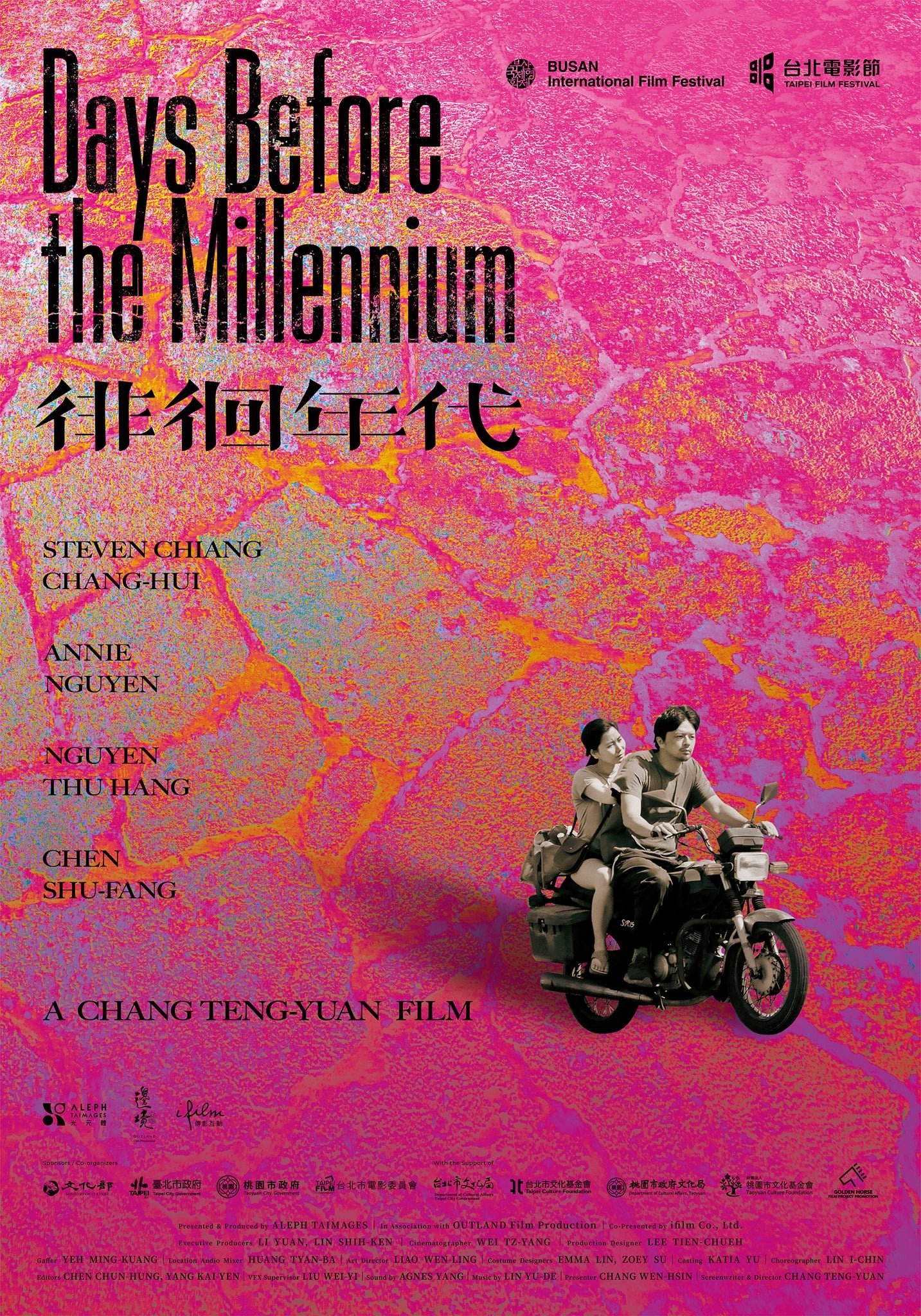
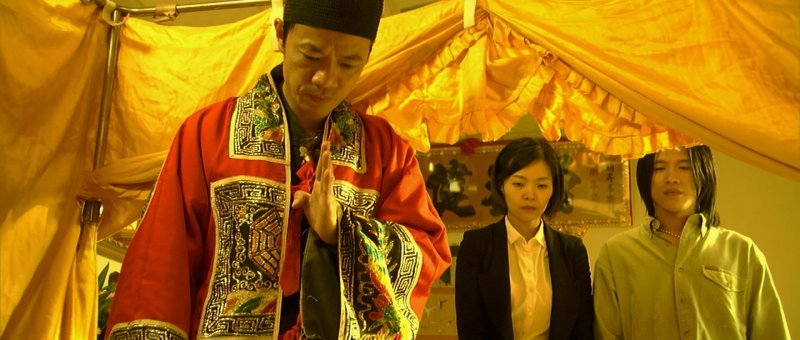
The strangeness begins at the hospital where Mei (Wang Li-Wen) and her brother Da-zhi (Chen Cha-Shiang) are repeatedly asked to explain to their father, who has just died, that they are taking him home. In the transport ambulance they ask if the family is Buddhist or Christian, and then simplify the question to whether they use incense sticks when a confused Mei is uncertain how to answer though as it turns out the rites they will be performing are largely Taoist. Anyway, the driver accidentally puts in the wrong tape and they get a blast of the Hallelujah chorus before he switches over to a series of sutras instead. A similar confusion sets in once they arrive back at the house where the funeral is being managed by a distant relative who works as a Taoist priest performing rituals largely concerned with death. 

A running gag sees these familial relationships so tangled that they need lengthy explanations, Yi (Wu Peng-Fong) the priest explaining to Mei’s cousin Zhuang (Chen Tai-hua) that he should have been calling him “brother” and not “uncle” while as it turns out Yi still carries a torch for Zhuang’s mother, Feng (Angie Wang), who left him to work in another town and married a wealthy man. Currently in Paris, she does not return for her father’s funeral and sends her son instead who is equally mystified by these strange rituals and decides to film them as part of a university project. 

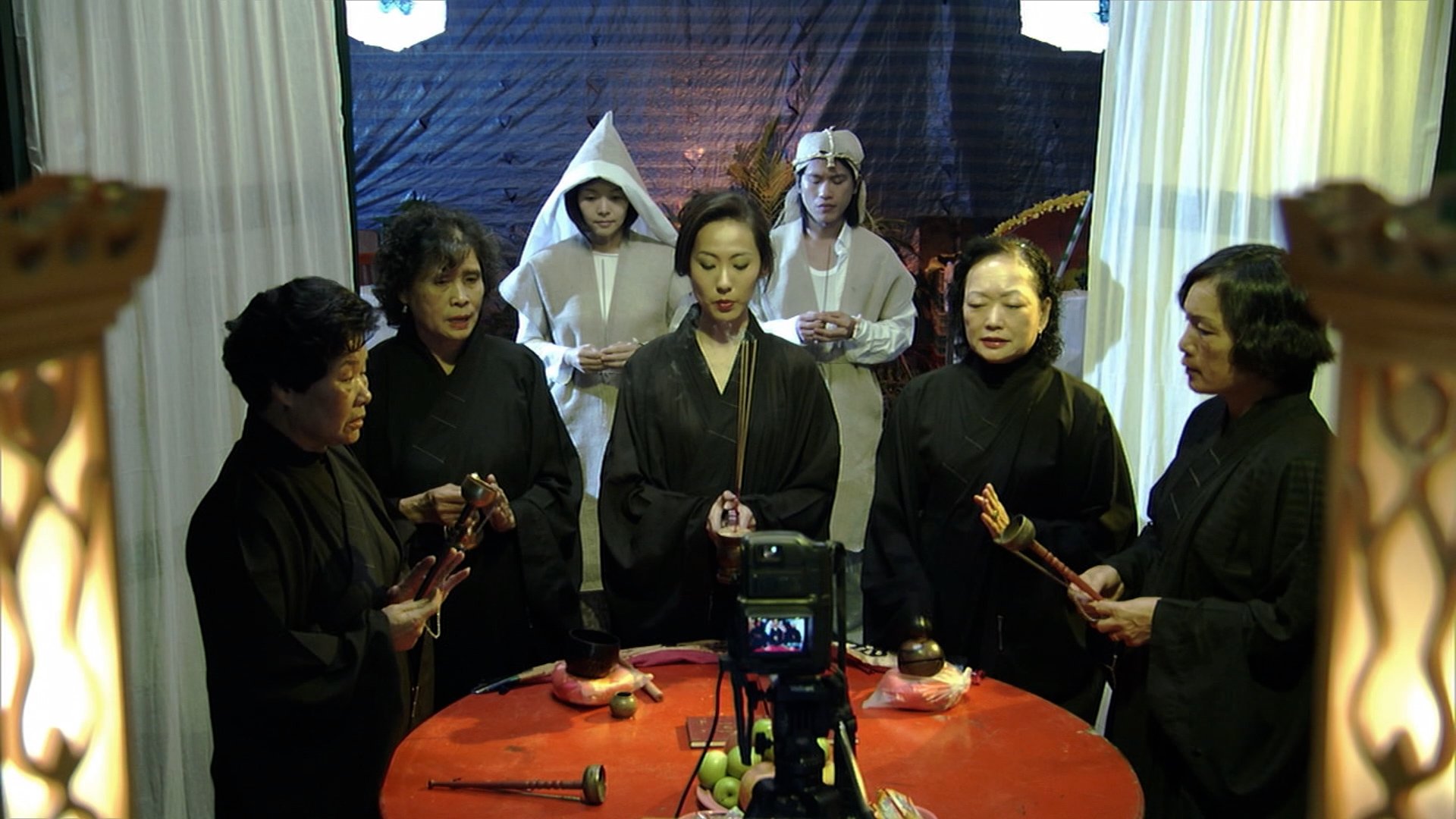
Yi consults some religious calendars and schedules the days of the funeral accordingly from when they close the coffin to when they conduct the final rites with Mei and Da-zhi merely expected to keep up. A detached Mei explains that as the daughter she’s explicitly instructed when to cry and when not to, forced to run in and wail by the coffin on cue. Yi’s partner, Chin (Chang Shih-Ying), herself works as a professional mourner wailing on the behalf of others merely altering the identity of the deceased but in this case the siblings are alternately bored and run ragged, possibly too exhausted by the process of mourning to fully process their grief. 

Zhuang’s film exposes the labour involved as he closes in Da-zhi explaining that he has to sweep up the ashes from the burning of ghost money. He asks him how he feels about his father’s death which might in itself be a little insensitive especially while pointing a camera in his face and he snaps back that he doesn’t know. Mei meanwhile is repeatedly drawn back to memories of her father, picking out a picture of him singing karaoke for the altar only to be told off by the older relatives. Zhuang eventually photoshops it to replace the mic with flowers and the background with a more appropriate scene of mountains and rivers. She doesn’t tell her friends her father passed away until months later and still finds herself forgetting, brought to tears on accidentally reminding herself to pick up some “longevity” cigarettes for him on a trip back from abroad only to realise there’s no need anymore. “Please stow your emotions” she imagines hearing the captain say in her father’s voice as she strives to accommodate her grief. 

Filled with a series of humorous digressions from Yi’s love life and their late father’s ability to charm his nurses even at death’s door, the film paints a warm and nostalgic portrait of small-town life and the various rituals that go along with it, including a small tangent on political corruption as a host of politicians are obliged to attend the funeral, because of the aforementioned ill-defined familial relationships, and send elaborate gifts including a large tower of beer cans that later collapses and requires even more tiding up. Finally the siblings must burn their mourning clothes as if symbolically moving on from their seven says in “heaven” and returning to their everyday lives but discover perhaps that grief is an ongoing process the rituals of which may continue long after the funeral is finished.


Seven Days in Heaven is available to stream in the US Sept. 25 to Oct.1 as part of the 17th season of Asian Pop-Up Cinema.

Trailer (English subtitles)
Days Before the Millennium (徘徊年代, Chang Teng-Yuan, 2021)

Perhaps deceptively titled, Chang Teng-Yuan’s bifurcated epic traverses the millennial divide in the company of two Vietnamese women each with very different stories but eventually agreeing “your generation or mine things were not easy for us” as they share their stories of migration amid the changing fortunes of Taiwan-Vietnam relations. Beginning in the mid-90s, Days Before the Millennium (徘徊年代, Páihuái Niándài) finds a mail order bride dreaming of a better life on an “island of riches” but soon finding herself trapped by an overbearing mother-in-law and violent husband, while another woman two decades later arrives happily married for love and well educated but often frustrated in her attempts to help those like herself struggling to adapt to a changing society. 

As Tue (Annie Nguyen) puts it, she exchanged her youth for a future of hope in Taiwan escaping a childhood of war for a more peaceful existence abroad. At the time she arrives, however, Taiwan is not so peaceful as relations with Mainland China continue to decline with many fearing military escalation. Meanwhile, the “mysterious man” to whom she was to be married, is a sullen construction worker filled with a sense of impossibility. Ming (Chiang Chang-Hui) patiently lays one brick on top of another attempting to build his home but finds himself under the watchful eyes of a couple of “surveyors” with eyes on his land. Alone in their van, the two men often debate the modern society the one decrying increasing globalisation while looking down on women like Tue complaining that half the town is now Vietnamese, “polluted”, as if they think they’re losing something even as they attempt to snatch Ming’s land out from under him to build, one assumes, some of the half-completed apartment blocks “private investigator” Lan (Nguyen Thu Hang) drives past 20 years later. 

Tue’s attempts to reclaim some of her agency through opening a small business selling street food only further irritate the already frustrated Ming whose internalised rage eventually turns violent while his mother (Chen Shu-fang) looks on saying nothing, later berating Tue for not having fulfilled the role for which she was desired pointing suggestively at an empty crib which seems to have been in the corner ever since she came. It’s at this point that her marginalisation intersects with that of women born on the island as her Vietnamese friend attempts to get her help by talking to the local police in the light of new legislation recently passed against domestic violence. Though the officer is sympathetic he can do little for her seeing as she has no material evidence while Tue blames herself and is otherwise trapped knowing that leaving her husband before completing her period of residency means potential deportation. Later doing just that she finds solidarity first at a buddhist temple and then a woman’s refuge, but even that is later disrupted by natural disaster.  

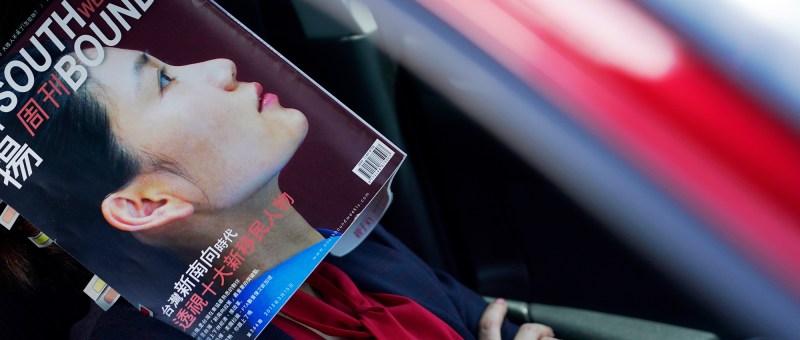
Tue’s story becomes a source of inspiration 20 years later for recent immigrant Lan, Chang transitioning to the post-millennial city during a storm which seems to narrow the screen now in a boxy 4:3 rather than the strangely oppressive widescreen with which the film opened. Unlike Tue, Lan has a degree in Chinese and an extensive resume having apparently met and married her Taiwanese husband in Vietnam. She applied for a position at a detective agency, the same agency which once offered to “help” Tue “fight for her rights” but didn’t really want to rent her an apartment, because she wants to help other women like herself in inter-cultural marriages find better solutions to domestic friction but finds her goals at odds with those of her capitalistic boss. Perhaps for these reasons, her first job does not go to plan as she accompanies a Vietnamese mail order bride on a mission to spy on the husband she suspects of having an affair, failing to stop her confronting him after discovering that he is a closeted homosexual who married her to please his parents but now feels guilty and conflicted in his treatment of her. 

This is of course another marginalisation, but one that Lan is ill-equipped to process while the woman she hoped to help is, as Tue once was, faced only with her broken dreams for better life in Taiwan. The Vietnamese news remarks on Taiwan’s geopolitical positioning as a delegation is awkwardly asked to leave an international conference because of Mainland pressure, while it also seems that a Taiwanese factory is responsible for a toxic waste spill that has damaged local fishing stocks and caused widespread illness in Vietnam. When Lan and Tue eventually meet they talk of the changing fortunes of their nations, Lan explaining that the port town where she’s from is now a bustling big city, the Vietnamese economy now much improved while Taiwan’s is falling behind. 20 years between them their fortunes are entirely different, even so they each agree things have not always been easy if differing ways. Nevertheless, their mutual sense of solidarity and desire to improve the circumstances of those like them offers a ray of hope in what might otherwise seem a difficult and hopeless future, Chang’s sometimes experimental, etherial tale of historical echoes and awkward symmetry finally allowing each of its heroines the sense of the better future of which they once dreamed. 


Days Before the Millennium screened as part of this year’s San Diego Asian Film Festival

Original trailer (dialogue free)