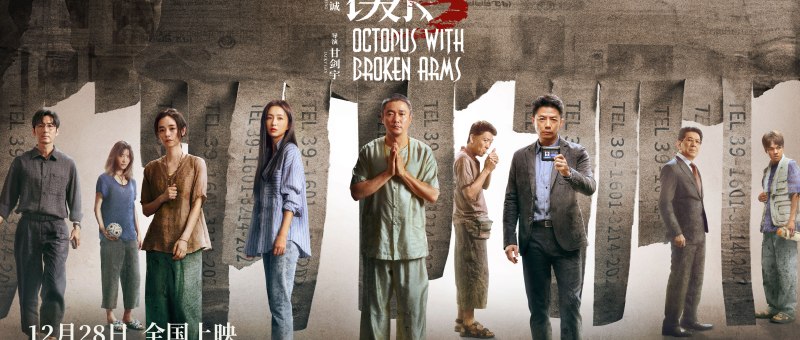
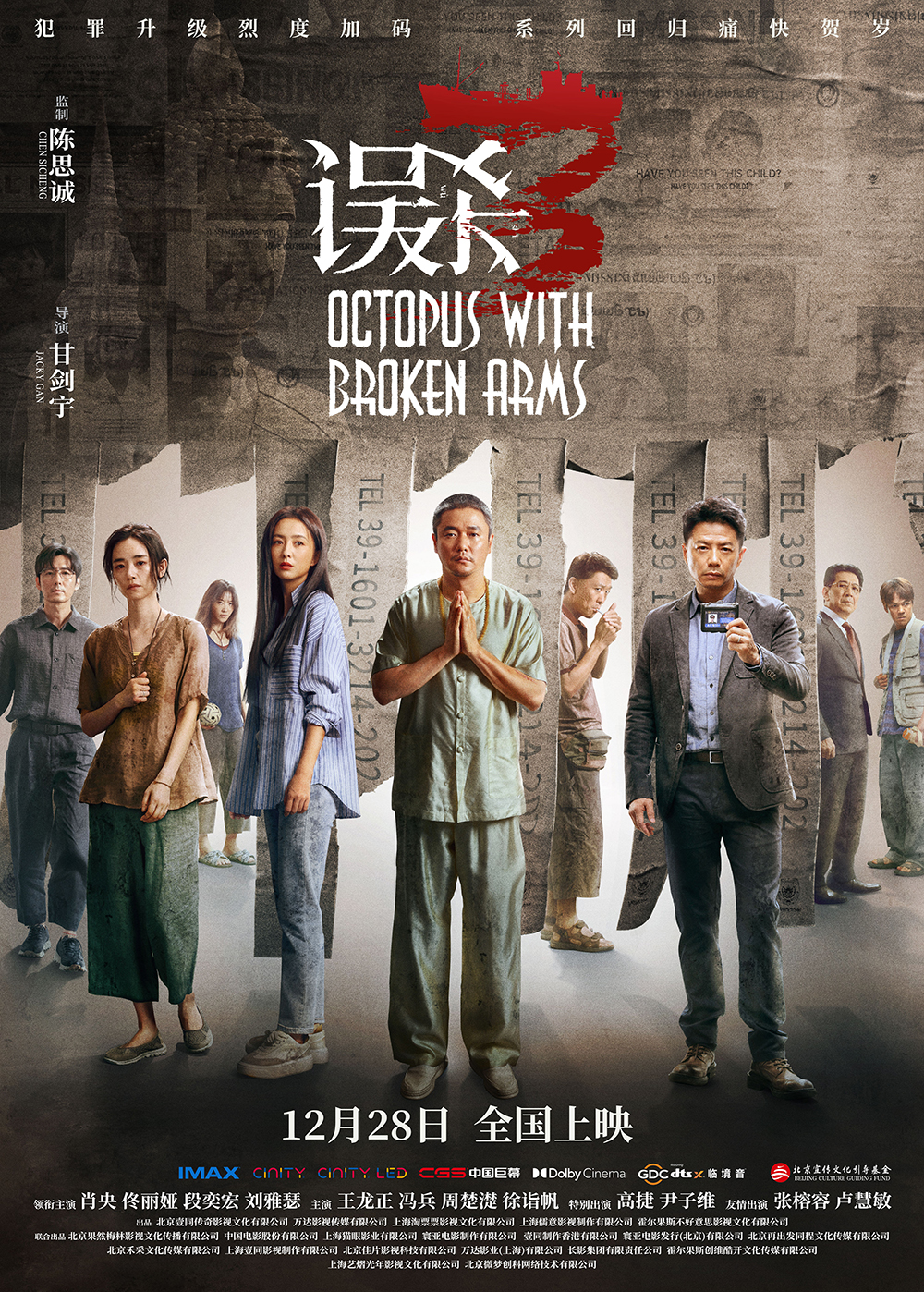
It’s quite surprising, somehow, that Octopus with Broken Arms (误杀3, wùshā 3) gets away with as much as it does simply being another recent mainstream movie set in an unidentified South East Asian nation where, conveniently enough, almost everyone speaks Mandarin. The third in the Sheep Without a Shepherd series, it quite clearly takes aim at the tendency of authoritarian governments to cover things up and deny the public the truth in any situation. Ordinarily, the censor’s board wouldn’t like that pointed out, nor would it like implications of police violence and corruption though as this is all taking place in “Not Mainland China”, it seems to have passed them by.
Then again, by setting itself overseas the film also deflects the implications of its focus on child trafficking which is a huge and well documented problem on the Mainland though here it becomes something that only happens overseas. The closing title cards in English offer a series of statistics about missing children worldwide, but avoid mentioning the statistics in China where the One Child Policy contributed to a phenomenon of children being kidnapped from the cities to be raised on rural farms while the preference of sons often saw daughters otherwise sold off.
In any case, Bingrui (Xiao Yang) is an ethnic Chinese refugee raised in an orphanage who got a huge capital injection from a gangster after finding his missing child and turned it into an internationally successful cosmetics corporation. When his own daughter Tingting is kidnapped, he seems to know immediately that he’s not been targeted simply because he’s a wealthy man and suspects the involvement of Fu-an (Feng Bing), an old “friend” with whom he’d had “a few issues” who had approached him for money for his son’s heart transplant which he had given him.
It doesn’t take long to figure out that Bingrui must have been involved in something untoward even if he’s now a devout Buddhist who’s just trying to be a good father having lost his wife in childbirth. Fed a series of clues to find his daughter, it’s clear he’s being led towards a kind of confrontation with his past along with a test of character. He may be able to say that he did the things he did because he had no other choice. If he had not joined the side of those acting against all common notions of humanity, he would simply have become one of their victims. But there is a choice involved all the same, and Bingrui chose survival through the sacrifice of other lives.
The fact that the kidnapper lives streams much of the chase suggests they’re less interested in the money than truth and ultimately want Bingrui to blow the whistle on a vast conspiracy which otherwise can’t be investigated because it’s burrowed deep into the police force and perhaps beyond. As one of those working against him later says, there are too many secrets destined to remain so that should be brought out into the light. A newsreader, however, remarks on hearing about a possible cover up of the deliberate murder of a number of trafficked children passed off as “refugees”, that what he most fears is that the people have lost faith in their government. Nevertheless, there might be something quite subversive about the lengthy scenes of citizens expressing discontent with blatant lies from the authorities and openly begging for the truth given the famously tightlipped CCP’s usual approach to public information.
In any case, the more we learn about Bingrui the harder it is for us to sympathise with him and the film then becomes more about proper paternity and the willingness of a parent to surrender their own life for that of their child. The film takes its English title from an incredibly elaborate school play little Tingting is involved in at the beginning of the film about how Octopuses are all orphans because their parents abandon them soon after birth and then pass away. Bingrui wasn’t exactly an orphan, like many of the children he was kidnapped from a loving family, but became one and lost his sense of humanity in the process. The question is whether he will be able to abandon his instincts for self-preservation to save his daughter or if, in the end, he will choose to save himself just as he did when chose to join those who kidnapped him rather than become a victim. Like many similarly themed thrillers of recent years, the film is built around a series of outrageous twists many of which are startlingly obvious but in their way serve the shocking quality of those that aren’t. What’s truly shocking is the depth of this conspiracy which hints not just at children being stolen and sold to overseas adopters, but trafficked into sexual exploitation or for illegal organ harvesting. The barbarity knows no bounds, and while the actions of Tingting’s kidnappers are in themselves brutal it’s clear they have no other way to ensure the injustice they face will be addressed. Indignant but avoiding sentimentality, Jacky Gan Jianyu’s slickly designed B-movie thriller nevertheless ends on a note of karmic retribution that the “hero” may not have earned but does at least allow him to make good on his promise and symbolically atone for the all the pain and suffering his callousness self-interest has caused.
Trailer (English subtitles)
 Windows on Worlds