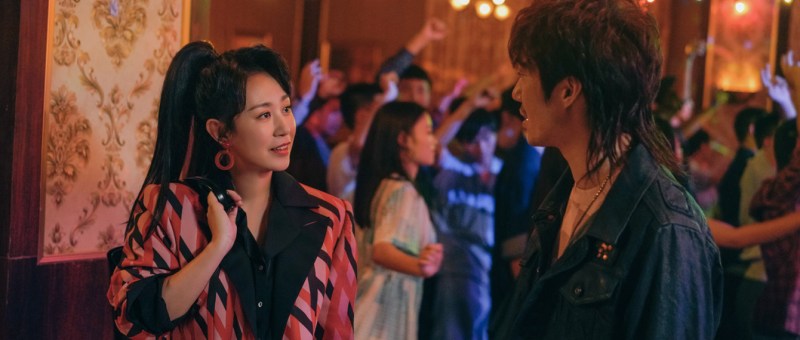

A struggling 30-year-old begins to repair his relationship with the difficult father he believed never liked him after being unexpectedly thrown back to the past and almost erasing himself from history in Zhang Luan’s sci-fi-inflected tale of filiality, Give Me Five (哥,你好, gē nǐhǎo). What begins as a Chinese riff on Back to the Future eventually skews closer to recent hit Hi, Mom which the Chinese title subtly echoes as the hero comes to appreciate the power of maternal love and sacrifice through bonding with the younger versions of his parents.
Now 30 years old, Xiaowu (Chang Yuan) explains that he was long estranged from his grumpy father Wu Hongqi (Wei Xiang) and rarely visited him but has since become his main carer now that he is living with Alzheimer’s. Xiaowu makes his living as an e-sports entrepreneur which is not something former engineer Hongqi can well understand and in truth Xioawu doesn’t seem to be that successful as he’s been putting off proposing to longterm girlfriend Huahua because of an anxiety about his finances. When Hongqi suddenly jumps off a bridge for no apparent reason and ends up in a coma, Xiaowu is at first oddly pleased and immediately begins raiding his office looking for his bankbooks only to find a mysterious ring and an old diary penned by his mother who died when he was a baby. Putting the ring on sends him back to 1986 where he manages to mess up his parents’ meet cute, endangering his own existence. In order to put things right he has to go back in time Marty McFly-style to ensure his mum and dad fall in love just like they were supposed to.
Back to the Future is a film from the 1980s expressing nostalgia for an idealised 1950s small-town America. Give Me Five to a degree romanticises the China of the mid-1980s but does so from an entirely different angle than the recent trend in 80s nostalgia which has taken hold in the West in that, other than a brief romantic moment featuring Teresa Teng’s Tian Mi Mi along with a few other retro hits, it is largely uninterested in pop culture or revisiting childhood memories but is attempting to draw a comparison between China before economic reform and the ultra-capitalist society of today. In what some might see as a simpler time, Xiaowu’s mother Daliu (Ma Li) is, as she’s fond of saying, a “model worker” in a factory which is in danger of closure while the “Biff” character, Qiang (Jia Bing), is a former employee who was dismissed for stealing coal. Having become wealthy after almost certainly doing something dodgy in Hong Kong he’s returned with a prominent Cantonese accent to buy the factory as part of a public-private partnership. A feisty young woman, Daliu sends him packing insisting she won’t let anyone disadvantage her fellow workers.
The comparison is further borne out by the melancholy figure of Qin (Huang Yuntong) who dated Hongqi after getting the meet cute that was supposed to go to Daliu but thew him over for the promise of riches with Qiang only to be left lonely in her old age having unwisely betrayed love for material gain. Meanwhile, there’s an interestingly progressive element to the relationship between Daliu and Hongqi in which Hongqi is somewhat feminised as the domestic partner cooking and shopping for his wife while Daliu is the uncompromising model worker as she proves during a high impact welding competition while eight months pregnant. The couple first fall in love talking over industrial plans with Daliu offering advice from the shop floor to help improve educated engineer Hongqi’s designs. While interacting with his parents before he was born, Xiaowu gains the familial experience he always felt he lacked in being able to share a family meal while touched by the love that existed between his mother and father and the knowledge that his parents were at least blissfuly happy with each other even if it was only for a short time.
Xiaowu had been resentful of his father that he never really told him how his mother died. He decides to try saving his mother’s life too and through his various experiences comes to an appreciation of maternal love not least through somehow being able to time travel into the womb to forge a more direct connection with her. In part an advocation for a more traditional filiality in which Xiaowu develops an understanding of the interplay between love and sacrifice between parent and child while coming to understand his relationship with his father after learning his family history, the film also offers a subtle rebuke against the consumerist society in idolising Daliu and her model worker attitude insisting that everything was better when people worked together for the good of all rather than for personal gain. It might be a slightly disingenuous message, Daliu’s factory life is indeed somewhat idealised, but there is something touching in Xiaowu’s eventual conversion and belated bonding with his heartbroken father.
Give Me Five is in cinemas across the UK, Australia and New Zealand courtesy of CMC and Well Go USA in the US and Canada.
International trailer (Simplified Chinese / English subtitles)

 Windows on Worlds