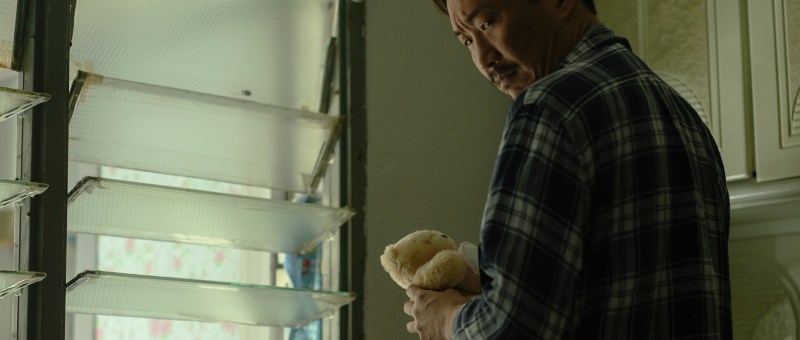

The legacy of abandonment visits itself on a trio of displaced Hong Kongers in Alan Fung Chi-hang’s melancholy crime drama, Elisa’s Day (遺愛). Set over 20 years from the Handover to the contemporary era, Fung draws inspiration from a real life crime while casting his ambivalent policeman, himself an orphan, as an ironic hero whose single act of compassion ends in a tragedy for which he feels he may not even have the right to atone.
Fung begins, however, in the present day as Inspector Fai (Ronald Cheng Chung-Kei) prepares to collect his daughter who is shortly to be released from prison. Flashing back, we’re introduced to Daisy (Carol To Hei-Ling), a pale and distant young woman picked up for suspected drug trafficking while momentarily captivated by a familiar song and carrying a bunch of roses. From there we head further back, all the way to 1996 when 15-year-old Elisa (Hanna Chan Hon-Na) discovers she is pregnant by her bad boy boyfriend Man-Wai (Tony Wu Tsz-Tung). Each abandoned by their parents, the pair decide to run away together and find solace in a family of three, but as expected economic impossibility disrupts their search for happiness. Man-Wai joins the triads and eventually agrees to become a hitman, temporarily separated from Elisa and their daughter while lying low in Thailand. A then Sergeant Fai remains hot on his trail, keeping tabs on Elisa who unwittingly brings her young baby to the cinema where his adoptive mother Auntie Bo (Anna Ng Yuen-Yee) runs the box office, the pair of them becoming surrogate parents to the lonely little girl while Elisa is forced to turn to sex work when Man-Wai’s triad bosses fail to uphold their end of the bargain.
“Everyone’s gone leaving only me behind” Elisa laments, learning that her estranged mother plans to move to the UK with her second family abandoning her once again in another, more complete sense. Trapped behind in a rundown area of the city, she finds herself caught between conflicting realities. Man-Wai pledges to stay with her forever but is soon gone eventually returning with promises of taking her to Thailand their dream of a better life symbolised by the red roses he brings with him that he claims reminded him of her. Man-Wai meanwhile is constantly told by his triad bosses that the future lies in Mainland China, a place he is originally so reluctant to travel that that he thinks killing is a better option only to later submit himself once again leaving Elisa alone in Hong Kong with no money and only a dwindling hope of ever achieving the familial bliss she longed for when she decided to run away with Man-Wai.
For his part, Fai is also an orphan though his fate his was different in that he was found by Auntie Bo who gave him a loving home. Even so he has his share of guilt, feeling responsible for Auntie Bo’s spinsterhood fearing that she never married or had children of her own because taking him in made it impossible in the more conservative Hong Kong of 70s and 80s. Ironically enough they become a surrogate family for the infant Daisy, but it’s Fai’s sense of empathy that eventually provokes tragedy in his decision not to arrest Man-Wai on his return seeing how much he loves his family and wanting to give him a chance to put things right rather than take a little girl’s father away from her. Unable to forgive himself, he abandons his responsibilities only to be reminded of them later finally ending the cycle by being willing to accept the responsibility which has been left for him.
Transitioning through the Hong Kong Handover, Fung evokes a sense of continual displacement, Elisa’s life destroyed firstly through abandonment and then through conflicted desires torn between a potential Thailand paradise and Mainland reality while longing only for a stable home(land). Daisy is offered something similar, her drug trafficker boyfriend to promising to take her to Thailand on their next run, the drugs ironically concealed in a bouquet of red roses just like those her father once brought for her mother. Her only salvation lies in the arms of Fai, a literal authority figure, reassuming his paternal responsibility and thereby restoring a sense of familial and political stability. Told in fragmentary, non-linear fashion, Fung’s melancholy tale of the legacies of abandonment and an innocent love eroded by economic and social realities eventually finds hope in familial repair and the remaking of a home in self-defined family.
Original trailer (English / Traditional Chinese subtitles)


 Windows on Worlds