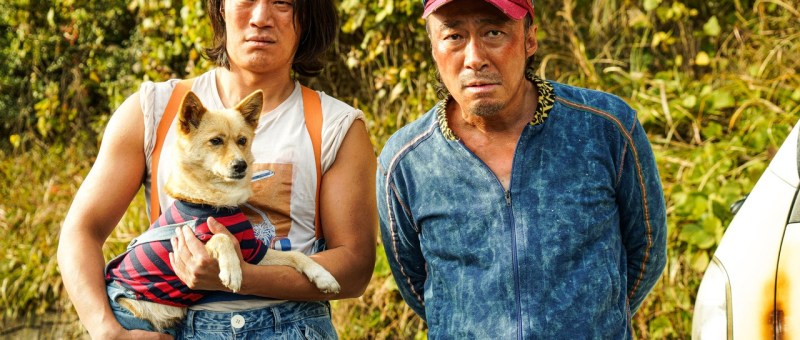
Handsome Guys (핸섬가이즈, Nam Dong-hyub, 2024)

The malicious inequalities of the contemporary society are manifested in an angry goat demon who wants to burn the world in Nam Dong-Hyub’s zany horror comedy, Handsome Guys (핸섬가이즈). Adapted from the American film Tucker & Dale vs. Evil, the film plays with prejudice and superficiality along with the pernicious snobbishness of a society founded on status in which, as a would-be-exorcist later says, some have lost the ability to distinguish good from evil.

Step-brothers Sanggu (Lee Hee-joon) and Jaepil (Lee Sung-min) often suffer precisely because of this inability. They are actually nice, sweet guys who are always trying to do the right thing but somehow their behaviour always comes off as creepy giving rise to a series of misunderstandings. That might be why they’ve decided to buy a cottage in the woods in order to live a rustic life, only the house they’ve purchased is a little more rundown than the estate agent implied and was previously home to a Catholic priest which doesn’t altogether explain the goat-themed pentagram in the basement. 

Like the brothers, Mina (Gong Seung-yeon) is also a nice person as we can tell because she’s the only one of her friends who wanted to give the goat they hit with their car a proper burial while the others decide to just leave it in the road and drive off. She too thought the brothers were creepy, but is also awakening to the fact that Sungbin (Jang Dong-joo), a rising star of the golf world, is a bit of a twit who wields his privilege like a weapon and has essentially invited her on this country weekend as entertainment. He also bullies his friend/minion Byung-jo (Kang Ki-doong) whom they regard as a loser and is evidently willing to bear humiliation merely to be in the same orbit as a man like Sungbin who with his good looks, refined manners and modern manliness projects an idealised image of contemporary masculinity that is the exact opposite of the brothers. 

In many ways, he is the demonic presence of privileged youth damaging the hopes and prospects of ordinary youngsters like Mina. Believing that she has been kidnapped by the brothers, the three guys set out to “rescue” her but Sungbin doesn’t care about Mina at all and in fact only wants to retrieve his phone which contains evidence of his sordid lifestyle which would destroy his prospects of becoming a celebrity through achieving success in his golfing career. Nevertheless, they decide to attack the brothers with mostly disastrous results believing them to be nothing other than idiotic hillbillies if also depraved backwoods serial killers living an animalistic, uncivilised existence that is far too close to the land for city slickers like Sungbin. 

Once again, the brothers are plagued by a series of bizarre misunderstandings based on the perception of their “ugliness” which aligns them with “evil” and demands they be exiled from a society that equates physical “beauty” with moral goodness. To that extent, having been rescued from falling in a pond, Mina becomes a kind of Snow White ensconced in the home of the brothers and coming to understand that they are actually nice, if a bit strange, and merely have difficulty expressing themselves while their down-to-earth homeliness only seems suspicious to those who are a little less honest with emotions.

Their niceness, however, seems to be perfectly primed to face off against the Goat Demon as they become determined to protect their homestead from the likes of Sungbin who has only contempt for them and thinks they’re merely fodder for his heroic fantasy of retrieving his phone and proving his manliness at the same time. In essence, it’s Sungbin who embodies the ugliness of the contemporary society with its hypocrisy and superficiality, its casual misogyny and petty prejudice, while the brothers later vindicated as angelic presences of altruistic goodness. Slapstick humour mingles with a sense of malevolence and an inescapable cosmic irony that plagues the brother’s with misunderstandings and has kept them isolated, “handsome guys” too beautiful for a profane world and attempting to find refuge in their remote homestead and homoerotic relationship but eventually discovering unexpected solidarity with the equally exiled Mina as she delivers a silver bullet to privilege and patriarchy, sending ancient evil back to whence it came.


Handsome Guys screened as part of this year’s London Korean Film Festival.

International trailer (English subtitles)

Family Ties (가족의 탄생, Kim Tae-yong, 2006)

What is it that binds a “family”, bonds or blood, and do you really have a choice when it comes to being in one? Those are all questions which might have greater import in societies in which the concept of family is clearly defined and deeply entrenched, but even so the answers may be in a state of flux in the face of rapid social change which perhaps dangles the possibilities of greater personal freedom while in other ways remaining rigidly conservative. 

More literally translated as the birth of a family, Kim Tae-yong’s Family Ties (가족의 탄생, Gajokeui tansaeng) explores these changing connections through three interconnected stories, the first two occurring roughly contemporaneously and the third around a decade later. The heroine of the opening chapter, Mira (Moon So-ri), is a reserved young woman running a small cafe mostly catering to noisy teens. Originally excited to receive a phone call from her younger brother Hyung-chul (Uhm Tae-woong) whom she hasn’t seen for five years letting her know he’ll be coming home for a visit, Mira’s enthusiasm for the reunion dwindles when he turns up with a new wife, Mu-shin (Go Doo-shim), who appears to be much older than him. Mira is understandably put out. Firstly, he obviously didn’t invite her to his wedding, in fact he didn’t even bother to share the news he’d got married, and secondly it’s quite inconsiderate not to have warned her there would be an extra guest in tow especially as they’ve not met before. 

On the other hand, perhaps seeing him again merely reminds her of all the reasons they haven’t stayed in touch. In a quiet moment, Hyung-chul reveals he wants to open a shop selling traditional hanbok nearby, which is a surprise, but Mira instantly realises he’s probably come for money and repeatedly tells him she doesn’t have any. When everyone’s asleep, she makes a point of putting her bank book in a locked box inside the safe just to be sure he won’t abscond with it in the night. With Hyung-chul picking a fight with her fiancé and a random child turning up who turns out to be Mu-shin’s unwanted stepdaughter from several relationships ago, Mira’s patience begins to come to an end. She suggests that perhaps they’ve outstayed their welcome, but then evidently thinks better of it only to be let down once again by her irresponsible brother who claims he can take care of everyone, but predictably does not follow through. 

Family becomes a burden left to women to bear while acting as a safety net for men who view their role as protector yet largely can’t look after themselves. Sun-kyung (Gong Hyo-jin), the slightly younger protagonist of the second story, is frustrated by this same self sacrificing quality in her mother who has been continually deceived by useless lovers all her life including the most recent, a married man who won’t leave his wife and children. She also resents the presence of her much younger brother, still an elementary student doted on by the mother from whom she feels increasingly disconnected. Having run away from home to become a singer, Sun-kyung now has her sights set only on escaping abroad and is currently working as a guide for Japanese tourists only to end up bumping into her ex-boyfriend on a day out with his new partner. For her family is little more than a trap, her boyfriend apparently breaking up with her for being too selfish while she eventually pays a visit to the home of her mother’s lover to confront him and ask if “love” is really worth the price of sneaking around living a lie. Yet bonding with her brother and discovering what was in the mysterious suitcase her mother insisted on leaving at her apartment perhaps reconnects her with her childhood self and a more positive take on family bonds, even if that means in a sense regaining one dream only to abandon another. 

In any case, the anxieties of the first two sequences are visited in the third through the story of a young couple we first meet sitting next to each other on a train. So familiar with each other are they that we assume they are already involved, but they are in fact strangers meeting for the first time. Flashing forward a little, however, we can see their relationship is strained. Kyung-seok (Bong Tae-gyu), the young man, has inherited a sense of male insecurity, flying into jealous rages ostensibly because his girlfriend Chae-hyeon (Jung Yu-mi), is simply too nice or more to the point she’s nice to everyone and not just to him. He is frustrated by her because he feels she allows herself to be taken advantage of, often lending money to people who won’t see the need to pay her back because she’s too “nice” to bring it up. The last straw comes when he feels she’s embarrassed him by not showing up for a family dinner because she got involved in the search for a missing child. 

“When I’m with you I’m dying of loneliness” he somewhat dramatically announces as part of a breakup speech, annoyed that Chae-hyeon does not devote herself entirely to him as perhaps he expects a woman to do, but defiantly carries on being indiscriminately nice to everyone. He describes his mother as “pathetic” for having been overly attached to unreliable men, only to be corrected by his sister who reminds him that she merely had a big heart, something he’s perhaps lacking in his broody neediness. Yet through meeting Chae-hyeon’s family we get a sense of something different and new in which two women have raised a child unrelated to them by blood who came into their lives by chance as the result of a man’s irresponsible behaviour, an unnecessary throwaway reference to separate bedrooms perhaps undermining the boldly progressive introduction of Chae-hyeon’s two mothers to the extremely confused Kyung-seok. Nevertheless what we see in this last family, born as it was through a series of accidental meetings, is the first instance of a warm and loving home built on mutual support and affection rather than simply on blood or obligation. Having reclaimed the nature of family for themselves perhaps gives the women the courage and conviction to firmly close the door on those who might seek to misuse or corrupt it with their own sense of selfish entitlement, blood relation or not. 


Family Ties streamed as part of this year’s London Korean Film Festival.