A Man and a Gisaeng (남자와 기생, Shim Wu-seob, 1969)

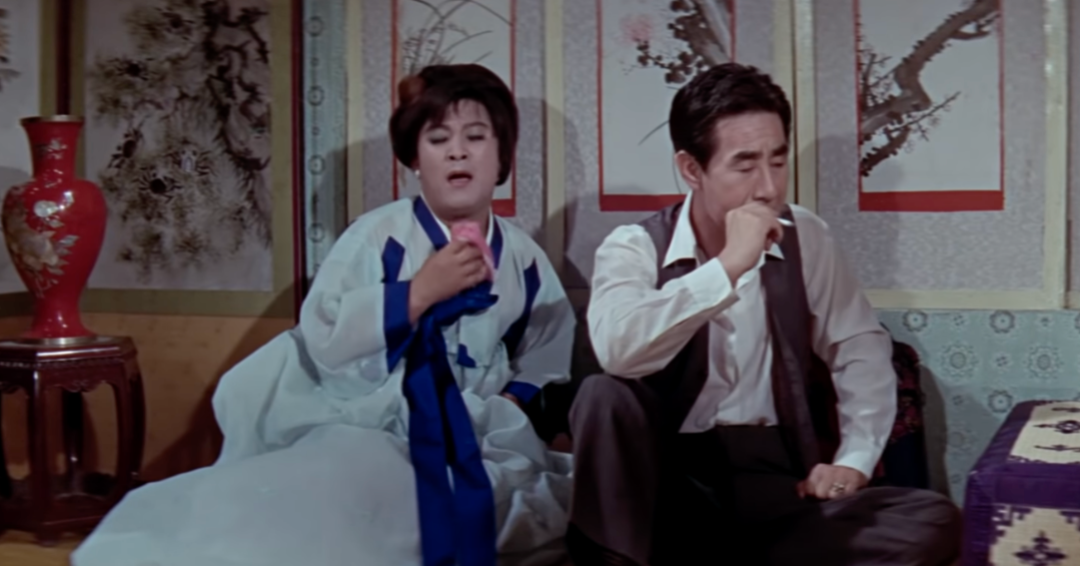
Under the authoritarian regime of Park Chung-hee, Korean Cinema was subject to increasingly stringent censorship and film was seen as an important means of moral instruction. The central message behind Shim Wu-seob’s raucous comedy A Man and a Gisaeng (남자와 기생, Namjawa Gisaeng) is that a man should be faithful to his family and avoid the double betrayal represented by drinking in the company of women which fritters away financial security and endangers his relationship with his wife. Yet the film is also subversive despite the underlying conservative message in making a mockery of so-called “traditional” gender roles.

Indeed, the film’s very thesis is that men are weak and women are strong. The men visit who gisaeng appear to have done so to reaffirm their dominant masculinity through their financial power in essentially paying women to be subservient towards them. Yet the gisaeng themselves are fully in control of the game they are playing as one makes clear when she tells a drunken businessman off after he gets handsy with her. She reminds him that a gisaeng is a person too, not a doll to be played with, and when he doesn’t listen she gets up and leaves proving who it is that has the upper hand in this situation. All the businessman can do is splutter and threaten the otherwise mild-mannered male manager. 

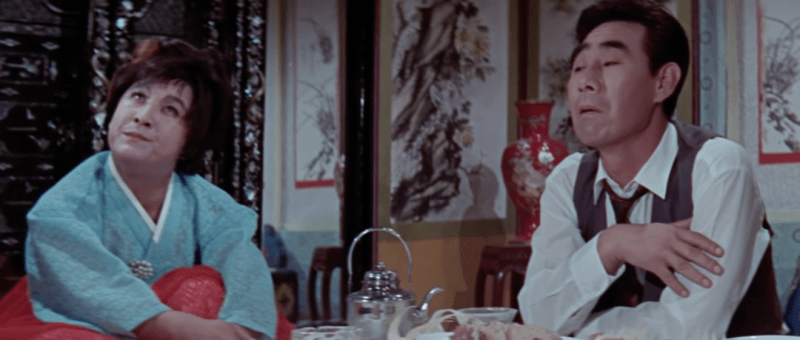
The hero’s boss, Heo (Heo Jang-gang), is a henpecked husband who visits gisaeng as a means of escape from his domineering wife (Do Kum-bong) who punishes him like a child. He asks Tae-ho (Gu Bong-Seo) to resign after catching him sitting at his desk darning socks to earn extra money and though it might be perfectly reasonable to fire an employee for brazenly doing another job on company time, Heo mainly lets him go because of his unmanliness. Tae-ho is a fully domesticated man who does work traditionally regarded as “feminine” in taking in sewing and looking after all of the domestic tasks such as cooking and cleaning as a “maternal” figure to his younger sister Tae-suk (Kim Chung-ja) who is then depicted as “manly” in her mastery of martial arts. 

It quickly becomes clear that the “effeminate” man Tae-ho is the film’s strongest character and the only one largely in control of his circumstances. He agrees to become a gisaeng partly because he needs to earn money after being fired, but also he claims as a “joke” before committing himself to punishing men who neglect their duty to their families by shaming them into changing their behaviour as he largely does with Heo who, bizarrely, develops a fascination with Tae-ho’s gisaeng persona San-wol as she apparently reminds him of the first love he was prevented from marrying because of her family’s disapproval. 

The gender subversion is in essence the joke, but there are also constant hints that it might not be and Tae-ho’s female persona is also authentic, not least among them the music cues which are extremely ironic. For example, the melody of “Don’t Fence Me In” plays over Tae-ho at the house of gisaeng, as do the strains of “Nature Boy” which also hint at a validation of Tae-ho’s expression of femininity. Before being fired, Tae-ho tells Heo that he’s repressing himself and it isn’t good for him, and there is a (joking) suggestion in the final scenes that Heo’s attraction to San-wol is partly born of her seeming masculinity. He did indeed unwittingly appreciate a drag performance from Tae-ho’s queer-coded musician friend, after all.

It’s also possible to read Heo’s reunion with his wife as a new appreciation for her own “masculine” qualities in her capacity to dominate him even if the film simultaneously suggests that the role of a “good wife” is to offer “affection” to her husband and if the husband visits gisaeng it’s the wife’s fault for not giving it to him. Even so, what the film’s conclusion implies is closer to a rebalancing than might be expected in allowing Jeong-mi, the gisaeng with whom Tae-ho falls in love to counter any suggestion of queerness, to open her own shop as an independent woman pursuing a relationship with Tae-ho who is then a travelling salesmen selling cosmetics. Jeong-mi asks Tae-ho to give up “knitting” before they get married which would signal a remasculinisation, but Tae-suk, though dressing in a more feminine fashion to meet her in-laws, is not directly asked to give up Taekwondo and it seems that her fiancé appreciates her feistiness rather than seeking to soften it. Even Heo’s wife if seeming more cheerful has not given up control in their marriage despite her own drag experience in the gisaeng house yet their relationship is now considered “repaired”. “Traditional” gender roles have ostensibly been reaffirmed, Heo’s marriage is saved and both Tae-ho and his sister are about to marry, but they’ve also been subverted and redefined in unexpected ways. Some of this may only be possible because A Man and a Gisaeng is an absurd comedy of the kind Shim was known for, but it nevertheless hints at an underlying plea for greater social freedom in an authoritarian era. 


A Man and a Gisaeng screened as part of this year’s Queer East .
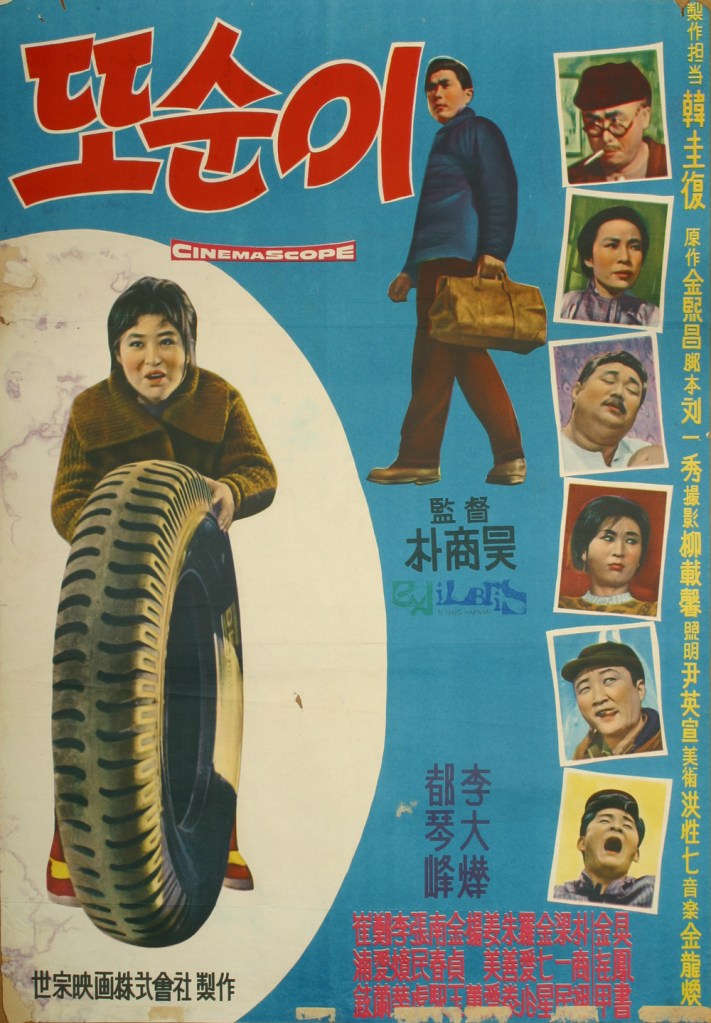
Tosuni: The Birth of Happiness (또순이, Park Sang-ho, 1963)

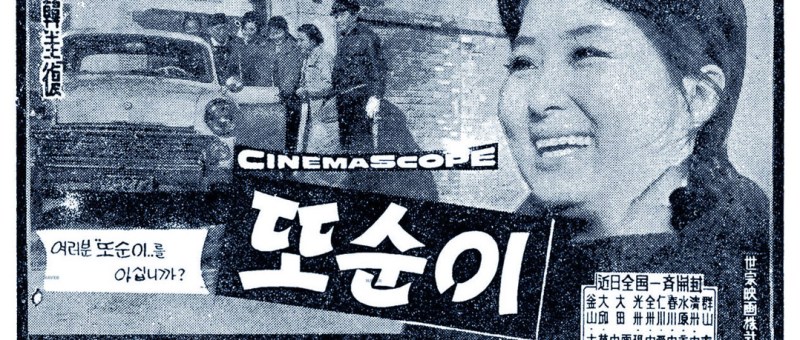
Korean Cinema had enjoyed a small window of freedom following the April Revolution that brought down the government of Rhee Syngman, but that window was closed all too soon by the Motion Picture Law brought in under Park Chung-hee which reformed the film industry and instituted an increasingly stringent censorship regime. Despite that, however, 1963 was something of a banner year which saw the release of such enduring classics as The Marines Who Never Returned, Bloodline, and Goryeojang. In comparison, Park Sang-ho’s Tosuni: The Birth of Happiness (또순이) seems like a much smaller film but was the fourth highest grossing that year, possibly because it was inspired by a hugely popular radio serial. Standing in direct contrast to contemporary melodrama, Tosuni puts a positive spin on go getting capitalistic individualism as its salt of the earth working class heroine defiantly makes her dream come true on her own despite the parade of useless men that attempt to drag her down. 

The cheerful Tosun (Do Kum-bong) is the daughter of Choi Jang-dae (Choi Nam-hyeon) who came from the North with nothing but the shirt on his back and now owns a bus company. A difficult, miserly old man, Jang-dae has a loathing for people who depend on others which is why he sends a young hopeful, Jae-gu (Lee Dae-yeop), packing when he turns up with a letter of recommendation and asks for a job as a temporary driver. Unbeknowst to Jang-dae, Tosun had already encountered Jae-gu on the bus where her father had sent her on an errand only to complain she’s not come back with as much money as he hoped. Tosun asks her father for a 50 won payment for her work but he refuses, leading to a blazing row during which Tosun points out that while both her parents were out working she was basically their housekeeper so he owes her around 15 years in back pay and is also in contravention of the child labour laws. Seeing as she was looking after them all these years, she feels she’s already well acquainted with the “independence” her father always seems so keen on. Eventually she storms out, vowing to become a success on her own. Jang-dae is annoyed to have lost the argument but also oddly proud, realising that he brought Tosun up right and impressed that she actually stood up to him and can obviously take care of herself. 

Tosun certainly is a very capable woman, working hard, taking every job going, and making money wherever she goes. Jae-gu, meanwhile, turns out to be something of a layabout, never really looking for a job but spending all his money drinking with the madam, Su-wol (Na Ae-sim), in a local cafe. Tosun carries on doing her own thing but also wants to help Jae-gu, not least because they pledged to try and achieve their dream of owning a modern motor car together. Jae-gu knows that Tosun is perfectly capable of getting the car on her own and is mildly put out by it, sore over wounded male pride despite her assurances that even if she’s the one who gets the money together he’s the one who’ll be driving. That’s perhaps why he’s so easily suckered by an obvious scam when he gets together with a friend who’s met a guy who needs to shift some tyres, but only after dark when there’s no one around. Tosun thinks it’s fishy, especially if they can’t take the tyres right away, but goes along with it to make Jae-gu feel better. 

Like Jae-gu, most of the other young men are also selfish and feckless, dependent on and exploitative of female labour to get them out of trouble. Tosun’s brother-in-law (Yang Il-min) is forever lying to his in-laws to get loans for spurious business opportunities which never work out, complaining that he can’t “slave away as a temporary driver forever” but taking no proactive steps to change his circumstances despite the responsibilities of being a husband and father. Jae-gu’s friend, meanwhile, takes the opportunity of his wife being in hospital waiting to give birth to their child to try it on with Tosun who manages to fend him off but has a major loss of confidence because of the shock of his betrayal. 

Tosun’s mother hadn’t wanted her to move out not only because that means she’s alone in the house with the difficult Jang-dae, but because being an “independent” woman was somewhat unheard of and she’s worried her daughter will lose her virtue, or at least be assumed to be a loose woman, after leaving home before marriage. Tosun might be a little naive and extremely good hearted, she keeps unwisely lending money to people who obviously aren’t going to pay her back, but as she keeps pointing out she didn’t move out for fun she wants her independence. That’s one reason she keeps Jae-gu at arms length even though she’s fallen in love with him despite her constant exasperation. 

Tosun is in many ways the embodiment of a capitalistic work ethic, proving that you really can make it if you just knuckle down. The car represents both independence itself and a sense of modernity, as demonstrated by the excited commotion among Tosun’s friends and neighbours when she finally gets one and arrives to take her parents for a drive. Even the brother-in-law suddenly realises he might be better off working for Jang-dae rather than living a feckless existence of constant and humiliating failures trying to get rich quick. That’s the problem with the younger men, apparently, they want everything right away, like Jae-gu and his tyre deal, and aren’t really prepared to work at it. Tosun sorted the tyre problem in her own cooly handled fashion, outwitting the unscrupulous vendor but doing it without malice and only showing him she won’t be had. Is the motor car and everything it represents the birth of happiness? Maybe not, but it doesn’t hurt, and Tosun unlike her father seems to have retained her good heart, setting off into an admittedly consumerist but hopefully comfortable future, a back seat driver but behind her own wheel. 


Tosuni: The Birth of Happiness is available on English subtitled DVD from the Korean Film Archive in a set which also includes a digital restoration before/after comparison and stills gallery plus a bilingual booklet featuring essays by Kim Jong-won (film critic & professor), and Park Yu-hee (film critic & research professor). It is also available stream online via the Korean Film Archive’s YouTube Channel.

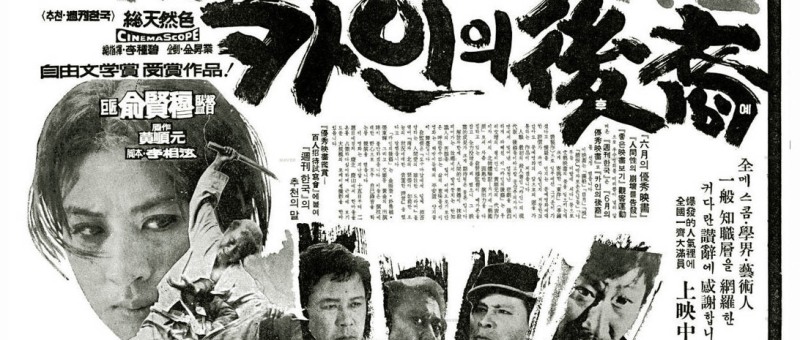
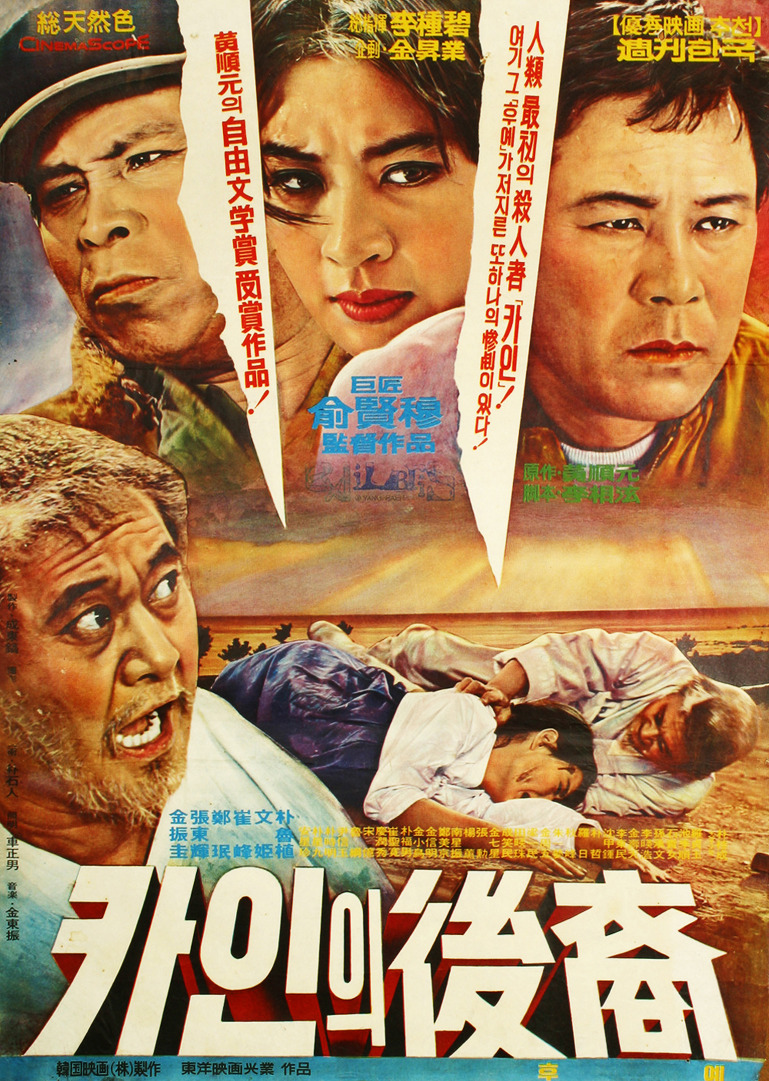
The Descendants of Cain (카인의 후예 / 카인의 後裔, Yu Hyun-mok, 1968)

Descendents of Cain poster 1Yu Hyun-mok, often regarded as among the more “intellectual” of film directors in Korea’s Golden Age, is also among those to have been arrested for violation of the Anti-Communist laws. Yu was later exonerated and went back to filmmaking as before but it remains true that Yu betrays a little more ambivalence to the anti-communist message so often required than many of his colleagues. That is to say, Yu often leans economically left in his frequent criticism of social inequality and his anti-consumerist stance, but remains socially conservative if with a strong desire for social justice. The Descendants of Cain (카인의 후예 / 카인의 後裔, Kainui Huyea), adapted from a novel by Hwang Sun-won, is as anti-communist as they come, but also offers its share of ironies in painting “communism” as a kind of disease born of greed and self-interest which thrives on fear and eventually consumes those who are seduced by its false promises.

Irony is indeed our starting point as our cheerful villagers enjoy a raucous celebration in honour of Independence Day only for the communists to suddenly turn up and spoil the party. Worst of all, one of the communists is a long lost son of the village – Choe is the absentee husband of Ojaknyeo (Moon Hee), a maid, who has developed an affection for her boss, the nephew of the local landlord, Park Hun (Kim Jin-kyu). The communists’ first action is to close down the school that Park Hun opened to provide education for the peasants and co-opt it as their base. Park knows he’s in a dangerous position and has little power to resist, opting to wait it out and see how far the communists really intend to go. The peasants, however, are becoming excited hearing about the land redistribution programme and are starting to forget everything that Park and his family have done for them over the generations, swayed by the false promises of the communists who preach equality while insisting on deference.

The central conflict is, in many ways, between the feudal past and the “democratic” future. Set in what would shortly the “the north” in 1946, Descendants of Cain positions itself on more than one kind of dividing line with the lingering spectre of tragedy always on the horizon. High on a ridge there’s a large stone slab erected as a memorial to the late Park, Park Hun’s grandfather, whose solicitous care for the villagers had earned their eternal respect and perhaps their love. The Parks are “good” landlords. They take their “feudal” responsibilities seriously as evidenced by Park Hun’s school and his father’s desire to finish construction on the local reservoir which is both his legacy and an important failsafe precaution against draught which is in the interests of all. By all appearances this is a well functioning village where no one is hungry or alone. The peasants have not felt “oppressed” or been unhappy, which is not to say they don’t want to better their lot but they have no burning desire for revolution and have nothing in particular to rebel against.

This leaves the communists with a problem – they have little leverage over happy peasantry which has never acknowledged its own oppression let alone longed for freedom from it. Their approach is therefore one of divide and conquer. Cynical in the extreme, the communists set about exploiting petty village disputes to foster discord between people – something which eventually contributes to a murder which they also manipulate for political gain. The “landowners” are of course a prime target, but their judgement must be at the hands of “the people” by means of a farmers’ trial. Having recruited something close to a former village leader, the communists assume they will have the villagers on side but they all (bar two) refuse to indict the Parks. The communist leader, fond of irony, gestures towards towards his armed men and reminds the villagers that no one here is “impinging on their freedom”. That is, their freedom to express the views they are required to express or suffer the consequences.

Threatened with violence and intimidation, feudal deference bends or perhaps shifts to a different master. The villagers, losing their attachment to the Parks, salivate over the possibility of “redistribution” and of being handed “free land”. Their desires are material and not political. Thus when the Parks’ estate is “returned” to the people, they simply walk in and start taking things. Not the most sensible way to redistribute wealth concentrated in the hands of the elite – the fast get horses, the indecisive dented pans which sounds like a recipe for rancour and discontent. When the old village chief becomes disillusioned with his choices and smashes the memorial to old Park, a small fight breaks out among villagers keen to snag the large pieces of stone for various other projects. Happy peasants who once shared everything and wanted for nothing, are now fighting with each other over rubble and trinkets.

The communists, far from fostering collective spirit, have become the evil feudal lords they rail against, oppressing the peasants with their rules and regulations while wilfully creating an atmosphere of fear in order to better oppress them. Their hypocrisy is rammed home early on by the slimy Cheol who complains about his wife’s supposed faithlessness while molesting a barmaid and smugly repeating the story of a large scar he has on his forearm. His superior, believing he got the scar during a labour dispute at a mine, promoted him for his communist spirit, but Cheol really got the scar in a scuffle over a girl (not his wife, incidentally).

Cheol is “a” force which comes between the two lovers, Ojaknyeo and Park Hun, as both are too morally upright to pursue a full romance when Ojaknyeo is still married to another man, even if the other man’s first action on seeing her is to throw her to the ground and begin kicking the living daylights out of her. Later Ojaknyeo gets another, more serious, beating from her father but this time because she’s chosen the wrong side in refusing to step away from the feudal world in her responsibility to Park Hun and his household, even if that responsibility is partly romantic desire. Yet Park Hun and Ojaknyeo are also separated by the feudal world’s rules in their obvious class difference. Communism is supposed to break down these barriers, not to mention removing the “patriarchal tyranny” of marriage, yet the communists would rather award Ojaknyeo to her former husband, little caring that he is abusive and neglectful. Ojaknyeo, at least, will not be freed from her oppression any time soon.

If Yu is making a mild defence of paternalistic feudalism as a metaphor for compassionate government, it is probably a little ambitious given the times in which he lived. Following a regular pattern, Yu paints the world as a terrible place where fear and self interest trump all, only to find small rays of light in the closing moments when an act of violence provokes a series of unexpected epiphanies and reconciliations. He ends on a note of hope in which an older man sacrifices himself for a younger one but is then rewarded with the possibility of salvation and a happier future with the woman he loves (and is now unafraid to pursue) south of the border. Communism seduces and betrays, whereas liberal democracy at least affords the “freedom” to be miserable with personal integrity.


Screened as part of the Korean Novels on Screen season at the Korean Cultural Centre London.