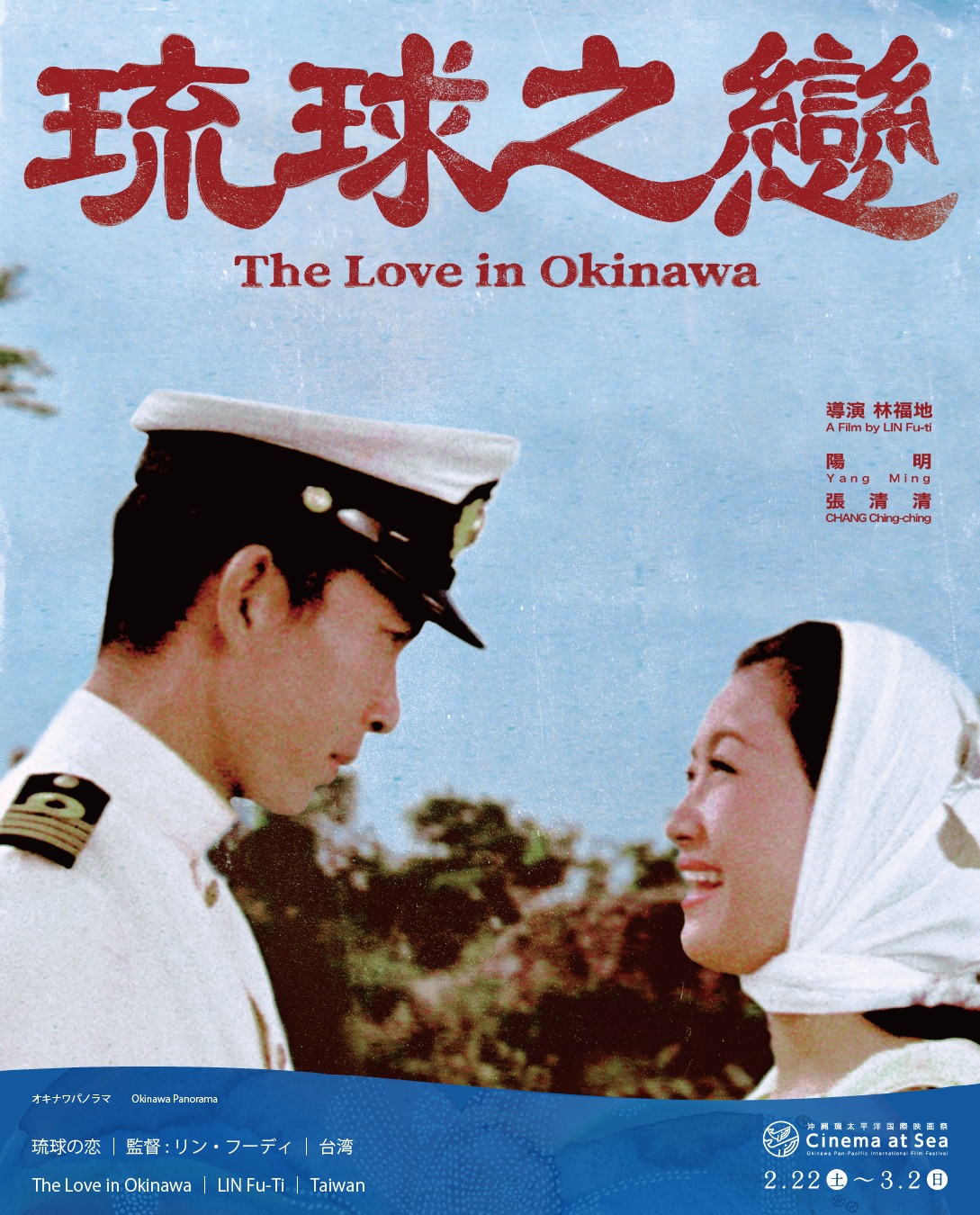
The Love in Okinawa (琉球之戀, Lin Fu-Ti, 1968)

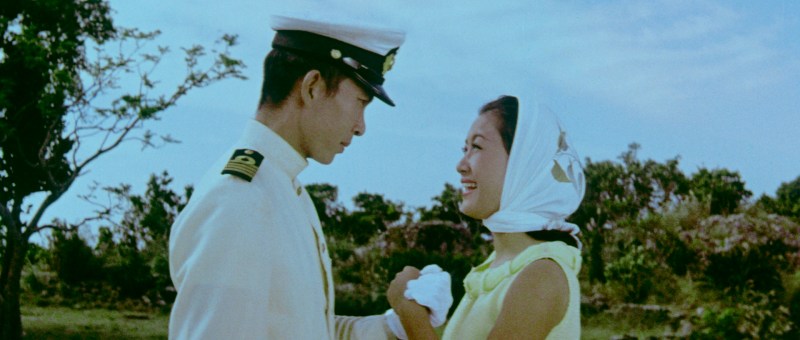
Though he may be captain of his own boat, a young man finds himself powerless in the matters of love in Lin Fu-Ti’s Taiyupian romance, The Love in Okinawa (琉球之戀). Long thought lost and recently restored from a Mandarin-dubbed print discovered in San Francisco’s Chinatown, the film was a collaboration between Taiwan and locally based film companies completed shortly before the islands’ return to Japanese sovereignty after an extended period of American occupation. Though the two nations share a degree of common ground in their experience of Japanese colonialism, the film seems to suggest that nothing really good comes of trying to do business here and events might have progressed differently if the family had not delayed its return to Taiwan.

Nevertheless, the real problem is that Hung-hai is a boat captain who in theory possesses the total freedom of the wide open seas yet he is unable to defy his father and marry the woman he loves out of a sense of filial piety. Hung-hai and Hsui-ling were childhood friends and their fathers were once like brothers only to be forced apart by a business dispute ending in a court case which Hung-hai’s father lost. Hsiu-ling’s father’s business later went bust anyway and he has been dead for several years but Hung-hai’s father still harbours fierce resentment towards him. The family went through a period of financial hardship following the court case during which Hung-hai’s mother worked herself to the bone gathering money for their new start. Hung-hai’s father blames his former friend for hastening his wife’s early death which is why he can’t accept Hsiu-ling, to whom he was once like an uncle, as his daughter-in-law.

But on the other hand he also has his own plans for his son’s life which include marrying Yoshiko. Yoshiko is the current “Miss Okinawa” and a minor celebrity who appears on television singing Japanese songs such as Mari Sono’s 1966 hit Yume wa Yoru Hiraku. She is always dressed in kimono, while Hsui-ling wears more westernised contemporary fashions but is later seen in more recognisably Chinese-style after her return to Taiwan. To that extent, Yoshiko represents a closer union with the growing economic powerhouse of Japan as mediated through Okinawa, while Hsui-ling represents an unsullied Taiwan yet one still restrained by increasingly outdated notions of filiality.

Eventually, after a series of ironies, Hung-hai’s father is forced to admit that his authoritarianism and refusal to allow his son to chart his own destiny has destroyed his family’s future. Unable to marry Hsui-ling who thinks that he has married Yoshiko after seeing her announce their engangement on television while he was away on his boat, Hung-hai falls into depression and takes to drink. Though he had long favoured Hung-hai to take over the business over his older son Ah-qin who has a physical disability and was therefore left behind in Taiwan to babysit the domestic business, Hung-hai’s father begins to realise the mistakes he has made and that in this ruined state Hung-hai will never amount to anything nor prove a worthy heir for his business empire.

Ah-qin, meanwhile, is oblivious to all this and the soul of kindness and decency. In some ways, he might play into a stereotypical vision of disabled people as saintly and innocent, yet is unwittingly drawn into his brother’s romantic drama knowing nothing of his father’s animosity towards Hsui-ling and her family nor of his brother’s love for her which is the cause of his depression. He wants only for everyone in his family to be happy, and in the end is willing to sacrifice his own happiness to facilitate it (which is a paradoxical expression of “positive” filiality). Hung-hai had suggested simply running away and eloping to Taiwan but Hsui-ling’s mother was on her deathbed and neither of them really had the stomach to abandon their parents in a “foreign” land. Thus this kind of filiality that divides the lovers is nothing but destructive. Not only does it ruin the family entirely, disrupting the relationship between the brothers as well as between father and sons, but leads only to futility and heartbreak in which true freedom is found only in death.


The Love in Okinawa screens as part of this year’s Cinema at Sea.

Trailer (Traditional Chinese / English subtitles)
The Rice Dumpling Vendors (燒肉粽, Hsin Chi, 1969)

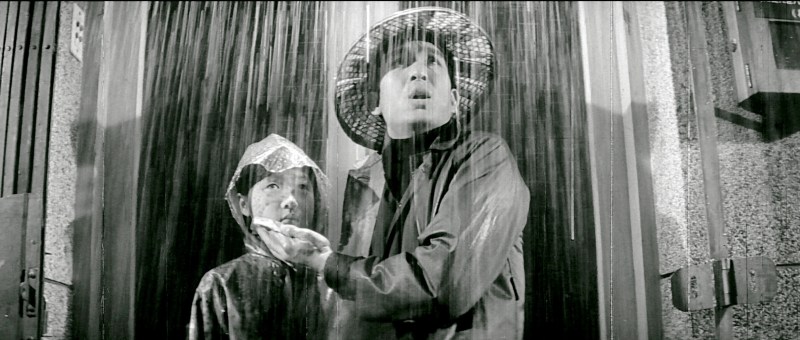
What could be more wholesome and comforting than a rice dumpling? To support their desperate family, a father and daughter become, unbeknownst to each other, Rice Dumpling Vendors (燒肉粽), hoping to buy back their innocence through honest work but secretly ashamed of the depths to which they’ve fallen. Rising economic prosperity has it seemed provoked a moral decline and resulted in an arrogant entitlement that allows wealthy men to assume they can do as they please, but one ordinary businessman is about to get an unexpected humbling when confronted by the consequences of his moral transgressions. 

Tsibing (Yang Ming) is outwardly successful. He dresses in suits, has a large house and chauffeur driven car, can afford to employ a nanny, and comes home to an elegant middle-class wife (Jin Mei) and three adorable children. Despite all of that, however, he’s about to ruin everything. His mistress is secretly part of a criminal gang. She gets her boyfriend to pretend to rob the place, knocking out Tsibing’s wife and undressing her, leaving a pair of underpants on the bed to make it look like her lover has thrown his clothes on in a hurry and jumped out of the French doors to avoid being caught out by Tsibing’s unexpected arrival. Tsibing doesn’t stop to ask questions. He rounds on his wife, beating her violently in front of their young son whom he also kicks in the ribs for trying to defend her. Hypocritically pointing out that his taking a mistress is no justification for her to take a lover a too, he throws her out of his house, only to be thrown out himself when he realises that his mistress has stolen all his money. Ruined and penniless he moves into a shack with the three kids and tries to keep things together while meditating on his mistakes. 

The Rice Dumpling Vendors is, somewhat unusually, a melodrama of male failure in which Tsibing experiences a humbling which pulls him away from the amoral capitalism of the post-war era towards humanistic compassion. The couple next-door, a balloon seller (Chin Tu) who dresses as a clown and his feisty wife (Siu Chu), were unable to have children of their own and quickly take to the young family, feeling sorry for Tsibing and often helping him out particularly with buying formula milk for the baby. “I always thought people were selfish” he confesses while lying on a hospital bed after sustaining a serious workplace injury, finally seeing a different, less materialistic way to live. 

As the closing song reminds us, however, you can’t do anything without money. Attempting to walk away from failure, Tsibing finds himself in an impossible position. He can’t find work that can support a family, and even once he finds a job he gets himself injured leaving him entirely unable to provide. Oldest daughter Hsiu-chuan (Dai Peishan) tries to take the burden on herself, selling lottery tickets and heading out at all hours to hawk rice dumplings to passersby in the streets, unconvincingly telling her father that she’s going to help a classmate who is sick in the hospital with their homework. Hsiu-chuan’s earnestness stands in complete contrast to her father’s increasing desperation compounded by guilt and regret. In a low moment, he even considers abandoning the baby in front of the house of a wealthy childless couple in the hope that they will adopt her.

Strangely, Tsibing never considers asking the childless couple from next-door who already dote on his children if they’d be willing to look after the baby, but determines straight on placing himself at the mercy of the wealthy. The couple at least seem nice – they want a child and would spoil it with both love and money, but they are also arch materialists. Their first thought is that they should give Tsibing money in compensation, as if they were buying a pet. It doesn’t quite occur to them that he might change his mind, after all they can give his baby a quality of life he currently cannot in which she’ll be well fed and taken care of. Is it selfish of him to deny her that? Hsiu-chuan and her brother, however, aren’t having any of it. They’re taking their sister home where she belongs, vowing to give up on school and double down on their part time jobs to make sure they can afford milk to feed her. 

Tsibing too lowers himself once again, selling not only lottery tickets but later rice dumplings, telling Hsiu-Chuan, who is doing exactly the same thing, that he’s got a job as a nightwatchman in a warehouse which is why he’s out all night. Humbled and encouraged by the warmhearted altruism of his kindly neighbours, he’s learning to renounce the materialist life and re-embrace what’s important. The mistress, meanwhile, making an unexpected reappearance, pays a heavy price both for her amoral materialism, and for her transgressions as an “immoral” woman whose attempts to use men provoke only jealousy and violence. Meanwhile, the wife is eventually vindicated and seems to have retained both her wealth and her class status even after being unfairly thrown out by Tsibing. 

What we’re presented with is a seemingly uncomplicated family reunion, completely ignoring Tsibing’s brutal use of violence against his wife and son which is itself intended to demonstrate his “manliness” and patriarchal authority. He reminds his wife of the cultural double standard that insists that a man may take a mistress but a wife must be faithful, punishing her not for betraying their family but for making a fool of him. Little does he know however that he’s already been made a fool of by a “wicked” woman, and it’s entirely his own fault for acting irresponsibly, regarding a mistress as little more than a status symbol. Nevertheless, now humbled he has a new appreciation for what it means to be a family man, seeking not riches but simple wholesome pleasures like rice dumplings and friendship surrounded by kind and honest people always willing to lend a hand to those in need.


Screened as part of touring retrospective Taiwan’s Lost Commercial Cinema