Chang’an (长安三万里, Xie Junwei & Zou Jing, 2023)

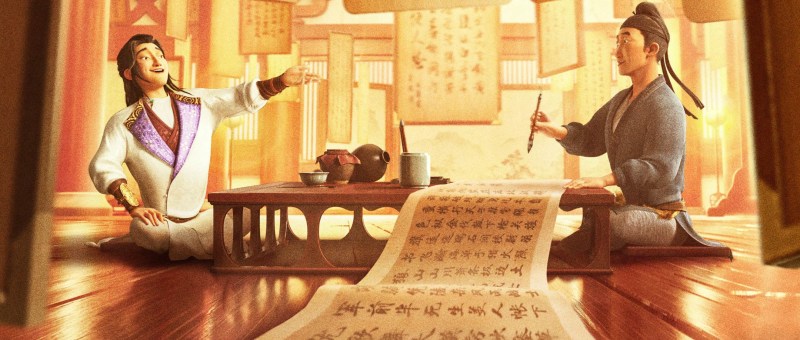
It’s a strange thought, in a way, that poetry could save a nation. In reality, it didn’t quite. The An Lushan rebellion significantly weakened the Tang dynasty and contributed to its rapid decline. Nevertheless, Tang was an era in which art, culture, and freedom of thought all flourished. Animated feature Chang’an (长安三万里, Cháng’ān Sānwànlǐ), named for the imperial capital of that time, attempts dramatise the era through the lives of its poets and the eyes of Gao Shi (Yang Tianxiang) reflecting on his youthful and often distant friendship with the legendary Li Bai (Ling Zhenhe) whose poems are still recited by the school children of today.

As the film opens, Gao Shi is an old man and embattled general staring down inevitable defeat at the hands of the invading Tubos emboldened by the weakening of borders following the failed An Lushan rebellion. But that’s not the reason he’s being visited by an imperial inspector who is far more interested in his relationship with Li Bai and the political importance it may have gained. Through this framing sequence, Geo Shi narrates the previous 40 years of history as he and Li Bai each age and take different paths in life while maintaining a distant if deeply felt friendship.

To that extent, Guo Shi is the earnest and practical son of a once noble house attempting to resurrect his family legacy, while Li Bai is a free spirited libertine attempting to overcome his lowly birth as the son of a wealthy merchant to gain government office through his skill as a poet. Then again, as future great poet Du Fu (Liu Jiaoyu / Sun Lulu) remarks, in this age poetry is something anyone can do and distinguishing oneself through it is no mean feat. It is however the only option for a man like Li Bai and the film in part seems to be an advocation for meritocracy in which those of ability would be free to prosper without needing to rely on social standing or personal connections. Despite the supposedly classless society of the modern day, this world may not yet have emerged. Another hopeful laments that she alone of her brothers inherited military skill yet as a woman there’s no door that is open to her to serve her country. 

Serving one’s country is the virtue that Gao Shi praises most highly and in effect his life’s purpose while Li Bai’s is more personal advancement and the perfection of his art. His poems are often melancholy and reflect on a sense of loneliness and longing for home, or else raucous celebrations of the art of drinking. Gao Shi does not approve of Li Bai’s party lifestyle and his debauchery later places a strain on their friendship. The film tacitly implies that this decadent behaviour is behind the decline of Tang, but also the reason that art and culture flourished amid a sense of destruction and despair. Having learned a few lessons in underhandedness from Li Bai, Geo Shi in effect restores order, albeit temporarily, through strategy and courage, while Li Bai first chooses isolation and then in its opposite after being pardoned for an apparently accidental and entirely thoughtless act of treason.

But what the film is keen to emphasise is the deep-seated friendship, or perhaps more, between the two men that makes the victory possible suggesting that a society needs both practicality and art to survive, not that Gao Shi was not a great poet himself if one well aware that Li Bai surpassed him in skill and keen support his success. Even so, as Gao Shi points out, a poet is not always an easy thing to be and in his old age those who once drank with Li Bai are either dead, one beaten to death at the age of 70, exiled or imprisoned. In a sense, both men achieve their aims if perhaps not in the way they intended. Gao restores his family name, and Li Bai finds a kind of immortality in his work that he otherwise failed to find spiritually in devoting himself to Taoism. The often beautifully rendered backgrounds capture a sense of a society on the brink of eclipse, such as the striking beauty of Gao Shi’s first entry to Yongzhou with its blossoming cherry trees lit by the warm light of lanterns under a full moon, only to turn to darkness on his return amid the twilight of the Tang dynasty. 


Dazzler Media presents Chang’an in UK and Irish cinemas from 28th February.

UK trailer (Mandarin with English subtitles)
White Snake (白蛇:缘起, Zhao Ji & Amp Wong, 2019)

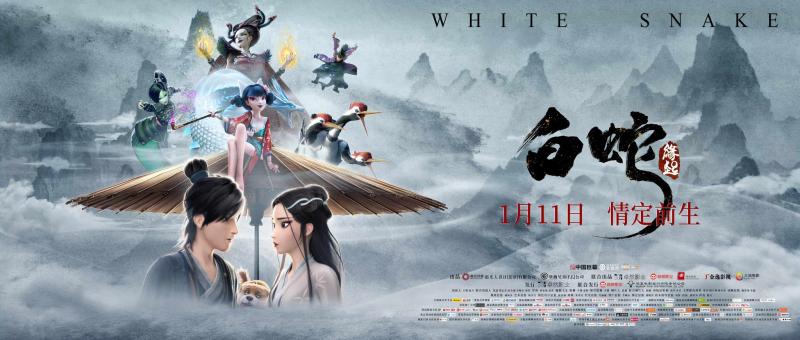
White Snake posterOne of the best known classical Chinese folktales, Madame White Snake has already inspired a host of cinematic adaptations, most famously Tsui Hark’s Green Snake. CGI animation White Snake (白蛇:缘起, Báishé: Yuánqǐ), co-produced by Warner Bros. in the US and China’s Light Chaser, takes a different tack in imagining a prequel to the original legend that hints at a wider destiny for the eponymous Bai Suzhen and the doctor Xu Xian. Like other similarly themed family films, White Snake is also a surprisingly progressive, if melancholy, love story which insists that love is love and does not, or should not, change if you discover the person that you love is a little different than you first thought – in this case, that she’s giant snake demon in beautiful human form.

A framing sequence opens with Bai Suzhen, here called Xiao Bai / Bianca, lamenting to her friend Xiao Qing / Verta (Tang Xiaoxi) that though she has meditated for 500 years she cannot achieve enlightenment and feels the block is due to a memory that she cannot recall. Xiao Qing then gives her a jade hairpin which casts us back 500 years to the Tang Dynasty and a time of chaos in which an evil general has ordered the mass killing of snakes in order to steal their energy for black magic purposes to improve his relationship with the emperor. The snake demons declare war and Xiao Bai is sent to assassinate the general but is injured before she can complete her mission. Washing up on a nearby shore, she is rescued by a local boy, Xuan (Yang Tianxiang), who happens to be a snake hunter. Having lost all her memories, Xiao Bai thinks she is human and bonds with Xuan as they team up to investigate her past with the hairpin as their first clue.

We are told that the land is in chaos and that the peasantry is cruelly oppressed by onerous loans and unjust treatment at the hands of the feudal lords. The general is forcing them to kill snakes and deliver them to him as a kind of tax incentive while threatening their livelihoods if they fail to comply. Despite participating in snake culls, however, Xuan is a kind and energetic young man who is also the village’s herbalist and dreams of becoming a doctor. Having rescued Xiao Bai, he does his best to help restore her memory and vows to be at her side protecting her no matter what. On figuring out that she is really a snake demon, his devotion doesn’t change and he stays with her all the same even knowing that she will be in danger if anyone else learns of her true identity.

Xuan may insist that your fate’s your fate but you can choose how you live, but he also acknowledges that “life is short and sorrows long”, affirming that it’s better to live in the moment making happy memories for less cheerful times. Then again, as Xiao Bai says, you can’t always do what you want and this is indeed a “heartless world” with rules which must be followed. As in any good fairytale, Xiao Bai and Xuan are divided by being on opposing sides of a supernatural plane with differing conceptions of time and eternity. As his song says, “this floating world is but a dream”, and Xiao Bai’s sojourn among the humans is likely to be a short one. Suspected of treachery, Xiao Bai’s good friend (or perhaps a little more than that) Xiao Qing volunteers to wear the Scale of Death, pledging her own life in place of Xiao Bai’s if she fails to fetch her back within three days only to immediately take against Xuan possibly for reasons unconnected to her distrust of humans who, she has been taught, are universally treacherous and hostile to snakes.

Of course, the original legend and the opening framing sequences are clues that this isn’t going to end happily but then with eternity to play with perhaps nothing is ever really as final as it seems. Beautifully animated with gorgeously rendered backgrounds and a melancholy romantic sensibility, White Snake is a huge step forward for Chinese animation which pays tribute the classic legend while creating a universe all of its own with sequel potential aplenty.


White Snake screens on 7th July as part of the 2019 New York Asian Film Festival. It will also be screened in Montreal as part of the 2019 Fantasia Film Festival on 27th July.

Original trailer (Mandarin with English & Simplified Chinese subtitles)