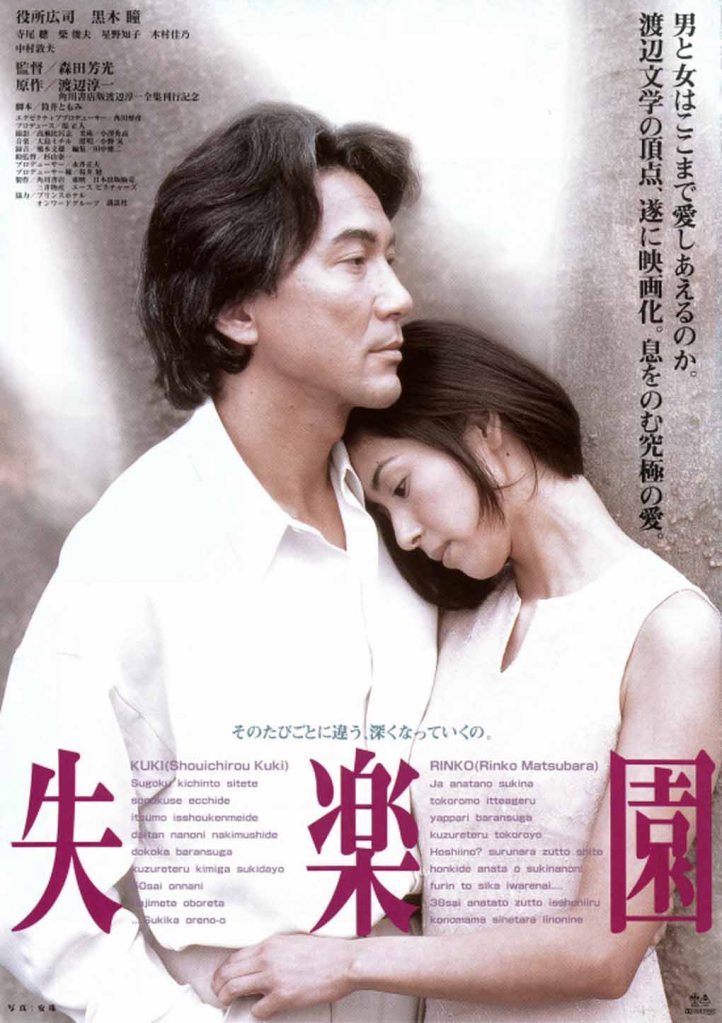
 Yoshitmitsu Morita tackled many different genres during his extremely varied career taking in everything from absurd social satire to teen idol vehicles and high art films. 1997’s Lost Paradise (失楽園, Shitsurakuen) again finds him in the art house realm as he prepares a tastefully erotic exploration of middle aged amour fou. Based on the bestselling novel by Junichi Watanabe, Lost Paradise also became a breakout box office hit as audiences were drawn by the tragic tale of doomed late love frustrated by societal expectations.
We meet Kuki (Koji Yakusho) and Rinko (Hitomi Kuroki) about to bid each other goodbye for the day, playfully in love though perhaps self conscious. It’s not until later that we realise they are both already married – just not to each other. Kuki, 50 years old, has reached an impasse in his life. Effectively demoted and sidelined at work, his homelife is not exactly unhappy but has long since lost his interest. His daughter is grown up and married herself, his wife has a career of her own, his mortgage is already paid off. There is really nothing left for him to do. That is until he meets calligraphy teacher Rinko and falls passionately in love for the first time in his life.
Rinko, 38, entered into an arranged marriage at 25 though the kindest way of describing it would be “unfulfilling”. Haruhiko (Toshio Shiba), her husband, is a doctor by profession and cuts a cold and distant figure. Prone to violent outbursts and pettiness, he treats Rinko more as a house keeper than a wife ordering her to buy his favourite kind of cheese (even urging her to travel to a different shop if the first one doesn’t have it) but then not even looking up when she brings it into his study for him. Lasciviously poking a spoon into the soupy mess, he pauses only briefly after savouring his first taste to give Rinko her next set of orders with no word of thanks or even acknowledgement of her success in obtaining this oddly specific cheese related request.
Finally in each other Rinko and Kuki find completeness long after they’d stopped seeking it. Rinko is unhappy in an arranged marriage which offers scant comfort, though Kuki’s problems are more akin to a mid life crisis as he finds himself an unnecessary presence at home whilst also realising that he’s already passed the high point of his career. Though there are no real barriers to Rinko and Kuki simply leaving their spouses and starting again together, it’s never quite that simple as the social stigma of an extra-marital affair continues to undermine their new found romance.
As in many of Morita’s films, the overall tone is one of pessimism as Rinko and Kuki face opposition from all sides whilst falling ever deeper into a whirlwind of self destructive passion. Rinko confides in a recently divorced friend who has guessed her secret and urges her to try and be happy, but Kuki keeps matters to himself whilst listening to the romantic problems of his workmates many of whom state that they too would like to fall madly in love, just once. When one of Kuki’s most valued colleagues falls ill, he laments having lived his life in the straightforward way expected by society. He’s done everything right – spent all his time working hard, built a career which was about to go south anyway. If all that happens is that you get old and die what was it all for – perhaps you’re better off just doing as you please, social expectations be damned.
Eventually the pair get an apartment and indulge in some part-time domesticity though an ill thought out blackmail plot soon changes things for both of them. Haruhiko refuses to divorce Rinko but Kuki’s wife is more sympathetic and open to the idea of sorting things out as quickly as possible. Though he suffers in other ways, Kuki finds it easier to accept the idea of moving on than Rinko who also faces opposition from her own mother who brands her as immoral and someone to be pitied for having given in to weakness and allowed her baser instincts to take over. Soon the couple find themselves thinking about a way to be together for eternity even if it lies in another world than this one.
Likened to the famous case of Sada Abe (also the inspiration for Oshima’s In the Realm of the Senses), Rinko and Kuki are consumed by their own passion and ultimately unable to continue living outside it. Morita opts for an artful aesthetic and keeps his eroticism on the classy side rather than descending into exploitation or salaciousness. Making use of frequent handheld camera and odd angles to bring out the giddy, unbalanced mindset of the central couple Morita also experiments with colour often cutting to black and white or sepia mid-scene. The tragedy of this love story is that it occurs at a societally inconvenient time – there is nothing wrong in Rinko and Kuki’s romance save that it started after they were already married to other people. This may not seem such a great problem but in a society which demands conformity and adherence to its rules, those who break them must be prepared to pay a heavy price. Perhaps the last words ought to belong to Kuki’s poetic friend who points out that life if short and rarely rewards those who play by the rules, it may be better to burn out brightly rather than flicker away for an eternity.
Original trailer (no subs)
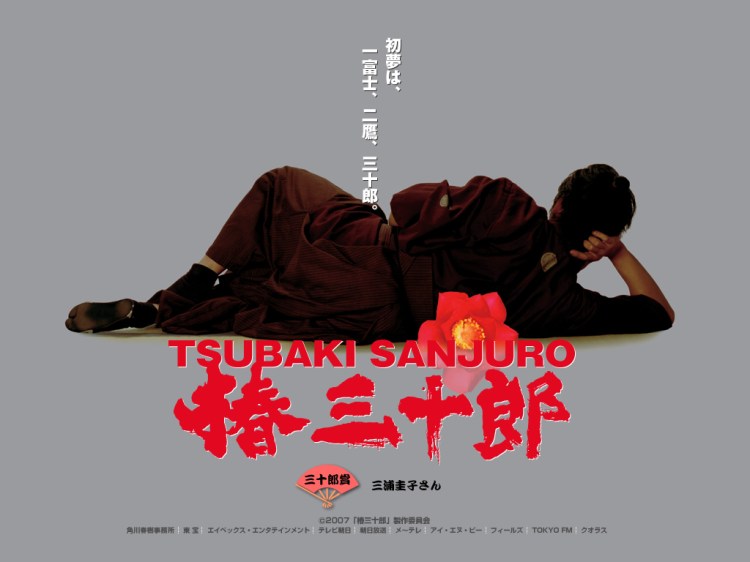 Generally speaking, where a film has been inspired by already existing source material, it’s unfair to refer to it as a “remake” even if there has been an iconic previous adaptation. That said, in the case of Tsubaki Sanjuro (椿三十郎), “remake” is very much at the heart of the idea as the film uses the exact same script as the massively influential 1962 version directed by Akira Kurosawa which also starred his muse Toshiro Mifune. Director Yoshimitsu Morita is less interested in returning to the story’s novelistic roots than he is in engaging with Kurosawa’s cinematic legacy.
 Windows on Worlds