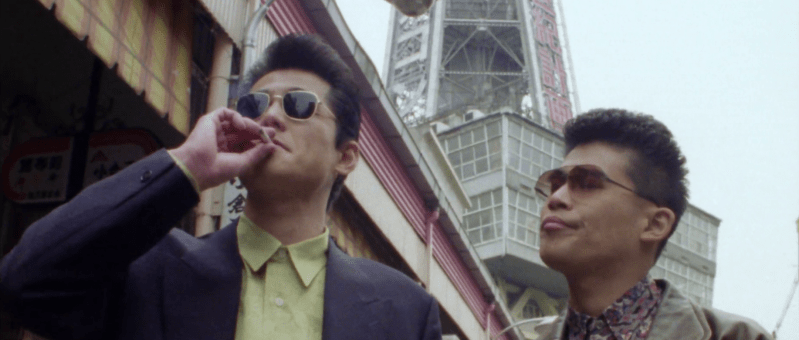
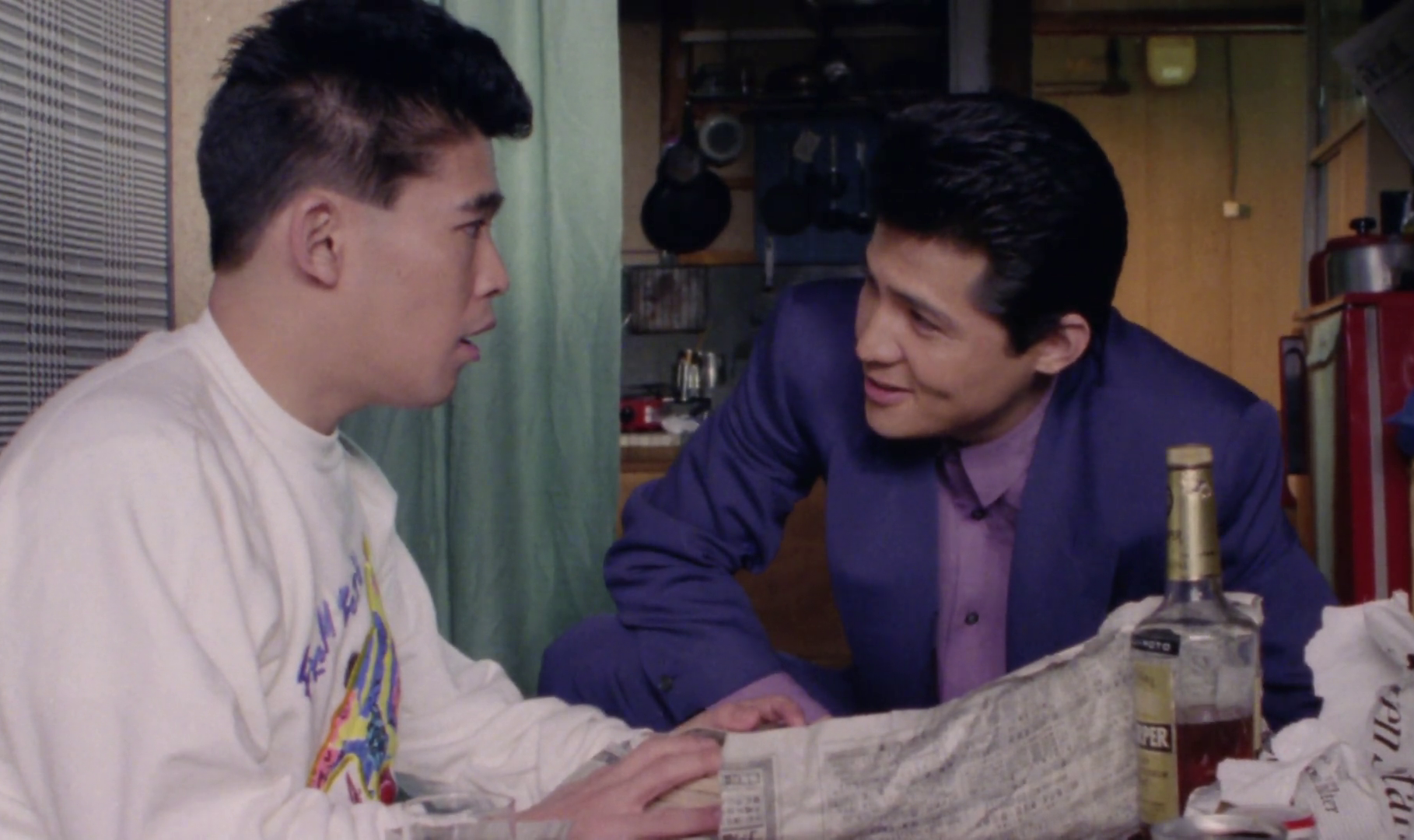
The King of Minami: Ginjiro Manda (難波金融伝 ミナミの帝王1 トイチの萬田銀次郎, Sadaaki Haginiwa, 1992)

“The one holding the money calls the shots,” according to a particularly sticky debtor in Sadaaki Haginiwa’s The King of Minami, though that turns out not quite to be the case. After all, though the money may be in his possession, technically it belongs to Ginjiro (Riki Takeuchi) and when they don’t return it to him, he begins to feel offended. Reflective of a kind of post-bubble malaise, the film has a rather cynical take on money and finance, but at the same time a weird kind of wholesomeness.

Ginjiro may be the King of Minami, but he sees himself as a saviour of the poor. Questioned by new underling Ryuichi, he brushes off concerns that people can be driven to suicide over debt by claiming that the loans he offers may save their lives. But though Ginjiro may claim to be somehow better than his yakuza counterparts in refusing to resort to violence, he’s ruthless in other ways and certain that debts must be repaid. Once he’s cheated by an old man, Tokugawa, who refuses to pay the interest on his loan, Ginjiro knows theres’s no point pressing him and decides to go after his daughter instead. She, however, has already maxed out all her card trying to save her dad’s business. 

For his righteousness, explaining that he’ll never end up with sometime love interest Asako because a loan shark has no room for relationships, Ginjiro’s world is essentially misogynistic. Sent after a runaway bar hostess, Ginjiro tells Ryuichi that women always have ways of making money with a note of envy in his voice as if he resented this essential unfairness on behalf of impoverished men. Of course, this way of making money is open to them too, though they wouldn’t consider it and no one would put it forward as an option or view their body as a commodity that should be traded away when one has debts. He says something similar to Tokunaga’s schoolteacher daughter Machiko too, agreeing that night work is the way to make a lot of money relatively quickly. Machiko has, however, already been forced into sexual slavery by Narita, a rival yakuza loanshark, who extorts sexual favours in lieu of money. 

Young Ryuichi is quite touched by her story and even falls in love with her a little bot despite Ginjiro’s warnings that a loanshark can’t afford to let his emotions overcome his reason. Even if he remains willing to make Machiko pay for her father’s transgressions, Ginjiro is equally angry with Tokunaga for rejecting this essential law that money should always find its way to its point of origin. Taking him to task for his immoral vices such as a gambling addiction that’s ruined his business, finances, and relationships, Ginjiro tells him that he ought to pay his debts himself rather than push them on his daughter. He seems to have contempt for people who do this to themselves through what he sees as their own poor choices, but less so for those like Machiko who end up needing his services through no fault of their own or an ironic sense of indebtedness to someone else.

In any case, he stands a kind of counter to those like Narita who only want to exploit people’s weaknesses and use violence to get their way. The two of them end up in a financial sparring match as Narita sets Girjio up with a deliberately bad debt, while he, in turn, masterminds a counter scam under the tutelage of his “financial teacher” who knows all sorts of underhanded ways to make money like selling land that doesn’t belong to you. One could say that he’s teaching Ryuichi all the wrong lessons, but then his behaviour is more roguish than dangerous and he’s obviously more morally righteous than the sneering Narita who seems to feed off human pain so it’s satisfying to see him win and humiliate the predatory yakuza. Ginjiro agrees that it’s a sad world in which people die over money, but, at the same time, has a healthy disregard for it. He tells Ryuichi that he should think of money in the same as a greengrocer thinks of vegetables and that he needs to lose his reverence for it if he’s to make it as a loanshark. That might, after all, be how he became the king of Minami, laughing at the ridiculousness of a world in which those with money call the shots while simultaneously holding all the cards himself.

The Mosquito on the Tenth Floor (十階のモスキート, Yoichi Sai, 1983)

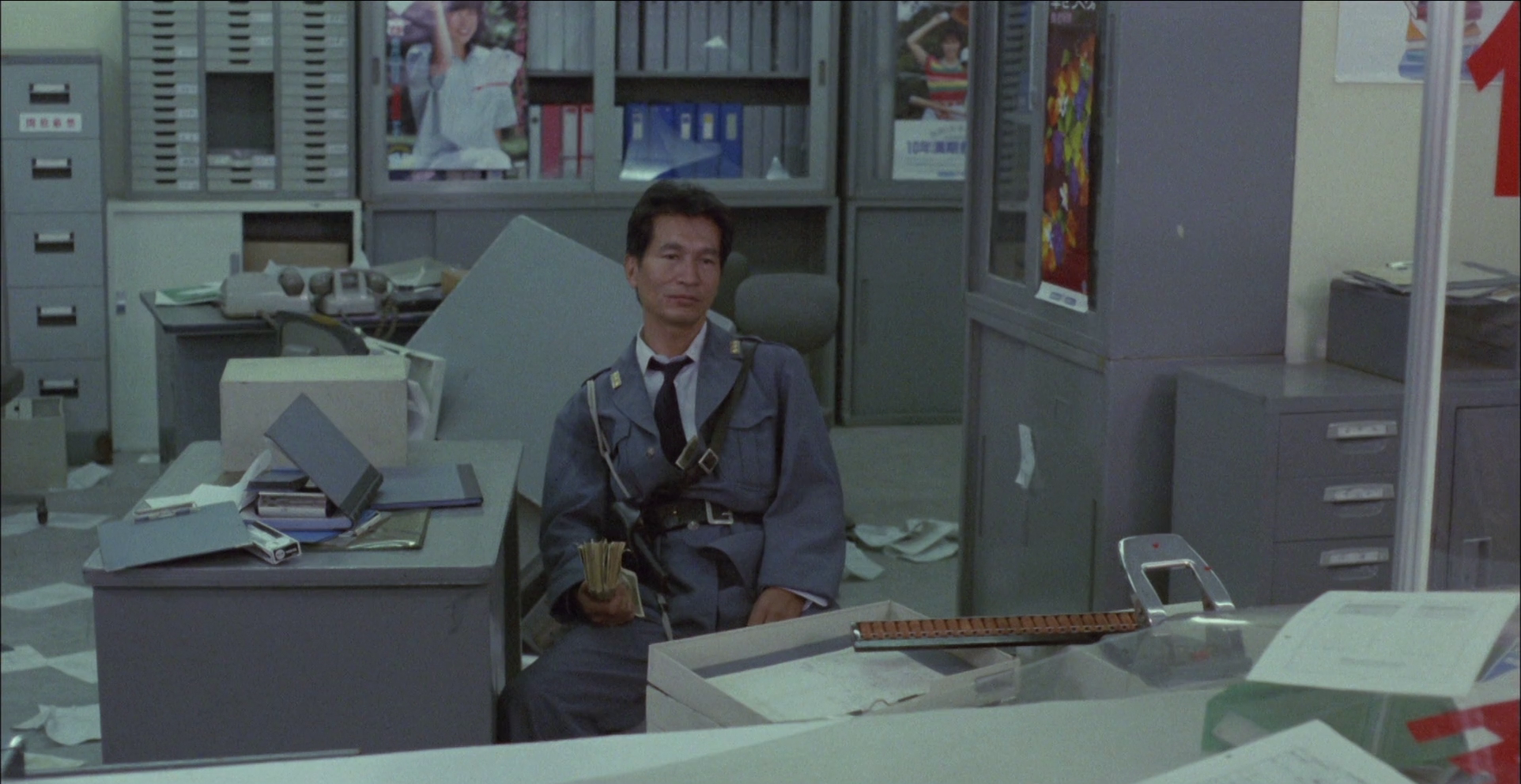
A beaten-down beat cop’s existential crisis progressively deepens after he throws himself into financial ruin to buy a computer in Yoichi Sai’s debut The Mosquito on the Tenth Floor (十階のモスキート, Jikkai no Mosquito). Like Pool Without Water, star Yuya Uchida conceived and co-scripted the film as a vehicle for himself and was apparently inspired by the sight of some blood, his own, on a wall where he’d squashed a mosquito though he also claimed the the 10 in the title is intended to reference the 10 commandments in addition to simply where the unnamed protagonist lives.

The fact that he lives on the 10th and top floor in a building with no lift is symbolic of his dismal circumstances. On the one hand he can rise no higher but on the other is stuck with an inconvenient living situation precisely because of his inability to rise socially. As it transpires the hero, a policeman, joined the force right out of high school with aspirations of rising to the rank of captain but has spent the entirety of his 20-year career manning a police box. He’s repeatedly failed the exam for promotion to lieutenant and realistically speaking is now simply too old to make much further progress. A man of few words, he listens as the other officers who took the exam with him outline the hierarchal structure of the police force while meditating that as a man on the wrong side of 40 his possibilities have decreased and it’s more than likely he’ll be stuck in the police box until he retires. 

His boss later says as much, sympathising with him but also pointing out that a policeman is also a public servant with a role to serve within the community. He is supposed to make people feel safe and contribute to the progress towards a crime-free society, but it’s clear that his life has spiralled out of control precisely because he cannot ally his career goals with the kind of life he wished to lead. His wife divorced him two years ago seemingly because she wanted a greater degree of material comfort and became resentful that he failed to progress in his career and could not move on from the low-salaried position of an ordinary street cop. She now makes a living selling golf club memberships, looking ahead to the oncoming Bubble-era and a society of affluent salarymen which is very much what her new boyfriend seems to be. Meanwhile, she lives in a very nice townhouse with their teenage daughter and constantly hassles the policeman for falling behind with his child support and alimony payments. He’s also racked up a healthy tab at a karaoke bar where he regularly hangs out and has a serious gambling problem with betting on boat races seemingly his only other form of social outlet.

As his daughter and others keep reminding him, the world is changing and his decision to buy a computer after unwisely taking out a payday loan is in part a symbol of his desire to progress into the modern society even if, somewhat ironically, others chastise him for spending what is then a huge amount of money on something they think of a child’s toy. Otherwise an upstanding policeman who irritatedly deflects a colleague’s joke about bribing someone to pass the exam, the policeman finds himself taking out one payday loan to pay another with loansharks constantly ringing him at the police box to remind him he’s behind on his payments. To overcome his sense of powerlessness, he begins by abusing his authority in catching a punk woman shoplifting and arresting her but then taking her back to his flat to play computer bowling and take advantage of her sexually. He later does something similar with a bar hostess, Keiko (Reiko Nakamura), who took him home when he was drunk. Though the encounter begins as rape, Keiko soon gives in and even comes back for more claiming that she’d never done it with a policeman before and it exceeded her expectations which is in many ways reflective social attitudes at the time. Emboldened, he invites danger by raping a female traffic cop, tearing her clothes as she fights back, screams, and cries though she presumably does not report him given the professional and social consequences that may adversely affect her life and career if she chose to. 

His ex-wife Toshie (Kazuko Yoshiyuki) says she’s not even sure if he’s human anymore, and his failed attempt to rape her after his boss reminds him that he advised against getting a divorce in the first place because it would negatively affect his chance of promotion may be a perverse way to prove he is though it obviously backfires. Having failed in every area of his life and with no prospect of ever getting back on track or starting again, he begins to go quietly insane typing rude words into his computer while the constant calls from loansharks take on a mosquito-like buzzing as does his own final wail of despair and powerlessness as he’s brought down by same authority he once served. His aloneness and confusion are palpable when he ventures into the city and discovers his teenage daughter Rie (Kyoko Koizumi) dancing in Harajuku staring at her intently but then walking away having invaded this space reserved for the young. “Police yourself!” one of the Rockabilly guys ironically instructs him on noticing that he’s dropped his ice cream cone, explaining that the police might shut them down if they’re discovered to be using the space irresponsibly by littering. Rie and her friends tell him to get a life, explaining that the world is changing while tapping him for cash he doesn’t have but is too embarrassed to refuse, laying bare the extent to which he and those like him have been left behind by the economic miracle, buzzing around maddeningly in mid-air with safe nowhere safe to land. 


Original trailer (no subtitles)