You Have To Kill Me (我是自願讓他殺了我, Chan Chun-Hao, 2021)

An earnest policeman discovers nothing is quite as he thought it to be in Chan Chun-Hao’s adaptation of the novel by Feng Shi, You Have to Kill Me (我是自願讓他殺了我, wǒ shì zìyuàn ràng tāshā le wǒ). Drawn into a dark web of intrigue which eventually points to abuse of power and a low regard for human life, he is forced into a realisation that even as a law enforcement officer he can never be certain of what is real and what is not while caught in the middle in a battle of between parents each trying desperately to protect their sons. 

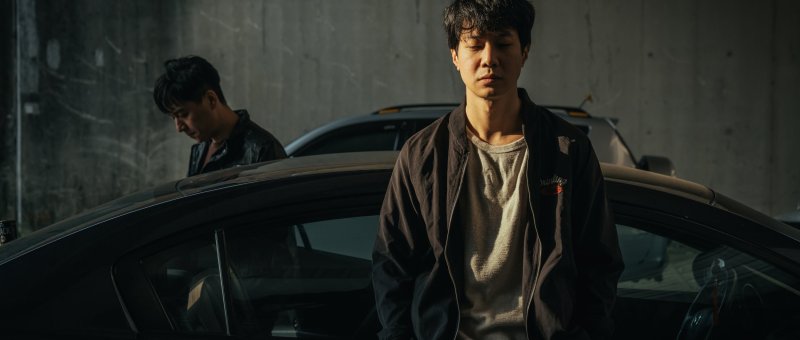
About to propose to his live-in girlfriend Kai (Janel Tsai), Shing’s (Cheng Jen-shuo) world comes crashing down when he and his partner Ye-ze (Xue Shi Ling) are dispatched to the mountains and discover that she is the victim of the homicide they’ve been sent to investigate. Shing apprehends the apparent killer, Li Zi-jian (Snoopy Yu), running away from the scene, but the situation is complicated when it turns out that Zi-jian is the son of a local politician, Chairman Li (Yin Chao-Te), and while he admits to the killing claims that he did it at the instigation of Kai who was suffering from terminal cancer and wanted him to help her escape her suffering. A look at Kai’s medical records bears out his story, but on closer examination Shing realises the documents don’t add up. His suspicions are confirmed when Kai’s parents, whom he had seemingly never met, arrive and fail to identify the body claiming instead that it is another woman who had been harassing their daughter, Lin Jing. 

Shing is forced to accept that he might not have known the woman he wanted to marry and that their relationship was founded on a lie, uncertain how much of any of it might have been real. Meanwhile he runs into a series of bureaucratic roadblocks as the chairman continues to disrupt the investigation in order to protect his son, eventually having Shing taken off the case leading him to investigate all alone discovering even more uncomfortable truths that cause him to question his reality. Leaving aside the minor plot hole that it seems unusually easy to live under an assumed name in contemporary Taiwan even if you’re involved in activities which would generally require an extensive background check, Shing has good reason to be confused as he dives ever deeper into an amoral morass in which those with power are prepared to manipulate it for their own ends without much thought for the lives of others. “That’s how much a person is worth” the chairman baldly states signing a settlement agreement over something else his son may or may not have done, later claiming that it doesn’t matter if he caused someone’s death “accidentally” and he’d do it all again to save his son. 

Even so, the chairman may have limits in that his attempts to manipulate the system are bureaucratic in nature and seemingly unnecessary at least it seems as if there would be easier ways to achieve his aims without directly harming others even if they would risk lives indirectly. Meanwhile his accomplice is also seemingly involved in order to protect their family, willing to compromise themselves morally to protect their elderly relatives while believing nothing that bad would come of their actions. Then again, Shing finds himself on the receiving end of further recriminations accused of having failed to protect the woman he knew as Kai from herself leaving her with only a dark path to ensure that justice would be done and corruption exposed. 

While Zi-jian feared he was a burden to his father feeling himself unloved even as he went to such drastic lengths to protect him, Kai/Jing was also afraid to fully trust Shing fearing she’d one day disappoint him unable to move on from her traumatic past without putting it to rest. Taking aim firmly at the societal corruption that allows the rich and powerful to misuse their position for their own gain while ordinary people suffer Chan’s noirish drama situates itself in a murky world of constant uncertainty in which even an earnest policeman can be largely oblivious of the lives of those around him while the purest of motivations can lead to only darkness and misery.  


You Have To Kill Me streams in the US April 4 – 10 as part of the 14th season of Asian Pop-Up Cinema.

Original trailer (English subtitles)

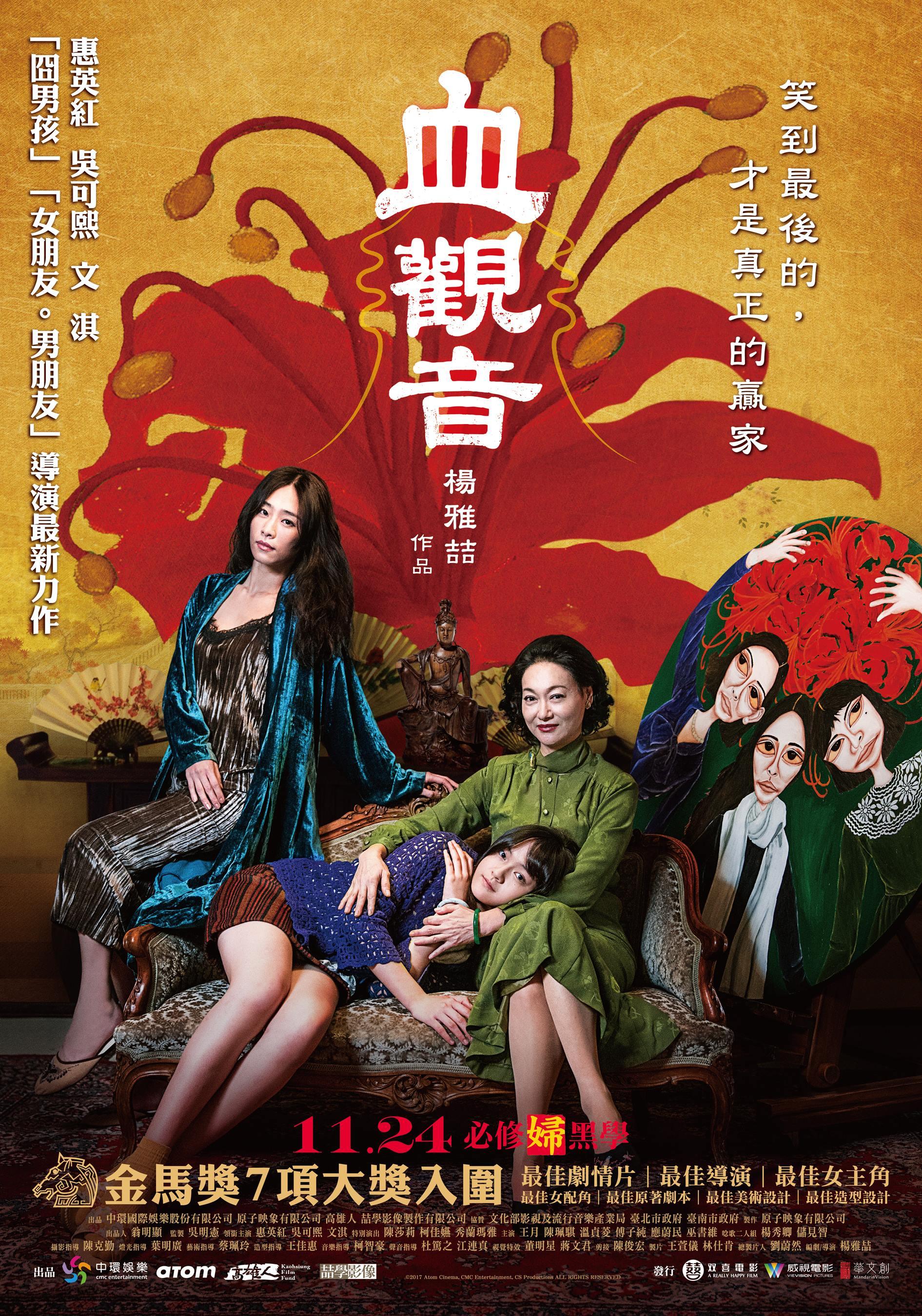
The Bold, the Corrupt, and the Beautiful (血觀音, Yang Ya-che, 2017)

The Bold the corrupt and the beautiful posterAre you playing the game or is the game playing you? The Bold, the Corrupt, and the Beautiful (血觀音, Xuè Guānyīn) is, as its name suggests, somewhere between trashy soap opera and spaghetti western as its entirely amoral matriarch prepares to sacrifice everything in order to get ahead. The family becomes a metaphor for the state – corrupt, prejudicial, hypocritical, and often heartless in its ruthlessness but like a family a state perhaps reaps what it sows and the lessons Madame Tang has taught her daughters may come back to haunt her.

In the Taiwan of the 1980s – the dying days of the old regime but firmly within the pre-democratic past, Madame Tang (Kara Hui) is the widow of a general and, on the surface of things, an antiques dealer. Her real worth however lies in making herself the society face of genial corruption as the conveyor of the ancient treasures that often stand in for monetary bribes in the complex system of reciprocal politics. Designed to manoeuvre herself and her family into a position of power and perhaps safety, Madame Tang’s machinations amount to a mess of intrigue, manipulating the social interactions of her “friends” in order to convince them to destroy each other and clear a path for her ascendance. Part of her grand plan has involved extensive use of her daughter, Ning Ning (Wu Ke-xi) – now approaching middle-age and thoroughly sick of being her mother’s prize pony, while Chen-Chen (Vicky Chen), still a teenager, has usurped her place as the latest cute little thing to be trotted out and fussed over.

Everything starts to go wrong when a powerful neighbouring family, the Lins, is murdered in a suspicious looking home invasion leaving the daughter, Pien-Pien (Wen Chen-ling), who was the closest thing Chen-Chen had to a real human friend, in a coma. Pien-Pien had been carrying on with Marco (Wu Shuwei) the stable boy which obviously had not gone down well with her parents though she had backed out of a plan to elope with him. The police’s theory is that Marco had come back to the family home and taken his revenge, but there is an awful lot more going here than just a jealous proletarian boyfriend hitting back at the bourgeoisie.

Piling layer upon layer Yang’s script is dense and sometimes impenetrable to those not well versed in Taiwanese history and culture. Madame Tang seems to have something of an interesting hidden backstory, swapping easily between standard Taiwanese Mandarin, Cantonese, and Japanese which she, and Chen-Chen, use to get close to Mrs. Lin whose grasp of Taiwanese remains poor despite having lived on the island for many years and being heavily involved in politics. The house the family inhabits is also distinctly Japanese in layout, a colonial era home now inhabited by post-war migrants from other areas of China. The Lins look down on their stable boy not only because of the obvious class difference, or because of their daughter’s relative youth and tarnished reputation, but because he is from a persecuted minority of native peoples.

Marco does however become a kind of key. Chen-Chen, curious and privy to more knowledge than a child of her age ought to have thanks to her mother’s scheming, has developed a fondness for the strapping stable boy and mildly resents being made fun of by the oddly amused Pien-Pien. The rot sets in as Chen-Chen is sent to fetch Ning-Ning only to find her engaging in some kind of orgy in a forest, over which Chen-Chen lingers a little to long only to catch Ning-Ning’s eye and find herself suddenly caught out while her “sister” apparently finds extra spice in her discomfort. Ning-Ning, after years of emotional abuse at the hands of her mother, has begun to rebel by embarrassing her, losing herself in drink, drugs, and promiscuous sex with unsuitable men while Madame Tang still harps on about possible dynastic marriages if now to a distinctly third class tier of potential husbands.

Yang adds a post-modern dimension to the story by framing it as a cautionary tale recounted by a pair of traditional musicians in the manner of Gezi Opera which begins closer to the now before flashing back to show us how we got here. Even if the political metaphors do not hit home without some kind of primer in Taiwanese history, the familial allegory is obvious enough – corruption breeds corruption and the hollow family will eventually swallow its young. The closing coda, presented via intertitles, reminds us that the scariest prospect is not imminent punishment, but a loveless future. The Tangs’ tragedy is not that there was no love between them, but that in their cynicism and insecurity they destroy themselves through a selfish need for control and possession. Madame Tang’s lessons have indeed been learned too well, and in this she damns herself as well as her daughters, condemning all to a loveless future fuelled by greed and fear from which it is impossible to escape.


The Bold, the Corrupt, and the Beautiful was screened as part of the New York Asian Film Festival 2018.

Original trailer (traditional Chinese subtitles only)

Interview with director Yang Ya-che from the 2017 Busan Film Festival (English subtitles)