Home Sweet Home (スイート・マイホーム, Takumi Saitoh, 2023)

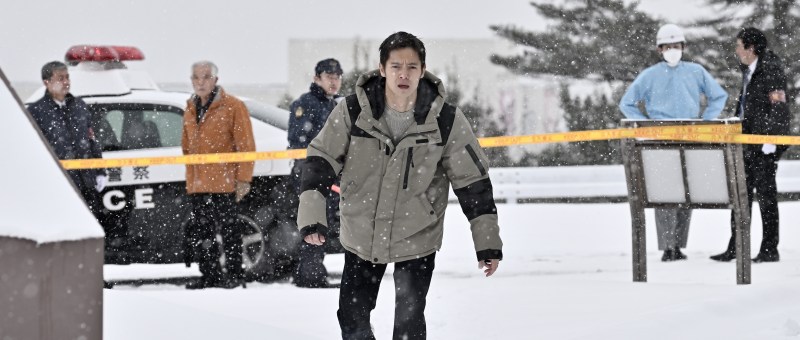
“The secret is in the basement” is not a phrase which inspires confidence when viewing a potential new living space, but as it turns out the cellar is the least of their worries in Takumi Saitoh’s eerie adaptation of Rinko Kamizu’s mystery horror novel, Home Sweet Home (スイート・マイホーム). The Kiyosawas are just looking for somewhere warm where they can enjoy life as a family in comfort and security, but if something sounds too good to be true then it usually is as they will discover to their cost. 

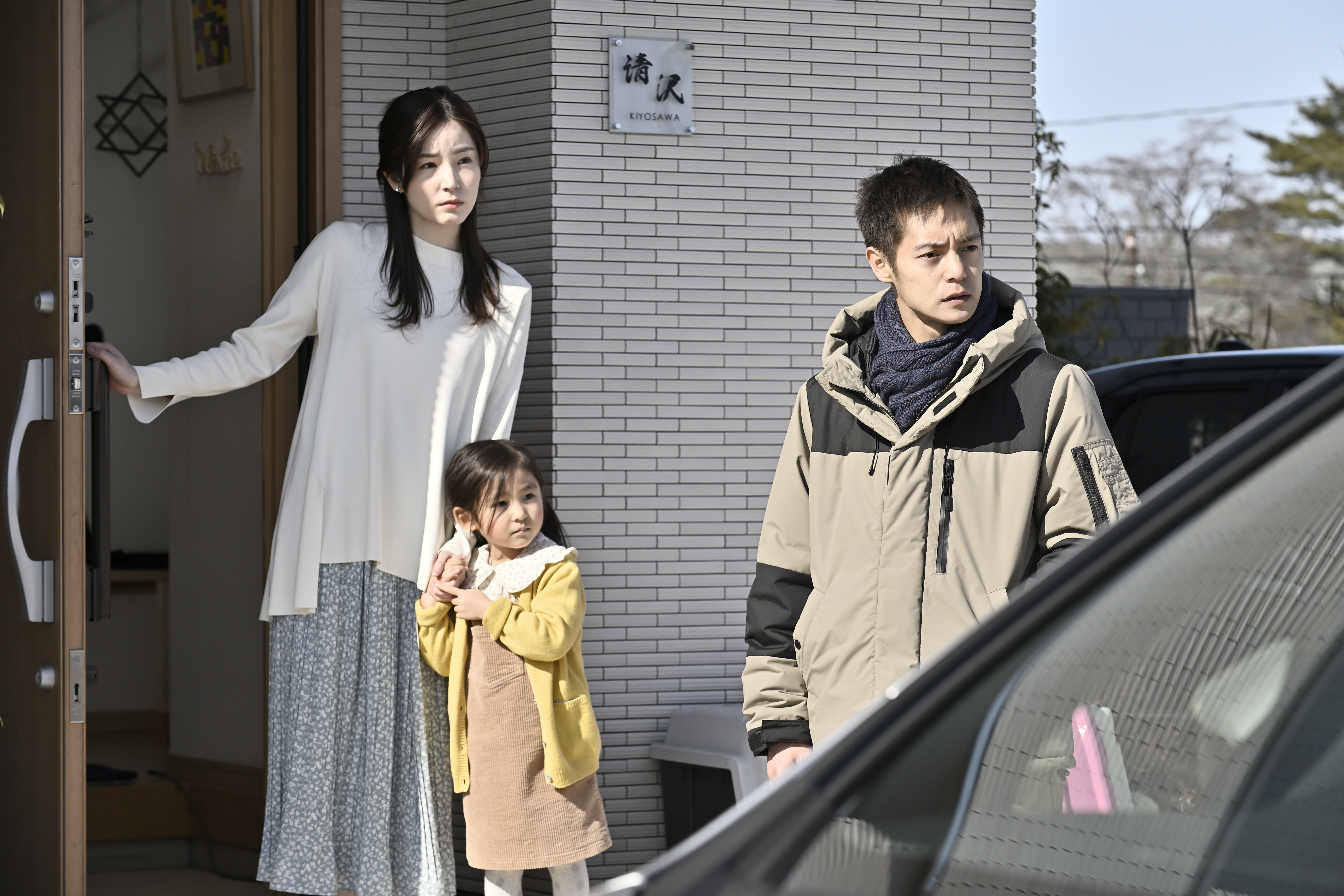
The saleswoman at Magic Homes describes the Kiyosawas as “the ideal family” for whom she is glad to build an “ideal” home. To many they may look “ideal” in that husband Ken (Masataka Kubota) has a steady job as a personal trainer while wife Hitomi (Misako Renbutsu) is a stay at home mum to four-year-old Sachi. But of course nothing’s quite as it seems and there are already cracks in the foundations of this happy family home as Ken has been having a years’ long affair with co-worker Yurie (Ririka). After finally deciding to take the plunge on the house, the affair comes to a natural end point as Yurie too decides to marry her longterm boyfriend with the aim of starting a family. But not long after the Kiyosawas have moved in to their new “magic home” complete with new addition Yuki, Yurie’s husband receives a video showing an unrecognisable Ken entering her apartment with the presumed motive of blackmail lending a note of anxiety to his moment of familial bliss. 

To begin with, the house itself takes on a eerie quality especially with the ominous rumble of the single AC unit in the pitch-black basement. The home does not seem to have been particularly well thought out for families with small children as the tiny doors leading to the hatch are at a toddler’s height and don’t appear to have any kind of safety locks in place. Everything else is run off the central smart system including a network of CCTV cameras sold to the family as a convenience that would allow them to keep an eye on the children wherever they might be in the house while getting on with other things, but also undoubtedly a privacy worry and no one likes to feel watched in their own home. Watched is exactly how they start to feel, Hitomi convinced someone’s been in the house while looking around realising how many vents and ducts there are ominously staring down at them in every room. 

Ken’s brother Satoru (Yosuke Kubozuka) is suffering with a mental illness that makes him paranoid, repeatedly insisting that there are people watching them and they need to protect the family because they are everywhere in the ceilings and the floors. Though it first seemed to us that the house was the problem, the family’s desire for conventional suburban living biting back at them, we wonder if the problem is Ken and his reckless endangerment of his family through his affair. When first viewing the house, the couple had been accosted by a creepy salesman, Amari (Yohei Matsukado), who makes barbed remarks about looking after the family that have Ken suspecting he’s got it in for them because they chose someone else to handle their sale or perhaps resents them for not being “ideal” enough to live in one of his “magic homes”. 

But then what is the “ideal” family, who gets to decide that? Why should the Kiyosawas have to fulfil a stereotypical ideal just to be judged worthy of homeownership? There might be something chilling in the uniformity of the house’s design, a utopian vision of suburban bliss founded on outdated patriarchal social norms of the nuclear family though in this case slightly adjusted for a new era, but then again the call is coming from within the house in more ways than one in Ken’s delayed response to traumatic childhood incident and concurrent anxiety around being able to protect his family in fulfilment in the social “ideal” for fatherhood. It’s the “ideal” that is the true enemy from the generic house design to the unfair expectations placed on the Kiyosawas to live up to a particular kind of suburban properness in order to qualify for the right to live there. Paranoid and eerie, Saito conjures a world of constant tensions in which we are all being “watched” if not to say judged and any bug in the system must be quickly removed so that the “ideal” may prevail.  


Home Sweet Home screens July 27 as part of this year’s New York Asian Film Festival.

Original trailer (no subtitles)

Images: ©2023 Rinko Kamizu, KODANSHA Ltd./ “Home Sweet Home” Film Partners

Sekigahara (関ヶ原, Masato Harada, 2017)

Sekigahara posterWhen considering a before and an after, you’d be hard pressed to find a moment as perfectly situated as the Battle of Sekigahara (関ヶ原). Taking place on 21st October 1600 (by the Western calendar), Sekigahara came at the end of a long and drawn out process of consolidation and finally ended the Sengoku (or “warring states”) era, paving the way for the modern concept of “Japan” as a distinct and unified nation. In actuality there were three unifiers of Japan – the first being Oda Nobunaga who brought much of Japan under his control before being betrayed by one of his own retainers. The second, Toyotomi Hideyoshi, continued Oda’s work and died a peaceful death leaving a son too young behind him which created a power vacuum and paved the way for our third and final creator of the modern Japanese state – Tokugawa Ieyasu whose dynasty would last 260 years encompassing the lengthy period of isolation that was finally ended by the tall black ships and some gunboat diplomacy.

Loosely, we begin our tale towards the end of the rule of Toyotomi Hideyoshi (Kenichi Takito) though, in a nod to the novel, director Masato Harada includes a temporal framing sequence in which our author depicts himself as a boy during another war sitting in these same halls and hearing stories of heroes past. As well he might given where he was sitting, the narrator reframes his tale – our hero is not the eventual victor, Tokugawa Ieyasu, but a noble hearted retainer of the Toyotomi, Mitsunari (Junichi Okada).

Riding into battle, Mitsunari reminds his men that this is a war of “justice and injustice” – they cannot lose. Yet lose they do. The narrator recounts Mitsunari’s improbable rise as an orphan taken in by Hideyoshi on a whim who nevertheless became one of the most powerful men in late 16th century Japan. Despite his loyalty to his master, Mitsunari cannot abide the cruelty of the samurai world or its various modes of oppression both in terms of social class and even in terms of gender. He resents the subversion of samurai ethics to facilitate “politics” and longs to restore honour, justice, and fairness to a world ruled by chaos. Rather than the bloody uncertainty and self-centred politicking that define his era, Mitsunari hopes to enshrine these values as the guiding principles of his nation.

On the other hand, his opponent, Tokugawa Ieyasu (Koji Yakusho) is famed for his intelligence and particularly for his political skill. Hoping to swoop into the spot vacated by Hideyoshi which his young son Hideyori is too weak to occupy, Ieyasu has been playing a long game of winning alliances and disrupting those other candidates had assumed they had secured. Unlike Mitsunari, Ieyasu is ruthless and prepared to sacrifice all to win his hand, caring little for honour or justice or true human feeling.

The framing sequence now seems a little more pointed. Sekigahara becomes a turning point not just of political but ideological consolidation in which Mitsunari’s ideas of just rule and compassionate fair mindedness creating order from chaos are relegated to the romantic past while self interest triumphs in the rule of soulless politickers which, it seems, travels on through the ages to find its zenith in the age of militarism. Mitsunari is the last good man, prepared to die for his ideals but equally prepared to live for them. His tragedy is romantic in the grander sense but also in the more obvious one in that his innate honour code will not let him act on the love he feels for a poor girl displaced from Iga whose ninja service becomes invaluable to his plan. With a wife and children to consider, he would not commit the “injustice” of creating a concubine but dreams of one day, after all this is over, resigning his name and position and travelling to foreign lands with the woman he loves at his side.

Working on a scale unseen since the age of Kurosawa, Harada patiently lays the groundwork before condensing the six hours of battle to forty minutes of fury. The contrast between the purity of the past and the muddied future is once again thrown into stark relief in the vastly different strategies of Ieyasu and Mitsunari with Ieyasu’s troops armed to the teeth with modernity – they fire muskets and shout cannon commands in Portuguese while Mitsunari’s veteran warriors attempt to face them with only their pikes and wooden shields. Unable to adapt to “modern” warfare and trusting too deeply in the loyalty of his comrades, Mitsunari’s final blow comes not by will but by chance as a young and inexperienced vassal vacillates until his men make his decision for him, betraying an alliance he may have wished (in his heart) to maintain. Goodness dies a bloody death, but there is peace at last even if it comes at a price. That price, for some at least, may have been too great.


Original trailer (no subtitles)