Daughter of Fire (불의 딸, Im Kwon-taek, 1983)

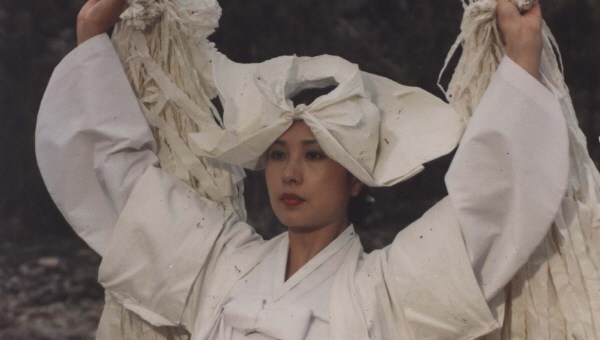
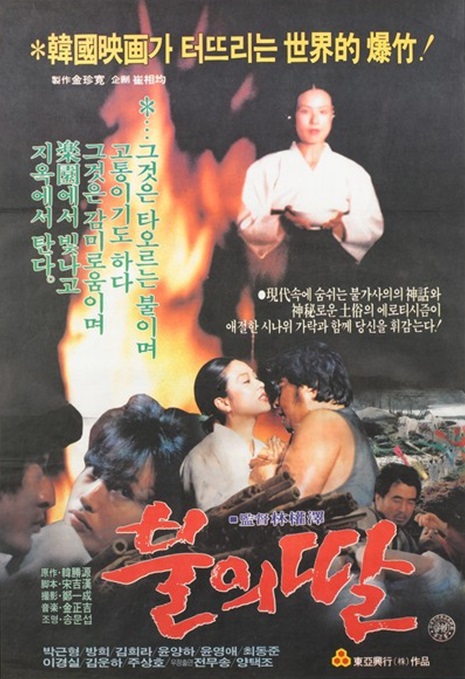
“Doctor, is it possible in our modern society for someone to suffer from that kind of illness?” the conflicted hero of Im Kwon-taek’s Daughter of Fire (불의 딸, Bul-ui ttal) asks his psychologist, plagued by nightmares of the mother who abandoned him at 11 and suffering what seems to him to be the call to shamanism, only what place could such a backward and superstitious practice have in “our modern society?”. In many ways, it’s exactly that question which Im seems to find so essential, implying in a sense that even in the politically repressive but increasingly prosperous Korea of the late ‘70s that they have perhaps lost something of their essential Koreanness in their abandonment of their ancestral beliefs in favour of modern “sophistication”.

Listening to his troubles, the disinterested psychiatrist reassures Hae-joon that it’s just a “minor neurosis” caused by “frustration” which can easily be cured. On his way home, however, Hae-joon is accosted by an older woman dressed in shaman’s clothing who addresses him as a son, reminding him that he has the blood of shamans running in his veins and try as he might he’ll never be able to escape it. Her intervention perhaps links back to an earlier encounter with the pastor at his wife’s church who explained to him that his wife is at the end of her tether, embarrassed by his lack of faith believing that it reflects badly on her as a religious woman hoping to lead others towards the lord if she cannot at least count her husband among the saved. So great is her distress that she has apparently even considered divorce. This is perhaps one reason Hae-joon is so keen to exorcise his shamanistic desires, though it’s also clear that his presence in his home is intensely resented, his wife later only warmly greeting him by hoping that he’ll be able to let go of his “dark and diabolical life” for something brighter and more cheerful, ie her religion though the grey uniformity and intense oppression of her practice only make her words seem more ironic. 

The pressing problem in his family is that his daughter is also sickly, seemingly with whatever it is which afflicts Hae-joon. She has begun sleepwalking and later suffers with fits and seizures which to a certain way of thinking imply the onset of her shamanistic consciousness. Hae-joon’s Christian family, in a touch of extreme irony, are convinced that an exorcism in the form of a laying on of hands will cure her, yet they like many others view the ritualised religious practice of the shaman as a backward relic of the superstitious past. The ironic juxtaposition is rammed home when Hae-joon is sent to cover a supposed miracle for his newspaper that his wife and her friends from church regard as the second act of Moses, standing ramrod straight and singing hymns while a noisy festival of shamanic song and dance occurs further along the beach apparently a rite to appease both the sea god and the vengeful spirit of an old woman accidentally left behind when her community migrated to another island to escape an onslaught of tigers. Stuck in the middle, Hae-joon exasperatedly explains to his photographer that this parting of the seas isn’t any kind of miracle at all, merely a natural result of low tide revealing that which would normally be hidden. 

Yet despite his unsatisfactory visit with the psychologist, Hae-joon becomes increasingly convinced that only by finding his mother can he come to understand what it is that afflicts him. Speaking to the various men who knew her from the step-father he later ran away from to escape his abuse after his mother disappeared, to a blacksmith who cared for him as an infant, and the men she knew after, Hae-joon begins to understand something of her elemental rage. Driven “mad” by the murder of her lover by the Japanese under the occupation, she wandered the land looking for fire to exorcise her suffering only later to lose that too when the oppressive Park Chung-hee regime outlawed shamanism entirely in his push towards modernity. Consumed by the fires of the times in which she lived, there was no place in which she could be at peace and nor will there be for Hae-joon or for his daughter until they embrace the legacy of shamanism within. 

“Shamanism will not disappear and die” Hae-joon later adds, now able to see that there is or at least could be a place for it in “our modern society” or perhaps that it’s the modern society which must change in order to accommodate it. Despite his long association with depictions of Buddhism, it is the shaman which Im considered the foundation of Korean culture, something he evidently thinks in danger to the perils of a false “modernity”, Hae-joon eventually professing his concerns that without it Korea will forever be oppressed by foreign influence. Only by accepting the shaman within himself can he hope to find freedom in an oppressive society. 


Daughter of Fire streams in the UK until 11th November as part of this year’s London Korean Film Festival.

Jagko (짝코, AKA Pursuit of Death, Im Kwon-taek, 1980)

Jagko poster

During the dark days of the dictatorships, the “anti-communist film” was a mainstay of the Korean film industry. Though it wasn’t exactly possible to make a pro-communist film and that therefore any and all films were at least implicitly anti-communist, the authorities had been especially keen on films which took a hardline on anything remotely leftwing. By the late ‘70s however times were changing and a more nuanced view of recent history began to become possible. Im Kwon-taek is thought to be among the first directors whose work precipitated a shift from the “anti-communist” to the “division” film in which the tragedy of the division itself takes precedence over the demonisation of the North (though such views were perhaps not as uncommon as might be assumed in films from the late ‘50s and early ‘60s before the passing of the Motion Picture Law). Jagko’s (짝코) two haunted protagonists are both flawed men betrayed by their country and changing times realising they have wasted their youth on a cat and mouse game over an outdated ideological disagreement when the conflict that defined their lives was merely a proxy war fought by two super powers on Korean soil.

Song (Choi Yoon-seok), a former policeman, is picked up by a vagrancy patrol and taken to a “rehabilitation centre”. Despite the name the centre is more like a debtors’ prison and Song is now a prisoner of poverty who will not be allowed to leave unless redeemed by a family member (of which he has none or he might not be here). Nevertheless, the men are treated well, fed three meals a day, and only asked for a couple of hours of non-strenuous work with the rest of the time marked “free”. Once Song has begun to calm down, he makes a shocking discovery. He is convinced that a man lying ill a few beds over is none other than Jagko (Kim Hee-ra) – a former North Korean partisan and the man he holds responsible for ruining his life.

Im lets us in on the stories of both men via a series of flashbacks. Though he pretends not to know him, the other man, calling himself Kim, is indeed “Jagko” though his life has been just as miserable as Song’s. Back on Mount Jiri at the end of the Korean war, Song was a respected policeman – he left school at 12 and made a name for himself catching partisans. When he catches the legendary Jagko, wanted for a series of atrocities and terrorist acts, all Song can do is boast and talk of his imminent promotion after which he will enjoy a life of comfort. Unsurprisingly, Jagko is not exactly happy for him but allows his captor to prattle on in order to buy time for his escape. It is Song’s own arrogance which permits him to do so. Claiming to need the bathroom, Jagko offers Song a gold ring hidden in his shoe which Song scoffs at, but he does loosen his cuffs to facilitate Jagko’s relief at which point he manages to headbutt him and run away. Song is accused of taking bribes and dismissed. He is humiliated and loses his status, job, and family all in one go. Fixated on Jagko, Song gives up everything to chase him in order to turn him in to his former commander and have him clear his name by confirming that he was not bribed and did not sell out his country for gold.

Almost thirty years later both men are older than their years, broken and defeated. As one of the rehabilitation centre residents puts it, they’re all about to die – what does it matter now if someone was a communist or a partisan, what good could it possibly do to drag the past up all these years later? For Song it’s almost as if there is no “past”, the last few decades have been spent in a relentless pursuit of the man who holds the key to his good name. He wants to undo the folly of his hubris by overwriting it, but time has passed and what he’s lost cannot be reclaimed. Meanwhile, Jagko is not an ideologically crazed leftist, but a lonely old man who is now in poor health and has nothing but regrets. The two men bond in their mutual suffering and work together to escape, but the world they emerge into is not that of their youth. Song was disempowered when he entered the facility – they took his arrest rope away from him, but when he tackles the weakened Jagko to the ground and tries to call two policemen on patrol over to arrest him as an “escaped communist guerrilla” the young officers of the law have no idea what he’s talking about. Those words no longer mean anything. The bemused policemen conclude the old men must be escaped mental patients before spotting the rehabilitation centre uniform and jogging off to phone someone to come and take them back.

The old men’s quarrel is exposed as ridiculous. Jagko, less angry more soulful, remarks that men like he and Song are the most pitiful souls on Earth as he watches America sit down with Russia on the TV and realises he is merely a victim of ongoing global geopolitical manoeuvring. It’s no longer a question of left and right, both men are victims of their times, neither “good” nor “bad” but flawed and human. We do not know if Jagko did the things Song says he did but he has paid a heavy price all the same. Song, by contrast, has shifted all the blame for his fate onto Jagko, believing that if he can catch him he can somehow make it all right, but of course he can’t and is trapped in a spiral of denial in refusing to accept his own responsibility for the tragedies of his life. What is to blame is the folly of war and particularly of an internecine fraternal conflict which remains unresolved and may well be unresolvable unless an attempt is made to address the past with empathy and understanding in place of enmity and rancour.


Jagko is available on blu-ray courtesy of the Korean Film Archive. The set includes subtitles in English, Japanese, and Korean with the audio commentary by Kim Dae-seung and editor of Cine21 Ju Sung-chul also subtitled in English. The audio commentaries from the DVD edition included with the Im Kwon-taek boxset, one by director Im Kwon-taek and film critic Huh Moon-yung, and the other by screenwriter Song Gil-han and film critic and director Kim Hong-joon, unfortunately do not carry over the English subtitles. The set also comes with a bi-lingual Korean/English booklet featuring an essay by film critic and professor Park Yuhee. Not currently available to stream via the Korean Film Archive’s YouTube channel.