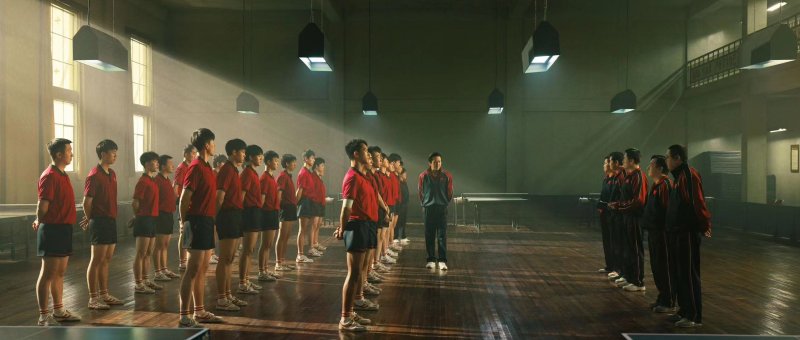
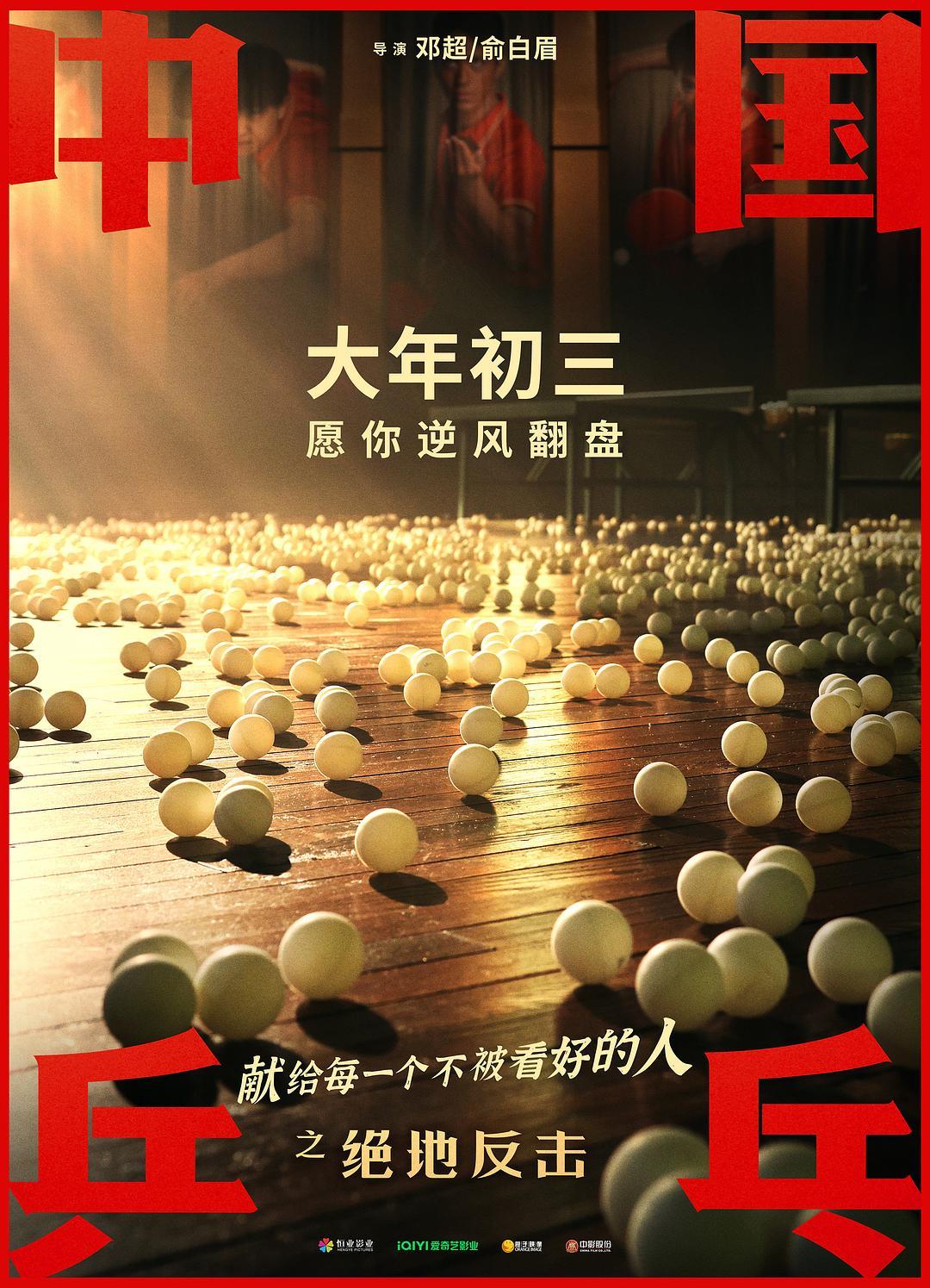
Ping Pong: The Triumph (中国乒乓之绝地反击, Deng Chao & Yu Baimei, 2023)

A changing China tries to recapture its sense of possibility by regaining its reputation as a ping pong powerhouse in Deng Chao and Yu Baimei’s rousing table tennis drama, Ping Pong: The Triumph (中国乒乓之绝地反击, Zhōngguó Pīngpāng zhī Juédì Fǎnjī). China can lose at any other sport, but not ping pong according to one aggrieved player making a dramatic return to the national team and echoing a sense of resurgent energy even as embattled coach Dai (Deng Chao) struggles to convince those around him that China can prevail. 

As the film begins, Dai is an exile living in Rome and training the Italian national team. He has fully acclimatised to the comparatively relaxed Italian society, is dressed in a stylish tailored suit and wool overcoat, and has a fashionable European haircut. But to some, including it seems an institutionally racist police force, he’ll always be an other as he discovers on trying to report a mugging but ending up getting arrested himself and questioned by a cop who doesn’t like it that he’s wearing an expensive watch. With his wife heavily pregnant, Dai decides to return home to China but is offered only an assistant coaching job and given a pokey flat that doesn’t even have its own bathroom in contrast to the spacious house the family were living in in Rome while the Chinese national team flounders in an ongoing decline. 

Dai’s fortunes in Italy play into the persistent message of contemporary mainstream Chinese cinema that there are no safe places for the Chinese citizen outside of China and that the only solution is to return home as soon as possible, while it’s also clear that his Westernisation is portrayed as a kind of bourgeois decadence that must eventually be corrected. On return to China, Dai continues to dress in his Italian suit rather than the team tracksuits worn by the other coaches until he’s fully reassimilated into the team and he’s even at one point criticised for spending too much time on his hair that could better be spent on training. Nevertheless, as he later points out they’re being beaten by European teams who are often trained by Chinese coaches who like him decided to chase their fortunes abroad in the confusions of early ‘90s China. 

A lengthy sequence near the film’s beginning suggests that the Chinese players feel the game has been taken away from them unfairly, that though they did not invent ping pong, it has become so integral to the Chinese identity that its loss strikes at the heart of the nation’s vision of itself. Afraid of China’s success, international nations conspired to effect the restriction in trade of a special kind of glue China used for paddles while modifying the rules so that they were more in favour of taller European players rather than small and speedy Chinese sportsmen whose techniques are no longer a fit for the contemporary game. Dai’s battle is partly to force change among traditionalists and convince them that China needs to up its game to meet international competition if it is to reclaim its sporting crown. 

It’s tempting to read the film as an allegory for China’s current economic ambitions if also a look back to a time of defeat in which the nation righted itself and became champions once again through unity, hard work, and faith in the future. The message is rammed home in the final pep talk Dai gives to a nervous player whose wealthy family disapprove of his choices and regard him as an embarrassment, reminding him that while their Swedish rivals took time out for holidays, sleeping, and eating breakfast they trained every minute of every day and he should learn to trust in that when faced with the seemingly insurmountable mountain of the European champion. Another player is told that he could lose the use of his arm if he continues playing but does so anyway (and is later fine), while it’s clear that Dai has made sacrifices which have strained his familial relationships in spending so much time away from his wife and young son. 

There’s also a subtle current of less palatable national unity in Dai’s wife’s claim that their son is slow to speak not only because his father is away so often but that he’s surrounded by too many different dialects and it’s impeding his development, making an uncomfortable argument for the primacy of standard Beijing-accented Mandarin. Nevertheless, the message is fairly clear in the frequent cut backs to young children watching the games and once again seeing China on the world stage, gaining a new sense of possibility for their own lives in the vicarious success of sporting championship. Deng and Yu shoot the matches with breathless intensity and an unexpected immediacy as the ball seems to barrel through the camera, and at one point takes the place of the star on the Chinese flag. “Chinese are the most diligent” Dai reminds his player, certain that they will get there in the end through sheer force of will, hard work, personal sacrifice for the national good, and above all togetherness as they battle seemingly insurmountable odds to reclaim their sporting crown and with it a national identity.


Ping-Pong: The Triumph screens in Chicago March 25 as part of the 16th season of Asian Pop-Up Cinema.

Original trailer (Simplified Chinese / English subtitles)
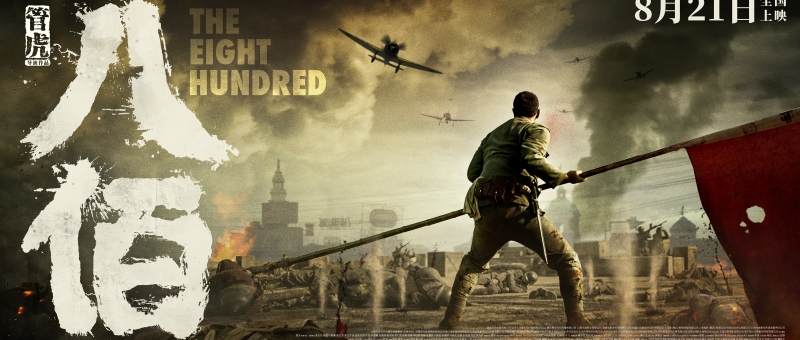
The Eight Hundred (八佰, Guan Hu, 2020)

“Enjoy Shanghai. Enjoy Your Life” reads a neon-lit sign in the art deco paradise of Shanghai in the 1930s. Across the river, however, a war is raging. Guan Hu’s The Eight Hundred (八佰, Bābǎi), the first Chinese film to be shot in IMAX and boasting an unprecedented budget of US$80 million, was the last in a series of movies to be ignominiously pulled from a festival slot, the opening night of the Shanghai International Film Festival no less, for “technical reasons”. In this case, most have interpreted the nebulous term as a squeamishness on the part of the censors’ board to the fact that the film celebrates the heroism not of the PLA but of Chiang Kai-shek’s Nationalist Revolutionary Army who put up the last stand during the fall of Shanghai, securing a warehouse on the opposite side of the river from the British Concession knowing that there was no hope of stopping the Japanese, but hoping that their defiance would inspire foreign powers over to the Chinese side. 

The action opens in October 1937 shortly after the outbreak of the second Sino-Japanese War. Shanghai is falling and the Japanese will soon be on their way towards Chiang’s capital, Nanking. Nevertheless, the Japanese have resolutely avoided encroachment into the foreign concessions for fear of inflaming international relations in ways which might be inexpedient for their current goals. As a diplomat later puts it, war is always a matter of politics. Ordered to hold the line, the last remnants of the NRA are expected to die as an act of political theatre. There is no practical benefit to their sacrifice save the vindication that they went down fighting, their moral righteousness a tool to garner sympathy firstly with the international community who might be persuaded to intervene at an upcoming conference in Brussels (which is finally postponed because of a corruption scandal engulfing the Belgian PM). 

In Guan’s retelling, however, it is a much more domestic audience which becomes the ultimate target. A contrast is repeatedly drawn between behind the lines China, a wasteland of fire and rubble, and the glittering lights of the foreign concession with its billboards for Hollywood movies, famous actresses surveying the scene while the sound of opera both domestic and Western wafts over the river and business carries on as normal in the large casino run by an eccentric short-haired madam dressed in a Western suit. Cynical journalists chase the story from the comparative safety of a balcony above the bridge, chiding the Chinese reporter, Fang (Xin Baiqing), who has also been working as an interpreter for the Japanese, that he acts as if this war is nothing at all to do with him. The heroism of the 800 is the key to unlocking the latent patriotism of those living in the dream of the foreign concession where war happens only across the water, in another world no more real to them than a movie. They stand by the water and they watch, increasingly grateful to the soldiers for their protection until they too remember that they are also Chinese and this war is also their war. Women extend their hands towards those retreating across the bridge while the Peking opera turns its drums to the rhythms of war and the casino madam gives up first a flag and then a large stash of morphine hidden in her safe for probably obvious reasons. 

The flag might be one of several explanations for the censors’ squeamishness in that it is obviously now the flag of Taiwan and reminds us that these men are members of Chiang Kai-shek’s NRA, more often characterised in ideological terms as traitors rather than heroes. They are not however saints in the propaganda movie mould and it is even perhaps suggested that they are not much better than the Japanese, ruthlessly executing their own men as deserters and using prisoners of war as target practice for untrained, nervous recruits (the Japanese meanwhile publicly dismember their prisoners with the intention of intimidating Chinese forces). The youngest of the soldiers is only 13, a farmer’s son pulled off his land with his older brother who was tricked into the war machine by the desire to see the shining city of Shanghai and perhaps travel to England. Some of them try to run, torn between the desire for escape and a responsibility to their fellow men, each eventually fully committed to their forlorn hope determined to hold the warehouse if only to prove that they held the line for as long as it could be held. 

That same diplomat encourages commander Colonel Xie (Du Chun) that what he does here will be remembered, and that his men are the “real Chinese people” in another statement that probably rankled with the censors. Repeated references to legendary general Guan Yu paradoxically link back to the contemporary context as the narrator of a shadow play echoes that the Han restoration rests with the young while an angry soldier rants about planting a flag on Mount Fuji as revenge for everything they’ve suffered, making the case for the resurgent China beholden to no one something echoed by the moving scenes juxtaposing the ruined warehouse with the ultramodern city which now surrounds it. Yet Guan opens with a peaceful image of pastoral serenity which stands in stark contrast to the chaos of war as his numbed camera slowly pans between one scene of carnage and the next. Men blow themselves up, cry out for their mothers, send letters home, and call out their names as they die to prove that they existed while a beautiful white horse runs wild in the vistas of desolation. Unashamedly patriotic despite its slightly subversive context, The Eight Hundred presents war as the meaningless chaos that it is, but also lionises the men who fought it in the mythic quality of their heroism as they alone stood their ground and finally convinced others to do the same.


The Eight Hundred is in UK Cinemas from 16th September courtesy of Cine Asia.

UK trailer (English subtitles)