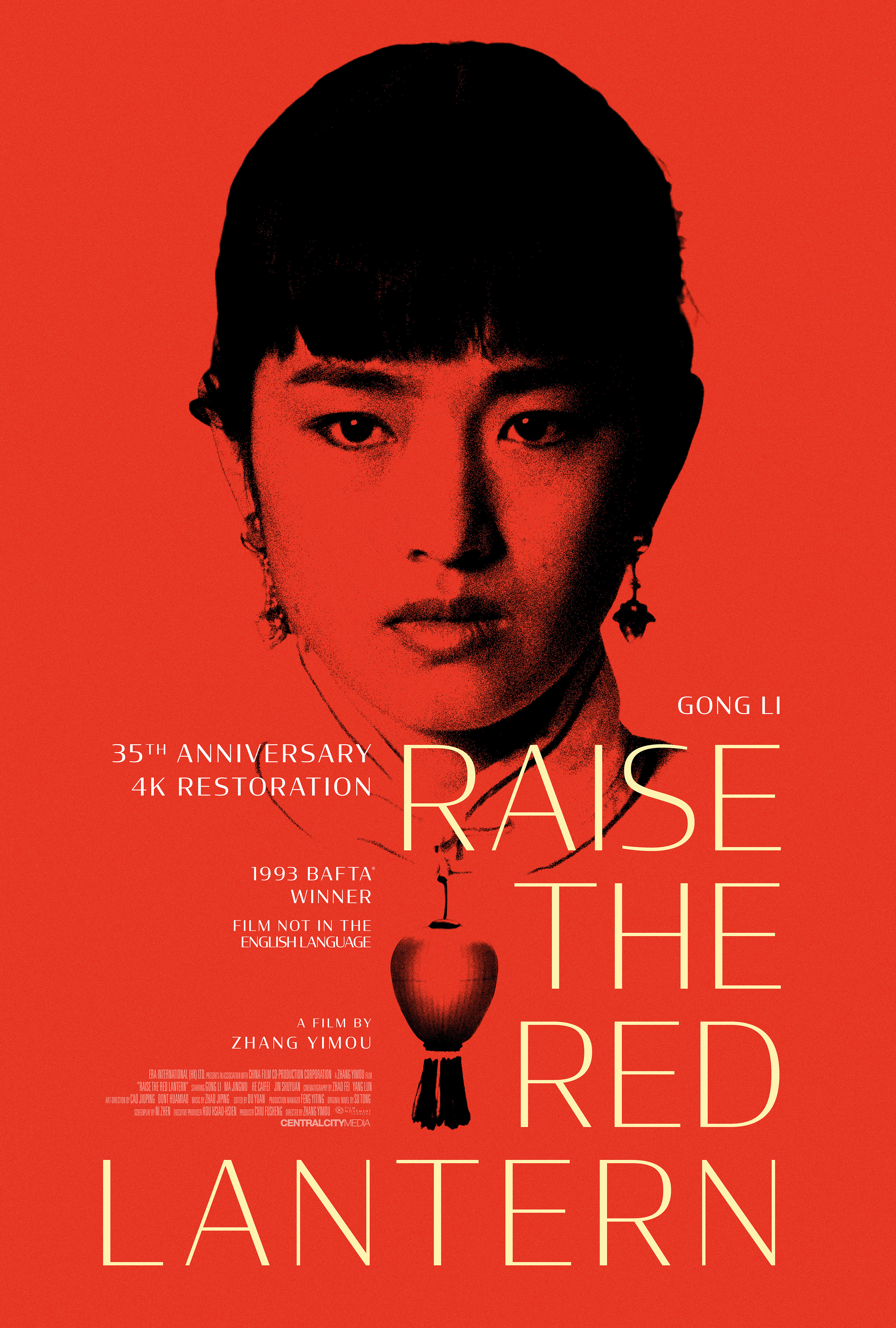
Raise the Red Lantern (大红灯笼高高挂, Zhang Yimou, 1991)

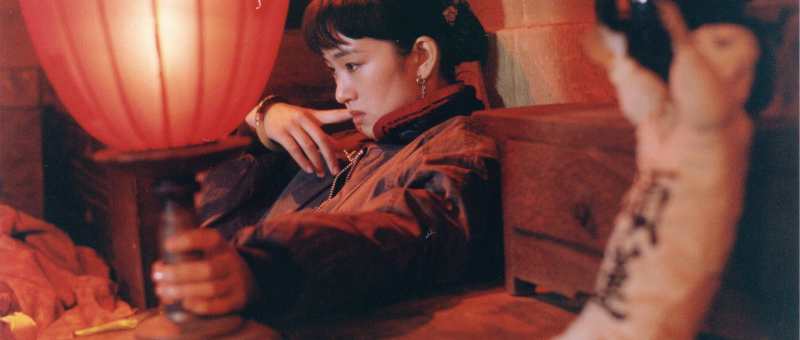
“Isn’t that a woman’s fate?” 19-year-old Songlian (Gong Li) tearfully asks on defiantly agreeing to drop out of university and become the “fourth mistress” of a wealthy man (Ma Jingwu) in Zhang Yimou’s seminal 1920s-set drama Raise the Red Lantern (大红灯笼高高挂, Dà Hóng Dēnglong Gāogāo Guà). It’s as if she wants to make clear that she has chosen this fate for herself even if, in reality, she has little other choice. She had, in any case, been dependent on her father who has now died. Her step-mother either cannot afford or does not wish to continue paying for her university education, welding her own newfound power and cutting off Songlian’s only possibility of independence.

Even so, it’s clear that she made this decision in temper and has no real idea of what kind of life she has committed herself to. She continues in defiance, declining the palanquin and walking into the master’s house carrying her own suitcase. Encountering the sullen servant girl Yan’er (Kong Lin), she owns her new position as the Fourth Mistress and in someways bends herself to this system by insisting on her superiority, demanding that Yan’er be the one to carry her suitcase into her new home. But it’s after this that she loses all delusion of power. Songlian is encircled by female servants who swarm around her performing various tasks they assure her are “family traditions” which she must now learn to obey.

As the new mistress, and a very beautiful young woman, she enjoys an unusual level of privilege but currently lacks the experience to realise that this holiday period will be short-lived and in reality she has very little currency to bargain with. Introduced to the other mistresses, Songlian begins sizing them up as if she meant to hang on to this crown, but soon realises that they are much more experienced in plotting than she is, and that she has crucially misunderstood the ways in which this world, ruled by arbitrary “tradition”, may work. First Mistress (Jin Shuyuan), an older woman and the mother of the master’s grown up son Feipu (Chu Xiao), is polite but distant, resigned to the fact she can no longer attract the master’s attention but with little to occupy her time. Songlian had thought her major rival to be Third Mistress (He Saifei), a formerly a famous opera singer who tries to leverage her power by interrupting their wedding night claiming that she is ill and calling for the master, little realising that Second Mistress’ (Cao Cuifen) kindness is all strategy and masks a devious heart.

In this way, the master’s compound plays out as an allegory for the wider society. The master himself is never seen clearly and acts merely as a distant authority. With no power of their own, the only currency the women have lies in their proximity to men. These “traditions” pit them against each other to win the master’s favour. Only the chosen mistress has lanterns lit for her in this gloomy environment, receives a foot massage, and gets to decide the menu for the day. But even within this largely female world, there are other divisions in play. Songlian comes to learn that the reason Yan’er took against her, was that she has become sexually involved with the master and hoped that he would make her his official mistress instead. Her hope was an unrealistic as Songlian’s that she would be able to exert control over her life in this environment. The master will never marry a servant girl, and after all he has no need to when she is already sexually available to him, which is the only interest that he has in any of these women outside of their absolute obedience. Wandering around on the upper floors Songlian finds a locked shed ominously referred to as the “death room” where she is told women of past generations hanged themselves, only later coming to understand its grim significance as a symbol of the authoritarian power she now lives under.

In fact, Songlian’s naivety and childish defiance lead to unforeseen consequences including the death of other women trying to navigate this system just as she is. With his trademark use of colour, Zhang opens in the honeymoon period of the summer in which Songlian’s world is illuminated by the warm glow of the red lanterns, only to transition towards autumn and winter in which their light becomes increasingly hellish. White is a colour that has a strong association with death in Chinese culture, and the arrival of the snow enveloping the compound only serves to reinforce the idea of Songlian’s spiritual demise as she comes to realise that there is no escape from this world nor any freedom within it. The fate of the First Mistress presents the very best that she could hope for, leading the dull life of a discarded toy devoid of possibility or emotional fulfilment while otherwise enjoying a fairly basic level of material comfort in return for compliance with the many “traditions” of this world.

The Third Mistress had found a kind of freedom in music, but even Songlian’s flute is taken from her by the jealous master. Eventually she is replaced when the inevitable fifth mistress arrives. The only way in which she can continue to exist in this world is to go mad, wandering the prison-like environment in ghostly fashion wearing the clothes she arrived in and having reverted to a hairstyle only worn by children and very young, unmarried women. In this way the master’s estate becomes a metaphor for the patriarchal superstructure and authoritarianism of the contemporary Chinese society in which there is no such thing as solidarity, only those scrabbling over each other to survive and others so broken they have simply stopped trying.


The 4K restoration of Raise the Red Lantern opens 6th November in UK cinemas courtesy of Central City Media.

Rerelease trailer (English subtitles)
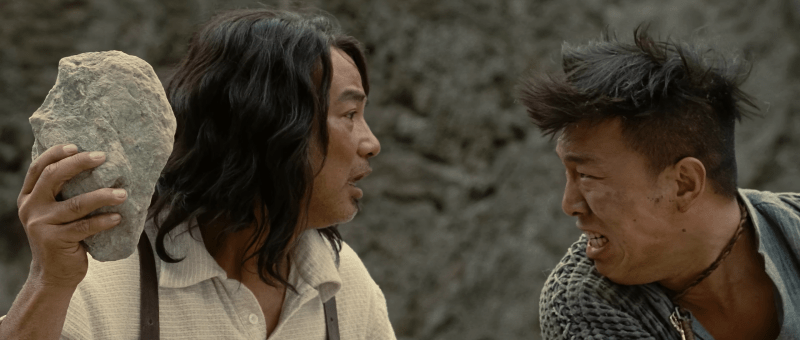
Design of Death (杀生, Guan Hu, 2012)

A doctor (Simon Yam Tat-wah) dispatched to put an end to a “mysterious disease” finds himself embroiled in mystery after discovering the barely breathing body of an unpopular villager in Guan Hu’s darkly comic drama, Design of Death (杀生, Shāshēng). Adapted from a 1998 novella by Chen Tiejun, the film’s Chinese title translates as “to kill a living thing”, the first act forbidden under Buddhism. Yet this particular village has decided it has no other choice if it is to maintain order along with its famed “longevity”.

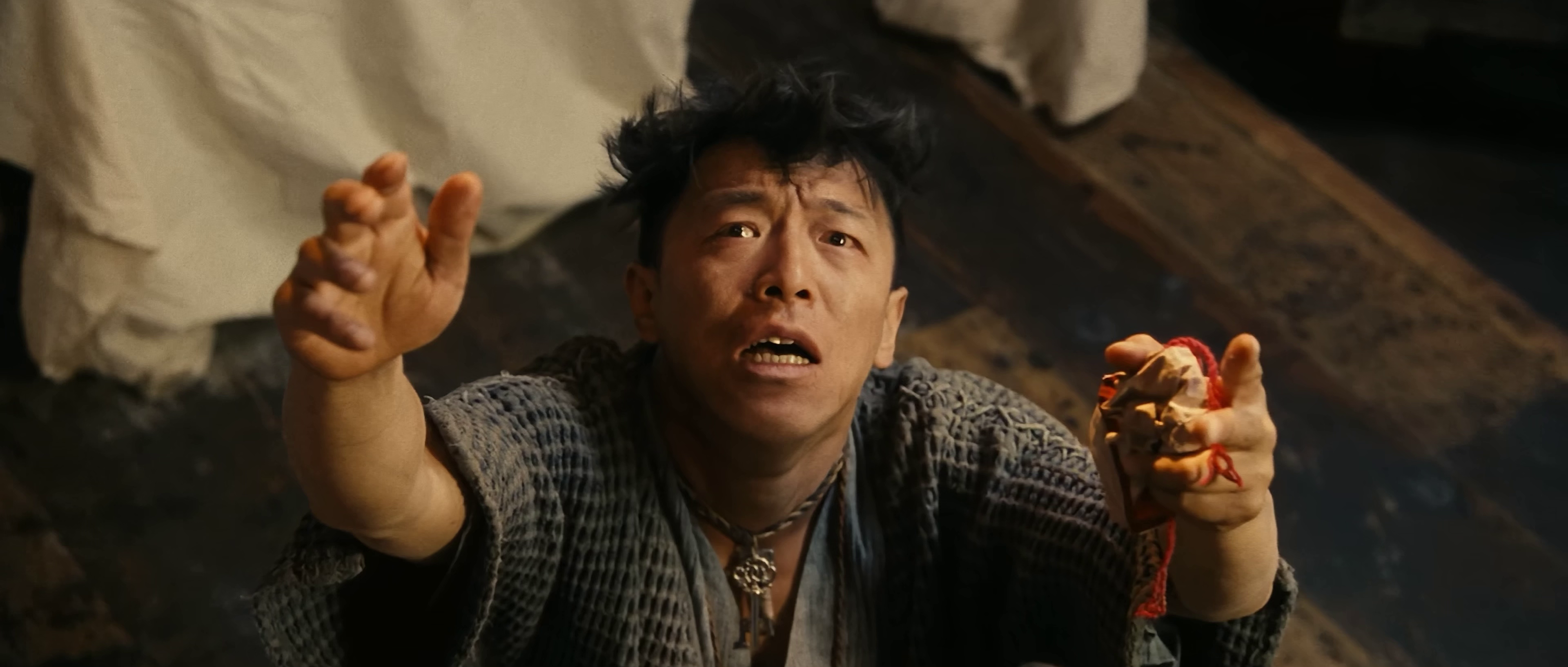
The son of an itinerant pedlar reluctantly taken in by the village’s ruling Niu clan, Niu Jieshi (Huang Bo) is a general nuisance and agent of chaos. For the first part of the film, we see him act in ways which are rude and vulgar, cruel, violent, and morally repugnant. In short, we can well understand why pretty much everyone wanted him dead and any one of them might have killed him. Yet as the film goes on, we come to sympathise with Jieshi. We see him more as a loveable rogue who was never fully accepted by the village because he was not of it by birth. His foreignness is the reason to which the other villagers attribute to his inability to conform with their rules and traditions, and though, in retrospect, most of his pranks are just silly, his presence destabilises the sense of order which has enabled this place to earn the name Long Life Village. In any case, living past 120 might not be much fun when you’re constrained by so many rules and social mores while many are concerned more with the village’s reputation than the lives or happiness of the villagers.

But the village’s reputation does seem to be important to the powers that be, which is why the doctor is eventually sent there. They want him to find out the cause of this “mysterious disease” and stop it spreading so the Long Life Village doesn’t lose its USP. When he arrives, however, it seems like the “mysterious disease” is actually cancer, which obviously doesn’t spread from person to person. The only other symptom is a minor eye infection, though the real disease running through the village is enmity with the determination to put a stop to Jieshi’s chaotic antics. Jieshi proves oddly unkillable, resurrecting himself after his first encounter with the doctor having been thrown off a cliff in a sack. His defiance only spurs on the villager elders, who then bring back another doctor, Niu (Alec Su You-peng), who had been away studying Western medicine in the cities after being kicked out of the village for another infraction some years previously.

There’s something disconcertingly modern about Niu that makes his presence in the village somehow threatening, as if he were the harbinger of a more authoritarian era. Despite being a doctor, he is cold-hearted and rational and is determined not only to kill Jieshi but his unborn child. The unnamed doctor is, by contrast, a master of Chinese medicine though also educated in the Western style and suspicious of Niu. All he wants to is to understand why Jieshi died, which is also in its way to cure the sickness in the village to which Niu is an obstacle. What he gradually realises is that most of the other people in the village are pretty awful and what they succeeded in doing was creating the circumstances for Jieshi’s death by making the village uninhabitable for him. 

But it may also be true that there’s something cosmically dangerous about killing such an elemental spirit and that the village cannot in fact survive in the absence of chaos. Jieshi is then the individual hammered into submission by implacable authoritarianism while the village is a microcosm of a corrupt authoritarian society ruled over by a petty elite obsessed with rules and tradition. That the doctor dresses in modern style and uses a mix of traditional and modern equipment suggests, as does the pregnant finale, that in all things there must be balance. The ultramodernism of Niu with its fascist undertones won’t work, nor will the hardline traditionalism of the village. Had they only made more of an attempt to understand and accept Jieshi rather than forcing him into submission, they too might have survived and evolved but in fact were only ever headed towards destruction in their obsession with a long life lived in misery.


The Eight Hundred (八佰, Guan Hu, 2020)

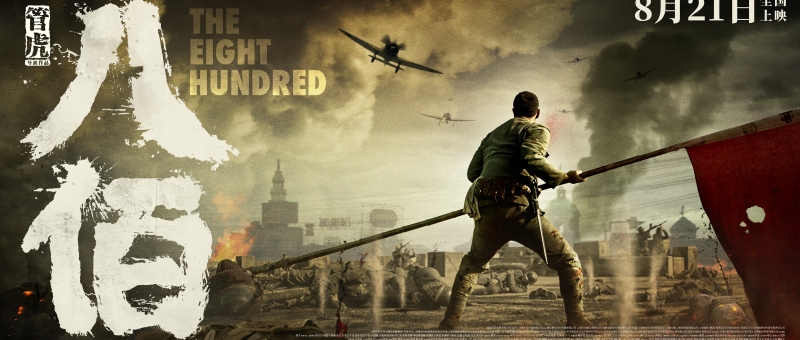
“Enjoy Shanghai. Enjoy Your Life” reads a neon-lit sign in the art deco paradise of Shanghai in the 1930s. Across the river, however, a war is raging. Guan Hu’s The Eight Hundred (八佰, Bābǎi), the first Chinese film to be shot in IMAX and boasting an unprecedented budget of US$80 million, was the last in a series of movies to be ignominiously pulled from a festival slot, the opening night of the Shanghai International Film Festival no less, for “technical reasons”. In this case, most have interpreted the nebulous term as a squeamishness on the part of the censors’ board to the fact that the film celebrates the heroism not of the PLA but of Chiang Kai-shek’s Nationalist Revolutionary Army who put up the last stand during the fall of Shanghai, securing a warehouse on the opposite side of the river from the British Concession knowing that there was no hope of stopping the Japanese, but hoping that their defiance would inspire foreign powers over to the Chinese side. 

The action opens in October 1937 shortly after the outbreak of the second Sino-Japanese War. Shanghai is falling and the Japanese will soon be on their way towards Chiang’s capital, Nanking. Nevertheless, the Japanese have resolutely avoided encroachment into the foreign concessions for fear of inflaming international relations in ways which might be inexpedient for their current goals. As a diplomat later puts it, war is always a matter of politics. Ordered to hold the line, the last remnants of the NRA are expected to die as an act of political theatre. There is no practical benefit to their sacrifice save the vindication that they went down fighting, their moral righteousness a tool to garner sympathy firstly with the international community who might be persuaded to intervene at an upcoming conference in Brussels (which is finally postponed because of a corruption scandal engulfing the Belgian PM). 

In Guan’s retelling, however, it is a much more domestic audience which becomes the ultimate target. A contrast is repeatedly drawn between behind the lines China, a wasteland of fire and rubble, and the glittering lights of the foreign concession with its billboards for Hollywood movies, famous actresses surveying the scene while the sound of opera both domestic and Western wafts over the river and business carries on as normal in the large casino run by an eccentric short-haired madam dressed in a Western suit. Cynical journalists chase the story from the comparative safety of a balcony above the bridge, chiding the Chinese reporter, Fang (Xin Baiqing), who has also been working as an interpreter for the Japanese, that he acts as if this war is nothing at all to do with him. The heroism of the 800 is the key to unlocking the latent patriotism of those living in the dream of the foreign concession where war happens only across the water, in another world no more real to them than a movie. They stand by the water and they watch, increasingly grateful to the soldiers for their protection until they too remember that they are also Chinese and this war is also their war. Women extend their hands towards those retreating across the bridge while the Peking opera turns its drums to the rhythms of war and the casino madam gives up first a flag and then a large stash of morphine hidden in her safe for probably obvious reasons. 

The flag might be one of several explanations for the censors’ squeamishness in that it is obviously now the flag of Taiwan and reminds us that these men are members of Chiang Kai-shek’s NRA, more often characterised in ideological terms as traitors rather than heroes. They are not however saints in the propaganda movie mould and it is even perhaps suggested that they are not much better than the Japanese, ruthlessly executing their own men as deserters and using prisoners of war as target practice for untrained, nervous recruits (the Japanese meanwhile publicly dismember their prisoners with the intention of intimidating Chinese forces). The youngest of the soldiers is only 13, a farmer’s son pulled off his land with his older brother who was tricked into the war machine by the desire to see the shining city of Shanghai and perhaps travel to England. Some of them try to run, torn between the desire for escape and a responsibility to their fellow men, each eventually fully committed to their forlorn hope determined to hold the warehouse if only to prove that they held the line for as long as it could be held. 

That same diplomat encourages commander Colonel Xie (Du Chun) that what he does here will be remembered, and that his men are the “real Chinese people” in another statement that probably rankled with the censors. Repeated references to legendary general Guan Yu paradoxically link back to the contemporary context as the narrator of a shadow play echoes that the Han restoration rests with the young while an angry soldier rants about planting a flag on Mount Fuji as revenge for everything they’ve suffered, making the case for the resurgent China beholden to no one something echoed by the moving scenes juxtaposing the ruined warehouse with the ultramodern city which now surrounds it. Yet Guan opens with a peaceful image of pastoral serenity which stands in stark contrast to the chaos of war as his numbed camera slowly pans between one scene of carnage and the next. Men blow themselves up, cry out for their mothers, send letters home, and call out their names as they die to prove that they existed while a beautiful white horse runs wild in the vistas of desolation. Unashamedly patriotic despite its slightly subversive context, The Eight Hundred presents war as the meaningless chaos that it is, but also lionises the men who fought it in the mythic quality of their heroism as they alone stood their ground and finally convinced others to do the same.


The Eight Hundred is in UK Cinemas from 16th September courtesy of Cine Asia.

UK trailer (English subtitles)

Super Me (超级的我, Zhang Chong, 2019)

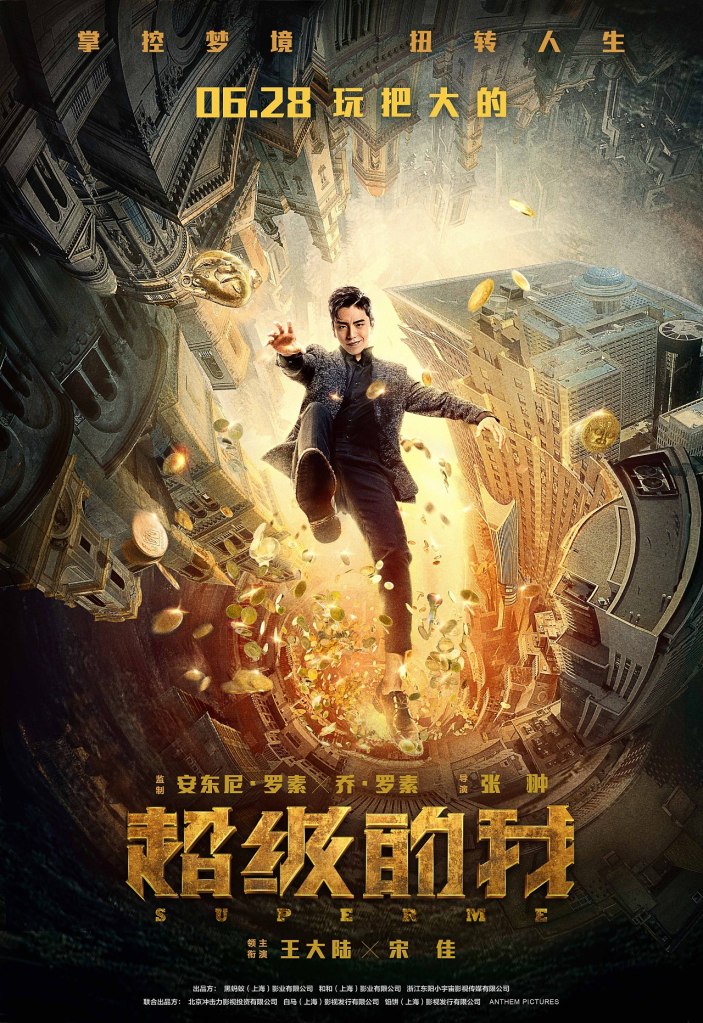
Can you dream yourself into a better reality, or should you concentrate on being your best self in this one? That’s a dilemma that the hero of Zhang Chong’s Super Me (超级的我, Chāojí de Wǒ) barely has time to think about as he battles despair-fuelled hopelessness and possibly unrequited love for the beautiful woman who runs his local cafe. If only I were rich, he might well think, but though poverty is undoubtedly a factor in his malaise it’s his sense of inferiority which has him beaten down and all the money in the world won’t change that. 

We first meet Sang Yu (Darren Wang Talu) on a subway train where he recites a mantra to himself about how he’s “not an ordinary man”, he has the ability to work under pressure, and though his parents died and he has no friends those are merely tests from God which he has overcome. He is “brilliant and talented, diligent and motivated”, he expects success will soon arrive only he hasn’t slept a wink in the last six months because of the constant night terrors which plague him such as the one we’re about to witness. Sang Yu is asleep, and a nightmare is stalking him. 

Killed by having his head plunged through the train’s floor, Sang Yu wakes up and we realise his waking life is also quite depressing. A 20-something screenwriter, he’s behind on his rent and in debt to his friend/agent while unable to work because of his insomnia. Wandering around in a daze after being evicted from his apartment and getting his laptop stolen, he writes a note to his friend telling him he’ll have to pay him back in the next life and prepares to jump off the roof opposite the cafe where his true love, Hua (Song Jia), works, only to be saved by the intervention of the jian bing seller (Chin Shih-chieh) from down below who advises him to try waking up from his dreams before he gets killed by reminding himself that he is dreaming. Sang Yu takes him at his word and manages to emerge from the dreamworld unscathed clutching the weapon that once belonged to his attacker. After selling the antique sword to weapons brokers, he realises he’s sitting on a cash cow, routinely looting the dreamworld of many of its treasures and quickly harnessing its power to become a wealthy and successful man. All of which gives him the courage to finally approach Hua, wielding his newfound economic power to invest in the apparently failing cafe. 

A modern day take on Jack and the Beanstalk, Super Me finds its nice guy hero corrupted by his wealth, abandoning his artistic dreams and becoming a debauched playboy living in a five star hotel even if he continues to pine for Hua while his friend, Sangge (Cao Bingkun), reverts to being something like a minion riding on his coattails to enjoy the life of the rich and famous without really having to do anything. The irony is that the money and the fancy clothes give Sang Yu the confidence to talk to Hua, but those aren’t things she particularly cares about and may in a sense actually turn her off. Enjoying romantic evening walks, she guesses he’s a screenwriter from his veiled hints about robbing the dreamworld and is interested more in his artistic self than the wealthy man of mystery, all of which gives Sang Yu the inspiration to finish that screenplay which of course becomes a hit beyond his wildest dreams. 

After a while, Sang Yu starts to suspect there must be a cost involved in all this good fortune, realising that he’s traded some of his life away in return for riches and will perhaps never be free of his nightmares. Yet, as a cruel gangster tells him, everyone’s wealth comes at the sacrifice of life, echoing his earlier thoughts that those who are successful are either those who’ve chosen to sacrifice things that others won’t or are unscrupulous thieves and exploiters. “A person who betrays himself can never control his own destiny”, according to the gangster. Asleep or awake, Sang Yu realises he’s battling himself, that there are no quick fixes, and illusionary success is as hollow and as fleeting as the dreamworld from which he has perhaps failed to learn the appropriate lessons. As the old man told him, perhaps what he needs is to wake up, not only to life’s possibilities but to his own. Echoing his earlier The Fourth Wall, Zhang allows Sang Yu to walk through a door into a “better” reality which is perhaps the one he inhabited before but was too intimidated to actually live in. He hasn’t definitively beaten his demons, but perhaps subdued them while his new life seems determined to reward him for his choice in unexpected ways. Nevertheless, can you trust this reality more than any other? There may be no way to know, but you’ll have to learn to trust it all the same. 


Super Me is represented by Fortissimo Films.

Original trailer (no subtitles)