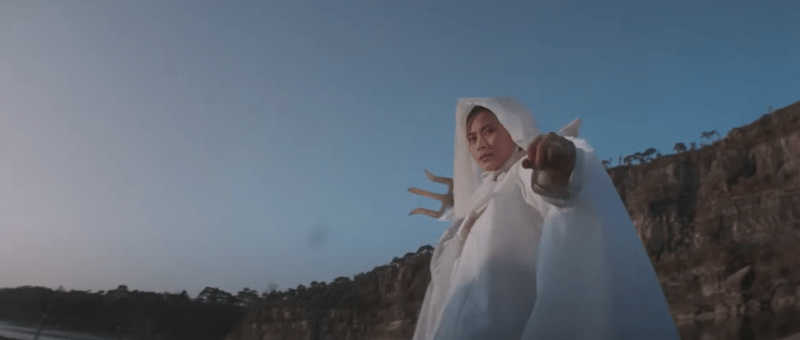
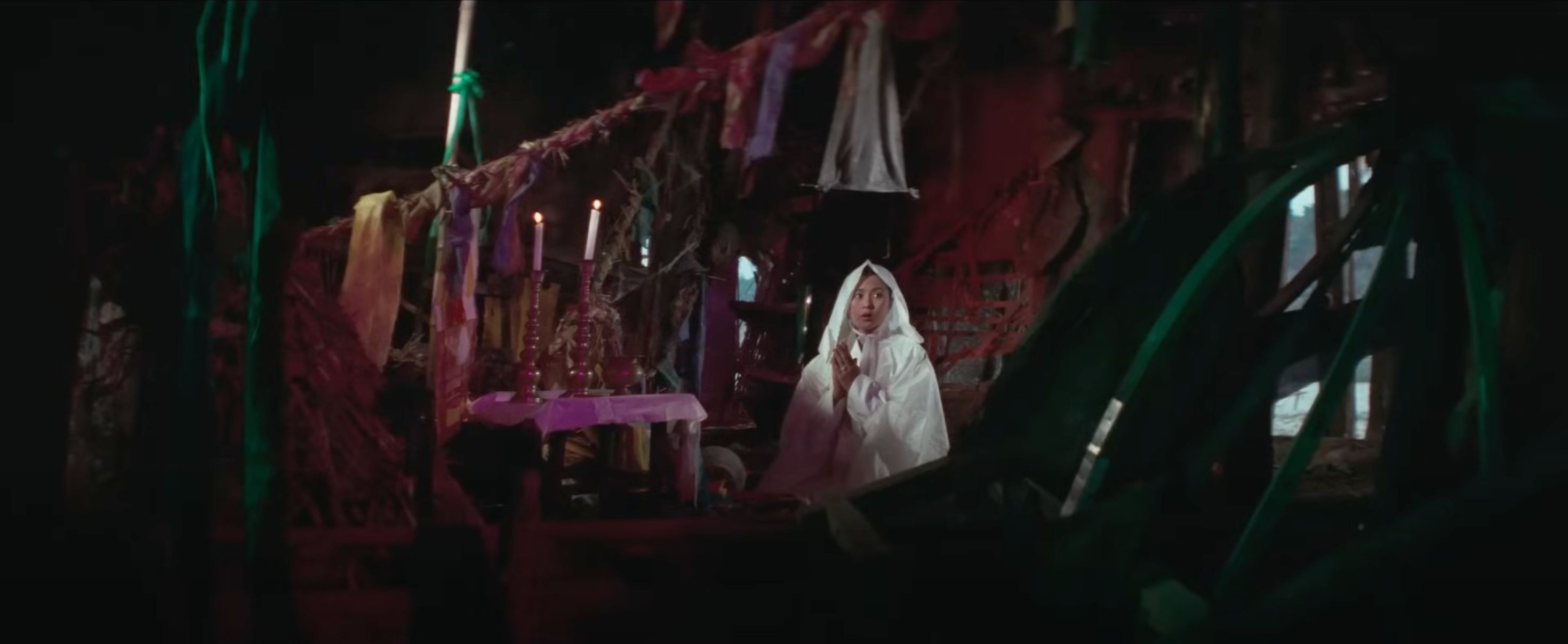
We’re told that the titular hut in Lee Doo-yong’s 1981 shamanism drama (피막, Pimak) is a like a stopping place between this world and the other. Babies are born there, but more usually it’s a place where the dying are sent to expire. Located in a more literal liminal space on the outskirts of the village, it presents a borderline that keeps the villagers safe from the taboo of death. They say the souls of those who die there cannot return to haunt the village, which is to say the village is a place free of death and also of the grudges of the past.
That is, however, not quite true. During the colonial era, the heir to noble house, Seongmin, has fallen ill and is likely to die but is being cared for at home by his desperate family who have invited shamans from all over the county in an attempt to cure him. This has obviously annoyed the village’s resident shamaness who is forever telling them they’ve made things much worse for themselves by sidelining her and shunning the local goddess, but the cause of the boy’s illness is quickly rooted out by Okhwa (Yu Ji-in), a powerful shamaness who leads the family to a buried vase in the woods which has been broken allowing the trapped should of Samdol (Nam Koong-won), the former keeper of the hut, to escape.
The Old Madam (Hwang Jung-seun) immediately admits that she was the one who put him in there, though she did not know where the vase was buried. The Gang family has a curse on it which results in many of their sons dying young before they could father sons of their own and leaving behind young widows which are perennial problem in the rigidly Confucianist, patriarchal society that some may argue continues into the present day but is certainly in the ascendent in the 1920s and 30s. As in many films of this kind, managing the sexual desires of young women, which are acknowledged as normal and natural, under such an oppressive system presents a key challenge to the social order. Given the taboo against second marriages, the family’s large collection of widowed daughters are seen resort to acts of self-harm in order to quell their desires in the absence of men. When the second daughter-in-law falls ill after stabbing herself in the thigh with a silver dagger, the Old Madam is sympathetic but believing she cannot be saved sends her to the hut to die. But before she does, the Old Madam also orders Samdol to sleep with her on pain of death so that she won’t pass into the afterlife with her needs unmet. The Old Madam is after all a widow herself, if an older one, and understands the frustration and desperation the younger woman feels.
But the decision she makes breaks another taboo for as he points out himself, Samdol is the lowest of the low, a commoner who deals with the dead. Not only is the sex itself non-consensual, but threatens the social order in its transgressive qualities, crossing a class divide while also occurring outside of a marriage. Of course, it takes place in the liminal space of the hut where such borders meet. Described as quiet, honest, and reliable, Samdol is a kind man who also patiently nurtures the daughter-in-law back to health with medical herbs from his garden and eventually reveals to her what he was forced to do by the Old Madam but the two later fall in love and conceive a child which of course means they must both die in order to preserve the social order.
Okhwa arrives as a kind of inspector exposing the poisonous past of Gang family which after all probably did do something untoward in order to become prosperous which is why there’s a curse on it. We get the impression that she may have ulterior motives and almost certainly knows more than she’s letting on while otherwise looking for information. She is not in fact a shaman, though her mother was and a fairly legendary figure at that, but later becomes one and with it a kind of avenger mainly for women who suffer under this system but also for men like Samdol abused by the feudal class order and forever at its mercy. The shamaness is also of course a liminal figure who lives outside of conventional society which views her with suspicion as a woman with both power and independence.
But even Okwha is subject to the unwanted attentions of men who despite their insistence on a woman’s chastity believe themselves entitled to her body, not only the head of the Gang family (who is actually elderly and presumably survived the curse), but men in Western dress who snatch and rape her. Thus the hut also exists at the nexus of tradition and a seemingly destructive modernity ushered in by Japanese imperialism. After recovering from his illness following Okhwa’s guk exorcism, Seongmin insists he just got better on his own and there’s no such thing as ghosts. We’re told he studied abroad in Tokyo and in fact dresses in a Japanese-style student’s uniform complete with cape. He tells his mother that they’re making scientific advances in Japan and that it’s ridiculous to think a ghost could have killed the Old Madam and the head of the family who died in odd circumstances during the guk along with his uncle in Western dress who had raped Okhwa. He proves to her scientifically that someone could have merely set traps for each of them and points the finger at Okhwa as a likely murderess rather than a gifted spirit medium.
Perhaps we more “rational”, modern people might agree with him but the film seems certain that there are indeed vengeful spirits haunting the landscape, those who fell victim to the hut mentality and were deliberately cast out and left to die by their society who effectively exiled them in their death. Okhwa can’t exorcise the evil ghosts of patriarchy, classism, feudalism, or sexual repression but she can perhaps in part symbolically end their tyranny by dissolving the border and burning the whole thing down.
 Windows on Worlds