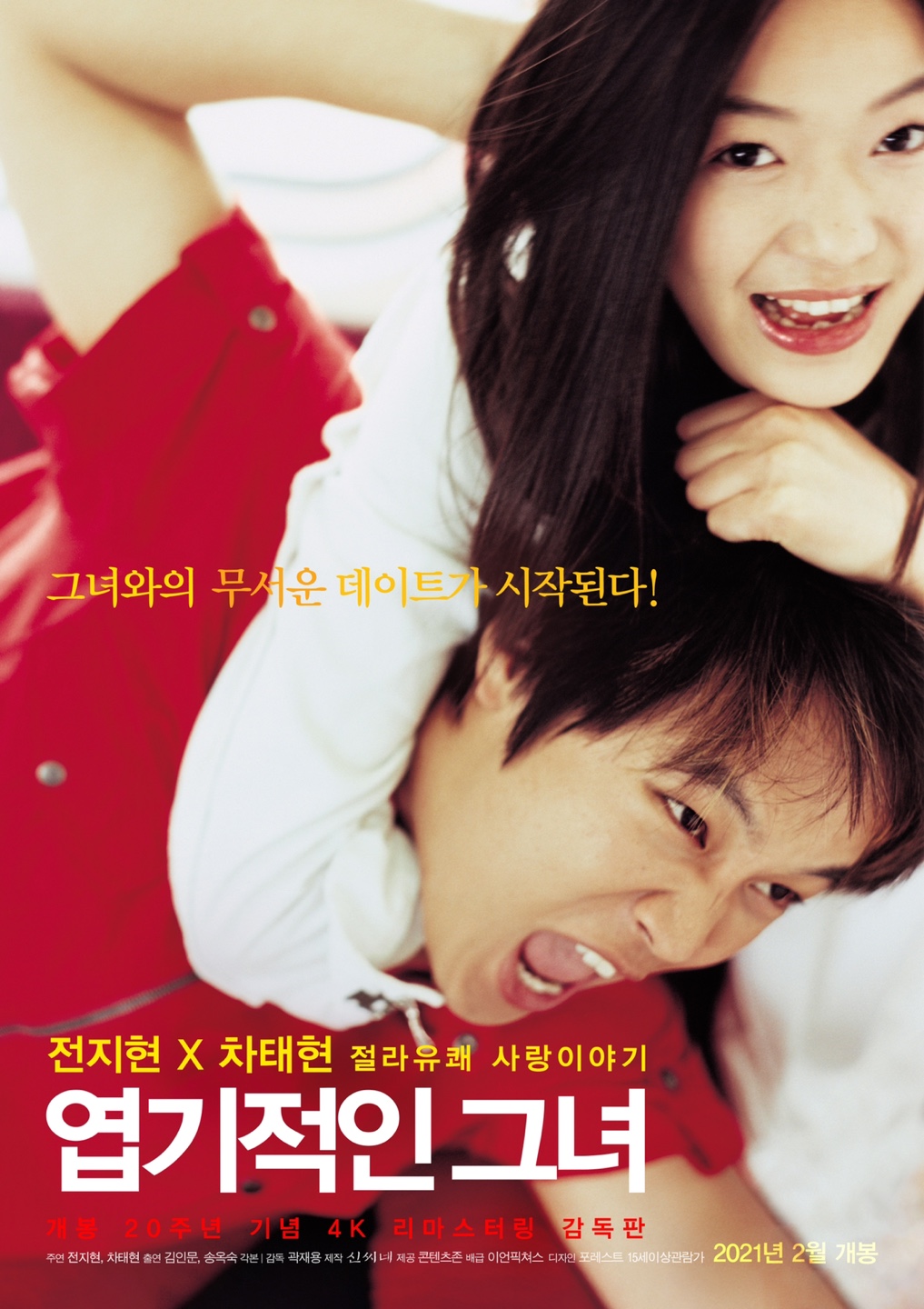
My Sassy Girl (엽기적인 그녀, Kwak Jae-yong, 2001)

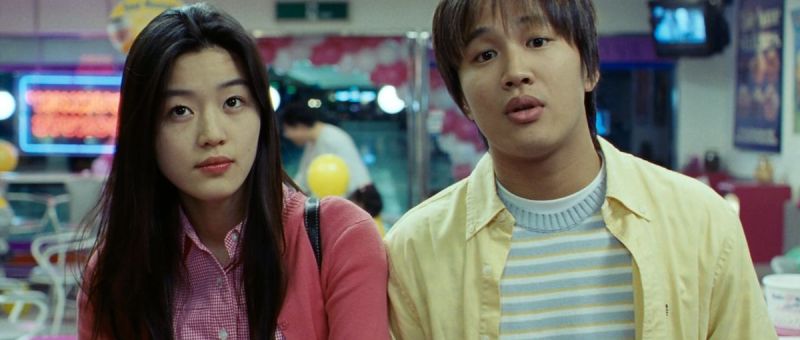
A smash hit and social phenomenon on its original release, My Sassy Girl (엽기적인 그녀, Yeopgijeogin geunyeo) is one of a small number of films from the early 2000s that like Japan’s Densha Otoko drew inspiration from the new media of online blogging and message boards. In a meta touch, the film includes these origins within the action as the hero, Gyeon-woo (Cha Tae-hyun), begins writing about his relationship with a strange and intimidating young woman (Jun Ji-hyun) on the internet only to see his work optioned for major feature film.

In some ways, these meta themes play into the central ideas of fate and time travel while giving the love story a sense of epic, romantic heft. It could be said that in the character of the unnamed woman, the film undercuts contemporary notions of gender roles and traditional femininity, but at the same time even in subverting them perhaps leans into a societal sense of misogyny. Gyeon-woo paints himself as a feminised man, raised for a time as a girl which is why he is mild-mannered, submissive, and lacks ambition in life. All qualities he associates with traditional femininity. He is attracted to the girl, but also disgusted by her unfeminine behaviour and most particularly by her public drunkenness. Her chewing of her own vomit on the train is apparently inspired by a real-life event and the reason for designating her the “bizarre and freakish” woman of the title. 

Gyeon-woo also suffers physical violence at the hands of most of the women in film including his mother, further marking him out as weak and hard done by in comparison to these strong women while most of the men, such as his own father and that of the girl who is a habitual drinker, are ineffectual and go along with their wives for a quiet life. The girl continues to boss him around, ordering for him in cafes, making him wear her high heels while she takes his trainers when her feet hurt, and generally telling him what to do in the relationship. Gyeon-woo appears to have a slightly masochistic streak and despite describing his discomfort this rejection of traditional femininity, actually seems to like being bossed around and physically abused by the girl, even later seeking out similar women, though the film does also include a transphobic joke that is very of its time. 

Eventually, he begins to realise that the girl’s violence and demanding nature are awkward ways of expressing love while she works through issues of her own that exist to one side of him. There are reasons that all her screenplays are about a heroic woman travelling in time to save someone she loves while simultaneously convinced she is destined to meet someone from the future. Gyeon-woo, meanwhile, an engineering student, is more grounded and down to earth. He nurtures their love in another way, replanting a damaged tree solely so the girl won’t be sad if she returns to find that it has died. Fate deliberately keeps them apart as their paths repeatedly fail to cross with a series of near misses before a fateful encounter, implying that romantic timing is much about the readiness for love as anything else, or as someone puts it, building a bridge of chance. Only once the girl has begun to work through her feelings, and Gyeon-woo has accepted his filial responsibilities, can their love be fulfilled. 

This is perhaps most obvious in the episode in which they become involved in a military siege when a soldier takes them hostage in an amusement park after deserting because his girlfriend has left him for another man. While the soldier’s obsessive love turns dangerously destructive, the girl is able to talk him down by reminding him that if he really loved his former girlfriend he’d set her free and rejoice in her happiness. The film’s quirky atmosphere with its series of weird events in a strange way recall the world of Tomihiko Morimi with its cosmic coincidences and tiny ironies that are nevertheless underpinned by a genuine sense of poignancy and warmth, willing these two star-crossed lovers to finally find each other at the right time as past and future finally coalesce into a more perfect present. 


My Sassy Girl screened as part of this year’s New York Asian Film Festival.

Trailer (English subtitles)
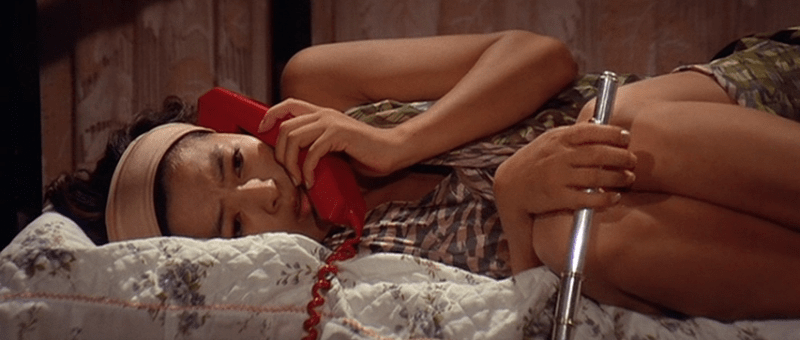
Between the Knees (무릎과 무릎 사이, Lee Jang-ho, 1984)

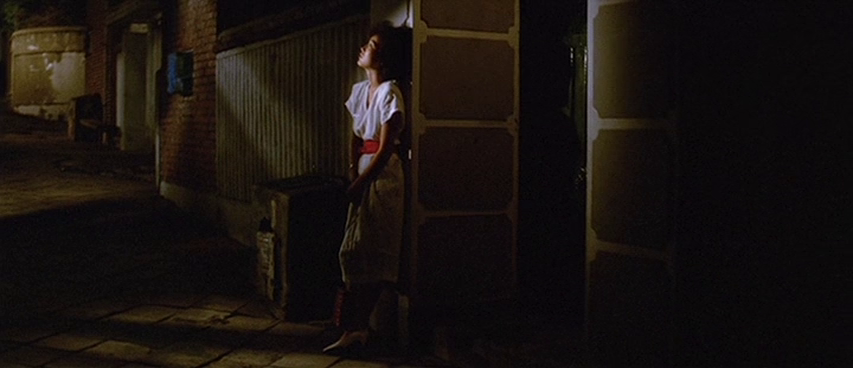
“We are all suffering from this Westernised lifestyle and way of thinking. They are not really meant for us,” according to a sympathetic doctor, played by the director himself, at the end of Lee Jang-ho’s erotic melodrama, Between the Knees (무릎과 무릎 사이, Muleupgwa muleupsai). The heroine does indeed find herself trapped between the Korea of the past and the modern society, but the film often seems confused in its central messages in its own use of the woman’s body as metaphor for that of the nation despoiled by foreign influence. 

This is most obviously the implication of Ja-young’s (Lee Bo-hee) flashbacks in which she is quite clearly molested by her flute teacher who is a bearded white man. When her mother walks in on the abuse, she blames Ja-young beating her and shouting what we would assume to be unpleasant words branding her as a seductress though she is a clearly a child. As is later explained, Ja-young’s mother is carrying her own baggage in that her own mother was the mistress of a married man and fearful of the same fate befalling her daughter, she has brought her up with problematic notions of bodily purity that have caused Ja-young to develop a complex surrounding her sexuality in which she is unable to process her desires as a young woman. 

She later says that through her “immoral behaviour and desire to sin” she has found “freedom” as if sexuality was her way of rebelling not only against her mother’s tyranny but social conservatism in general. However, she also characterises it as the extreme opposite, blaming her mother in insisting that her treatment of her has left her with no control at all over her sexuality. In the film’s problematic framing, she essentially allows herself to be raped by a series of men partly as an act of self-harm, partly as rebellion, and partly because she has no other way of permitting herself to satisfy her sexual desires. This is of course dangerous, portraying a woman who says no as one who is really saying yes but resisting out of shame, but there is also a completely paradoxical criticism of Korean men all of whom are rapists except for Ja-young’s sort of boyfriend Jo-bin (Ahn Sung-ki) who is so obsessed with traditional Korean culture that he has earned the nickname “antique”.

Jo-bin lives in a Korean-style home and spends his time playing the flute, training in traditional martial arts, and watching pansori in comparison to the pursuits of other young people such as Ja-young’s brother Ji-cheol who mimics Michael Jackson and spends all his time in discos. Towards the beginning of the film is seems that Ja-young will be torn between Jo-bin to whom she originally says “if you’re so old-fashioned I may have to run away with you” and an incredibly unpleasant fellow student who refuses to take no for an answer and in fact eventually rapes her during an expressionist rainstorm that violently awakens her sexuality. The battle then really becomes whether or not Ja-young will be able to accept it, despite the realisation that she is “no longer the kind of virtuous bride that Korean men expect.”

This hints at the pernicious double standard of the contemporary society in which men largely behave like animals, treating women like trophies to be conquered and then discarded while insisting on a “pure woman” for a wife. The discord in Ja-young’s home stems from patriarchal failure, not only that of the man that made her grandmother a mistress and not a wife, but her father’s in having fathered a child with a 17-year-old Korean War orphan he took into his home. Resentment over his betrayal has further embittered Ja-young’s mother and caused her to double down on her sexual conservatism while fiercely resenting her husband’s other daughter. Yet in the film’s final stretches, a degree of female solidarity arises between the women that largely excludes the father with Ja-young’s mother accepting Bo-young as another daughter and inviting her to live in their home now her still young mother has remarried. 

Violent male sexuality also rears its head in a subplot in which a mute man who had developed feelings for Bo-young’s mother while they were being raised in the same orphanage attacks Ja-young’s father for ruining her life, as he undoubtedly did even if he tried to take at least some responsibility for his transgression. Bo-young later says that her mother hated the mute man and did not want to be in a relationship with him anyway, though he too it seems could not take no for an answer. In any case, it is only the traditionalist, Jo-bin, who is willing to accept Ja-young for who she is. He knows all of her ordeal and does not reject her for her sexually active past, rather scoffing when she had described sex as being a sin with the perhaps mistaken implication that such things were not regarded as taboo in the Korea of the past even as, paradoxically, it appears that Jo-bin is drawn to Ja-young’s old-fashioned modernity in rejecting his mother’s constant attempts to set him up with an arranged marriage. 

Of course, all of this is also very much informed by the climate of contemporary Korean cinema which had descended into an era of softcore pornography deliberately supported by the Chun regime as part of a bread and circuses social policy designed to distract the people from their democratic desires. Lee opens with sexually charged closeup of Ja-young’s lips on her flute, a phallic symbol also present in Ja-young’s forbidden fantasises as she idly fondles it after hearing heavy breathing on the telephone and experiences another moment of sexual crisis. Perhaps that’s paradoxical itself in that it’s learning to play this Western instrument that has led to her corruption in an allegory for a nation’s pollution by Western culture. In any case, Lee seems to imply that sexuality can be an act of resistance towards oppressive social codes but is otherwise unsure if that represents liberation or merely another form of oppressing one’s self.


A Fine, Windy Day (바람 불어 좋은 날, Lee Jang-ho, 1980)

Lee Jang-ho returned to filmmaking after a short hiatus having been temporarily banned for the possession of marijuana in 1980 with a fresh new approach focussing on the social issues of the day as Korea found itself in the midst of confusion following the assassination of president Park Chung-hee. Though many hoped for a new era of long-awaited democratisation, those hopes were soon dashed by another military coup and the continuation of oppressive dictatorship under Chun Doo-hwan. During his time away from the film industry, Lee had run a bar with his mother and it was there that he became more acquainted with the struggles of ordinary people.

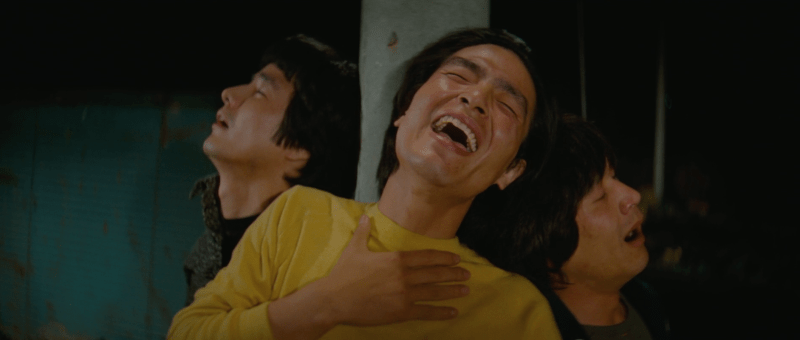
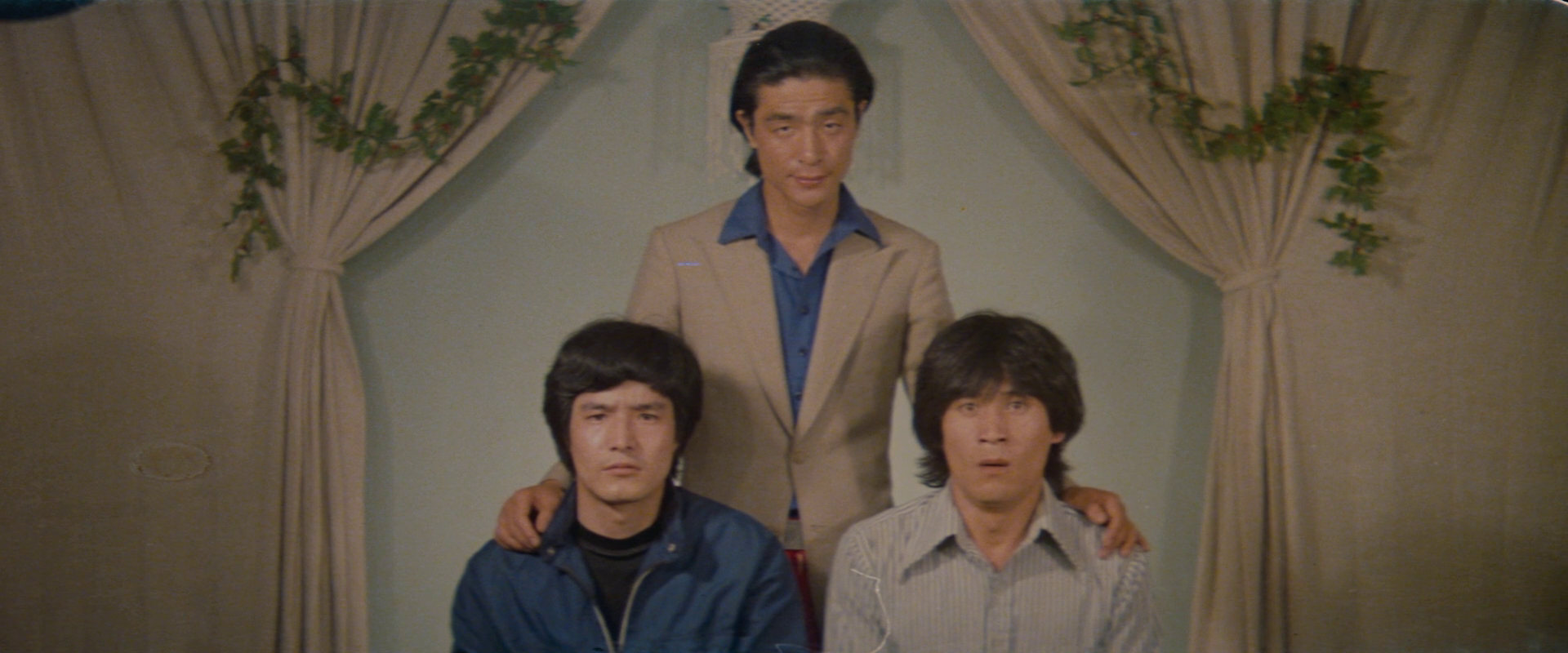
Adapted from a novel by Choi In-name, A Fine, Windy Day (바람 불어 좋은 날, Barambuleo Joheun Nal) follows three young men who have migrated from the countryside to Seoul in wider movement of urban migration. The sister of one of the men who later joins them remarks that there are no young people left in the countryside and her brother agrees that there is no longer any future in farming. Yet as the opening of the film makes clear in its idealised vision of pastoral life, it is really the expansion of the cities which has displaced the men and destroyed the natural habitats they once inhabited. The film often aligns the three with stray dogs who’ve come scavenging in the city because they can no longer survive in their rural hometowns. 

“It’s as if I’ve been taking a beating for two years straight from some invisible person” delivery boy Deokbae (Ahn Sung-ki) remarks during the film’s conclusion of his life in Seoul which does indeed seem to have been one long and bloody battle that had forced him into submission. As he tells equally naive country boy Suntae, he never stuttered before he came to the city but is now cowed and anxious all too aware of how the native Seoulites treat men like him. Daughter of a wealthy family, Myung-hee (Yu Ji-in) drives her own car around town, knocking over school children and not even bothering to stop until challenged by Deokbae for ruining the food he was currently in the middle of delivering. He later gets a telling off from his boss and his pay docked while she wraps her expensive scarf around his neck and promises to send compensation money to the restaurant where he works. 

Deokbae knows that Myung-hee is merely playing with him, her strangely childish glee like a little boy pulling the wings off a fly, yet he continues to associate with her. She laughs at him when he sits on the floor instead of the sofa after she ordered from the restaurant to get him to come to her house, and then tries to kiss him before becoming angry and pushing him away. Her posh friends later invade the restaurant and are drunk and rowdy, refusing to leave until a fight develops and they’re all carted off to the police.

But it’s only one of several degradations the men suffer at the hands of a new aristocracy not so different from the feudal elite. Chunsik (Lee Yeong-ho) works at a hairdresser’s where he is smitten with the pretty stylish Miss Yu (Kim Bo-yeon) who is being more or less sold by her ambitious boss and thereafter coerced into a compensated relationship with a sleazy businessman, Mr Kim, who was himself once a country boy but got rich quick through property speculation having cheated the old man who appeared in the film’s opening out of his ancestral land which has since been turned into the half-built slum inhabited by the three men. He is about to open a new shopping centre where the barber hopes to gain a prime position thanks to providing access to Miss Yu. The old man rails around the town demanding the return of his land, decrying that heaven will punish Mr Kim for what he’s done, and finally commits suicide in the newly completed building almost as it he were cursing it. 

The old man’s body is laid out on the last remaining stretched field where a shamanistic funeral song plays as a lament for the now ruined pastoral idyll which has been taken from each of the men and replaced with internecine capitalism in which wealth comes at the exchange of humanity. At the Chinese restaurant where Deokbae works, the wife of the dying boss had been carrying on an affair with the manager whom she hopes to marry once her husband has gone, while he expects to take over the shop though as is later revealed he is already married with children and technically performing a long con on her. The third man, Gilnam (Kim Seong-chan), works in a motel while saving money to open a hotel of his own but unwisely gives his savings to his girlfriend who runs off with them leaving him with nothing. He is then drafted for military service, receiving another blow from the contemporary Korea.

The man who spars with Deokbae who takes up boxing after his altercation with the rich kids is also wearing a shirt that reads “Korea” on the back and we watch as he is mercilessly beaten but this time refusing to give up reflecting only that he’s learned how to take a hit which is it seems the only way to survive in the Seoul of the early 1980s. The tone that Lee lands on is however one of playful irony, particularly in the meta-quality of the closing narration along with its victory in defeat motif as Deokbae acknowledges the need to roll with the punches which is also a subversive admission of the futility of his situation in which it is simply impossible to resist the system. A lighthearted but also melancholy chronicle of the feudal legacy repurposed for a capitalist era the film encapsulates itself in its bizarre disco scene as a confused Deokbae dances like a shaman, forever a country boy lost in an increasingly soulless and capitalistic society.