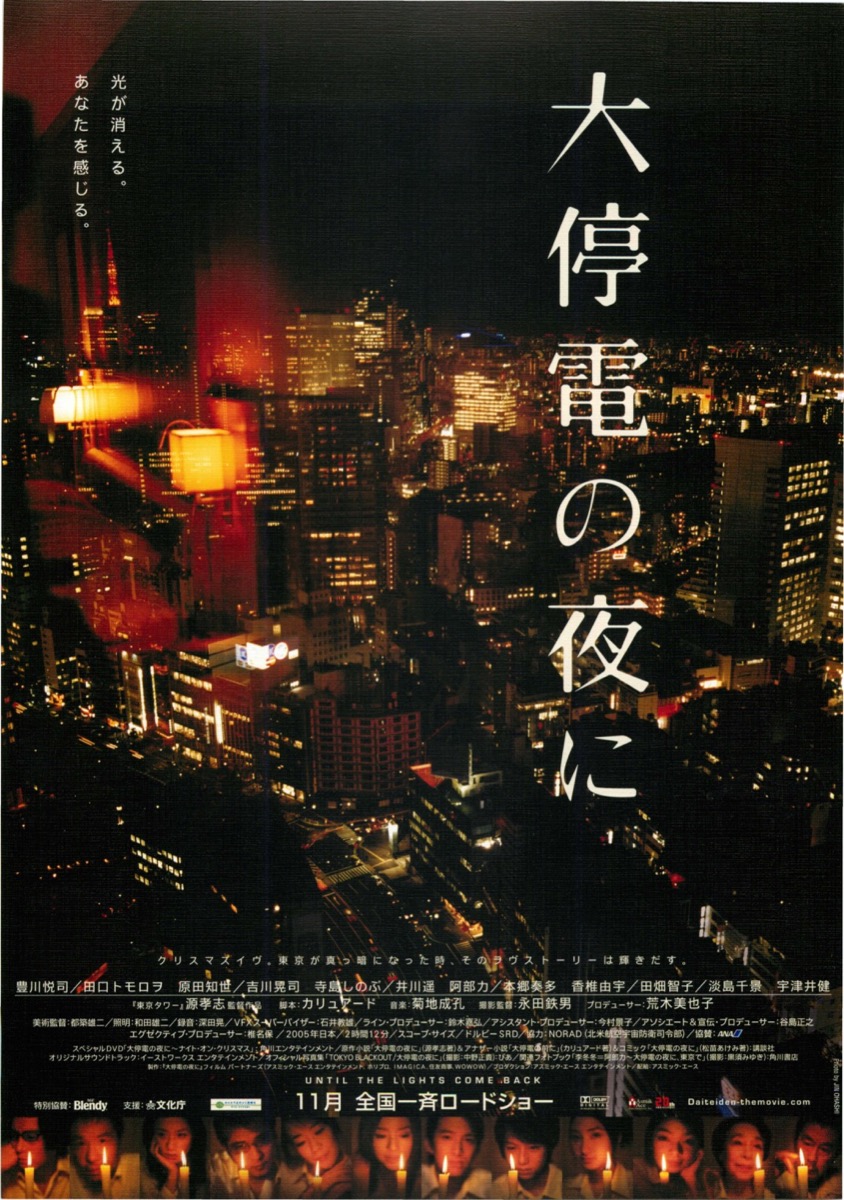
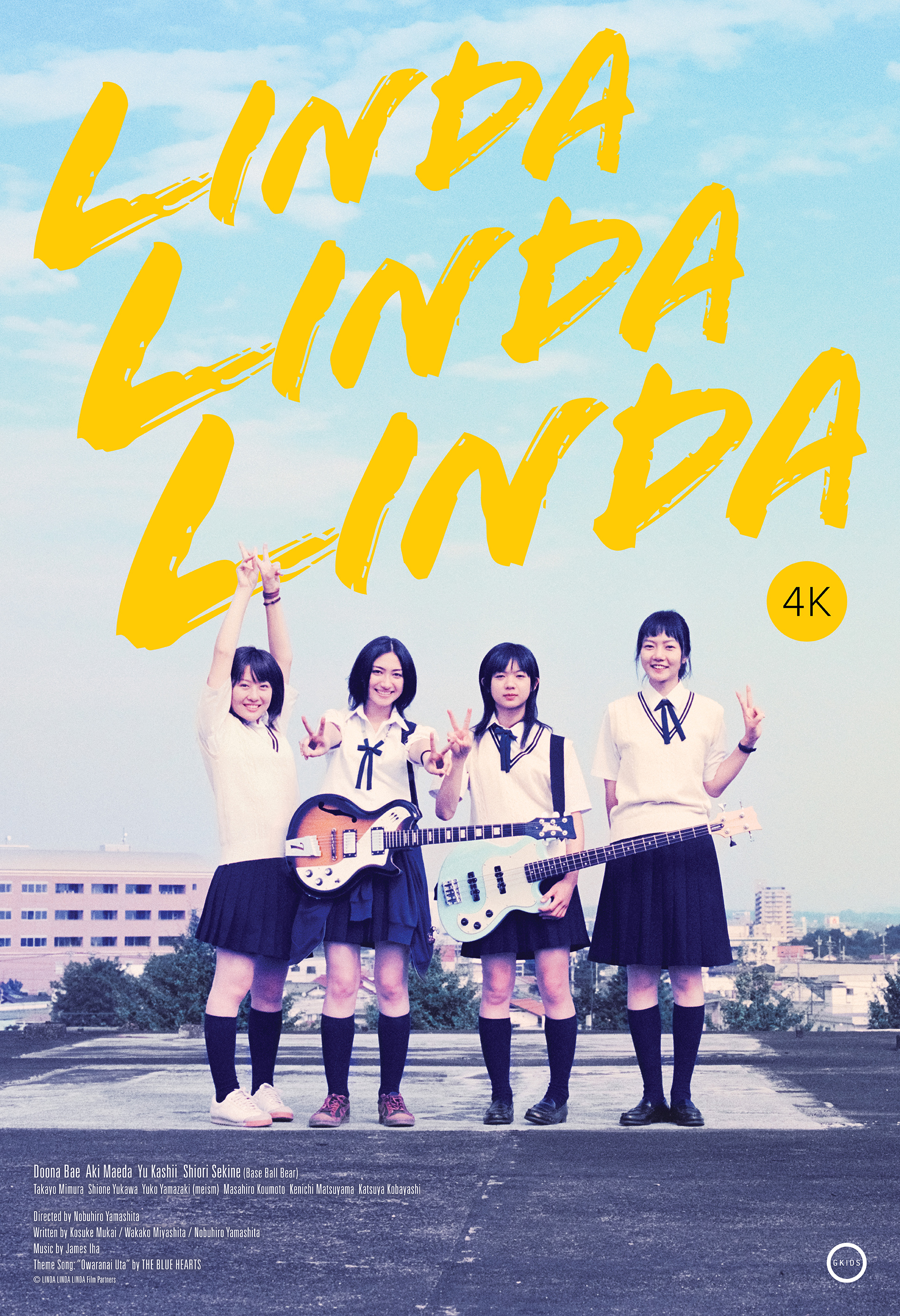
Linda Linda Linda (リンダ リンダ リンダ, Nobuhiro Yamashita, 2005)

“We’ve only got a little more time to be the real us,” according to a young woman making a promo video for the upcoming school festival, but who really is the “real us”? Now celebrating its 20th anniversary, Nobuhiro Yamashita’s wistful high school dramedy Linda, Linda, Linda (リンダ リンダ リンダ) is in many ways about the process of coming into being along with the anxieties of what comes next. “We won’t end here,” the girl later adds, “We won’t let our high school days become a memory,” yet they already are in a kind of contemporaneous nostalgia and elegy for idealised youth.

Or at least, there’s already a kind of reaching back taking place as the tracks the girls pick for a replacement act are by The Blue Hearts, a 1980s punk band that has become a kind of cultural touchstone echoing a sense of youthful alienation and rebellion. “Linda Linda” is the kind of song everyone knows, and even if for some reason they don’t or don’t even speak Japanese, can at least join in with the riotous chorus. It’s this sense of universality that eventually gives it its power as torrential rain brings the entire school inside just in time to see the girls’ belated act and find themselves captivated by its infectious energy and an identification with their own sense of insecure anxiety.

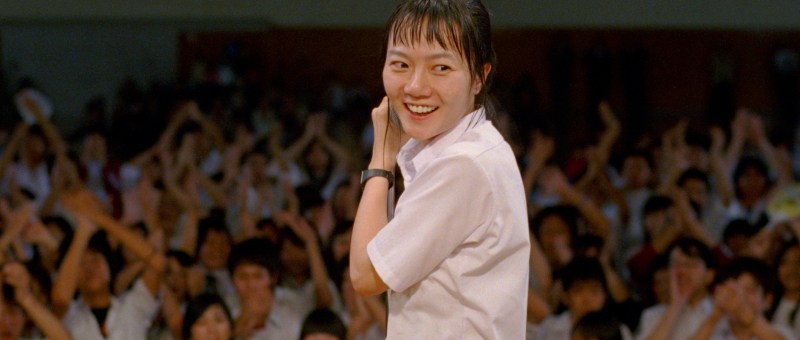
It’s also the serendipitous rain that allows lonely songstress Takako an opportunity to perform having previously declined to do because it’s no fun playing on your own and all her former bandmates graduated the previous year. Moe, the girl who broke her fingers playing basketball in PE leaving the original band members unable to take the to the stage, also gets an opportunity to sing having otherwise been denied a moment of closure in being prevented from taking part in her final school festival. While Moe feels intensely guilty about rendering all their time spent rehearsing somewhat pointless, it’s really the drama between founding members Kei and Rinko that leads to the band’s demise in Rinko’s conviction that it’s “meaningless” to continue while the others decide to go ahead anyway asking Korean exchange student Son (Bae Doona) to be their vocalist because she just happened to come down the stairs at the right moment and said yes because she didn’t really understand what they were saying.

Prior to her involvement with the band, Son had been a rather isolated figure trapped in the “Japan-Korea Culture Exchange Exhibit” which seems to have been more her teacher’s idea than her own and in any case gets no actual visitors. Her Japanese is a bit limited and most of her interactions are with a little girl who lends her manga to help her learn quickly, but becoming part of the band allows her to find her voice both literally and figuratively in taking the lead as the vocalist. A boy who claims to have fallen in love with her (Kenichi Matsuyama) goes to the trouble of learning a long speech in Korean to convey his feelings, yet a bemused Son replies to him in Japanese that she’s pretty indifferent to his existence before switching to Korean to explain that she’s leaving because she’d rather be hanging out with her friends with an expression that implies she’s only just realised that’s what they are. By contrast, she has a bilingual conversation with guitarist Kei (Yu Kashii) in which they seem to understand each other perfectly and each express how glad they are that they got to be in the band together. 

Similarly, it’s the concert itself that seems to heal rifts with a simple “Are you alright?” from Rinko (Takayo Mimura) to Kei whose friendship might, as someone says, essentially be too close for them to really get along. Drummer Kyoko (Aki Maeda) decides to declare her feelings for a longstanding crush before the concert. In the end she doesn’t manage it, but it doesn’t quite matter somehow because their performance is itself a kind of coming into being in which “the real us” comes into focus if also in a moment that itself becomes romanticised or idealised as an encapsulation of youth. Yamashita travels through the school festival as if it were a passage from one state of being to another, from the noodle stalls and crepe stands to haunted houses and the boy creating his own moment through encapsulating them on film, before ending with an unending song “so we can laugh tomorrow,” and the “real us” lives on.


Linda Linda Linda opens in US cinemas 5th September courtesy of GKIDS.

Trailer (English subtitles)
Until the Lights Come Back (大停電の夜に, Takashi Minamoto, 2005)

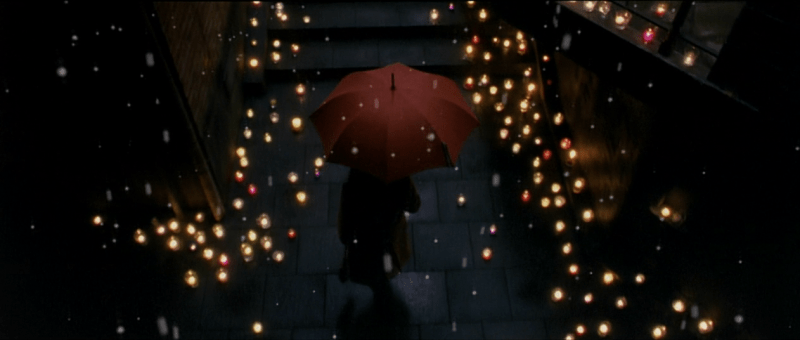
Until the Lights Come Back posterChristmas is, among other things, conveniently held on the same day every year. As such, it can’t help but become a moment of minor introspection inviting a thorough investigation of a life’s trajectory. In Japan, Christmas is also about romance which means it can also be an intense or melancholy occasion in which relationships past and present come up for reappraisal. Takashi Minamoto’s ensemble drama Until the Lights Come Back (大停電の夜に, Daiteiden no Yoru ni) spins a tale of city life as it catches hold of a number of accidentally connected souls and puts them through the emotional ringer thanks to an artificial psychological pause engineered by a power cut on Christmas Eve,

A melancholy barman sets a record going. A boy tracking satellites sees a girl hovering dangerously close to edge of the roof opposite. A conflicted salaryman finds out a dark family secret. A mistress is dumped while a wife wonders how much longer she should wait. A pregnant woman is chased by a yakuza, and an old lady gets an unexpected phone call.

Somehow, all of these events are connected though it takes a moment to figure out how. Christmas is a time for romance, but for the dejected salaryman, Ryotaro (Tomorowo Taguchi), it’s about to become a very difficult day indeed. When his terminally ill father decides to tell him the secrets of his birth, it prompts him into a mild bout of introspection concerning his own familial relationships. Ten years with the patient Shizue (Tomoyo Harada) haven’t cured his philandering and the marriage is strained to breaking point. Still, he thinks nothing of cancelling their special Christmas Eve dinner together to go meet his mistress even if his true purpose is to end things before they get any more complicated.

Missed connections and frustrated love stories continue to dominate. The mistress, Misuzo (Haruka Igawa), gets into a lift with Chinese bellboy Dongdong (Tsuyoshi Abe) who was supposed to be going back to Shanghai to visit his long-distance girlfriend who he worries is losing interest. Meanwhile, the melancholy barman, Mr. Kido (Etsushi Toyokawa), is pining for a failed love of his own – a woman he foolishly abandoned and then tried to pick back up again only to learn she had married someone else and that the marriage was unhappy. Mr. Kido gave up his musical dreams to open a jazz bar in the hope his love would someday return to him, only to be visited by “hope” in a different form – that of the strange young woman, Nozomi (Tomoko Tabata), from the across the way who’s about to have a very big business night in her off the beaten track artisanal candle shop.

Meanwhile, the recently released ex-yakuza, Gin (Koji Kikkawa), pines for his lost love in the form of the heavily pregnant Reiko (Shinobu Terajima) who swore to wait for him but eventually drifted away and married someone else though she seems to be happy enough which, strangely, he seems to find a comfort. When the lights go out there’s nothing much else to do but talk and think and so each of our wounded protagonists is forced to put their pain into focus, considering the wider context of an emotional landscape and attempting to find accommodation within it. Mr. Kido can’t quite let go of his failed love, however much he might want to, but Gin can perhaps learn to be thankful that the woman he loved found someone nice who looked after her when he couldn’t.

While the older generation swap stories of the eerie wartime blackouts and those of the comparatively less worrying power outages born of an inability to keep up with a rapidly recovering economy, the young make the best of it – swapping the twinkling lights of Christmas displays for the wonder of the stars. Candlelight and unexpected friendships give birth to new ways of thinking and create their very own Christmas miracles which seem set to pave a way towards a happier future for all in which forgiveness and understanding rule. Strangely warm yet never sentimental, Until the Lights Come Back captures a brief moment of stillness in a lonely city as its disconnected heroes find themselves pulled into a series of concentric epiphanies, putting the past to rest while learning to embrace an as yet unseen future.


Original trailer (no subtitles)

Hold Up Down (ホールドアップダウン, SABU, 2005)

hold-up-downReteaming with popular boy band V6, SABU returns with another madcap caper in the form of surreal farce Hold Up Down (ホールドアップダウン). Holding up is, as usual, not on SABU’s roadmap as he proceeds at a necessarily brisk pace, weaving these disparate plot strands into their inevitable climax. Perhaps a little shallower than the director’s other similarly themed offerings, Hold Up Down mixes everything from reverse Father Christmasing gone wrong, to gun obsessed policemen, train obsessed policewomen, clumsy defrocked priests carrying the cross of frozen Jesus, and a Shining-esque hotel filled with creepy ghosts. Quite a lot to be going on with but if SABU has proved anything it’s that he’s very adept at juggling.

Christmas Eve – two guys hold up a bank whilst cunningly disguised as Santas, but emerging with the money they find their getaway car getting away from them on the back of a tow truck. Still dressed as Father Christmases, the guys head for the subway and decide to stash the cash in a coin locker only neither of them has any change. After robbing a busker at gunpoint for 800 yen, the duo get rid of the loot but the guy chases after them at which point they lose the key which the busker swallows after being hit by a speeding police car. Trying to cover up the crime the two policeman bundle him into the car but crash a short time later at which time the busker gets thrown in a lake and then retrieved by a defrocked priest under the misapprehension that he is Japanese Jesus!

Following SABU’s usual spiralling chase formula, events quickly escalate as one random incident eventually leads to another. Christmas is a time of romance in Japan, though encountering the love of your life during a bank robbery is less than ideal. After a love at first sight moment heralded by a musical cue, the thieves head back on the run with the girl in tow but the course of true love never did run smooth. If romance is one motivator – death is another. On this holiest of days, our defrocked priest is caught in a moment of despair, contemplating the ultimate religious taboo in taking his own life and ending the torment he feels in having failed God so badly. Therefore, when our scruffy hippy busker washes up right nearby he draws the obvious conclusion – Jesus has returned to save him! Attempting to make up for his numerous mistakes, the priest is determined to save and preserve his Lord, but, again, his clumsiness results in more catastrophes.

The situation resolves itself as each of the players winds up at the same abandoned hot springs resort which turns out to be not quite so closed down as everyone thought. Filled with ghostly charm, the gloomy haunted house atmosphere sends everyone over the edge as they thrash out their various issues as if possessed by madness. Culminating in a sequence of extreme slapstick in which everyone fights with everyone else and frozen Jesus plays an unexpectedly active part, Hold Up Down brings all of its surreal goings on to a suitably absurd conclusion in which it seems perfectly reasonable that those wishing to leave limbo land could take a 2.5hr bus trip back to the afterlife.

Pure farce and lacking the heavier themes of other SABU outings, Hold Up Down, can’t help but feel something of a lightweight exercise but that’s not to belittle the extreme intricacy of the plotting or elegance of its resolution. An innovativeIy integrated early fantasy sequence begins the voyage into the surreal which is completed in the strangely spiritual haunted house set piece as the disillusioned priest spends some time with congenial demons before attempting to make his peace with God only for it all to go wrong again. If there is a god here, it’s the Lord of Misrule but thankfully they prove a benevolent one as somehow everything seems to shake itself out with each of our troubled protagonists discovering some kind of inner calm as a result of their strange adventure, as improbable as it seems (in one way or another). Christmas is a time for ghost stories, after all, but you’ll rarely find one as joyful as Hold Up Down.


Scene from the end of the film: