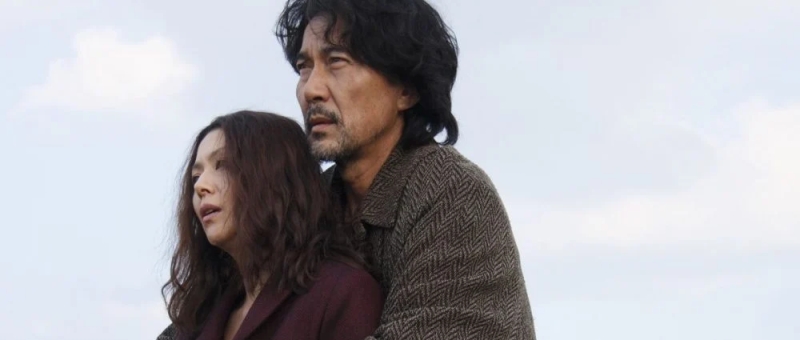
Tokyo Sonata (トウキョウソナタ, Kiyoshi Kurosawa, 2008)

Orphaned salarymen are the soulless ghosts haunting an increasingly empty city in Kiyoshi Kurosawa’s eerie tale of urban anxiety Tokyo Sonata (トウキョウソナタ). Undermining the certainty of the traditional family, Kurosawa paints it as a simulacrum dependent on each member playing their respective role blindly or otherwise, though in this case the integrity of the family unit is shaken by an economic intervention in which the accepted rules of the society have been upended with a vindictiveness that seems inexplicably unfair. 

This is the bargain of the salaryman dream. A man like Sasaki (Teruyuki Kagawa) now aged 46 came of age at the tail end of an era of economic prosperity. He was brought up in an atmosphere of jobs for life in which the corporate family was almost more “real” than the emotional which is one reason why it comes as such a shock when his boss effectively divorces him. He’s found someone new, planning to outsource Sasaki’s entire department to China while less than kindly explaining that as he has no other skills he of no more use to the company. Sasaki immediately clears his desk in anger, walking home early with a pair of carrier bags then, after meeting his son in the street, attempting to climb in through an upstairs window to avoid alerting his wife, Megumi (Kyoko Koizumi), to the fact he’s home early.

Sasaki is unable to tell her that he’s lost his job in part because of the acute embarrassment it would cause him. Somewhat dazed and confused, he’s become one of many disenfranchised salarymen who survived the 15 years of economic stagnation only to have the rug pulled out from under them. Being a salaryman was in a way his whole identity and without it he doesn’t know who he is, which is one reason he puts on a suit every day and goes to sit in the park surrounded by other similarly dressed men with briefcases who now seem to haunt the city like crows ominously dotting the horizon. In a repeated motif, Kurosawa shows us people trapped in kafkaesque queuing situations shuffling around buildings while prevented from moving forward but forced to keep pace with the increasingly glacial environment. At the moment an old school friend he runs into, Kurosu (Kanji Tsuda), seems to give up he is swept into a great parade of the suited and hopeless while Sasaki hovers on its edges. 

It’s this threat to Sasaki’s masculine pride which is largely founded on his economic ability to support a family that kickstarts a chain reaction in his home even he becoming increasingly violent and authoritarian in an effort to overcome the sense of humiliation and powerlessness he feels after being made “redundant”. His younger son, Kenji (Kai Inowaki), tells him he wants to learn the piano but Sasaki irritably shuts him down either because he’s now worried about the money or simply sees it as a frivolous waste of time. Later when Megumi asks him why he won’t he change his mind he insists that he has to stick to his original decision otherwise it would undermine his patriarchal authority as a father. 

But this “authority” was perhaps already largely illusionary given that an intense work schedule meant he was rarely home to do much parenting. After finding out Kenji spent his lunch money on piano lessons behind his back he ironically shouts at him for lying and keeping secrets even though this is obviously what he himself has been doing in keeping up the illusion of his identity as a conventional salaryman. His older son, Takashi (Yu Koyanagi), was keeping secrets too his being his desire to join the US military believing that Japan no longer has a future for him in an atmosphere of stagnation not only economic but emotional and spiritual. Takashi tells his mother she should leave Sasaki, but to her question of who would play the role of mother replies that it makes no difference simultaneously encouraging her to reclaim an individual identity and perhaps robbing her of one just as Sasaki lost his in being shorn of his salaryman credentials. 

Lying on the sofa one evening she raises her arms and poignantly asks someone to lift her up but Sasaki has already gone to bed without even looking at her. Her life as a housewife is thankless and emotionally unfulfilling. Donuts she spent ages making go uneaten while her husband and sons brood on their own problems alone. At a car dealership, the salesman shows her a people carrier explaining that it’s perfect for family camping trips while she gravitates towards a red convertible, mesmerised by the way the roof can just disappear as if it were literally freeing her of her stultifying existence. On showing Takashi the shiny new driving license she’s just got as a symbol of her desire for independence, he scoffs that she’ll never use it but she counters him that it’s for “ID” which it is in more ways than one.

The family is imploded, the illusions of a conventional middle-class life upturned as Sasaki and Megumi each ask themselves if there’s a way to start again and escape their sense of middle-aged futility and disappointment. Cracking under the weight of conventionality, the foundations begin to fracture but the family nevertheless finds itself returning if with greater degrees of clarity and perhaps with less inclination to play the play the roles assigned to them rather than those they might wish to play as embodied by Kenji’s moving performance at the piano capturing all of the chaos and confusion of the world around him but finding in it also harmony and a gentle breeze that feels almost as if the city itself were breathing once again.


Tokyo Sonata screens Feb. 18 as part of Family Portrait: Japanese Family in Flux

International trailer (English subtitles)
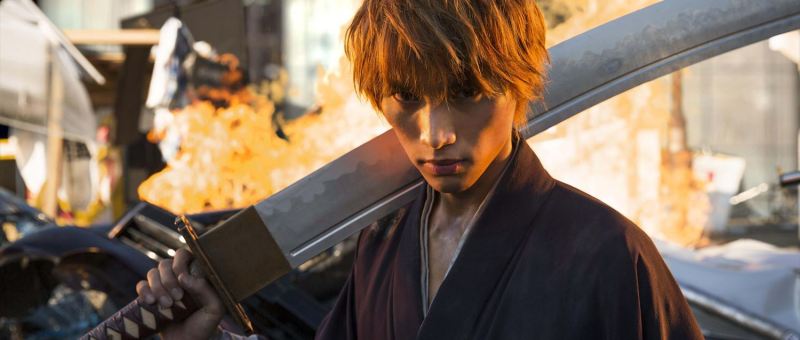
Bleach (BLEACH ブリーチ, Shinsuke Sato, 2018)

BL_honpos_setTite Kubo’s Bleach (BLEACH ブリーチ) had the distinction of being one of three phenomenally popular long running manga series (alongside Eiichiro Oda’s One Piece and Masashi Kishimoto’s Naruto) which dominated the industry from the early 2000s until its completion in August 2016. The series spans 74 collected volumes and was also adapted into a successful television anime which itself ran for several seasons and spawned a number of animated movies. It might seem like a no brainer to bring the series to the big screen with a live action adaptation but Bleach is no ordinary manga and the demands of recreating its fearsome world of cruel death gods and huge soul sucking monsters are a daunting prospect. Perfectly placed to tackle such a challenge, director Shinsuke Sato (I am a Hero, Inuyashiki) spent more than a year in post-production working on the CGI and has brought his characteristic finesse to the finely crafted world of Kubo’s Karakura.

Our hero, Ichigo Kurosaki (Sota Fukushi), is a regular fifteen-year-old high school student, save for his fiery orange hair and the ability to see ghosts. He lives with his relentlessly cheerful father (Yosuke Eguchi) and two cute little sisters but is also nursing guilt and regret over the death of his mother (Masami Nagasawa) who died protecting him from a monster when he was just a child. Feeling disconnected from his family, Ichigo likes to put on a front of bravado – taking on petty punks to teach them a lesson though, in a motif which will be repeated, he only escapes an early encounter unharmed thanks to the intervention of his unusually strong friend, Chad (Yu Koyanagi). Ichigo’s life is changed forever when he finds a strange girl, Rukia (Hana Sugisaki), in his room where she despatches a lingering spirit back its rightful destination of Soul Society. That was not, however, her primary mission and a giant “Hollow” suddenly punches a fist through Ichigo’s living room and scoops up his littlest sister. Rukia does her best to defeat the beast but is seriously wounded. Sensing Ichigo’s high psychic ability, she breaks the rules of her own society and transfers her powers to him but later discovers she gave him too much and is unable to return to Soul Society unless Ichigo ups his Soul Reaper rep to the point he is strong enough to survive giving her powers back.

Loosely speaking Sato adapts the “Soul Reaper Agent” (which is eventually attached to the title during the credits sequence) arc, otherwise known as “Substitute Shinigami”, in which Ichigo gets used to his new life as a Soul Reaper. Condensing Kubo’s considerably lengthy manga to a mere 108 minutes is obviously a difficult exercise necessitating a slight refocussing of Ichigo’s essential character arc as well as that of the feisty Rukia. Sato’s streamlined narrative emphasises Ichigo’s ongoing psychodrama as an adolescent young man attempting to deal with the repressed trauma of his mother’s death and his own feelings of guilt and regret in having unwittingly dragged her into a dangerous situation from which he was unable to protect her. Being “the protector” remains a primary concern of the young Ichigo who withdraws from his family but is determined to protect them from harm. His odd friendship with the similarly conflicted Rukia whose upbringing in the austere surroundings of Soul Society has left her also feeling isolated and friendless (but believing these are both “good” things to be) paradoxically returns him to the real world just he’s turned into an all-powerful monster fighting hero.

Yet the important lesson Ichigo learns is through repeated failures. His mother died saving him, his first fight is ended by a friend, and he is finally redeemed once again by an act of selfless female sacrifice. What Ichigo is supposed to learn, is that he doesn’t always need to be the protector and that being protected is sometimes alright because what’s important is the mutuality of protection, emotional, spiritual, and physical. Meanwhile Rukia, having lost her powers, is perhaps sidelined, rendered both vulnerable and empowered as she becomes Ichigo’s mentor in all things Soul Reaper. This quality of restraint is also how she chooses to make use of her power – something beautifully brought out in Sugisaki’s wonderfully nuanced performance as Rukia’s icy Soul Reaper exterior begins to thaw thanks to her unexpected connection with Ichigo.

Rather than get bogged down in exposition, Sato is content to let the world simply exist with occasional explanations offered in the form of Rukia’s improbably cute rabbit drawings in a motif borrowed from the manga. Sato makes sure to include a number of background players including the strong armed Chad and the lovelorn Orihime (Erina Mano) as well the omniscient shop owner Urahara (Seiichi Tanabe) though their role is strictly to add background colour rather than actively participate in the plot. Despite occasional narrative fudging, Bleach succeeds as a high-octane action blockbuster, by turns slick, ironic, and affecting but always grounded in the real even in excess.


Bleach is currently available to stream worldwide via Netflix.

Original trailer (no subtitles)

700 Days of Battle: Us vs. the Police (ぼくたちと駐在さんの700日戦争, Renpei Tsukamoto, 2008)

700days-of-battleThose golden last few summers of high school have provided ample material for countless nostalgia filled Japanese comedies and 700 Days of Battle: Us vs. the Police (ぼくたちと駐在さんの700日戦争, Bokutachi to Chuzai-san no 700 Nichi Senso) is no exception. Set in a small rural town in 1979, this is an innocent story of bored teenagers letting off steam in an age before mass communications ruined everyone’s fun.

In the summer of 1979, a group of teenage high school students get their kicks pulling pranks around the neighbourhood. They finally meet their match when a new policeman, Chuzai (Kuranosuke Sasaki), arrives in town intent on actually enforcing the law. When one of the boys is fined for speeding after coming down a steep hill on his bicycle, the guys decide to make Chuzai their new enemy, virtually daring him to arrest them with their constant trolling.

However, things take a turn when the boys move their prank planning meetings to a local cafe and discover the beautiful waitress working there, Kanako (Kumiko Aso). Instantly smitten the boys step up their romance game (donning some fancy outfits in the process) and semi-forget about their mission. Unfortunately Kanako is a married woman and worse than that she’s married to Chuzai! This whole thing just got real.

Chuzai, for all his uptight authoritarianism is onto the boys and their generally innocent mischief. Finding it all very irritating rather than actually dangerous, Chuzai gradually starts playing them at their own game by attempting to prank them back such as in one notable incident where he makes them attend a public behaviour seminar but gives the entire lecture through a ventriloquist’s dummy called Taru-kun. As a slightly older man, Chuzai can see the boys are just hopelessly bored in their backwater town. Breaking with his hitherto austere persona, Chuzai drops the authoritarian line to offer some fatherly advice to the effect that these summers are precious times,  soon the boys’ high school lives will be over and they’ll most likely leave their pleasant small town for the bustling metropolis of Tokyo so they’d better make the most of these aimless days while they can.

Idyllic as it is, the nature of the boys’ mission changes in the second half as the war against Chuzai takes on a slightly more affectionate quality. At this point they decide to use their pranking powers for good to help a little girl who’s stuck in the hospital finally enjoy the summer fireworks she’s been longing for even though the doctors won’t let her out to go to the festival. With the fireworks heist hovering in the background the guys get into various romanctic difficulties while enjoying archetypal teenage summer adventures.

Infused with period detail, 700 Days of Battle: Us vs. the Police has an authentically ‘70s soundtrack with some of the biggest hits of the era running in the background. Frequent cultural references such as a brief appearance from Ultraman add to the atmosphere which has a kind of retro, nostalgic innocence behind it as these kids live in a golden era of friendship and bike riding when the sun is always shining and graduation is still a long way off.

Director Tsukamoto keeps things simple though the production values are high and visual gags are spot on. Somewhat episodic in nature, the tale is split up into various chapters by means of title cards which helps to break up the seemingly endless summer as the boys attempt to fill their otherwise empty days. Apparently this was only the beginning of the “war” against the police, occupying only 108 days of a “conflict” which would finally run to 700. Presumably the guys have finished up their high school days by that point but at least they’ve succeeded in making some amusing memories of their elaborate and sometimes fiendishly clever schemes to take revenge on the surprisingly patient Chuzai-san. Filled with innocent, witty and whimsical comedy 700 Days of Battle: Us vs. the Police offers no great leap forward even within the realm of quirky teen comedies but still manages to provide some old fashioned, wholesome summer themed fun.


Original trailer (English subtitles)