Random Call (ランダム・コール, Riki Ohkanda, 2022)

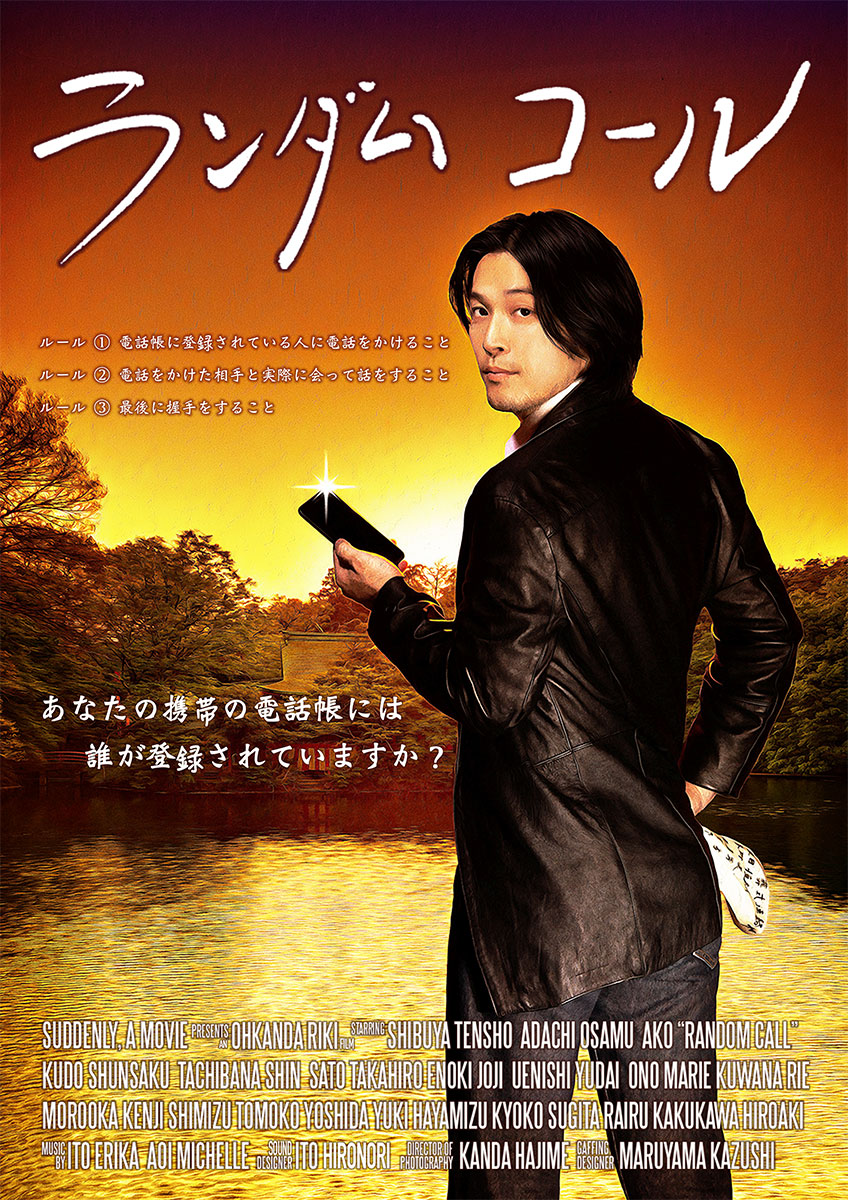
We may be more connected than ever before but now that it’s so easy to stay in touch we hardly every think of doing it. When was the last time you called someone just because with no specific reason in mind other than a desire to spend time with them? Struggling in his career and personal life, the hero of Riki Ohkanda’s heartwarming dramedy Random Call (ランダム・コール) begins to reconnect with his sense of humanity after a series of meetings with contacts from his phone selected at random each of whom teach him something about himself while reminding him that he is not alone and even if he’s not always been his best self love him anyway. 

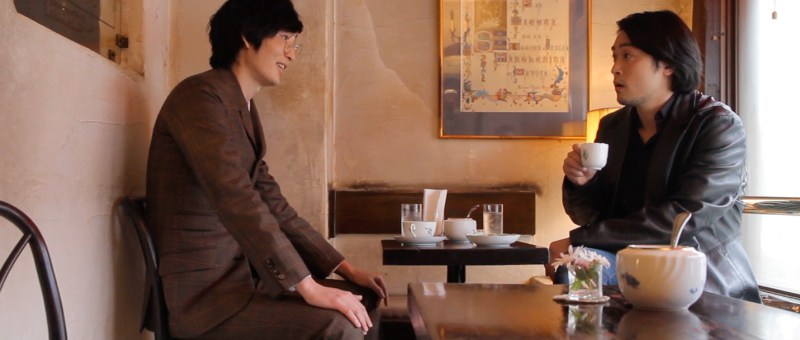
A little over 30, Ryo’s acting career has not worked out as well as he’d hoped and he’s beginning to get depressed, isolated by his internalised sense of failure while believing he’s sunk too much into his dream of becoming a successful actor to simply give up as several people including his mother advise him to do. The random call he gets from old friend Shintaro is then a kind of lifesaver reminding him he’s not been forgotten though he’s slightly bemused to discover that Shintaro claims to have no reason for wanting to meet, except he does in fact have an ulterior motive. Inspired by a recent experience in which he became ill abroad and people just helped him out of nothing other than simple human compassion, he’s embarked on the “Random Call” social experiment the results of which he hopes to turn into a book. The idea is he calls a number at random from his phone’s contact book and asks them to go for coffee making sure to shake their hand before he leaves, just checking in with old friends with no other demands or expectations. Inspired, Ryo decides to try it out for himself and encounters various reactions to the unusual project. 

Perhaps that’s understandable, after all it’s natural enough that we mainly contact people when we want something from them so it’s only fair that some are annoyed or confused to discover there is no “point” to the meeting. It probably doesn’t help that the first “random” call is to a business contact, Saito, a TV producer, rather than to a friend with whom it might be more natural to meet up for a drink out of the blue. Saito is then irritated and suspicious, annoyed that Ryo is “wasting” his time assuming he’s making an awkward attempt to network but then something strange happens. He gives in to the magic of the random call and takes it at face value, accepting the warmth of an unexpected friendship and leaving a little happier than he arrived. 

But then, Ryo finds himself not being entirely honest with some of his encounters painting himself as more successful than he’s actually been talking up meetings about movies after hearing of another friend’s award-winning career success and recent marriage though as we later discover the friend wasn’t being entirely honest either. Meanwhile, he cheats a little in making a not all that random call to old friend Mie after learning that she may have fallen on hard times but she tells him that her contact list is mainly full of people she’d rather not speak to so random calling’s probably not for her though she does begin to tag along on some of his adding an additional perspective to his quest for connection through which he gradually begins to realise that his inner insecurities have him led to treat people badly with the consequence that they don’t always remember him fondly. 

Of course it doesn’t always work out, people don’t answer his calls, have moved away, or leave abrupt voicemails explaining they’re not lending him any money but even if it’s awkward or painful both sides gain something from the encounter emerging with a little more confidence in the knowledge that they haven’t been forgotten or else gaining a little closure to some unfinished business that allows both parties to begin moving forward. Through his various re-encounters, Ryo re-establishes a sense of connection with the world around him, encouraging and encouraged by others, and walking with a new sense of positivity into a less lonely future. 


Random Call screened as part of Osaka Asian Film Festival 2022

Trailer (no subtitles)
Erica 38 (エリカ38, Yuichi Hibi, 2019)

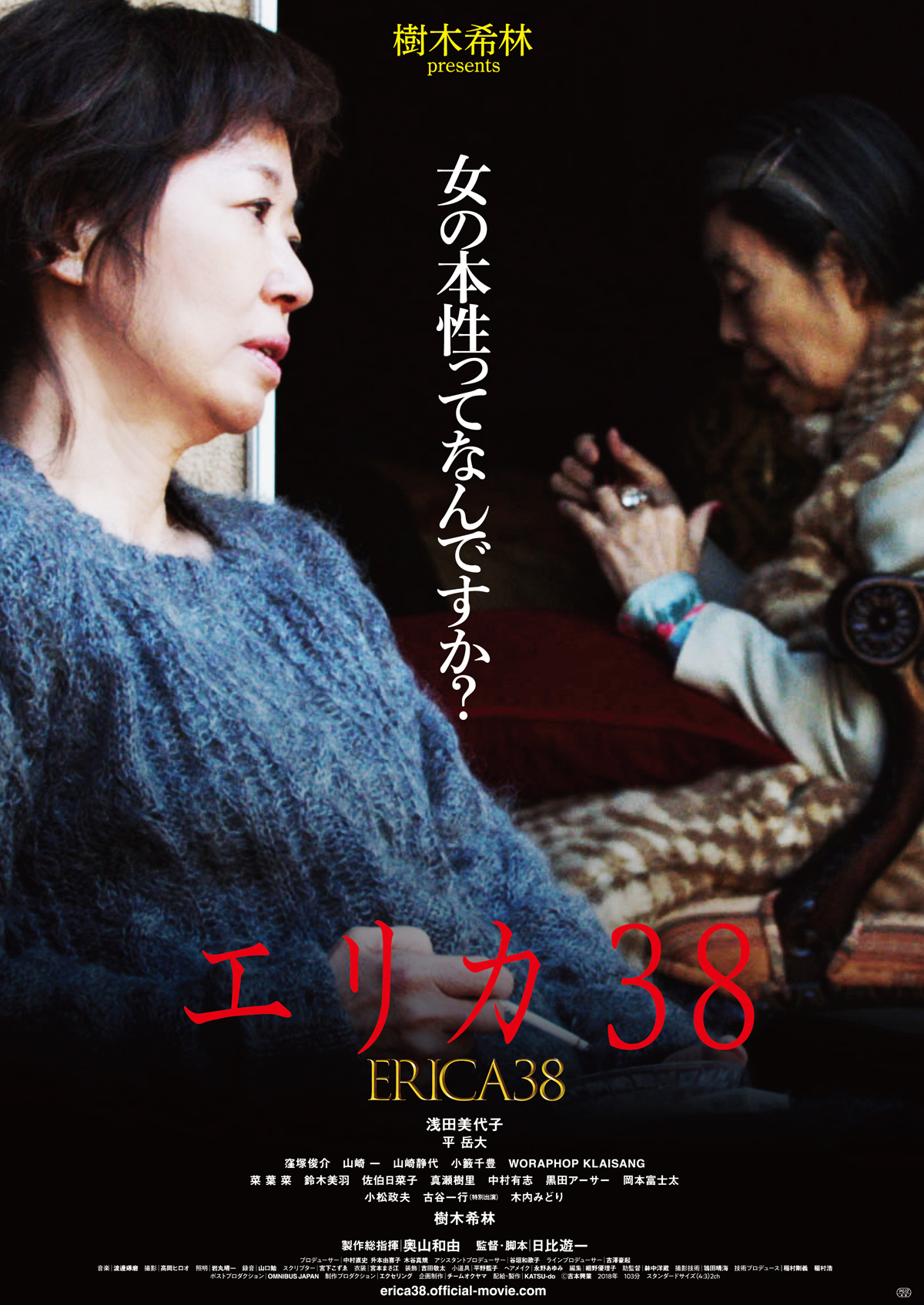
Erica 38 poster“Everybody’s life is in someway unfulfilling”, admits the philosophical victim of a con woman in ripped from the headlines tale Erica 38 (エリカ38). “It’s like a crutch” he adds, without a little fantasy you can’t go on. Like the “Erica” of the title, her victims are also looking for escape from an unsatisfying reality, and unfortunately for them already have what she feels would make her life more bearable – vast wealth. Returning to Japan after three decades abroad, director Yuichi Hibi does his best to humanise the figure of the coldhearted grifter, painting her as just another disappointed, lonely old woman desperately trying to recapture the sense of possibility so cruelly denied her in youth.

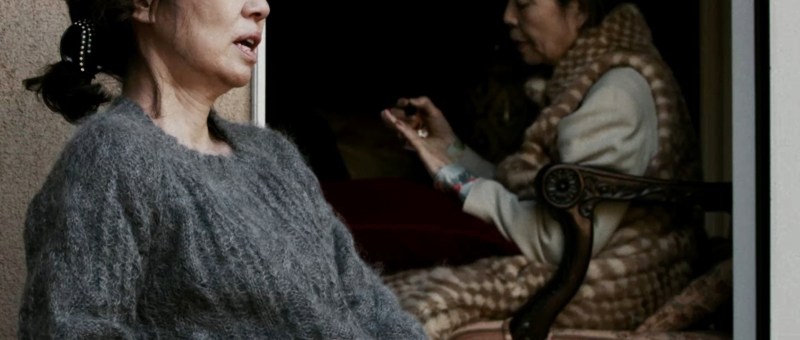
Later rebranding herself as “Erica”, a 38-year-old woman of means, our “heroine” is Satoko Watanabe (Miyoko Asada), an ageing bar hostess supplementing her income by peddling a dodgy multi-vitamin pyramid scheme to bored housewives eager to make a few extra bucks. Her sales pitch, however, gets her noticed by a refined old woman sitting close by in an upscale hotel during in one of her sessions. The woman, Mrs. Ito (Midori Kiuchi), introduces her to a “friend”, Hirasawa (Takehiro Hira), who cuts in with a sales pitch of his own in branding himself as a paid up member of the global elite who works with the Pentagon on important international matters. Hirasawa heavily implies his business is not quite on the level, but Satoko, captivated by his suave sophistication, fails to realise just how dodgy he really is. Before long, she’s joined him in his “consultation” business, selling fraudulent investment opportunities in the emerging market of Cambodia.

It is surprisingly easy to sympathise with the dejected Satoko as she falls under Hirasawa’s spell. Already well into her 50s when the film begins and clearly over 60 when she rebrands herself as the 38-year-old Erica, Satoko has led an unhappy life beginning with a traumatic childhood lived in the shadow of an abusive, adulterous father. The only memory of joy from her youth is when she and her mother (Kirin Kiki) giggled together after accidentally tipping rat poison into dad’s miso soup. Life since then, it seems, has been one disappointment after another spent in the hostess bars of Kabukicho. What all of that means, however, is that she’s become skilled in the art of selling fantasy. All that time invested in extracting cold hard cash from lonely men has set her in good stead for selling unrealistic investment opportunities to the already comfortably off.

Unrepentant, Satoko tells herself that she bears no responsibility towards those who lost money in her scams because they were chasing exactly the same thing she was – escape, and they both found it at least for a moment. Her victims made the decision themselves, she never forced anyone, and so it’s their own fault that they fell for her patter while she perhaps laments only that she’s been foolish and profligate in not planning better for the eventual implosion of all her schemes.

“There’s a thin line between real and fake”, she tells a party guest admiring one of her paintings, “if someone sees it as real then real it is”. Satoko’s cons are, in essence, an extension of the paradox of the hostess business. Anyone with an ounce of sense would have seen that the business isn’t legitimate, but like a salaryman in a hostess bar they invest in the semblance of connection while knowing in a sense that isn’t “real”. Ironically enough, Satoko is forced to realise that the first victim of her subterfuge is herself. Chasing a dream of love, she fell hard for Hirasawa without thinking him through. Hirasawa succeeds in his schemes because he’s scrupulously careful in maintaining his persona – he operates out of hotels, has no fixed address, and uses several cellphones. As Satoko later finds out, he is effectively running a harem, romancing several women all like herself bringing in the big bucks while he sits back relatively risk free. She has been used, once again.

The implosion of her dream of romantic escape is what sends her to Thailand where she ponders a reset, rebranding herself as the 38-year-old Erica of the title and beginning an affair with a young and handsome Thai man she rescued from gangsters with her ill-gotten gains. Porche (Woraphop Klaisang) later describes her as “My Angel”, of course realising that she was much older than she claimed but claiming not to care. It may be that he really did love her, but you can’t ignore the corruption of all that money and the power that it buys. In the end, money can’t buy you love, or a path out of loneliness, or a cure for disappointment.

Satoko was, like many, just another lonely, disappointed old lady trying to escape an unsatisfying present through a fantasy of returning to the past, rebooting herself as a successful business woman, loved and in love, as someone with a brighter future to look forward to. Her sales patter worked because it was “true”, the similarly dejected could sense in her the desperation for escape and as they wanted to escape too they let her take them with her. A melancholy tale of delusion and disillusionment, Erica 38 has immense sympathy for the scammer and the scammed painting them both as victims of an often unfair, conformist society in which freedom is the rarest commodity of them all.


Erica 38 screens in New York on July 25 as part of Japan Cuts 2019.

Original trailer (English subtitles)