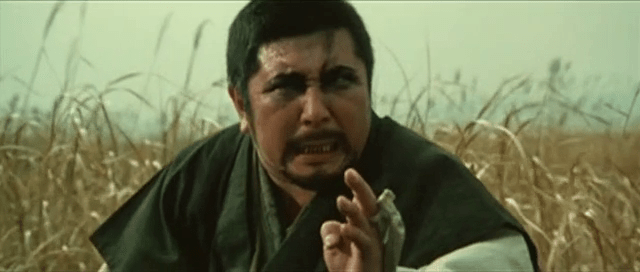

At the heart of the Wicked Priest series is an idea of rootlessness, the wandering monk Shinkai (Tomisaburo Wakayama), an orphan, often finding himself dragged into familial disputes between fathers and sons for one reason or another often estranged from each other. The aptly named Wicked Priest 4: The Killer Priest Comes Back (極悪坊主 念仏三段斬り, Gokuaku Bozu: Nenbutsu Sandangiri) finds Shinkai returning to his hometown after reencountering a childhood friend who’s found himself on the wrong side of a historical divide.
When Shinkai and Takegoro (Ichiro Nakatani) left their childhood village, they swore to become the best priest and mountain owner in Japan respectively but that obviously hasn’t worked too well for either of them. Takegoro evidently joined the wrong side during Bakumatsu chaos, a fact rammed home when his attempt to use currency issued by a feudal lord is rebuffed in a gambling den whose owner reminds him that it is now worthless. Only official currency issued by the central government is considered legal tender. On top of all that, it seems Takegoro might also have been cheating which signals just how far he has fallen. Running into him by chance, Shinkai ends up saving the day while accidentally humiliating a chastened Takegoro who is given a further dressing down by the old school lady yakuza boss Kuroda (Chieko Naniwa), also known as “the Thunder Woman”, who appears to be in charge, shooting off his little finger as an attempt to save face.
In any case, the encounter has Shinkai feeling nostalgic and he decides to return to his hometown to hold a proper memorial service for his late mother. Only once there he ends up being drawn into another cycle of local corruption on discovering that the river workers are being exploited by rival yakuza groups who are working them to exhaustion and paying almost nothing. The leader of the Gondawara is quite obviously up to no good as he wears a western suit and has a handlebar moustache, quite clearly an amoral capitalist while his rival Ryuo (Eizo Kitamura) is a violent thug in ominous sunshades. In actuality, however, they are both branches of the yakuza syndicate led by Kuroda who is of the old school and doesn’t approve of their exploitative mindset. Just as she had Takegoro, she gives both men a good telling off reminding them that the river workers are essential for providing a steady supply of coal without which the new industrial economy will flounder.
It’s also true that this same industry is fuelling militarisation and an eventual eye towards expanding imperialism, but Kuroda does seem to be mainly mindful of the workers welfare immediately insisting they should be paid a fair wage which is five times more than they’re currently getting. Ryuo and Godawara superficially agree but intend on simply exploiting their workers differently by demanding five times as much work for five times as much pay in a fifth of the time. Shinkai does his best to defend the rights of the local people, but is faced with a dilemma on realising that Takegoro is member of Godawara and hellbent on killing him having become cynical and desperate, willing to sell out a childhood friend for a few pennies.
Part of Shinkai’s mission is winning Takegoro back over the side of right while reuniting him with his mother whom he’d been too ashamed to visit. On the other hand, this is perhaps the first time Shinkai shows a darker side to himself on threatening to rape a lascivious nun who tricked him into a martial arts contest while rebuffing his amorous intentions. He’s also still being pursued by Ryotatsu (Bunta Sugawara) and ironically ends up temporarily losing his sight himself but just as always Ryotatsu decides to come to his rescue mostly because it would be very annoying if someone else killed him first before he’s got his revenge. He also agrees to wait for Shinkai to finish his mother’s memorial service before scheduling their death match, the most patient revenger in jidaigeki history. In any case, it all ends with another massive showdown as a wounded Shinkai purifies the town of corrupt yakuza and liberates the river workers while finally getting to honour his late mother’s memory leaving Ryotatsu to make his exit deciding that vengeance can wait until the mourning’s over.
 Windows on Worlds