

Nemurubaka: Hypnic Jerks (ネムルバカ, Yugo Sakamoto, 2025)

Is it better to have a goal and know what you want, or is it easier to be just kind of muddling along? The heroines of Yugo Sakamoto’s oddly titled slacker comedy Nemurabaka: Hypnic Jerks (ネムルバカ) are coming at this from opposite sides. Ruka (Yuna Taira) is a rock band and her dream is to make it as a musician, though she isn’t really sure she has what it takes, while Yumi (Shiori Kubo), though in some ways the more sensible of the pair, has no idea what she’s doing with her life.

The fact that Yumi addresses Ruka only as “sempai” bears out the ways in which she feels slightly inferior to her, and, in fact, to everyone. As she says to Ruka, it’s like everyone else has a foot on the ladder, but she can’t even see where the ladder is let alone climb it. Ruka offers to split her pay for polishing up some ornaments for a friend who works as a maid at a posh person’s house as long as she does half of it, adding that now at least Yumi’s on the bottom rung while simultaneously trying to make her an equal. While Yumi idolises Ruka, Ruka seems to be jealous of Yumi’s carefree nature and relative lack of impetus. 

Then again, the way she seems to quickly shut down anyone making romantic overtures towards Yumi along with her habit of gazing at her while she’s asleep may suggest another kind of desire. The gazing turns out to have a practical dimension, at least, that somewhat dissolves the disparity as it’s Yumi who has facilitated Ruka’s art and, to an extent, all her songs appear to be about her. This may be what she means when she tells Yumi that she’s very important to her to try and quell her feelings of low self-worth and inferiority. Nevertheless, this notion of being somehow lesser is only reinforced by the intrusion of a guy, Taguchi (Keito Tsuna), who pretends to have romantic interest in Yumi but is in reality after Ruka who exploits him for free food and the use of his car. 

Exposed, Taguchi calls Yumi “low-tier” and “a simpleton”, but inexplicably still expects Ruka to date him despite having just confessed to using her friend and then insulting her as part of a botched apology. Part of the problem is that Taguchi is a spoiled rich kid who doesn’t understand how the world works. He has a useless GPS device installed in his car featuring a maid-style character who deliberately gives rubbish directions because men like him generally prefer women to be stupid and cute even though he’s set his sights on Ruka who is moody and rebellious. While the girls are humming and hawing over a new rice cooker and going hungry at the end of the day, he’s obsessing over getting a new outfit for his GPS mascot. His comparatively more sensible friend who sort of mirrors Yumi indulges in superhero fantasy and is jealous of Ruka because of her certainty about her path in life even if Ruka is anything but certain in her ability to follow it.

It’s that sense of uncertainty that, in a way, convinces her to accept an offer of a record contract despite the fact they only want her and not her bandmates while she’ll also have to move out of the flat she shares with Yumi to go to Tokyo. She admits that she’d like to live this aimless life with her for longer, but is frightened of becoming stuck and never able to progress to anything else. But the price of that is she ends up making soulless idol pop for the commercialised music industry despite having been signed for a punk anthem about youthful despair. Yumi may be the “sleeping idiot” of the title in a more literal sense, but perhaps Ruka isn’t really fully awake either but allowing others to lead her towards what she should want but perhaps really doesn’t. In any case, unlike similarly themed films, this one doesn’t really lean into the idea that an aimless life is fine itself but encourages Yumi and the others to try and find a sense of purpose as she becomes a “sempai” herself, if also maintaining the courage to walk away from a compromised vision of success that isn’t at all what they wanted.


Nemurubaka: Hypnic Jerks screens as part of this year’s Japan Foundation Touring Film Programme.

Images: © Masakazu Ishiguro, Tokuma Shoten_Nemurubaka Film Production Committee
Godzilla Minus One (ゴジラ-1.0, Takashi Yamazaki, 2023)

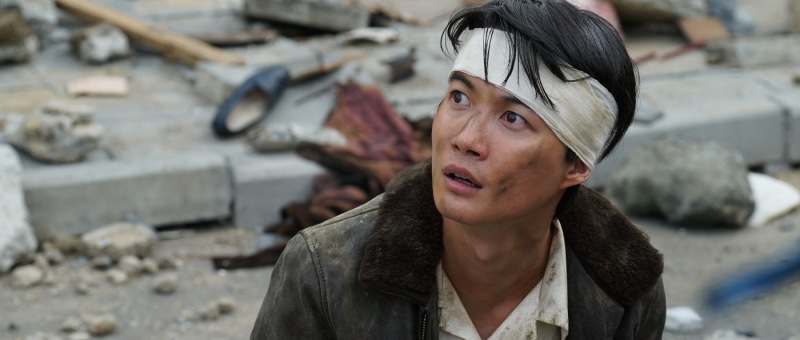
When Godzilla emerges from the waves in Takashi Yamazaki’s entry into the classic tokusatsu series Godzilla Minus One (ゴジラ-1.0), he does so as an embodiment of wartime trauma most particularly that of the hero, Koichi (Ryunosuke Kamiki), a kamikaze pilot who failed die. Some might call his actions cowardice, returning to base siting engine trouble rather than doing what others regard as his duty, though the film implies it’s simply a consequence of his natural desire to live, a desire which the tenets of militarism which in essence a death cult insisted he must suppress. 

But for Koichi as he’s fond of saying the war never ends. He’s trapped in a purgatorial cycle of survivor’s guilt and internalised shame, feeling as if he has no right to a future because of the future that was robbed from other men like him because of his refusal to sacrifice his life. When he first encounters Godzilla on a small island outpost, he is ordered back into his plane to fire its guns at him but freezes while the rest of the men, bar one, are killed. Tachibana (Munetaka Aoki), a mechanic who had already branded Koichi a treacherous coward, gives him a packet of photographs belonging to the dead men each featuring the families they were denied the opportunity to return to. Photographs on an altar become a motif for him, though he has none for his parents who were killed when their house was destroyed by the aerial bombing of Tokyo. A surviving neighbour similarly blames him, directly aligning Koichi’s act of selfish cowardice with the razing of the city.

The return of Godzilla is literal manifestation of his war trauma which he must finally confront in order to move into the new post-war future that’s built on peace and solidarity rather than acrimony and resentment for the wartime past. But then again, the film situates itself in a fantasy post-war Tokyo in which the Occupation is barely felt and the government, which mainly consisted of former militarists, is also absent. Both the US and the Japanese authorities refuse to do anything about Godzilla because of various geopolitical implications making this a problem that the people must face themselves, though they largely do so through attempting to repurpose rather than reject the militarist past. Noda (Hidetaka Yoshioka), a scientist who worked on weapons production during the war, gives a rousing speech in which he explains that this time they will not pointlessly sacrifice their lives but instead fight to live in a better world which is all very well but perhaps mere sophistry when the end result is the same. 

Called back by their old commander, many men say they will not risk their lives or abandon their families once again because they have learned their lessons but others are convinced by the message that they must face Godzilla if they’re ever to be free of their wartime past. Koichi wants vengeance against Godzilla but also to avenge himself by doing what he could not do before. The film seems to suggest that this time it’s different because he has a choice. No one has ordered him to die, and he is free to choose whether to do so or not which is also the choice of being consumed by his war trauma or overcoming it to begin a new life in the post-war Tokyo that Godzilla has just destroyed. 

Despite the desperation and acrimony he returns to, Koichi maintains his humanity bonding with a young woman, Noriko (Minami Hamabe), who agreed to take care of another woman’s child. Even the neighbour, Sumiko (Sakura Ando), who first rejected Koichi and is suspicious of Noriko, willingly gives up her own rice supply for the baby proving that in the end people are good and will help each other even if that seems somewhat naive amid the realities of life in the post-war city ridden with starvation and disease. In any case, it’s this solidarity that eventually saves them, Godzilla challenged less by a pair of large boats than a flotilla of small ones united by the desire to finally end this war. Like Yamazaki’s previous wartime dramas The Eternal Zero and The Great War of Archimedes, the film espouses a lowkey nationalism mired in a nostalgia for a mythologised Japan but as usual excels in terms of production design and visual spectacle as the iconic monster looms large over a city trapped between the wartime past and a post-war future that can only be claimed by a direct confrontation with the lingering trauma of militarist folly.


Godzilla Minus One opens in UK cinemas 15th December courtesy of All the Anime.

International trailer (English subtitles)