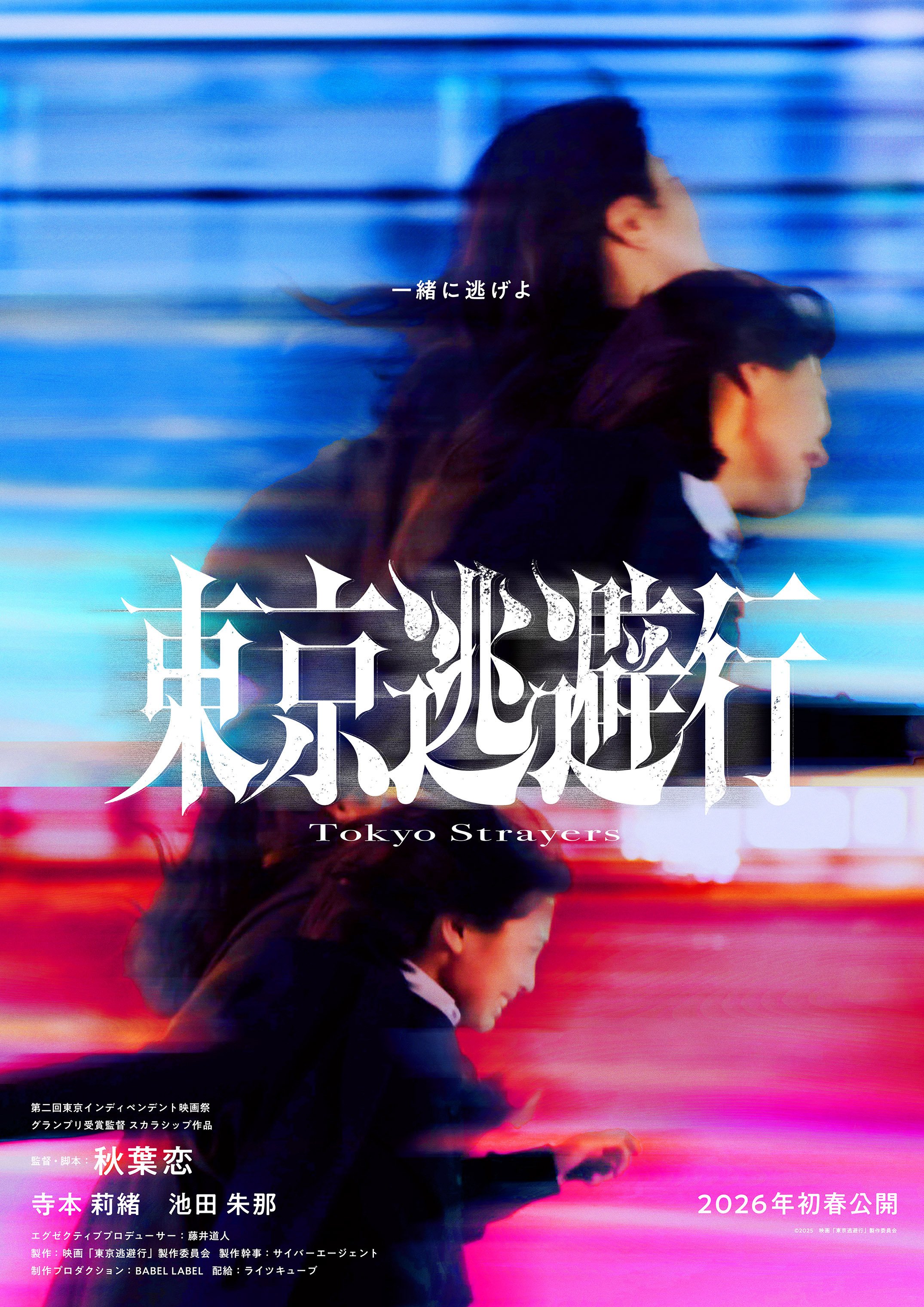
Tokyo Strayers (東京逃避行, Ren Akiba, 2026)

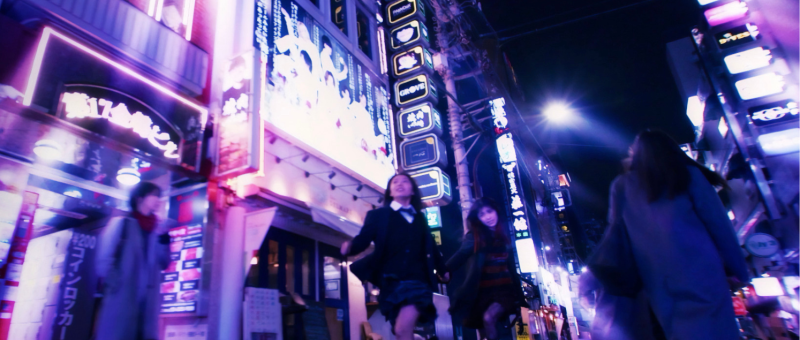
Amid increasing gentrification of urban centres, where are the kids supposed to go? Ren Akiba’s Tokyo Strayers (東京逃避行, Tokyo Tohiko) seems to suggest efforts to clean up Kabukicho haven’t actually been all that successful, while young and impressionable people for whom home is not or safe place or who feel themselves to be out of place in their hometown continue to flock to the city in search of a kind of grimy glamour that promises freedom in a conformist society.

At least, that’s why Asuka ends up in Shinjuku while in flight from a policeman father she resents for leaving their family for a younger woman. In truth, Asuka’s problems are more of the normal teenage variety and otherwise she appears to come from a more stable, financially comfortable home with parents that are invested in her welfare even if she finds them to be overbearing. The same is not true for many of the other runaways including Hiyori left home away after experiencing physical and sexual abuse at the hands of her father. It’s Hiyori who is currently writing the Tokyo Strayers blog that’s attracted Asuka and countless other young women to this hip and happening place, though it soon becomes clear that the diary is an idealised vision of Shinjuku life that doesn’t really exist.

The film seems to present two young men, Edo and Merio, as the angel and demon of Shinjuku. Edo runs a kind of shelter for runaway teens that provides a safe space for them where they can find food and start to rebuild their lives. Merio, meanwhile, gets young women hooked on drugs in order to sexually exploit them. The distinction between them would seem to be black and white, but in reality the two were once a team and Merio apparently only started working with a local drug dealer in order to get money to fund Edo’s sanctuary, which Edo eventually accepted, if unwillingly. In any case, Edo started the sanctuary with money he made as a host working in Kabukicho which means that it still arises from the sleazy underbelly of the red light district which is built upon the exploitation of women. 

Nevertheless, Edo is committed to keeping runaway kids safe, which is why he tells Hiyori to make sure Asuka gets home safely knowing that she likely means to sell her to Merio in exchange for drugs. Hiyori is only really doing this because she feels she has no other means of survival and the implication is that she began doing sex work as a kind of self-harm intended to wipe out the abuse she received at the hands of her father. Edo warns his runaways to avoid going out because of the increased police presence given that they will just send anyone they catch back home without considering whether that might be a safe environment for them. A policewoman later confesses her regrets about sending a girl back to her family thinking it was for the best and they’d patch things up over time only for the girl to take her own life shortly afterward. The film is then implicitly critical of an unthinking adult world that is failing to protect these children. Even if they try to report what’s happening to them, they are not believed or no action is taken because of a reluctance to interfere in domestic matters and an unshakeable belief in the sanctity of family. 

But this environment is obviously no good for them either, leaving them open to exploitation or falling into criminal activity as a means of supporting themselves. Edo’s initiative is one way of fighting back through youth solidarity, but it’s also rooted in the dark side of Kabukicho given the impossibility of running such an establishment without any kind of funding. Akiba seems to want to show the two sides of Kabuki, one seemingly glamorous and alluring, and the other seedy and depressing, while suggesting that the only real source of solidarity exists among the young people themselves if only they can find the strength to look after each other while simultaneously striving to escape the traumatic circumstances that have forced them onto the streets.


Tokyo Strayers screened as part of this year’s Toronto Japanese Film Festival.

Trailer (English subtitles)


Nemurubaka: Hypnic Jerks (ネムルバカ, Yugo Sakamoto, 2025)

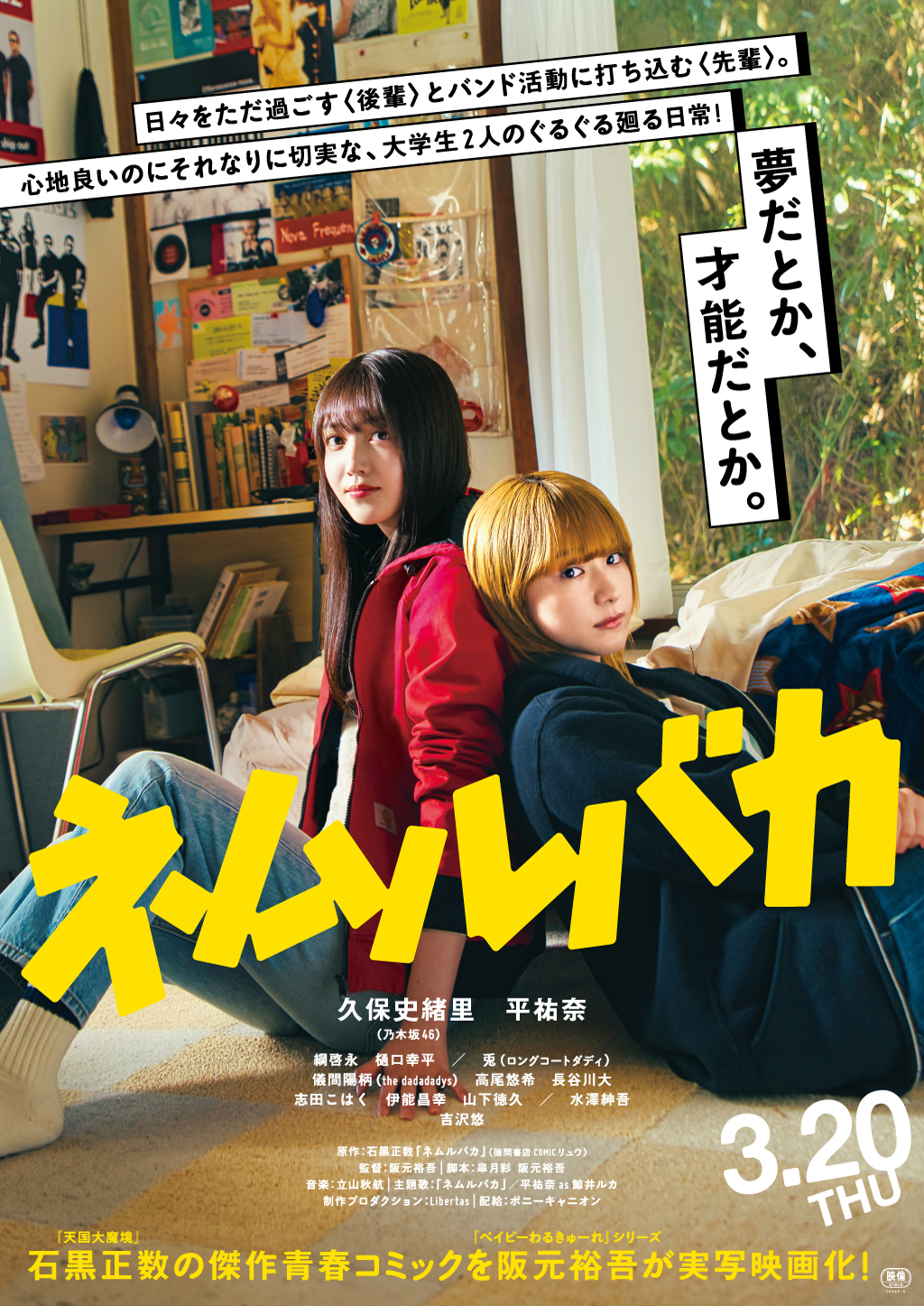
Is it better to have a goal and know what you want, or is it easier to be just kind of muddling along? The heroines of Yugo Sakamoto’s oddly titled slacker comedy Nemurabaka: Hypnic Jerks (ネムルバカ) are coming at this from opposite sides. Ruka (Yuna Taira) is a rock band and her dream is to make it as a musician, though she isn’t really sure she has what it takes, while Yumi (Shiori Kubo), though in some ways the more sensible of the pair, has no idea what she’s doing with her life.

The fact that Yumi addresses Ruka only as “sempai” bears out the ways in which she feels slightly inferior to her, and, in fact, to everyone. As she says to Ruka, it’s like everyone else has a foot on the ladder, but she can’t even see where the ladder is let alone climb it. Ruka offers to split her pay for polishing up some ornaments for a friend who works as a maid at a posh person’s house as long as she does half of it, adding that now at least Yumi’s on the bottom rung while simultaneously trying to make her an equal. While Yumi idolises Ruka, Ruka seems to be jealous of Yumi’s carefree nature and relative lack of impetus. 

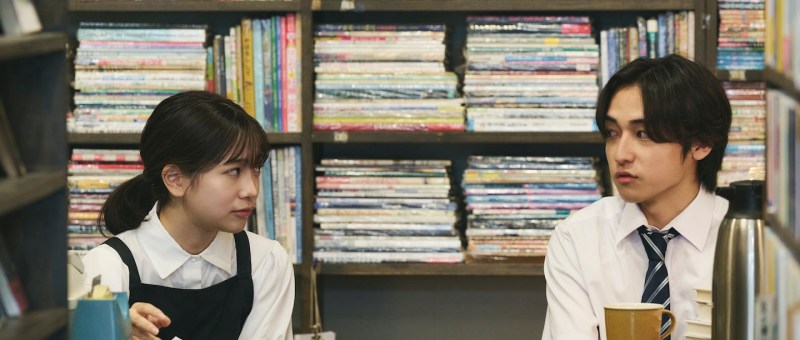
Then again, the way she seems to quickly shut down anyone making romantic overtures towards Yumi along with her habit of gazing at her while she’s asleep may suggest another kind of desire. The gazing turns out to have a practical dimension, at least, that somewhat dissolves the disparity as it’s Yumi who has facilitated Ruka’s art and, to an extent, all her songs appear to be about her. This may be what she means when she tells Yumi that she’s very important to her to try and quell her feelings of low self-worth and inferiority. Nevertheless, this notion of being somehow lesser is only reinforced by the intrusion of a guy, Taguchi (Keito Tsuna), who pretends to have romantic interest in Yumi but is in reality after Ruka who exploits him for free food and the use of his car. 

Exposed, Taguchi calls Yumi “low-tier” and “a simpleton”, but inexplicably still expects Ruka to date him despite having just confessed to using her friend and then insulting her as part of a botched apology. Part of the problem is that Taguchi is a spoiled rich kid who doesn’t understand how the world works. He has a useless GPS device installed in his car featuring a maid-style character who deliberately gives rubbish directions because men like him generally prefer women to be stupid and cute even though he’s set his sights on Ruka who is moody and rebellious. While the girls are humming and hawing over a new rice cooker and going hungry at the end of the day, he’s obsessing over getting a new outfit for his GPS mascot. His comparatively more sensible friend who sort of mirrors Yumi indulges in superhero fantasy and is jealous of Ruka because of her certainty about her path in life even if Ruka is anything but certain in her ability to follow it.

It’s that sense of uncertainty that, in a way, convinces her to accept an offer of a record contract despite the fact they only want her and not her bandmates while she’ll also have to move out of the flat she shares with Yumi to go to Tokyo. She admits that she’d like to live this aimless life with her for longer, but is frightened of becoming stuck and never able to progress to anything else. But the price of that is she ends up making soulless idol pop for the commercialised music industry despite having been signed for a punk anthem about youthful despair. Yumi may be the “sleeping idiot” of the title in a more literal sense, but perhaps Ruka isn’t really fully awake either but allowing others to lead her towards what she should want but perhaps really doesn’t. In any case, unlike similarly themed films, this one doesn’t really lean into the idea that an aimless life is fine itself but encourages Yumi and the others to try and find a sense of purpose as she becomes a “sempai” herself, if also maintaining the courage to walk away from a compromised vision of success that isn’t at all what they wanted.


Nemurubaka: Hypnic Jerks screens as part of this year’s Japan Foundation Touring Film Programme.

Images: © Masakazu Ishiguro, Tokuma Shoten_Nemurubaka Film Production Committee

Yoyogi Johnny (代々木ジョニーの憂鬱な放課後, Satoshi Kimura, 2025)

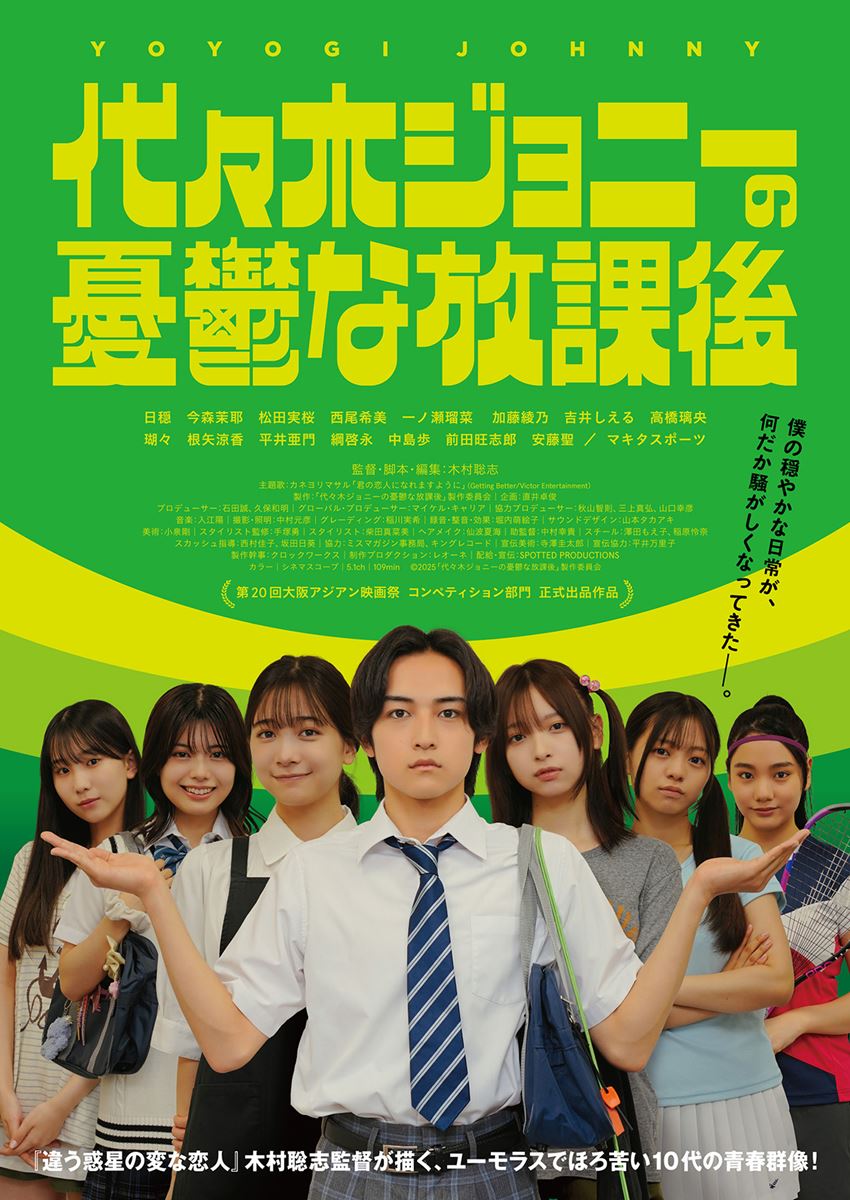
Not much makes a lot of sense in the world of the titular Yoyogi Johnny. Nothing’s quite as it first seems and life is full of contradictions, but that’s alright, for the most part. Johnny just floats on through life going with the flow, but then he meets a series of girls who each for some reason want to practice things with him though for very different reasons while he tries to make sense of it all and gain the courage to push for what he really wants.

Then again, he breaks up with Asako (Mio Matsuda) because he realises he likes her in the same way he likes “history” which is to say, when someone asks him what his favourite subject is he just says that but doesn’t actually know if he even likes history or not. Having never been in love, he doesn’t know what it’s like and therefore wants to end the relationship. Mostly he just spends his time hanging out in the “squash club” where they don’t actually play any squash but just use the clubroom to hideout from the less satisfying aspects of their lives or otherwise avoid other people. In fact, they’re only in the squash club to make up the numbers and were all looking to start clubs of their own but for various reasons were prevented from doing so. But when a mysterious young woman they christen Deko (Shieru Yoshii) for her prominent forehead arrives at the club looking for the founder, Ondera, whom they call “Button”, it wrecks their peaceful lives because of her insistence that they actually play some squash.

Deko wants to practice squash with him, but his childhood friend Kagura (Runa Ichinose) wants him to role play real world interactions while she has otherwise become a virtual recluse who no longer attends school. Meanwhile, he’s also drawn to a colleague at his part-time job at a bookshop/bar, Izumo (Maya Imamori), who is also the boss’ daughter. Somewhat salaciously, she wants him to practice “physical contact,” as that’s one of the areas she has difficulty in having herself also been a recluse who dropped out of school and has come to Tokyo for a fresh start. Johnny immediately picks up on this irony of Izumo salmoning her way to the capital while, in general, most people are travelling away from the city to a less populated area for a quieter life rather than the other way around though like many of these conversations it’s lost on Izumo to whom it is of course just normal. Johnny has several of these conversations in which he attempts to point out that something doesn’t make sense but just finds himself trapped in an infinite loop of back and fore as the other person struggles to understand his logic or he theirs. He is however a kind person who tries to help everyone who asks him though perhaps without really thinking about it. 

Yet most of the young women eventually oscillate out of his life depriving him of these very important friendships and ironically rebounding to the squash club even though they now actually have to play squash. Nevertheless, through his various relationships Johnny begins to gain a new perspective on himself and even finds out what it’s like to fall in love. A strange young woman who seems to be part of what very much looks like a cult, reminds him that “self-sufficiency” is a lie even though it’s supposedly what their cult is founded on. It is after all an organisation that promotes “independent living” while sending its members who all live in the dorm to farm the fields, though this yet another thing that doesn’t really make sense but Johnny just has to accept. Nevertheless, it seems she’s right when she says people can’t live by themselves alone and by and large need each other to survive. She tells Johnny that he should stop visiting Kagura because it’s “meaningless” and wouldn’t help her, but at the same time seems to appreciate his good-naturedness and the gentle positivity he puts out into the world in his ability to just be nice and be there for that want or need him while never expecting anything in return. As he’s fond of saying, if you regard a person as a friend then it doesn’t really matter whether they agree or not they’re still your friend and Johnny has more than many might awesome he would. Warm-hearted and filled zany humour, the retro aesthetic of its opening titles only adds to film’s charm as a little gem of indie comedy.


Yoyogi Johnny screened as part of this year’s Osaka Asian Film Festival.

Trailer (no subtitles)

The Scoop! (新米記者トロッ子 私がやらねば誰がやる!, Keiichi Kobayashi, 2024)

The print media industry in Japan has often come in for criticism because of its perceived toothlessness in which it is often afraid of speaking truth to power lest it lose its access. Of course, as we’ve seen all too well just recently, that’s not a problem limited to Japan, but it’s something that’s preoccupied the students at the centre of Keiichi Kobayashi’s teen drama The Scoop! (新米記者トロッ子 私がやらねば誰がやる!, Shinmai Kisha Torokko: Watashi ga Yaraneba Dareka ga Yaru) whose unofficial newspaper club is threatened by the school because of its tendency to expose scandal and oppose the elitism which has otherwise taken over the institution.

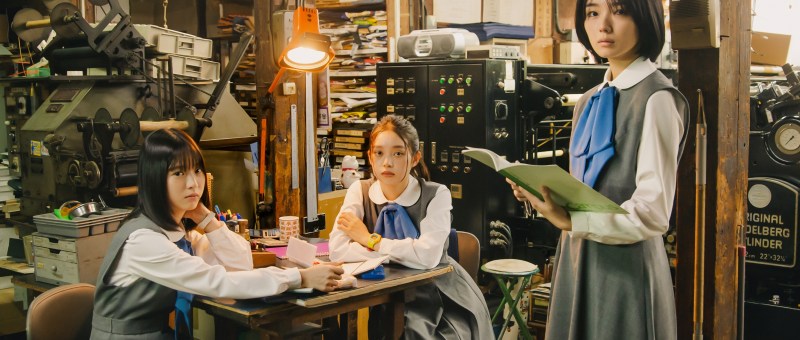
Yui (Karin Fujiyoshi) only enrolled here because of the famous literature club and the possibility of meeting her idol, Konoha Midorimachi, the winner of a prestigious student writing competition. But as she quickly finds out, the Literature Club is pretty high up in the school hierarchy and only really open to those in the “advanced” class. All of its members wear red scarves to distinguish them from the other students who wear blue. You have to take a test to get in, but Yui’s dreams end before they’ve even started when she’s hit by a rogue drone and knocked out. They won’t let her retake the test because they say it would be unfair to the other students, but the club president, Mari (Rinka Kumada), has another proposition for her. It turns out that Konoha Midorimachi isn’t a member after all but a mysterious person using a pen name. Mari wants to know who it is too so she suggests they team up to find out. Following a lead to the unofficial Newspaper Club, Mari advises Yui to sign up there and win their trust to find out Konoha’s true identity on the promise of being admitted to the Literature Club once she’s solved the mystery.

Yui isn’t really happy with this plan in part because the Newspaper Club has a bad reputation for being a bunch of cranks and nerds. The Newspaper Club isn’t really all that keen on talking about Konoha either but is glad to have Yui on board while she also begins to embrace the opportunity to hone a different side to her writing skills. While there, she’s confused by the tactics employed the editor, Kasane (Akari Takaishi), whom she describes as more like a con-artist than a journalist as she employs some unorthodox methods to get to the truth, but also wakes up to the myriad problems at the school and comes to understand that the newspaper is necessary for exposing them. 

This does not, however, endear them to the headmaster, Numahara (Masahiro Takashima), who is a fascistic elitist intent on ruling the school with an iron fist. Backed into a corner, he agrees to make the Newspaper Club “official” with funding from the school but only as a gambit to control it. If Kasane accepts his offer, they will have to abide by his rules which means puff pieces and propaganda only. “Submit to me,” he snarls, inappropriately pinning the teenage Kasane to a wall while making her an ultimatum to join his side or get the hell out. “Women should be compliant,” he advises shortly before Kasane socks him on the jaw. What happens after that is a neutering of the paper while Numahara strengthens the elitism of the school by deepening the privileges held by the so-called “advanced” class represented by the Literature Club. 

The Japanese title of the film is the more evocative “Rookie Reporter “Trolley”: If I don’t do it, who will?” As Kasane had said to Numahara, silence changes nothing. Kasane later claims that she started the Newspaper Club because she lost faith in the power of fiction, but also wanted to bring about real change and expose Numahara’s corruption. Though their paper is suppressed, they do eventually manage to bring about something like a more egalitarian revolution and expose Numahara for what he really is by using the same tactics he used against them. In some ways, it’s an allegory for the wider society and an advocation for the power of journalism to bring about real change by refusing to shrink from the truth or be cowed by those in power, as much it is a coming-of-age tale in which the heroine learns that things aren’t always what they seem and a club that’s founded on the principle of excluding others isn’t one you want to join.


The Scoop! screens as part of this year’s Japan Foundation Touring Film Programme.

Trailer (English subtitles)