The Final Piece (盤上の向日葵, Naoto Kumazawa, 2025)

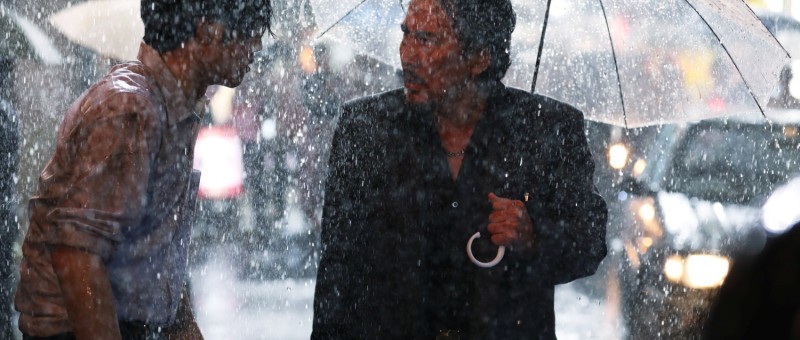
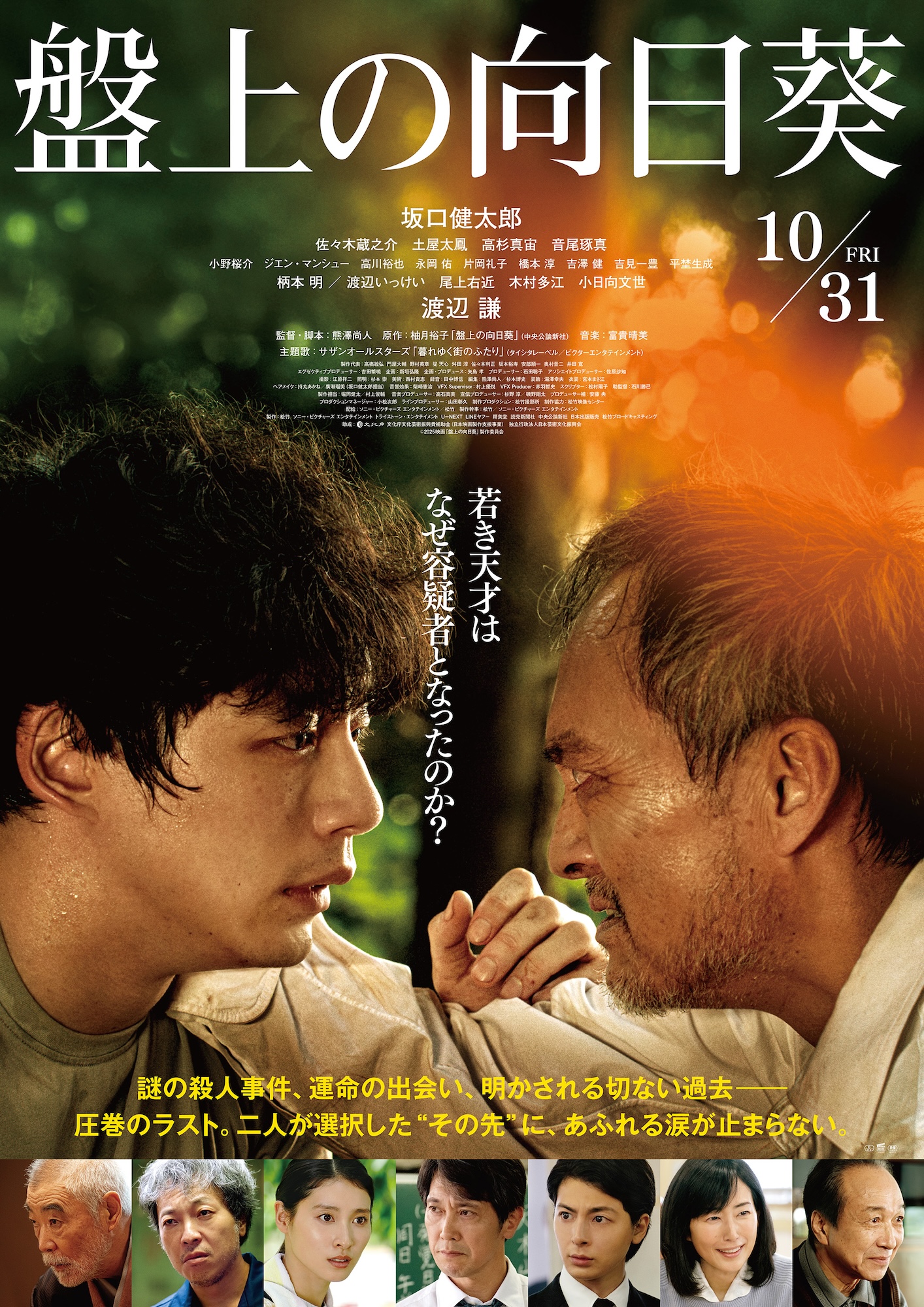
When a body is discovered buried with a priceless set of shogi tiles, it unearths old truths in life of an aspiring player in Naoto Kumazawa’s sprawling mystery, The Final Piece (盤上の向日葵, Banjo no Himawari). In Japanese films about shogi, the game is often a maddening obsession that is forever out of reach. Hopefuls begin learning as children, sometimes to the exclusion of everything else, but there’s age cut off to turn pro and if you don’t make the grade by 26, you’re permanently relegated to the ranks of the amateur. 

Junior policeman Sano (Mahiro Takasugi) was one such child and in some ways solving the crime is his final match. The thing is, he loves the game and admires Kamijo’s (Kentaro Sakaguchi) playing style along with the aspirational quality of his rise from nowhere not having trained at the shogi school and turning pro at the last minute to win a prestigious newcomer tournament. He’s hoping Kamijo will win his game against prodigious player Mibu (Ukon Onoe) with whom Kamijo’s fortunes are forever compared. Which is all to say, Sano really doesn’t want Kamijo to be the killer and is wary of accusing him prematurely knowing that to do so means he’ll be kicked out of professional shogi circles whether he turns out to be guilty or not.

Nevertheless, the more they dig into Kamijo’s past, a sad story begins to emerge that strongly contrasts with his present persona, a slightly cocky young man with a silly beard and smarmy manner. While Mibu seems to have been indulged and given every opportunity to hone his skills, Kamijo was a poor boy whose father had drink and gambling problems and was physically abusive towards him. His mother took her own life, leaving Kamijo to fend for himself with a paper round while his father occasionally threw coins at him and railed against anyone who questioned his parenting style. Good intentions can have negative consequences, the landlady at his father’s favourite bar remarks recalling how he went out and beat Kamijo for embarrassing him after another man told him he should be nicer to his son.

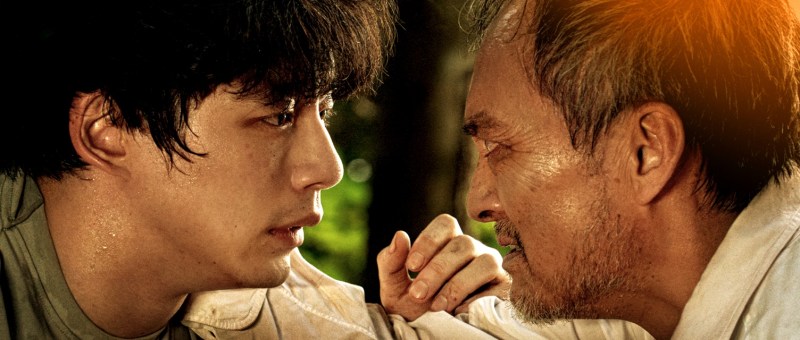
Toxic parental influence is the wall Kamijo’s trying to break in shogi. Aside from the man raising him, Kamijo finds another, more positive, paternal figure in a retired school teacher (Fumiyo Kohinata) who notices his interest in shogi and trains him in the game while he and his wife also give him clean clothes and a place to find refuge. But Kamijo can’t quite break free of his father’s hold much as he tries to force himself to be more like the school teacher. As an impoverished student he meets another man, the cool as ice yakuza-adjacent shogi gambler Tomyo (Ken Watanabe), who insists he’s going to show him the “real” shogi, but in reality is little different from his father if more supportive of his talent.

Kamijo finds himself torn between these three men in looking for his true self. Though he may tell himself he wants to be like the schoolteacher being good and helping people in need, he’s pulled towards the dark side by Tomyo and a desperate need for shogi which tries to suppress by living a nice, quiet life on a sunflower farm that reminds him of the happier parts of his childhood. There’s a cruel irony in the fact that the police case threatens to ruin to his shogi success at the moment of its fruition, even if it accompanies Kamijo’s own acceptance of his internal darkness and the way it interacts with his addiction to the game. 

Tomyo’s own obsession may have ruined his life as he looks back over the town where he spent his happiest months with a woman he presumably lost because of his gambling and need for shogi glory even though he never turned professional and remained a forever marginalised presence as a gambler in shogi society. Unlocking the secrets of his past seems to give Kamijo permission to accept Tomyo’s paternal influence and along with it the darker side of shogi, but there’s something a little uncomfortable in the implication that he was always doomed on account of his “bad blood” aside from the toxic influences of his some of his father figures from the man who raised him and exploits him for money well into adulthood, and the ice cool gangster who taught him all the best moves the devil has to play along with a newfound desire for life that may soon be snuffed out.


The Final Piece screens as part of this year’s Japan Foundation Touring Film Programme.
Last of the Wolves (孤狼の血 LEVEL2, Kazuya Shiraishi, 2021)

“The Showa era’s over. We don’t use guns now, business is our battlefield.” a recently released foot soldier is told, finding himself in a whole new world emerging from a not so distant past of turf wars and street scuffles into a late bubble wonderland of besuited corporatised gangsters. Set in 1988, Kazuya Shiraishi’s Blood of Wolves had been about the twilight of post-war gangsterdom forever associated with an era that was literally about to pass. Set three years later in the twilight of the bubble economy and an already established Heisei, Last of the Wolves (孤狼の血 LEVEL2, Koro no chi: Level 2) finds no longer rookie cop Hioka (Tori Matsuzaka) taking on the mantle of his late mentor Ogami, attempting to broker peace by getting uncomfortably close to yakuza. 

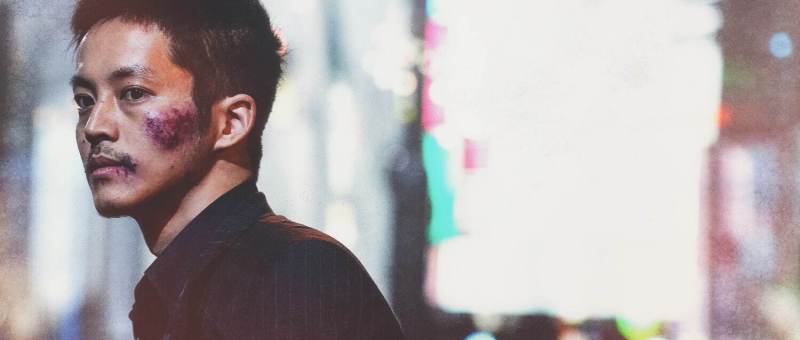
At the end of the previous film, Hioka had managed to engineer a truce between rival gangs Odani (with whom he is affiliated), and Irako through pushing top Odani guy Ichinose to take out boss Irako. Three years later, the peace has held and in any case Heisei yakuza no longer take violence to the streets. The release of crazed Irako foot soldier Uebayashi (Ryohei Suzuki), however, threatens to destabilise the local balance of power. Despite mournfully declaring that he doesn’t intend to wind up back in prison, Uebayashi’s first call on release is to the sister of one of his guards whom he rapes and kills in quite gruesome fashion. Hioka is put on the case and partnered with a genial veteran, Seshima (Yoshiko Miyazaki), weirdly excited about investigating a murder at this late stage of his career, but quickly realises that Uebayashi’s recklessness is primed to destroy everything he’s built. 

Having started out a straightlaced rookie, Hioka has fully incorporated the Ogami persona dressing in sharp suits and sunshades, driving a sports car, and hanging out with the Odani guys, while also using his girlfriend’s little brother Chinta (Nijiro Murakami) as a mole in rival gangs. As a cynical reporter points out, however, Ogami was essentially “undercover” in that he understood hobnobbing with yakuza was part of his job and something he did solely to keep civilians safe by preventing another street war. Hioka has started to lose his way, enjoying himself a little too much and already way out of his depth as the fragile peace he’d brokered by less than ethical means begins to crumble beneath his feet. 

Having been in prison, Uebayashi is unaware of the various ways in which the world has changed seeking to return to old school rules of gangsterdom, ironically lecturing his superiors on the absence of jingi (honour and humanity) in their new corporate existence. He’s a monster and a sadist, but his violence is also a result of the horrific abuse he suffered as a child which led to an equally heinous act of revenge while as a member of the ethnic Korean Zainichi community, like Chinta and his siblings, he continually faces discrimination and social oppression. His first act on release is of revenge against the guards who relentlessly tortured him in prison, the murdered woman’s brother confessing that they wrote him up as a model prisoner in the hope he’d be released early so they wouldn’t have to deal with him anymore.  

Yet what Hioka and Uebayashi have in common is that they’re both pawns in a game they were unaware was being played. As it turns out the police corruption Hioka discovered during the previous film did not go away, and in certain senses they liked things the way they were before. Hioka’s truce is very bad for business for a certain subset at least. They might be minded to let a dangerous killer go loose if it disrupts Hioka’s attempt to suppress the criminal underworld to manageable levels. Mimicking the classic jitsuroku, Shiraishi throws in occasional voiceover from an anonymous narrator along with freeze frame and montage while skewing still darker in the levels of depravity among these desperate men fighting over the scraps of a world already in terminal decline even as the bubble seems fit to burst. Shiraishi ends on a note of change with the institution of the organised crime laws which have contributed to the ongoing decline of the yakuza, a relic of the Showa era unfit and unwelcome in the modern society, but also discovers that for good or ill there may yet be wolves in Japan.


Last of the Wolves screened as part of this year’s New York Asian Film Festival.

Teaser trailer (English subtitles)

The Blood of Wolves (孤狼の血, Kazuya Shiraishi, 2018)

korou_honpos_0220_fin.aiJapanese cinema, like American cinema, is one of the few in which the hero cop is a recognisable trope. Though they may be bumbling, inefficient, obsessed with bureaucracy, or perhaps just lazy, police in Japanese cinema are rarely corrupt or actively engaged in criminality. Even within the realms of the “jitsuroku” gangster movie, the police maintain a fringe presence, permitting the existence of the underground crime world in order to contain it. “Jitsuroku” is, in a fashion, where we find ourselves with Kazuya Shiraishi’s throwback underworld police story, The Blood of Wolves (孤狼の血, Koro no Chi). Set in 1988, the end of the Showa Era which had seen the rebirth of post-war Japan and the ascendency of yakuza thuggery, The Blood of Wolves is based on a novel by Yuko Yuzuki rather than a “true account” of life on the frontlines of gangsterdom, but otherwise draws inspiration from the Battles Without Honour series in updating the story of nihilistic yakuza violence to the bubble era.

In 1988, a young accountant “goes missing” sending his sister to ask the police for help in locating him. The case gets passed to sleazy detective Ogami (Koji Yakusho) and his new rookie partner, Hioka (Tori Matsuzaka). Ogami leers disturbingly at the dame who just walked into his office before dismissing the newbie and extracting a sexual favour from the distressed relative of the missing man. Unfortunately, the accountant turns up dead and the bank he worked for turns out to be a yakuza front caught up in a burgeoning gang war between the Odani with whom Ogami has long standing connections and the gang from the next town over who are looking to increase their territory.

Ogami, a chain smoking, hard drinking, womanising detective of the old school, has one foot in the yakuza world and the other on the side of law enforcement. Hioka, a recent graduate from the local but also elite Hiroshima University (something of a rarity in his current occupation), is not quite sure what to make of his new boss and his decidedly “unorthodox” methods, becoming increasingly concerned about the way the police force operates in a town defined by organised crime. Deciding that Ogami has gone too far, he eventually makes the decision to go to IA with a list of complaints but there’s still so much he doesn’t know about Hiroshima and it is possible he may have picked the wrong side.

What he discovers is that the police force is so intrinsically rotten as to have become little more than a yakuza gang itself, only one with the legal right to carry guns and a more impressive uniform. Ogami, for all his faults, apparently has his heart in the right place. His “friendships” with gangsters are more means to an end than they are spiritual corruption, gaining leverage that will help him keep a lid on gang war – after all, no one wants a return to the turbulent days of the 1970s when the streets ran red with the blood of unlucky foot soldiers and that of the civilians who got in their way. Meanwhile Hioka, starting out as the straight-laced rookie, is himself “corrupted” by the corruption he uncovers, developing a complex mix of disgust and admiration for Ogami’s practiced methods of manipulation which, apparently, place public safety above all else.

Ogami, as he tells the conflicted Hioka, knows he walks a tightrope every day, neatly straddling the line between cop and yakuza, and the only way to stay alive is to keep on walking knowing one slip may lead to his doom. He may say cops can do whatever they like in pursuit of “justice” (and he does), but Ogami has his lines that cannot be crossed, unlike others in his organisation who care only for themselves and have long since given up any pretence of working for the public good.

Shiraishi channels classic Fukasaku from the noticeably retro Toei logo at the film’s opening to the voice over narration, garish red on screen text, and frequent use of freeze frames familiar from the Battles Without Honour series and associated “jitsuroku” gangster fare that followed in its wake. Moving the action up to 1988, the gangster world is once again in flux as it tries to corporatise itself to get in on the profits of bubble era prosperity which largely has no need for the thuggish gangster antics of the chaotic post-war years in which the yakuza could paint itself as a defender of the poor and oppressed no matter how ridiculous it might have been in reality. Ogami is a dying breed, a relic of the Showa era meeting its natural end, but perhaps you need to be a wolf to catch a wolf and guardian spirits can come in unexpected forms.


Screened at the 20th Udine Far East Film Festival.

Original trailer (English subtitles)