Love Will Tear Us Apart (ラヴ・ウィル・テア・アス・アパート, Kenichi Ugana, 2023)

“This film depicts a pure and genuine love between an awkward boy and a girl with a pure heart,” according to a pop idol starring in a film called “garbage love”, but it’s a true enough description of Kenichi Ugana’s genre-crossing slasher romance, Love Will Tear Us Apart (ラヴ・ウィル・テア・アス・アパート). Co-scripted by Hirobumi Watanabe, the film has a deadpan, surreal sensibility but has a lot to say about entrenched patriarchy and a bullying culture. 

As the film begins, Wakaba is a cheerful little girl who has an all encompassing obsession with a handsome pop idol, but is secretly enduring an oppressive atmosphere of domestic violence in her family home at the hands of her cruel and violent father. In this she might have found a kindred spirit in classmate Koki who is enduring physical abuse at the hands of his mother who openly tells him how much happier she’d be if only he’d never been born. Koki is also being bullied by a pair of mean kids at school and meekly takes it, unable to stand up for himself. When Wakaba steps up and tries to help him, the bullies turn on her too and their teacher (Atsuko Maeda) seemingly does nothing. After the pair bond through a screaming session at a local river, the bullies mysteriously fall out of a window which Koki is then seen ominously staring out of. 

The film jumps on seven years to a teenage Wakaba (Sayu Kubota) who discovers the world is not a safe place for women, repeatedly encountering a series of skeevy guys beginning with her favourite pop band who lure her to a cabin in the woods where they openly talk about getting her drunk to take advantage of her or spiking her drinks. One of the chief victimisers is another woman, Moeka, whose apparent “job” it is to recruit girls for the guys to have fun with. Wakaba’s friend Kanna (Riko) wants to leave, sensing that there’s something not quite right but Wakaba is naive and unable to see the danger. A similar thing happens when she visits Tokyo alone and has a meet cute with a guy who spills coffee on her shirt and offers to buy her a new one, then to show her around, takes her for sushi, declares his love and makes a proposal of marriage. 

As might be expected, many of these men end up dead at the hands of a vicious, chainsaw-wielding serial killer in a white hazmat suit, gas mask, and goggles. You can’t quite blame him for his crimes because everyone he kills is so irrediambly awful while it really does seem that he might be trying to protect Wakaba in some way from the hidden dangers she remains unable to see because of her pure heartedness. While her own father had been cruel and violent, she discovers that Moeka’s, police detective Kamiyama (Mitsuru Fukikoshi), is the opposite but worse in his unsettling obsession with his daughter, whom he believed to “pure and earnest” little knowing that she had been procuring young girls to serve up to the sleazy band members.

In a strange way, the serial killer turns out to be Wakaba’s healthiest relationship even if he’s basically stalking her not to mention murdering people with chainsaws because they threatened her happiness. The film runs through a series of genres from the cute childhood romance that soon turns ominous and the cabin in the woods slasher movie complete with creepy monkey and trainset, to martial arts epic as Wakaba abandons her life to train with a YouTube serial killer catching guru in a tropical resort town but retains its sense of anarchic innocence and internal integrity. As the pop star had implied, it really is a tale of genuine love between an awkward boy and a pure hearted girl in which they gradually realise that they each have a right to be happy and can be so together despite all violence and mayhem around them which includes killing a guy by shoving a grapefruit blender on his head. Strange and absurd the film nevertheless has a heartwarming romantic sensibility along with a desire for a less destructive world defined more by kindness and compassion than bullying and violence. 


Love Will Tear Us Apart screened as part of this year’s Camera Japan.

International trailer (English subtitles)

A Far Shore (遠いところ, Masaaki Kudo, 2022)

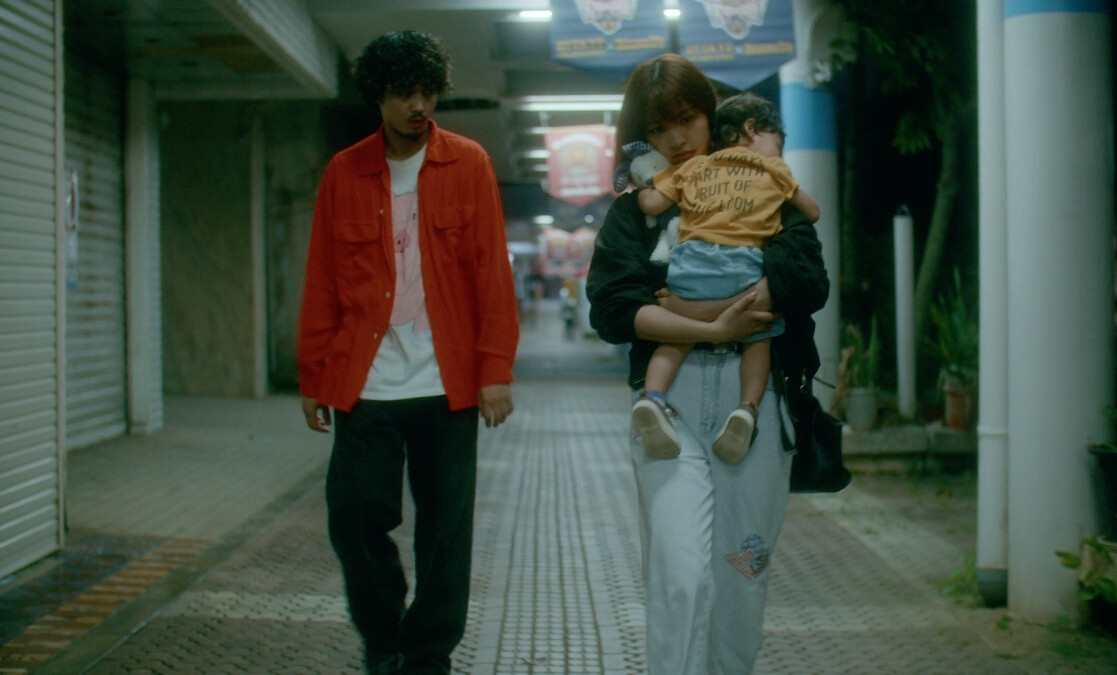
A young mother struggles to find a way through a legacy of parental abandonment and exploitation in Masaaki Kudo’s Okinawan drama, A Far Shore (遠いところ, Tooi Tokoro). As the title implies, the heroine does indeed long to go somewhere far away but finds herself hemmed in by the nature of the island on which she lives while facing rejection from all sides. She tries to do everything right, working to support herself and her son, but is finally left with no place to turn in a fiercely patriarchal and judgemental society. 

At 17 (Kotone Hanase), Aoi makes her living as a bar hostess leaving her two-year-old son Kengo (Tsuki Hasegawa) with her grandmother. Her husband, Masaya (Yoshiro Sakuma), is a drunken lout who can’t, and doesn’t want to, hold down a job. She hides the money she earns in various stashes around their apartment including in the bathroom bin fearful that Masaya will take it and they’ll be left short on the rent again. Though he refuses to work, Masaya resents being kept by his wife and often turns violent, viciously beating Aoi if he suspects her of hiding money from him or otherwise feels in some way belittled. 

On the one had, she isn’t supposed to be working in the clubs because she’s a minor but realistically they are the only place where she can find the kind of employment that will pay enough to support herself and her son. The clubs know they make more money off underage girls so they are keen to employ them, a gaggle of men from Tokyo obviously taken with the transgressive thrill of buying cocktails for a girl who technically isn’t old enough to drink, but cut them loose when the police come knocking as Aoi discovers when she is picked up by a patrol who take her in for questioning and ask insensitive questions such as how a woman who does what she does can love her son while making her the criminal rather than prosecuting the bar which employed her. In any case when Masaya beats her so badly she is forced to take on even more debt paying for hospital treatment she can no longer do bar work because men won’t want to drink with a woman whose face is bruised. In another irony, it’s the inability to work in bars, which only requires sitting and talking with men, that finally leaves her with little option other than sex work in which her clients are also often violent. 

Her plight in a sense echoes a legacy of abandonment in the Okinawan islands, her own parents having seemingly disowned her with her mother apparently in prison on the mainland and her father remarried with other children. When she asks him for help he just tells her that it’s easy for a woman to find work when men will struggle all their lives in Okinawa’s difficult employment environment, brushing off grandma’s reminder of the lucrative subsidy she assumed he had as a fisherman. Meanwhile Grandma also takes against her, believing she’ll end up wayward like her mother but seemingly accepting little responsibility for either of the women while suggesting that part of her problem lies in not having given enough respect to her local Okinawan heritage neither speaking the language nor obeying the customs. Grandma’s last straw is seeing Aoi take back Masaya after he abandoned her and ran off with all her savings, while he echoes his refusal to work by insisting they move in with his mother who can’t do anything with him either because he’s been indulged by a fiercely patriarchal social culture that encourages him to think he owes women no basic respect or decency. To add insult to injury he ends up landing Aoi with even more debt when he’s arrested after a bar fight and tells the police that his wife will pay the compensation money he owes to the other guy for throwing the first punch.

Eventually Aoi is brought to the attention of social services who do actually seem a little more sympathetic than might be expected but still largely fail to accept that she may be a mother but she’s also a child in need of care. She tries get to a respectable job in a cafe but encounters only further exploitation with extreme low wages, a shift pattern that doesn’t suit a working mother, and a one month probationary period during which she wouldn’t be paid which is obviously impossible for her to manage with no other means to support herself while everywhere she goes people just look down on her. A bleak portrait of life in contemporary Okinawa, Kudo’s icy drama suggests the hope of a distant place is all women like Aoi have to keep them going but in the end it may not be enough. 


A Far Shore made its World Premiere at this year’s Karlovy Vary International Film Festival.