 Akira Kurosawa’s later career was marred by personal crises related to his inability to obtain the kind of recognition for his films he’d been used to in his heyday during the golden age of Japanese cinema. His greatest dream was to die on the set, but after suffering a nasty accident in 1995 he was no longer able to realise his ambition of directing again. However, shortly after he died, the idea was floated of filming some of the scripts Kurosawa had written but never proceed with to the production stage including The Sea is Watching (海は見ていた, Umi wa Miteita) which he wrote in 1993. Based on a couple of short stories by Shugoro Yamamoto, The Sea is Watching would have been quite an interesting entry in Kurosawa’s back catalogue as it’s a rare female led story focussing on the lives of two geisha in Edo era Japan.
Throughout this tale of love bought and love lost, we mainly follow the kindly geisha Oshin (Nagiko Tono) who ends up helping a nervous young man one night when he crashes into her geisha house in an attempt to avoid being picked up by the police. It seems he’s been out drinking with friends for the first time and, after having drunk far too much, may have stabbed another customer (though he can’t quite remember). Oshin comes up with a plan by cutting off his topknot and passing him off as one of her regular customers but Funosuke (Hidetaka Yoshioka) is not a born dissembler and remains sitting bolt upright before heading home at the first light of day.
Something passes between the two in the night and Oshin unwisely begins to fall in love. Though she begs him not too, Funosuke repeatedly visits her claiming to enjoy her company. However, though the other girls at the geisha house are in favour of Oshin’s love across the class divides romance and go to great lengths to help her, Funosuke is just a feckless boy completely unaware of the way he’s been toying with people’s hearts. Later, Oshin meets another damaged man, Ryosuke (Masatoshi Nagase), and begins to fall in love again but can a put upon geisha ever believe the words of men who think they can trade money for love?
Kurosawa has sometimes had the charge of misogyny thrown at him, somewhat unfairly, as his films are often very masculine in nature. The Sea is Watching, conversely, is the story of two women, Oshin and her fellow geisha Okikuno (Misa Shimizu), who claims to have come from a wealthy samurai background. Oshin is still young, her kindness and softness have not yet been eroded by the often harsh and cruel world in which she lives. She contents herself with romantic dreams of finding a man who will rescue her from this unpleasant way of life. Okikuno, by contrast, is older, harder, more experienced in the ways of the world, and therefore more inclined to towards pragmatism. She finds her salvation in self deception about the past whereas Oshin’s fantasies are all focussed on her future. In many ways the women are mirrors of each other but they also have a tight, sisterly bond in which each seems to understand the other perfectly without the need for explanation.
Structurally, the film feels unbalanced as it focusses more heavily on Oshin in the early stages only to gradually shift through to Okikuno by the end. The thematic split between Oshin’s twin tales of love doesn’t quite help, though it does add a degree of pathos to the situation as Okikuno can see that Oshin’s happy ever after is an unlikely prospect, but still somehow wants to make it happen. Oddly, Kumai chooses not to emphasis the relationship between the two women until the very end, preferring to deal with each of their disappointments and dead end romances separately, but the film does finally come together when they are trapped alone in the geisha house following a freak flood.
In many ways, filming the unfinished work of a great director is an entirely thankless task – every fault is because you aren’t him and every success is down to the departed genius, but Kumai does what he can to both honour Kurosawa’s memory and put his own stamp on the material. There are frequent Kurosawa-esque compositions and the final, deliberately unreal scene of the geisha house underwater framed against the starry sky also has a suitably Kurosawan feeling. That said, something about The Sea is Watching never quite catches fire, its symbolism feels underworked and the final, climactic scene lacks the power it seems to want to have despite Misa Shimizu’s impressive performance. Not drowning, but waving, The Sea is Watching is an uneven experience but makes up for its tonal problems through the strong performances of its cast and powerful, expressionist imagery which allow it to successfully ride the waves of the emotional storms at its centre.
The Sea is Watching is available on DVD with English subtitles in the US and UK from Sony Pictures Entertainment.
US release trailer:
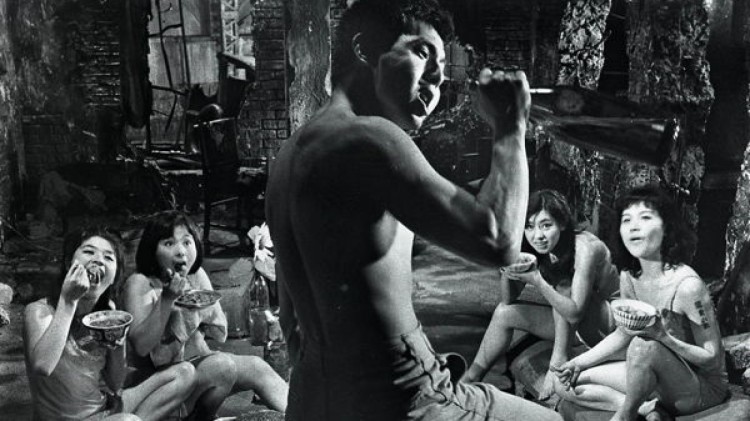 What are you supposed to do when you’ve lost a war? Your former enemies all around you, refusing to help no matter what they say and there are only black-marketers and gangsters where there used to be merchants and craftsmen. Everyone is looking out for themselves, everyone is in the gutter. How are you supposed to build anything out of this chaos? Perhaps you aren’t, but you have to go one living, somehow. The picture of the immediate post-war world which Suzuki paints in Gate of Flesh (肉体の門, Nikutai no Mon) is fairly hellish – crowded, smelly marketplaces thronging with desperate people. Based on a novel by Taijiro Tamura (who also provided the source material for Suzuki’s Story of a Prostitute), Gate of Flesh has its lens firmly pointed at the bottom of the heap and resolutely refuses to avert its gaze.
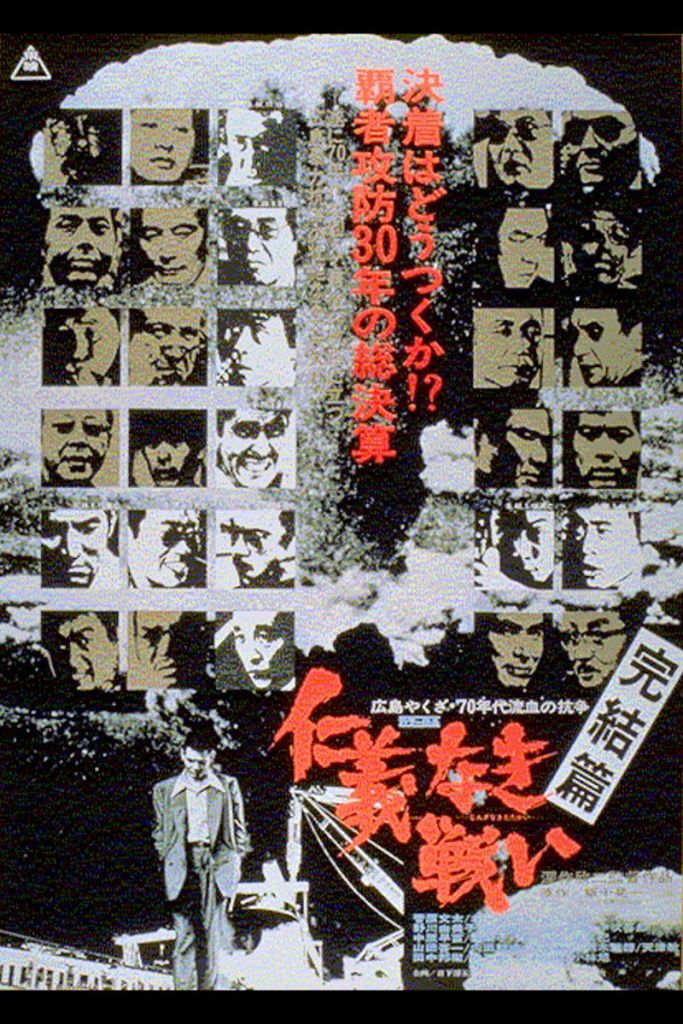 And so, the saga finally reaches its conclusion. Final Episode (仁義なき戦い: 完結篇, Jingi Naki Tatakai: Kanketsu-hen) brings us ever closer to the contemporary era and picks up in the mid ‘60s where Hirono is still in prison and Takeda, released on a technicality, has decided to move the yakuza into the legit arena. The surviving gangs have united and rebranded themselves as a political group known as the Tensei Coalition. However, not everyone has joined the new gangsters’ union and the enterprise is fragile at best.
 Windows on Worlds