Winny (Yusaku Matsumoto, 2023)

Can a creator be held legally responsible for what other people might decide to do with their creation? For some, that is the essential question of the trial at the centre of Yusaku Matsumoto’s legal drama Winny, but in speaking more to the present day than the early 2000s in which the real life events took place the film is more concerned with freedom of speech in a society in which established authorities may seek to resist the democratisation of information. 

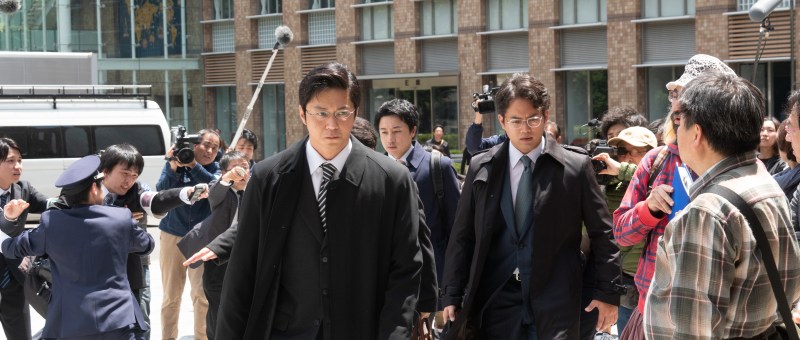
A talking head seen on television at one point suggests that peer-to-peer file sharing programme Winny disrupts the democratic copyright regime, but according to its creator Isamu Kaneko (Masahiro Higashide) the appeal of peer-to-peer is that it is by nature democratic in forging a network of machines on an equal footing. Nevertheless, in November 2003 two people were arrested for using Winny to share copyrighted material and Isamu’s home was searched by the Kyoto police who arrested him for aiding and abetting copyright infringement. He and his lawyers argue that to charge the developer is wrongheaded and irresponsible in that it will necessarily stifle technological advance if developers are worried about prosecution if their work is misused by others while his intention in any case had not been to undermine copyright laws but essentially for technological innovation in and of itself. 

Meanwhile, the film devotes much of its running time to a concurrent police corruption scandal in which a lone honest cop is trying to blow a whistle on a secret slush fund founded on fraudulently produced expense receipts. The implication is that the reason the police decided to go after Isamu is that they feared Winny’s potential to expose their own wrongdoing. A member of the police force had apparently used Winny and introduced a vulnerability to the police computer system that allowed confidential data to be leaked, and Winny is indeed later used to publicly disseminate evidence which proves the claims of the whistleblower, Semba (Hidetaka Yoshioka), are true. Semba had previously tried to take his concerns to the press privately but was ignored, the editor simply printed a police press release without investigation unwilling to rock the boat. But a programme like Winny exists outside of the establishment’s control which is why, the film suggests, the police in particular resent it. 

A younger officer Semba reproaches at his station gives the excuse that everybody does it and refusing to fill in the false receipts would make it difficult for him to operate in an atmosphere in which corruption has become normalised. Even the police use Winny, a prison guard confiding in Isamu that he’s used the programme to download uncensored pornography while prosecution lawyers conversely attempt to embarrass Isamu by leaking pictures of his porn collection to the press and bringing it up on the stand. “Everybody does it” is not a good defence at the best times aside from being a tacit admission of guilt but reinforces a sense that the police operates from a position of being above the law. A particularly smug officer thinks nothing of perjuring himself on the stand, spluttering and becoming defensive when Isamu’s lawyers expose him in a lie. 

Isamu is depicted as a rather naive man whose social awkwardness and childlike innocence leave him vulnerable to manipulation. He’s told to sign documents by the police so he signs them thinking it’s better to be cooperative, taking the advice he’s given when he questions a particular sentence that he can correct it later at face value while assuming that he’ll be able to straighten it all out in court by telling them the truth and that he signed the documents because the police told him to. Meanwhile, he’s almost totally isolated, prevented from talking to friends and family out of a concern that he may use them to conceal evidence. 

The film seems to suggest that the stress of his ordeal which lasted several years may have led to his early death at the age of 42 soon after his eventual acquittal. In any case he finds a kindred spirit in his intellectually curious lawyer (Takahiro Miura) who defends him mostly on the basis that the right to innovate must be protected and a developer can not be responsible for the actions of an end user any more than a man who makes knives can be held accountable for a stabbing. Matsumoto captures the sense of wonder Isamu seems to feel for the digital world and has a great deal of sympathy for him as an innocent caught up in a game he doesn’t quite understand while fiercely defending his right to express himself, along with all of our own, without fear no matter what the implications may be.


Winny screens in New York Aug. 2 as part of this year’s JAPAN CUTS.

Original trailer (no subtitles)
It’s All My Fault (ぜんぶ、ボクのせい, Yusaku Matsumoto, 2022)

A young boy and a homeless drifter attempt to overcome the legacy of parental rejection in Yusaku Matsumoto’s sensitive coming-of-age drama, It’s all My Fault (ぜんぶ、ボクのせい, Zenbu, Boku no Sei). “It’s all my fault” is something many children think about circumstances which are well beyond their control, but it’s also something they’re encouraged to believe by an abusive or neglectful parent who tells them that they are to blame for the treatment they receive. Nevertheless, Yuta (Haruto Shiratori) comes to think that all the bad things happening in the world are in some way his fault, which might on one level be easier to believe than trying to accept that the world is sometimes a relentlessly unkind place. 

A sad and sullen boy, Yuta is viewed with some suspicion by the staff at the care home where lives due to his brooding nature and refusal to speak. The cause of his anger is that he was told by a previous caretaker that he’d be able to see his estranged mother, Rika (Marika Matsumoto), when he entered middle school and is resentful that he has still had no contact with her. The sad fact is, however, that Rika stopped taking their calls a long time ago and seemingly has no further intention of maintaining contact with her son. 

After the orphanage is rocked by a literal earthquake, Yuta sets off to find his mother but though she is moved to see him it quickly becomes clear that she is not really prepared to play a maternal role. When her drunken boyfriend returns home, she tells him that Yuta is a relative’s child she agreed to watch for a short time and appears otherwise conflicted, solicitously making sure he has enough to eat but more or less forgetting he’s even there whenever the boyfriend is around. Eventually she rings the care home to come and take him back, forever ruining Yuta’s faith in genuine human connection. 

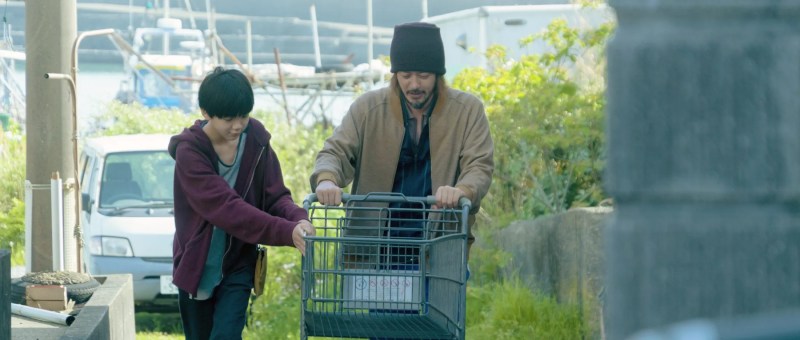
Managing to run away, Yuta is later taken in by eccentric drifter Sakamoto (Joe Odagiri) who strongly identifies with the boy in having grown up with an abusive mother whose legacy he has been unable to escape. Shiori (Ririka Kawashima), a teenage girl with issues of her own who also befriends Sakamoto, is envious of his untethered lifestyle viewing him as free and bound by no one. But in truth he too is trapped as symbolised by the broken van which prevents him from leaving to travel to Nagoya and confront his mother as he often says he intends to do. Sakamoto describes his trauma as a like a rock in the heart that tortures him as he continues to resent his mother for the abuse she dealt him while simultaneously suggesting that she has dementia and may not even remember that she has a son. Yuta by contrast insists that his mother is not a bad woman and continues to yearn for her, treasuring the friendship bracelet she made for him only for it to be broken by thuggish teens who get their kicks bullying those they perceive to be weaker than themselves.

Sakamoto becomes an awkward paternal figure, teaching Yuta how to survive in his way of life by hatching scams on wealthy passers by and fetching junk to sell to a local scrap merchant but is equally arrested, unable to come to terms with the traumatic past and therefore unable to move on. Shiori envies what she sees as his freedom in part because she has little of her own. Secretly blaming her authoritarian father for her mother’s death which she has come to doubt was really from an illness as she was told, Shiori has an internalised sense of shame and inadequacy knowing that she cannot be the person her father wants her to be and longs to escape him. Yuta continues to dream of a family, inviting Shiori to come with them to Nagoya when the truck is fixed, but is met only with despair as the world conspires against his happiness and encourages him to blame himself for his all his misfortune. Shot with an unsentimental if empathetic eye, Matsumoto’s hard-hitting drama examines the legacies of parental abuse, neglect, or absence persisting long into adulthood while his young hero struggles with himself in his conflicting emotions towards the woman who abandoned him with only an impossible future. 


It’s All My Fault screened as part of this year’s Camera Japan.

Original trailer (no subtitles)

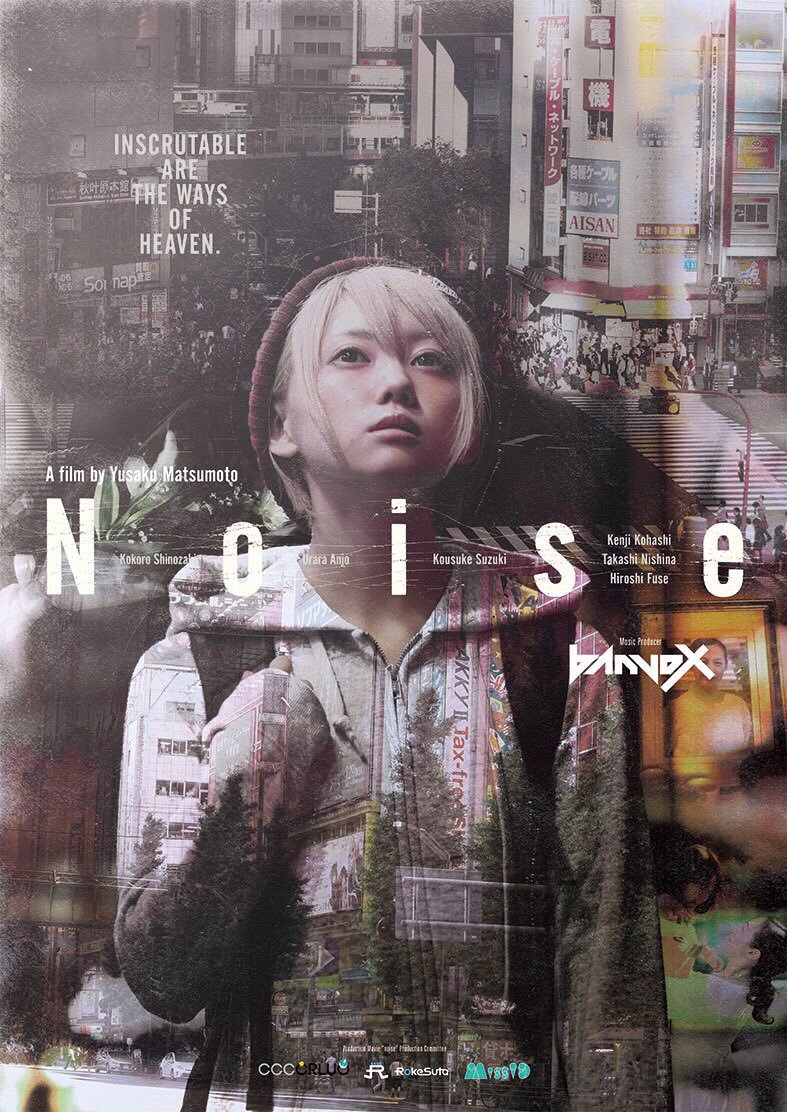
Noise (Yusaku Matsumoto, 2017)

noise posterWhat makes someone take off on a homicidal rampage? First time director Yusaku Matsumoto attempts to find out by examining the down and dirty backstreets of Akihabara eight years after a mass killing shook the nation. Dealing with trauma, the death of the family, the precarious position of vulnerable young women pulled into an industry they don’t quite understand, economic insecurity, underground idols, and general nihilistic hopelessness Matsumoto has certainly conjured enough noise to drive even the most level of heads to distraction but once again, it is the city itself which eats its young in the indifferent frenzy of modern life.

Eight years ago, Misa’s mother was one of several people murdered by a lone assailant who drove a truck into a busy pedestrian intersection in Akihabara before getting out and stabbing random passersby. Misa is now making a go of it as an “underground idol” – young girls who sing and dance in clubs in Akihabara but don’t have recording contracts or big studios behind them. When not performing on stage she makes ends meet by working in the “massage parlour’ attached to the studio where she provides sexualised services but not actual sex to met who pay a flat rate on the door and then pick their particular activities off the menu inside.

Meanwhile, delivery driver Ken lives a lonely and miserable existence with his hedonistic mother who rolls in drunk early in the morning and constantly badgers her son for money. Ken would like to better himself and escape his dreadful living conditions, but his mother disagrees and disapproves of him spending his money on online courses rather than giving it all to her. Ken’s mother is also in trouble with the same loanshark gangsters which (secretly) run Misa’s club.

The third plot strand follows high school girl Rie and her lonely father who looks after grandpa at home and tries to reconnect with his daughter but can’t seem to get through to her. Rie chases a delinquent boyfriend she fantasises about trapping through pregnancy before getting herself mixed up with gangsters and embroiled in the same world as Misa but with no one looking out for her.

The strongest theme which runs through the film is that of familial breakdown. All of the protagonists come from one parent families in which the remaining parent has largely failed in their responsibilities. Though this seemingly deliberate approach is unfortunate in playing into the stigma surrounding atypical families, it is certainly true that none of the young people has any access to support from the older generation. Misa’s father had long been abusive even before her mother died, gambling the family money away betting on the horses and spending his life at home drinking. Now seemingly reformed (though not perhaps free of gambling), he wants to try again but it may already be too late.

Similarly, Rie’s father does his best – coming home from work on time, cooking proper meals, and trying to take an interest but he can’t get through to his angry teenage daughter and is also preoccupied by the need to care for his aged, bedridden father. In a strange coincidence he ends up visiting Misa’s underground idol bar where he takes a liking to Misa precisely because she looks a little bit like Rie. Nicknamed Yama-chan by the girls, Rie’s father’s attempts to forge a connection with a look-a-like of his own daughter take on a painfully tender quality of muddled, misdirected affection but a quick look around the rest of the club makes plain it’s not so far removed from the massage parlour as one might think. One of the other regular patrons is a colleague of Ken’s who seems to have little else in his life apart from underground idols, spending his life in the club buying false connection through Polaroid photos and handshakes. What the girls are selling isn’t sex but (false) kindness, providing a facsimile of the love each of these disconnected men is seeking but either thinks themselves unworthy of or is unable to find out in the “real” world.

Ken looks down on these men, he doesn’t understand why they waste their lives in vacuous pursuits of empty pleasure, but his own life, which has been more or less ruined by his irresponsible mother, holds little pleasure of its own. Reading books about mass killings and inspired by the 2008 mass murder, Ken repeatedly makes nuisance phone calls to the police station which arrested the killer threatening to commit a similar crime himself. Flat broke, abandoned, evicted, and with no future possibilities it’s little wonder he feels as backed into a corner as he does but Ken’s final, raw phone call in which the policeman on the other end tries to reassure him that hope does exist proves the last straw in his ever fracturing mental state.

In trying to answer the question why someone might want to kill others, Matsumoto does indeed blame noise. Misa, in giving a painful to camera interview looking back on the massacre reveals that she took all of her anger and internalised it, hurting herself rather than others. Ken, by contrast, seems to burn with rage permanently on the brink of explosion. Rie tries to find the peace she couldn’t find in her own family by starting a new one but is extremely deluded by her choice of mate and then deluded once again by a man faking kindness but thinking only of commerce. All of this desperation – the exploitation, the gangsters, the dire economic prospects of neglected children, conspire to push the already strained closer to the edge, believing that harming others will make them feel better through a strange kind of social revenge. Matsumoto’s Akihabara pulses to beat of synth strings and idol pop, though its soundscape is not one of freedom and joy but anxiety and depression as the city’s disenfranchised youth marches towards its dead end future with no hope in sight.


Screened at Raindance 2017

Original trailer (no subtitles)