Laughing Under the Clouds (曇天に笑う, Katsuyuki Motohiro, 2018)

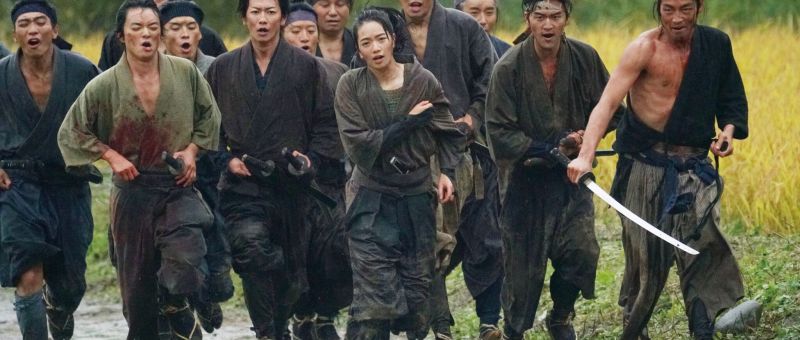
A cheerful former samurai chooses laughter as the best weapon against existential anxiety in Katsuyuki Motohiro’s big budget adaptation of the manga by Karakara-Kemuri, Laughing Under the Clouds (曇天に笑う, Donten ni Warau). Set amid the chaos of the late Meiji social revolution in which the samurai are no more, Motohiro’s supernatural drama is in some ways uncomfortably reactionary even as it takes as its heroes the defenders of a burgeoning new democracy who, our hero aside, seem to have a tendency towards authoritarianism in their insistence on the kind of order only they can bring. 

Indeed, prisoners brought to “prison island” are coldly informed that “hope, freedom and peace. These are things of the past” because “once you’re in here you’ll never get out”, “you have no rights in here”. Most of the prisoners are here it seems because of their opposition to the new regime including the mysterious Fuma Kotaro former leader of a ninja clan wiped out by imperial forces now held in solitary confinement. The man we first see dragged in is apparently a former samurai struggling to adjust to his loss of privilege and unable to find new ways of living in a world of superficial equality. 

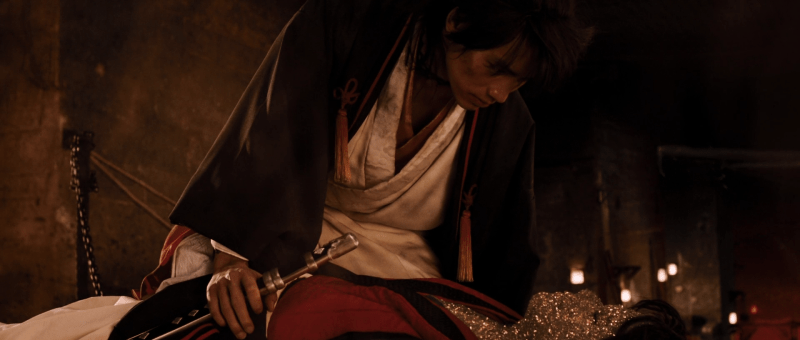
Yet it’s not this destabilisation of the social order which presents the moment of chaos so much as a prophecy that Orochi, a vengeful snake spirit, is due to make his return to Earth and wreak even more havoc. As the legend goes, Orochi brought clouds and rain which provided humanity with a bountiful harvest yet humanity resented him for his ugliness and so Orochi took revenge for their ingratitude by creating chaos. Tenka (Sota Fukushi), a former member of the Nile imperial Wild Hound squad, sees his familial legacy as the duty to combat the vicious cycle of hate through the power of laughter. His decision to leave the Wild Hounds after his parents were murdered by ninjas in order to care for his orphaned brothers is another indication of his essential humanity as is his determination that he will protect not only his town but whoever it is that has been selected as a vessel for Orochi’s return. 

These humanitarian concerns stand in direct contrast with the unfeeling authoritarianism of the Wild Hounds or the innate cruelty of the existence of a place like prison island where those who threaten the new regime are exploited as slave labour. On the other hand, the anger of the disempowered ninja clans is perhaps understandable even if their opposition to the regime, intending to harness the power of Orochi to overthrow the government, is an attempt to hang on to their privilege as a path back to the way things used to be. As such it’s they rather than Orochi who become the central villain though one could also read Orochi as an expression of the intense anxiety of the age especially as it invades the body of a young man himself feeling resentful and confused while looking for a sense of direction in a rapidly changing society. 

Tenka’s opposition is rooted in cheerfulness, in learning to laugh even under the clouds and becoming stronger for it though his otherwise openhearted nature stands in direct contrast with his oft repeated catchphrase “I am the law” as he enforces order in his small provincial town willingly delivering criminals and fugitives to prison island but also making a point of befriending a former ninja, Shirasu (Ren Kiriyama), he rescued after the raid which killed his parents in acknowledging that Shirasu himself was not responsible for their deaths only the chaotic world in which they live. 

Boasting some impressive special effects as Tenka and the forces of order team up for some spiritual magic to send Orochi back where he came from, Laughing Under the Clouds ultimately sells a positive message casting Tenka’s revolution as an ideal world of love, laughter, and happiness while simultaneously ignoring the oppressive qualities of new social model such as its shady prisons, lack of tolerance for opposing political views, and failure to make good on the promises of a classless society. Nevertheless with its fantastical production design and inherent cheerfulness it does perhaps suggest that laughter may be the only real salve for internal darkness.  


Original trailer (no subtitles)

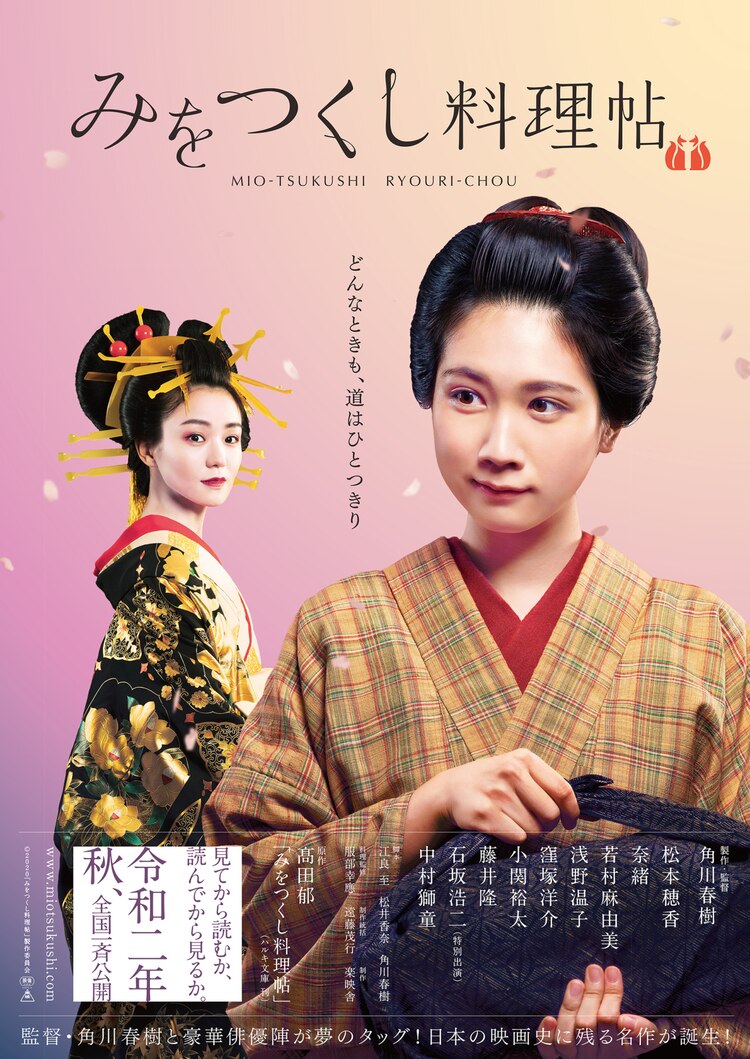
Mio’s Cookbook (みをつくし料理帖, Haruki Kadokawa, 2020)

“Food nurtures like heaven” according to a piece of advice from a local doctor which quickly becomes a catchphrase of the heroine of Haruki Kadokawa’s slice of foodie cinema Mio’s Cookbook (みをつくし料理帖, Mi wo Tsukushi Ryoricho). Adapted from the novel by Kaoru Takada, the Meiji-era drama is at once a tale of a pioneering young woman making her way in fiercely patriarchal society, and a heartwarming exploration of chosen and re-formed families discovering new senses of solidarity in the of wake tragedy while resolving to extend that sense of community to other lonely souls. 

The titular Mio (Honoka Matsumoto) meanwhile has had her share of loss, orphaned during a catastrophic flood and thereafter separated from childhood best friend Noe (Nao Honda) who simply disappeared. 10 years later, Mio and her adoptive mother Yoshi (Mayumi Wakamura) have relocated from Osaka to Edo though their lives have not been easy, Yoshi’s son having run off never to be seen again following the failure of the family restaurant. Mio is now working in a small cafe owned by a kindly older gentleman, Taneichi (Koji Ishizaka), but struggling to adapt to the sophisticated tastes of the capital with customers flatly refusing to eat her overly subtle oysters. A sullen samurai, Komatsubara (Yosuke Kubozuka), points her on her way by explaining that her food lacks “foundation” which is why she hasn’t yet found her groove. 

Mio’s culinary journey is also one of growing confidence as she learns to reorient herself in her new city life eventually realising that the key lies in uniting the tastes of Osaka and Edo as if integrating the two cities into her essential identity. A fortune teller had once told her that she would suffer many hardships but eventually reach “blue sky beyond clouds”, discovering a taste of that in her unexpected success even as those around her marvel at the female chef, a hitherto unheard of phenomenon, as she climbs the ranks of the local restaurants with her innovative cuisine after taking over from Taneichi. 

Yet her success also brings her enemies in the conservative and increasingly greedy Edo society. A rival restaurant rips off her signature dish and charges twice the price, a customer admitting that many will gladly pay more just to be seen doing so, less interested in the quality of the food than what is fashionable (times it seems do not change all that much). Even so “food is only as good as the cook” Yoshi is fond of saying believing that a bad person can’t make good food, something brought out by Mio’s compassionate nature as she continues to help those around her, vowing to “take vengeance through food” in concentrating on perfecting her craft and nourishing people’s souls rather than allowing herself to be beaten into submission by elitist intimidation. 

Meanwhile she continues to wonder whatever happened to Noe, reflecting that she was lucky in having found Yoshi who took her in out of compassion and continues to stay with her all these years later while gaining a surrogate father in the kindly Taneichi who himself lost a daughter. Noe’s prophecy was that she would “rise like the sun” and achieve “world-conquering fortune” though as it turns out she was not so lucky even if the prophecy did in fact come true if ironically. Both women continue to suffer because of the world in which they live each prevented from pursuing their romantic freedom, Mio forced to give up on her probably impossible love for samurai Komatsubara in order to embark on a quest to save her friend through achieving true success with her restaurant while Noe is constrained by her inescapable life as an oiran.  

Even so the film never really digs into the division placed between the women by the existence of the Yoshiwara into which one cannot enter and from which the other can never leave while the open ended conclusion that only advances a hope that the division may be breached perhaps suggests that it may never be, in part because it depends on Mio’s success as an independent woman in a feudalistic, patriarchal society. Meanwhile the two women continue to support each other in ways they can, Mio trying to raise her friend’s spirits with frequent care packages designed to remind her of home and their more innocent childhood smuggled in by supportive friends while each of them have in their own way found new families based on mutual compassion as a means of overcoming despair to rediscover a sense of hope for a better future founded on human solidarity. 


Mio’s Cookbook streams until 27th February in several territories as part of Japanese Film Festival Online 2022.

Original trailer (English subtitles)

Samurai Marathon (サムライマラソン, Bernard Rose, 2019)

Samurai Marathon posterAfter two and a half centuries of peaceful slumber, Japan was jolted out of its isolation by the arrival of Commodore Perry’s Black Ships. The sudden intrusion proved alarming to most and eventually provoked a new polarisation in feudal society between those who remained loyal to the Shogun and the old ways, and those who thought Japan’s best hope was to modernise as quickly as possible to fend off a foreign invasion if it did eventually arise as many feared it would. Lord Itakura (Hiroki Hasegawa) has a foot in both camps. He has no desire to move against the Shogun, but fears that centuries of peace have made his men soft and complacent. His solution is to institute a “Samurai Marathon”, forcing his retainers to run 36 miles to prepare for a coming battle.

If you’ve spent your life sitting around and occasionally waving a sword at something just to keep your hand in, suddenly trying to run 36 miles might not be the best idea, as many samurai keen to win favour through racing glory discover. There is, however, an additional problem in that, unbeknownst to anyone, samurai accountant Jinnai (Takeru Satoh) is a secret ninja spy for the shogun. Confused by the preparations for the race, he reported that a possible rebellion was in the offing only to bitterly regret his decision on realising Itakura’s anxieties are only related to external, not internal, strife. All of which means, the Shogun’s men are on their way and Itakura’s retainers are sitting ducks.

Helmed by British director Bernard Rose, Samurai Marathon (サムライマラソン) plays out much more like a conventional European historical drama than your average jidaigeki. Where samurai movies with an unusual focus tend to be comedic, Rose opts for a strangely arch tone which is somewhere between po-faced Shakespeareanism and post-modern irony. Rather than the stoical elegance which defines samurai warfare, the violence is real and bloody, if somewhat over the top in the manner of a gory Renaissance painting complete with gasping severed heads and gruesome sprays of dark red blood.

A chronicle of bakumatsu anxiety, the film also takes a much more pro-American perspective than might perhaps be expected, taking the view that the arrival of the Americans heralded in a new era of freedom and the origins of democracy rather than the more ambivalent attitude found in most jidaigeki which tend to focus much more strongly on the divisions within samurai society between those who wanted to modernise and those who just wanted to kick all the foreigners back out again so everything would go back to “normal”. Itakura, like many, is suspicious of foreign influence and the gun-toting, yankee doodle humming Shogunate bodyguard is indeed a villain though it’s Itakura himself who will end up firing a gun as if conceding that the future has arrived and the era of the sword has passed. 

Ramming the point home, Itakura is also forced to concede to the desires of his wilful daughter, Princess Yuki (Nana Komatsu), who wanted to travel and see the world while her society (and conventionally minded though doting father) insisted all there was for her was marriage and a life stuck inside castle walls. Managing to escape and disguising herself by cutting her hair and putting on peasant clothes, Yuki is able to evade detection longer than expected precisely because few people have ever seen her face. She also gets to make use of some of the samurai training she’s received by holding her own out on the road, though it seems improbable that her father would let her ride out alone even if he finally allows her free rein to go where she chooses.

Meanwhile, other ambitious retainers try to use the race to their own advantage though there’s poignant melancholy in one lowly foot soldier’s (Shota Sometani) dreams of being made a samurai considering that in just a few short years the samurai will be no more. The final sepia shift into the present day and a modern marathon may be a stretch, as might the unnecessary final piece of onscreen text informing us that we’ve just watched the origin story for the Japanese marathon, but the main thrust of the narrative seems to be that the samurai were running full pelt into an uncertain future, preparing to surrender their swords at the finish line. An unusual take on the jidaigeki, Samurai Marathon perhaps takes an anachronising view of Bakumatsu chaos in which the samurai themselves recognise the end of their era but finds its feet on the road as its self-interested heroes find common purpose in running home.


Samurai Marathon screens as the opening night gala of the 2019 New York Asian Film Festival on June 28 where actress Nana Komatsu will be in attendance to collect her Screen International Rising Star Asia Award.

Original trailer (no subtitles)