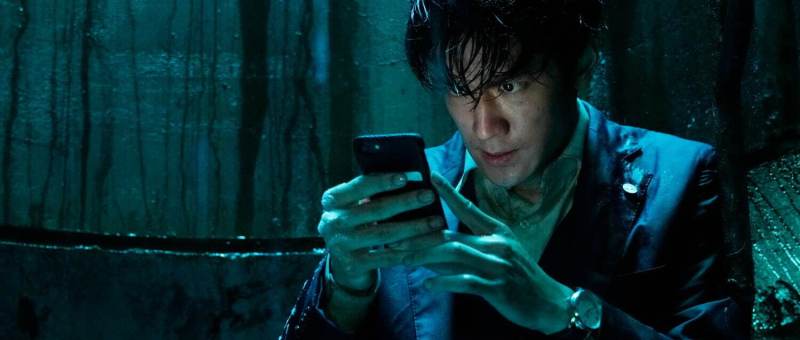
#Manhole (#マンホール, Kazuyoshi Kumakiri, 2023)

“Who are you? Why are you here?” both questions that might occur to anyone at any point in their lives, but don’t seem to bother the hero of Kazuyoshi Kumakiri’s off the wall B-movie thriller #Manhole (#マンホール) until he’s been trapped underground long enough to realise that his literal fall from grace might not be an accident after all. An existential journey deep into the soul of a seemingly blessed salaryman, Kumakiri’s defiantly absurdist drama is part social satire revolving around fluctuating identity in the social media age and meditation on the inevitability of karmic retribution. 

Shunsuke (Yuto Nakajima) does indeed seem to have it all. A successful estate agent, he’s about to get married and even has a baby on the way, only on his way home from a “surprise” party hosted by his work colleagues the night before his wedding he somehow manages to fall down an open manhole in the middle of Shibuya and becomes trapped there. His attempts to simply climb out are frustrated by a nasty gash on his thigh and a broken ladder while no one seems to be able to hear his cries for help. Though his phone still works, the only person who picks up when he calls is a former girlfriend, Mai (Nao), whom he threw over to court the boss’ daughter five years previously which makes it somewhat awkward to ask for help. 

As we can gradually gather, Shunsuke is not really a great guy and is in part in a hole of his own making. Even so, you can’t really confine someone to a hole just for being one. To begin with he busies himself with trying to solve various hole-related problems such as a leaking gas pipe with the salaryman tools at his disposal like the tiny of roll of sellotape in his pencil case or the cigarette lighter he was gifted by suspiciously aloof colleague Kase (Kento Nagayama) as a wedding present though there’s not much he can do about the weird foam or various animal corpses that surround him. 

It’s at this point he decides to enlist the help of the internet in setting up a profile on Twitter-like social media app Pecker where he identifies himself as “Manhole Girl” under the rationale that people are more likely to rush to the rescue of a pretty young woman than a 30-year-old salaryman who had too much to drink and fell in a hole. His readiness to do this hints at his internal duplicity and a confident sense of entitlement. It doesn’t seem to occur to him that whoever comes to his rescue might decide not to bother on discovering the truth. In any case, he soon becomes Pecker’s main character with engaged netizens keen to help him figure out where he is and, once it becomes clear it might not be an accident, who put him there. But claiming to be his own sister he’s also confronted with sordid speculation about his personal life and character that reveal there might be quite a few people who privately hoped he’d someday disappear down a hole in the ground and never come back up again.

Even before his ordeal, Kumakiri often frames Shunsuke looking at his own reflection hinting at a lack of self-recognition in the images that he sees of himself. Of course, he doesn’t know who any of the helpful netizens are either because most of them don’t use their “real” names or profile pictures that are actually of “themselves” just as he pulled a picture of a cute girl off the internet to create the Manhole Girl persona. He can’t even be sure of the identity of the people he speaks to on the phone, and wonders if Mai really did come to look for him when she says she’s been all over Shibuya and couldn’t find any open manholes. 

For a while it really does seem like he’s in “a completely different place”, some alternate dimension of existential purgatory. The sense of eeriness is only deepened by the strong blue-green lighting and ominous clouds above the hole that obscure the image of the full moon which, in the urban absence of stars and the disruption of his GPS seemingly caused by an unknown force, are all he has to go on in trying to figure out where exactly he is. Few will be prepared for the answer, though as some may expect Shunsuke knew all along for as much as it’s a “real” place it’s also a part of himself he sought to deny. Kumakiri excels in capturing the claustrophobic otherworldliness of Shunsuke’s near literal hell hole while mining a deep seam of cynical dark humour and anarchic absurdity culminating in an incredibly ironic and deliciously wry use of cheerful 1960s hit Sukiyaki. 


#Manhole screens at UltraStar Cinemas Mission Valley April 20/21 as part of this year’s San Diego Asian Film Festival Spring Showcase.

International trailer (English subtitles)

Our Meal For Tomorrow (僕らのごはんは明日で待ってる, Masahide Ichii, 2017)

Eat, drink, and be merry, as they say, for tomorrow we may be gone. The hero of Masahide Ichii’s Our Meal for Tomorrow (僕らのごはんは明日で待ってる, Bokura no Gohan wa Ashita de Matteru) has committed himself to the first of those, is still too young to be much interested in the second, and is resolutely failing at the third. Somewhat gloomy and introverted, he has decided on a course of self-isolation, convinced that it’s better not to get attached because all attachment ends in heartbreak, but a life without sensation is barely a life at all and in the end all you can do is live while you’re alive taking your pleasure where you can. 

Young Ryota (Yuto Nakajima) is a dreamy high school boy with his head in the clouds. Bamboozled into participation in a sack race relay with pretty classmate Koharu (Yuko Araki) he approaches the matter in characteristically analytical fashion, eventually realising that he, taller and stronger (physically at least), will have to take the lead if they are to move forward. Off the track, however, that’s a lesson he finds difficult to learn. After their victory, Koharu stuns Ryota by confessing that she asked him to join her in the sack race precisely because she has a crush on him. He panics and apparently turns her down, but eventually reconsiders.

Their romance continues in typical high school fashion, only strengthening as they prepare to move on to new stages in their lives in heading off to uni while idly dreaming of an imagined future with the family they will forge together as adults. There is however a shadow hanging over their love. The reason Ryota is so brooding and contemplative is because he’s reeling over the death of his older brother from an illness, something he tries to “discuss” (or more accurately monologue) with Koharu but she abruptly cuts him off because she has more important things to do than listen to a long sad story she feels she already understands. He, meanwhile, never quite thinks to ask her very much about her life outside of him and is both hurt and slightly resentful when she casually mentions that she’s had her share of loss too which is why she’s so keen to start a family of her own. 

Ryota may be the contemplative sort, but he’s also the type that likes to talk out loud about his feelings without feeling the need to hold anything back. Koharu meanwhile is precisely the opposite. She might be upfront about what she wants and direct in stating her desires, but she’s also resolutely uncurious, dislikes talking about “unpleasant” things, and is content to let the mystery linger where Ryota wants to know absolutely everything (but without actually asking any questions). Taking a (solo) holiday, he finds himself alone among a gaggle of middle-aged women taking a break from their husbands who explain to him that small secrecies are an entirely normal and in fact essential element of a healthy relationship. Without them, their lives would not be possible.

It was a quest for self knowledge, however, which took him to Thailand. Ironically, he went “alone” but as part of a tour group, whereas Koharu took the opportunity to go to Australia and hunt gemstones entirely by herself only to be confronted by a sense of loneliness in wanting to turn to someone with whom to share the moment but finding no one there. In sync to a point, they are still not quite ready to act as one, Koharu confessing that it’s undoubtedly easier to do things on your own, laying bare the shyness that unpins her deceptively outgoing personality in her fear of the awkwardness that comes with shared intimacy. 

That intimacy is something Ryota craves but also fears. He’s afraid of getting attached, she’s afraid of getting bored. Ryota compares his fear of falling in love to the sense of emptiness one feels when a movie ends, or perhaps the act of enjoying a beautifully cooked steak but knowing that the meal will all too soon be over. Koharu points out that a never ending steak would be a hellish nightmare, implying that it’s better to just enjoy the steak until you’re full and then be thankful for a delicious meal. That’s something she too finds hard to accept, however, when she discovers that her dreams of a picture perfect family may be impossible to achieve. She pulls away, isolating herself, nobly trying to spare Ryota the pain of witnessing her suffering. An old lady (Hairi Katagiri) advises him to be foolish in love, make an uncharacteristically grand gesture. The future may not be quite the way you pictured it, but that’s no reason you can’t be happy with what you have while you have it. No one knows what may come. Savour the moment while the moment lasts, everything else is for another day.


Screened as part of the Japan Foundation Touring Film Programme 2020.

Original trailer (no subtitles)