Forever Young (栀子花开, He Jiong, 2015)

“As long as you don’t give up, it’s never too late to follow your dream” according to a sympathetic teacher perhaps incongruously advising a conflicted student who might in one sense be facing an ending but also has his whole life in front of him. Apparently inspired by a song from 2004, Gardenia in Blossom, Forever Young (栀子花开, Zhīzihuā Kāi) ironically concerns itself with the lives of a collection of youngsters facing their first roadblock as they approach the end of university while their dreams seem further away than ever. 

Popular girl Yanxi (Zhang Huiwen) has her heart set on joining the Paris Opera Ballet along with her three roommates with whom she dances the Dance of the Four Swans. Yanxi’s boyfriend Xunuo (Li Yifeng), meanwhile, dreams of making it as a rockstar with his three bandmates. The combined group of friends, cheerful and excited about celebrating Yanxi’s upcoming 21st birthday, are upbeat about the future and looking forward to their graduation concert “Dream Night” at which they hope to catch the eye of influential people. When tragedy strikes however and it seems the girls will not be able to perform, Xunuo makes a surprising decision, roping his bandmates in to take their place and dance the Dance of the Four Swans in their stead. 

Mirrors of each other, Yanxi and Xunuo can each be blinkered and self-centred. Yanxi takes it for granted that the group all want the same thing and are determined to go to Paris with her but apparently hasn’t noticed that her friends have their own problems and at least one may not be able to afford to go abroad because she’s already subsidising her brother’s education. Stubborn and unsympathetic, Yanxi later comes to regret having been so unforgiving as she faces the prospect of continuing alone only to encounter yet another setback. Xunuo meanwhile does something similar in convincing his bandmates to join him in the Four Swans project at the expense of their own dream in taking time away from their band practice while forcing them to don tutus and possibly make fools of themselves in front of all their friends. 

Asked why she chose ballet, Yanxi replies that standing on tiptoes allowed her to see further, but now she worries she’s been suffering with a particular kind of myopia in having seen nothing at all while still clinging on to a vain hope for her Paris dream. The idealised relationship between the pair is marred only by Xunuo’s petulant decision not to get on the bus with everyone else after their night out when Yanxi reminded him she was bound overseas, and her later despondency as they’re temporarily forced apart by Xunuo’s secret plan even while his strange rivalry with a former friend with whom he wrote a plaintive love song takes on an overtly homoerotic quality.  

Nevertheless, there’s something of an incongruity in such young people being constantly reminded that as long as you don’t give up there’s always time to achieve your dreams though it’s true enough that they’re each at a crisis point, about to lose the student safety net and faced with the choice of whether to keep trying to make it or go for the “safe” option of heading into the workforce. Xunuo declares that he just wants “all the sadness and troubles to go away”, only for his teacher to point out that if you’ve nothing to overcome then you’ll never grow. The presence of tragedy never seems to touch them as deeply as one would think, though at least through Xunuo’s vicarious dancing dream the guys are able to renew their friendships, acknowledging their own strengths and weaknesses as they work together in memory of absent friends and perhaps their own fading youth. 

A strangely cheerful campus drama despite its darkness and the foreboding of the title, Forever Young allows its heroes to be just that as they promise themselves that as long as they refuse to give up it’s never too late for their dreams to come true while also subtly hinting at a new ideal of masculinity in the infinitely sensitive Xunuo who is selfless and kind and just wants everyone to be happy. An overly idealised conclusion perhaps as the youngsters bid goodbye to their adolescent lives for the stormy seas of adulthood, but also a reassuring one as they emerge from their respective traumas and hardships with renewed hope for the future.


Forever Young streams in the US Feb. 12 to 18 as part of Asian Pop-Up Cinema’s “Happy Lunar New Year!”

Original trailer (English subtitles)
Fat Buddies (胖子行动队, Bao Bei’er, 2018)

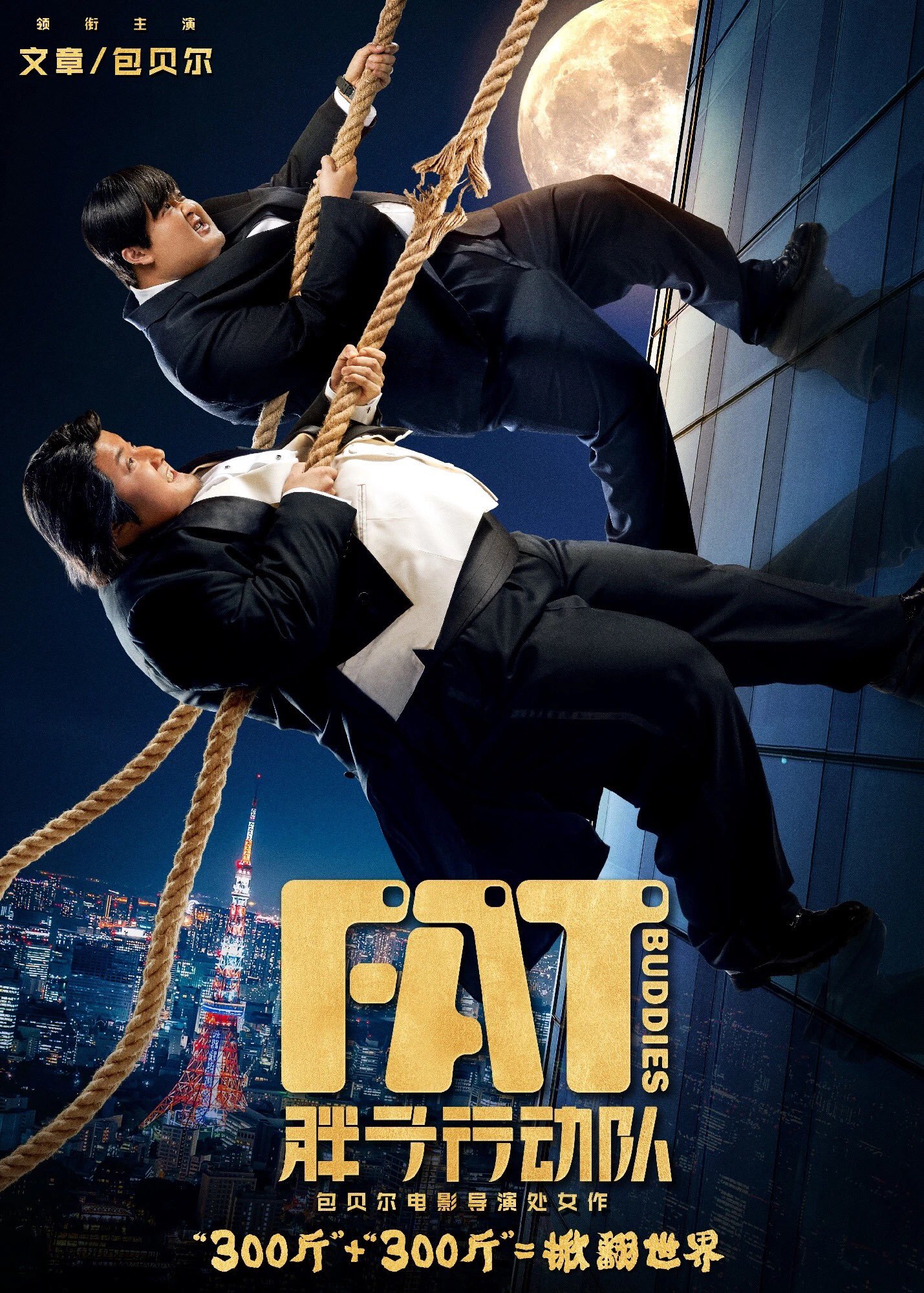
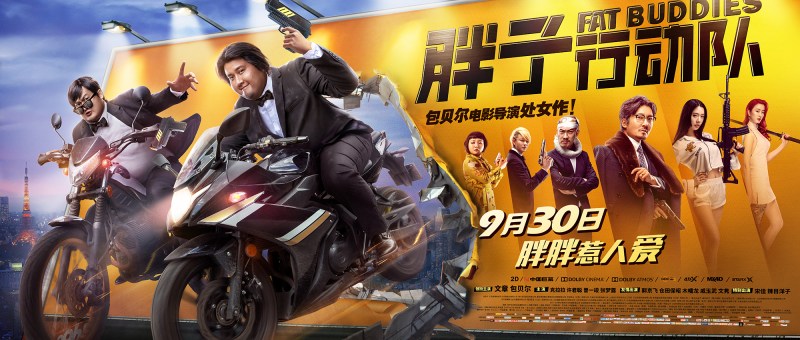
Fat Buddies posterChinese cinema hasn’t exactly had the best record when it comes to dealing with atypical heroes, but then no cinema really has. Gazing at the poster for Fat Buddies (胖子行动队, Pàngzi Xíngdòng Duì) – the debut directorial feature from actor Bao Beier who also stars, one can’t help but assume the next two hours will be one long joke at the protagonists’ expense, but to its credit Fat Buddies is not (entirely) the film it seems to be and, ironically enough, there is more going on beneath the surface than an excuse to have at a “permissible” target.

The hero, played by Bao Beier himself, is a very rotund security guard currently working in a hospital in Tokyo for reasons which will (mostly) be explained later. Though Hao is a cheerful and friendly man with a strong sense of justice, he is ostracised by the (strangely large number of) other guards and has no real friends save his extraordinarily beautiful Japanese wife. Hao’s life changes forever one day when another large Chinese man calling himself “J” arrives at the hospital and causes a ruckus by trying to escape without paying. J convinces Hao that he is an international super spy on a top secret mission and that he needs Hao’s help to get out of the hospital so he can save the world. Believing he is finally being given the chance to become the agent of justice he’s always dreamed of being, Hao is only too eager to oblige.

Strangely enough, the entire film takes place in Tokyo even though the heroes and antagonists are all Chinese. Even so, it never resorts to the comedic caricatures common in recent mainland cinema when depicting the Japanese with even the police characterised as dedicated and efficient if sometimes a little overzealous and misguided, though one does wonder if the setting was chosen solely for the sumo associations of the grand finale. There is however a degree of bite in Hao’s view of himself as a non-Japanese person living in Japan who is married to a Japanese citizen and speaks the language fluently but still remains an outsider both because of his unusual appearance and because of his nationality (with a mild implication from some that perhaps the two things are not entirely unrelated). In an early set piece, Hao and J find themselves trying to infiltrate an upscale party where they have unwittingly stolen the clothes of a pair of famous dancers and eventually end up improvising a strange routine to a bawdy song which is all about being a “foreigner” in Japan who “doesn’t understand Japanese but loves Sora Aoi” and then continues in a similarly lowbrow vein with a mix of Mandarin, international English, and intentionally broken Japanese.

Rather than a two hour fat joke – though there are a fair few of those in a recurrent motif of J getting stuck in things Pooh-style and losing his trousers in the process, the the major message is that the pair are fine as they are and apart from the aforementioned problem, their size is not a barrier to being able to do anything they want including taking on international spy missions. Despite his happy marriage, Hao still suffers from loneliness and low self-esteem due to a lifetime of being looked down and on belittled, unable to make friends because of prevalent social stigma towards those on the heavier side. The solution, however, is not a makeover or a crash diet but a gradual process towards Hao regaining his sense of self worth and realising he has plenty to offer the world despite what anyone else might say. Similarly J, who experienced rapid weight gain after a life threatening injury and also suffers from narcolepsy, proves that he is still able to do his job even if he benefits from having a partner around when he randomly falls asleep at inopportune moments.

Fat Buddies isn’t claiming to be high art and there is certainly enough of the low humour the title implies to keep those enticed by the poster happy enough, but there is also genuine heart in its odd couple buddy comedy as the two similarly under-appreciated big guys bond in their shared desire to reclaim their sense of dignity and refuse to be shamed or belittled just because of their size (even if they are otherwise quite bumbling and inefficient in their mission). Strangely uplifting, Fat Buddies is an extremely silly comedy starring two men in fat suits repeatedly bumping into things but like its heroes refuses to be bound by stereotypical conventions and manages to make heartwarming drama out of its admittedly ridiculous premise. 


Fat Buddies is currently on limited release in UK Cinemas.

International trailer (English subtitles)