
Kung Fu Soccer (功夫女足, Stephen Chow, 2026)

Seven years on from New King of Comedy, Stephen Chow returns with another reimagining of a past hit in Kung Fu Soccer (功夫女足, gōngfu nǚzú), a new take on the 2001 global sensation Shaolin Soccer. Throughout the ‘90s, Chow had been one of Hong Kong cinema’s most bankable talents with a series of mo lei tau or “nonsense” comedies. There’s no getting away from the fact that the Cantonese language is intrinsic to the genre which heavily relies on zany puns and wordplay in addition to slapstick humour, though the later phase of Chow’s career has largely been in Mainland-friendly Mandarin as is Kung Fu Soccer.

As such, the film struggles to achieve the kind of comedic rhythm that made Chow’s earlier work so popular while its nonsense gags such as a man burning his leg in order to get rid of unwanted hair after mistakenly thinking someone talking on the phone about cooking pork was talking to him play out less successfully. As in Shaolin Soccer, Chow turns subpar CGI into a kitsch feature, leaning in to the unreality of virtual stadia and the uncanniness of a CGI ball being knocked around the pitch to create a cartoon world where the normal rules of physics do not apply.

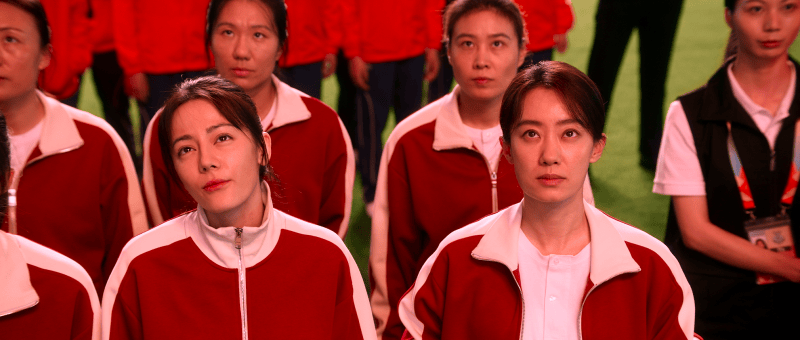
This time around, the action follows the Emei women’s football team who face ageism and sexism after making a belated bid to win an Asian championship. Headstrong captain Shuang (Zhang Xiaofei) and her childhood friend Jade (Dilraba Dilmurat) are struggling to overcome a falling-out over Jade’s decision to leave the sport and get married only to return following her divorce, while Shuang has dedicated her life to football and kung fu but now at almost 40 is beginning to realise that she may have missed out on other life experiences and has no plans for the future. Shuang is an orphan who found a place within the team and fears abandonment, whereas Jade is a wealthy heiress whose devil-may-care attitude is informed by her financial security.

As expected, part of the path for the team’s success is getting the pair to patch things up, which they eventually do after a little manipulation by “Grand Uncle” Xu Feng (Lay Zhang), another childhood friend with a longstanding crush on Shuang she in fact returns but is unable to act on due to being arrested emotionally having done nothing but sport and kung fu since she was a child. The conclusion that Shuang is gradually guided towards is that she’s too intense and has lost her love of playing the game. She has a lack of empathy for her teammates and an autocratic management style that alienates those around her, a criticism that has been levelled at Chow himself in the past. It’s this internalised pressure that makes it difficult for the players to perform. If they chilled out a bit and rediscovered the joy of it, they might be better placed to face their opponents who also have their own particular quirks.

The film has also come in for criticism for the ways that it depicts the other Asian nations in the competition, most particularly the South Koreans who are shown to be obsessed with beauty and play in underhanded ways while the Korean spoken in the film is delivered unconvincingly. The team from India similarly have some kind of super-stretchy ability and the Australians are defined by aggression and tactlessness. The Japanese team, coached by Takeru Satoh in a cameo appearance, are mainly just violent while the decision to make their goalie a figure of fun for not being considered conventionally attractive seems very outdated and undercuts the film’s other messages of female power and solidarity. The Emei team face questions of ageism and are forced to constantly prove themselves, but eventually come out on top after learning to trust each other, pool their respective strengths, and just have fun playing the game. Backed by Carina Lau’s mahjong-obsessed grandmaster, they have perhaps learned to integrate their martial arts abilities and love of sport to overcome not only the prejudice held against them, but their own internalised anxieties.


Kung Fu Soccer is in North American, UK, & Ireland cinemas from 23rd October.

Trailer (Simplified Chinese / English subtitles)
Fat Buddies (胖子行动队, Bao Bei’er, 2018)

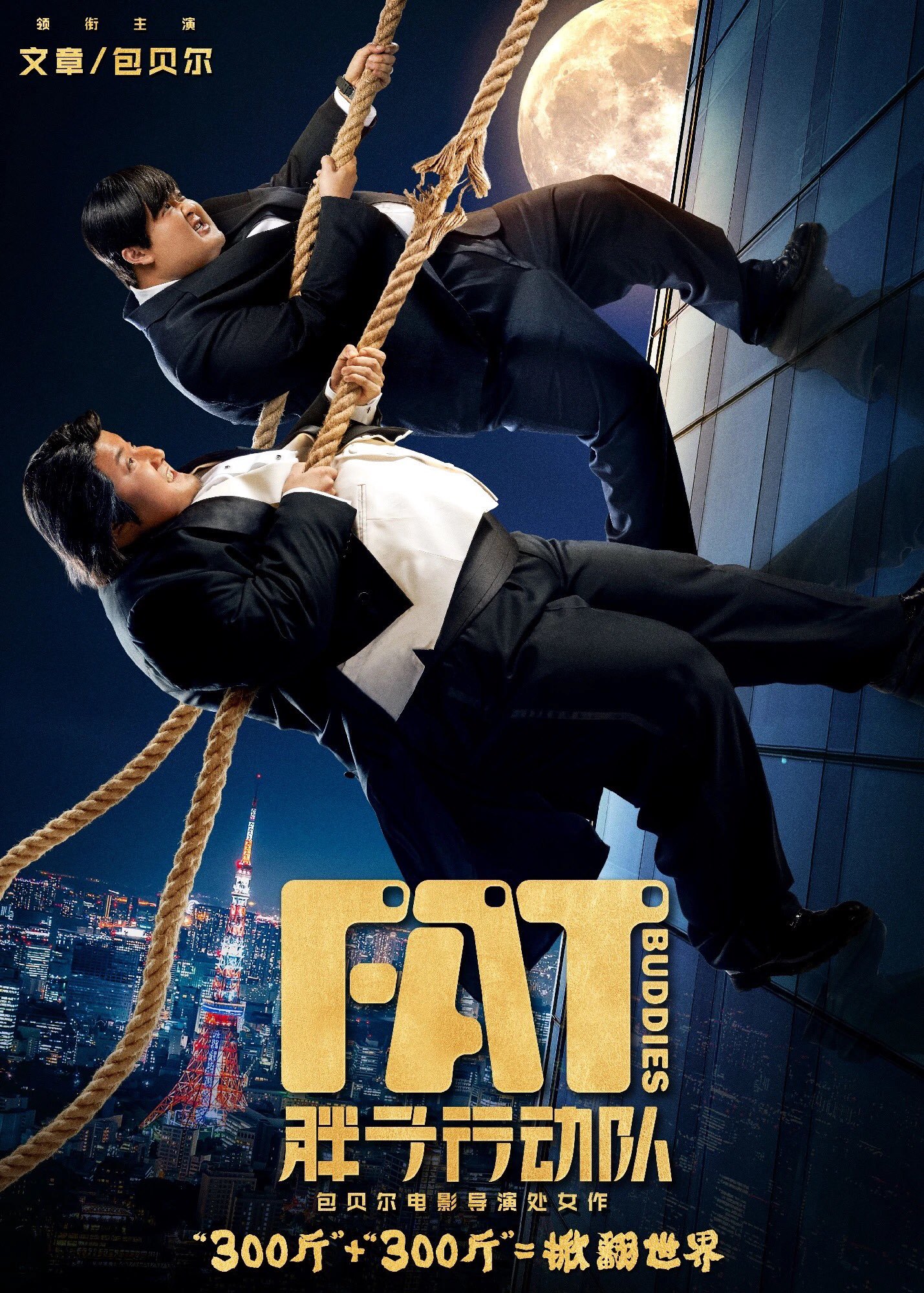
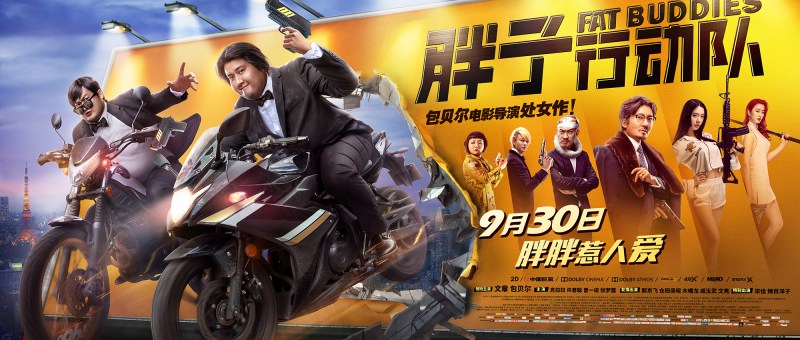
Fat Buddies posterChinese cinema hasn’t exactly had the best record when it comes to dealing with atypical heroes, but then no cinema really has. Gazing at the poster for Fat Buddies (胖子行动队, Pàngzi Xíngdòng Duì) – the debut directorial feature from actor Bao Bei’er who also stars, one can’t help but assume the next two hours will be one long joke at the protagonists’ expense, but to its credit Fat Buddies is not (entirely) the film it seems to be and, ironically enough, there is more going on beneath the surface than an excuse to have at a “permissible” target.

The hero, played by Bao Bei’er himself, is a very rotund security guard currently working in a hospital in Tokyo for reasons which will (mostly) be explained later. Though Hao is a cheerful and friendly man with a strong sense of justice, he is ostracised by the (strangely large number of) other guards and has no real friends save his extraordinarily beautiful Japanese wife. Hao’s life changes forever one day when another large Chinese man calling himself “J” arrives at the hospital and causes a ruckus by trying to escape without paying. J convinces Hao that he is an international super spy on a top secret mission and that he needs Hao’s help to get out of the hospital so he can save the world. Believing he is finally being given the chance to become the agent of justice he’s always dreamed of being, Hao is only too eager to oblige.

Strangely enough, the entire film takes place in Tokyo even though the heroes and antagonists are all Chinese. Even so, it never resorts to the comedic caricatures common in recent mainland cinema when depicting the Japanese with even the police characterised as dedicated and efficient if sometimes a little overzealous and misguided, though one does wonder if the setting was chosen solely for the sumo associations of the grand finale. There is however a degree of bite in Hao’s view of himself as a non-Japanese person living in Japan who is married to a Japanese citizen and speaks the language fluently but still remains an outsider both because of his unusual appearance and because of his nationality (with a mild implication from some that perhaps the two things are not entirely unrelated). In an early set piece, Hao and J find themselves trying to infiltrate an upscale party where they have unwittingly stolen the clothes of a pair of famous dancers and eventually end up improvising a strange routine to a bawdy song which is all about being a “foreigner” in Japan who “doesn’t understand Japanese but loves Sora Aoi” and then continues in a similarly lowbrow vein with a mix of Mandarin, international English, and intentionally broken Japanese.

Rather than a two hour fat joke – though there are a fair few of those in a recurrent motif of J getting stuck in things Pooh-style and losing his trousers in the process, the the major message is that the pair are fine as they are and apart from the aforementioned problem, their size is not a barrier to being able to do anything they want including taking on international spy missions. Despite his happy marriage, Hao still suffers from loneliness and low self-esteem due to a lifetime of being looked down and on belittled, unable to make friends because of prevalent social stigma towards those on the heavier side. The solution, however, is not a makeover or a crash diet but a gradual process towards Hao regaining his sense of self worth and realising he has plenty to offer the world despite what anyone else might say. Similarly J, who experienced rapid weight gain after a life threatening injury and also suffers from narcolepsy, proves that he is still able to do his job even if he benefits from having a partner around when he randomly falls asleep at inopportune moments.

Fat Buddies isn’t claiming to be high art and there is certainly enough of the low humour the title implies to keep those enticed by the poster happy enough, but there is also genuine heart in its odd couple buddy comedy as the two similarly under-appreciated big guys bond in their shared desire to reclaim their sense of dignity and refuse to be shamed or belittled just because of their size (even if they are otherwise quite bumbling and inefficient in their mission). Strangely uplifting, Fat Buddies is an extremely silly comedy starring two men in fat suits repeatedly bumping into things but like its heroes refuses to be bound by stereotypical conventions and manages to make heartwarming drama out of its admittedly ridiculous premise. 


Fat Buddies is currently on limited release in UK Cinemas.

International trailer (English subtitles)