
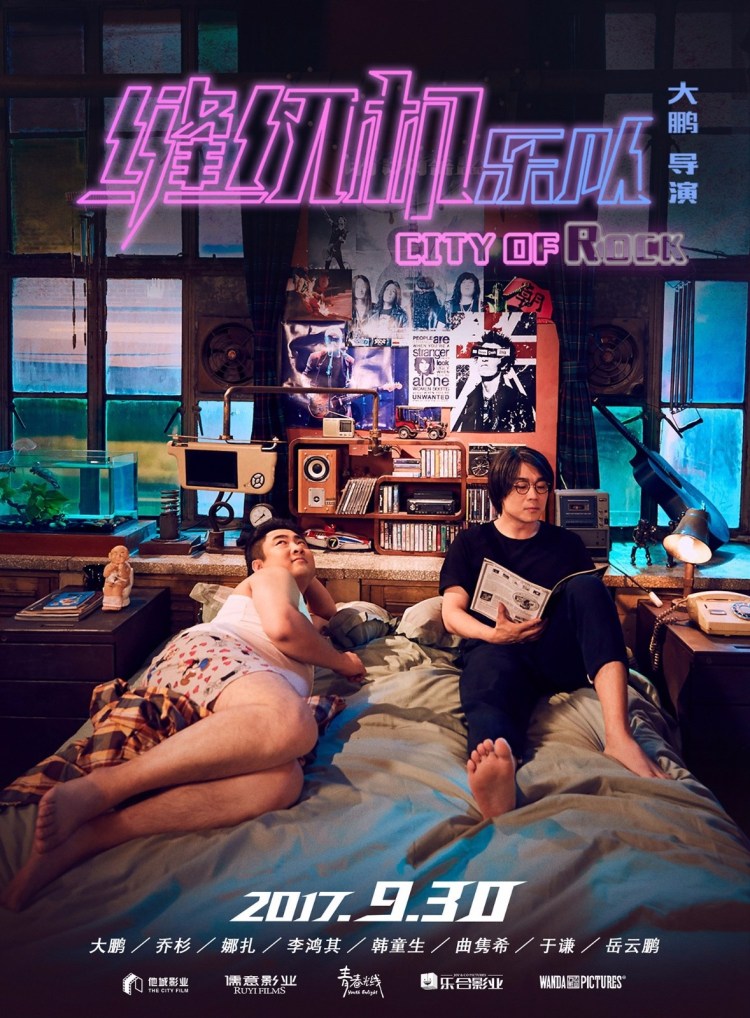
 They built this city on rock and roll! Right in the middle of Ji’An, there’s a giant statue of an electric guitar with a plaque underneath it reading “The Heart of Rock” that was erected in memory of a legendary concert given by a super famous band, Broken Guitar, who happen to hail from the region. This being a particularly musical town, Broken Guitar continues to inspire young and old alike to pursue their musical dreams, but there is trouble on the horizon. Shady mobbed up developers want to tear down the Great Guitar and put flats there instead, which is not very rock and roll when all is said and done.
Meanwhile, in Beijing, shady musical agent Chen Gong (Da Peng), who was actually the agent for Broken Guitar at the time they broke up, is working on his latest venture – trying to turn three middle-aged, pudgy rockers into a Chinese K-pop act. Needless to say it’s not going well and Gong is perpetually cash strapped. When he receives an unsolicited call from Hu Liang (Qiao Shan), a Ji’An resident who wants him to help promote a local concert as a kind of benefit to help save the Great Guitar, Gong isn’t interested and quotes him a ridiculous sum of money only to see it instantly pop-up in his account. Jumping straight on a train, Gong is met at the station by a rapturous welcome parade which includes a marching band and kids throwing garlands but quickly figures out that Hu Liang is every bit as much of a schemer as he is. Hu Liang doesn’t even have a band and needs Gong to help him find one.
Once again, the conflict is between cynicism and artistic integrity as a group of misfits comes together to help stop a monument to true rock being torn down by soulless suits. Gong, as we later find out, had musical dreams himself but, after having gone against his father’s wishes to pursue a musical career, was forced out of the conservatoire after an accident robbed him of the feeling in two of his fingers and he became too depressed to sing. Having lost his faith in music, Gong has sold out and become a cynical money man, cutting deals anywhere and everywhere he can. Rather than work on the “unique” sound of the guys he was mentoring, he’s obsessed with the idea of sending them to Korea to get plastic surgery, and turning them into some kind of K-pop inspired Chinese song and dance group.
Hu Liang, meanwhile, is just as much of a con man but his heart is in a better place. Only two people show up for his auditions to join the band – jaded alcoholic with a broken leg, Ding Jianguo (Gulnazar), and a drummer from Taiwan who calls himself “Explosive” (Li Hongqi) and sits with his back to the audience. The other bandmates include a former member of Broken Guitar now a gynaecologist (Han Tongsheng) whose daughter has forbidden him from playing rock and roll, and a little girl (Qu Junxi) who’s a whizz on the keyboards despite the disapproval of her Taekwondo loving mother who thinks things like music are a frivolous waste of time. Together they face various obstacles in their quest to save the great guitar and the spirit of rock and roll itself but finally discover that the true spirit of rock lies in getting the band back together for one last hurrah and channeling all into music.
Gong, tempted by the shady developer, is reminded that money can save lives but dreams cannot. Faced with a dilemma, Gong falls back into cynicism and rejects the new sense of fun and togetherness he’d found as a peripheral member of the band. Yet reuniting with his hopeless wannabes and easing back into his soulless Beijing life, he begins to realise what he’s been missing and rediscovers the the true nature of rock and roll which isn’t trapped inside a giant concrete guitar but inside the hearts of musicians who need their instruments to help bring it out. Dreams, it seems, save lives after all. An often hilarious, sometimes silly comedy, City of Rock (缝纫机乐队, Féngrènjī Yuèduì) is as full of heart as it encourages its protagonists to be, arguing for the importance of the right to express oneself in a society which often actively suppresses it.
Screened at the 20th Udine Far East Film Festival.
Original trailer (simplified Chinese subtitles only)

 Like the rest of the world, China, or a given generation at least, may be finding itself at something of a crossroads. The past few years have seen a flurry of coming of age dramas in which the melancholy and middle-aged revisit lost love from their youth but Derek Tsang’s Soul Mate (七月与安生, Qīyuè yǔ Anshēng) seems to be speaking to an older kind of melodrama in its examination of passionate friendship pulled apart by time, tragedy, and unspoken emotion. The story is an old one, but Tsang tells it well as its twin heroines maintain their intense, elemental connection even whilst cruelly separated.
 Windows on Worlds