A Song Sung Blue (小白船, Geng Zihan, 2023)

Late into Geng Zihan ’s coming-of-age drama A Song Sung Blue (小白船, xiǎo bái chuán), the heroine’s father (Liang Long) who perhaps knows a little more about her than we might have assumed, tells her that love and resentment are often the same thing. At least, they are both unforgettable. Resentments are something Xian (Zhou Meijun) has in spades, though she has little way of expressing them outside of her sullenness and silence while perhaps learning some unhelpful lessons in her seemingly unreturned attraction to the daughter of her father’s receptionist. 

Firstly, Xian is resentful towards her mother who has abandoned her to go on a humanitarian mission to Africa for an entire year explaining that the hospital have promised her a long awaited promotion after which she won’t have to do the nightshifts and so can spend more with her daughter, the irony being that by that time Xian will be in her late teens and perhaps less keen to spend time with her mum. Secondly, Xian is resentful towards her estranged father whom she only sees at family gatherings and has little connection with. She also seems resentful towards the other children in the choir and has no real friends. When the choir runs out of female uniforms she’s told to wear one of the boys and stand at the back hoping no one will notice. Meanwhile, she’s a little surprised after venturing backstage and catching sight of her choir mistress embracing another woman. 

Yet in other ways Mingmei (Huang Ziqi), the daughter of her father’s receptionist with whom he is also in a relationship, is simply her inverse. Flighty and confident, Mingmei appears much older than her years and is training to be an air stewardess but inwardly seems hurt and vulnerable. She lives a fairly chaotic life in which she’s learned at an early age how to weaponise her sexuality and largely relies on sugar daddies for her financial upkeep while hating herself for doing so. It’s after learning that the man in question maybe about to leave his wife and marry Mingmei that Xian abruptly kisses her but is immediately rebuffed, Mingmei running a thumb across Xian’s lips as if more concerned about what she may have passed to Xian than outraged or offended.

Then again, Mingmei seems to have been aware of Xian’s attraction while no doubt tipped off by the fact that she was playing around with a stethoscope and presumably noticed her heart beating unusually fast. At times she seems insensitive, wilfully so or otherwise, or perhaps simply doesn’t know how not to manipulate the attraction that she inspires in others cruelly taking Xian along on one of her sugar daddy dates or asking her to help her dress. But then Xian also learns some problematic lessons, adopting some of Mingmei’s behaviour patterns in attempting to manipulate the attraction shown for her by a boy in the choir she is otherwise uninterested in by virtually forcing herself on him and then asking for a loan to get the money for Mingmei to open a store so she won’t have to rely on potentially violent sugar daddies and would therefore be more available to Xian who has also developed a white night desire to save her from her self-destructive instincts.

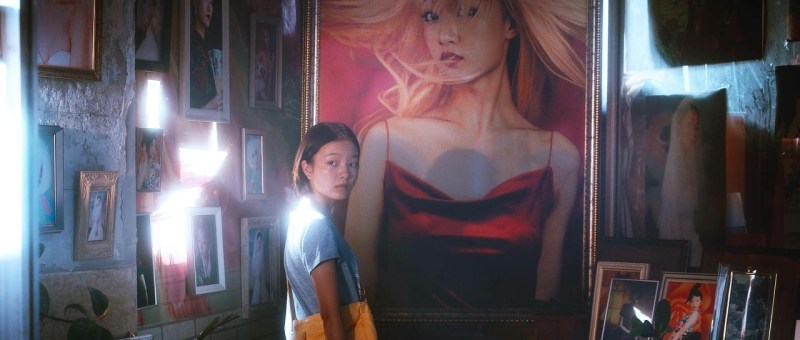
The only bright spot in Xian’s melancholy existence which is generally coloured in blue, her desire for Mingmei is palpable even gazing at the many photos of her taken by her father including one in striking red. Yet there’s an another sense of distance in her longing given that Mingmei is a member of the Chinese-Korean community. Xian is at once struck by this additional layer of exocitity and bewildered by her inability to understand it knowing no Korean nor much of Mingmei’s culture. The film takes its Chinese title from the song Xian sings at the choir recital, the traditional folksong Little White Boat which actually originated in Korea. Xian is disappointed not to spot Mingmei in the audience little knowing that she had been there but left early. Later in the film, Mingmei sings the song herself but in Korean perhaps a way of letting Xian know she came after all, or else simply intended in the way song is often sung as one of parting. In any case, Xian is indeed like the little boat dotting the horizon drifting along barely noticed and with no means of controlling her direction. Geng frames her with a quiet empathy and a gentle sense of recognition for those whose gaze is rarely returned.


A Song Sung Blue screened as part of this year’s Queer East.

Trailer (English subtitles)
Angels Wear White (嘉年华, Vivian Qu, 2017)

©22 HOURS FILMS

angels wear whiteChinese cinema has been preoccupied with stories of unfairness and systematic corruption for quite some time but they’ve rarely been as difficult to process and horribly universal as Vivian Qu’s Angels Wear White (嘉年华, Jiāniánhuá). A storm of conflicting social attitudes leaves young women open to the most terrible of manipulations while well placed men are infinitely protected by a system of deference and complicity. Women must be pure, angelic and draped in neutral white – a concept so deeply entrenched that it barely needs manipulating to be used as a tool of control.

Teenage runaway Mia (Wen Qi) is working illegally at a seaside hotel. Wandering the beach before work, she’s rudely shoved out of the way by two hyperactive little girls who want to take a selfie underneath a colossal statue of Marilyn Monroe in her classic pose from the Seven Year Itch. Meanwhile, several sets of newlyweds are busy taking romantic photos in the picturesque though currently overcast coastal environment. Mia spots the girls again later when she is (illicitly) covering reception for a colleague and they’re brought in by a middle-aged man. Mia finds the man suspicious but seeing as he books two rooms lets it go. She pauses slightly when the still over excited girls order themselves a few beers, but delivers the drinks and leaves the girls to it. Remaining worried she keeps her eyes on the CCTV and eventually spots the man trying to enter the girls’ room but does nothing other than record it on her smartphone.

The two girls, Xiaowen (Zhou Meijou) and Xinxin (Jiang Xinyue), are so young they don’t even quite understand what’s happened to them except for a lingering feeling that they’ve been involved in something bad that will get them into trouble. Xiaowen, on the surface at least the more affected by the incident, has a difficult relationship with her parents which leaves her with no one to confide in and no one to defend her. Xinxin eventually tells her mother what happened and we realise the perpetrator is a police chief and the boss of Xinxin’s father who had made him a godparent as a way of currying favour at work leaving Xinxin’s mother to make the reasonable accusation that he has, in fact, sold his daughter to his boss for the prospect of career advancement. Where Xinxin’s mother is angry with her husband but apparently solicitous for her injured daughter, Xiaowen’s mother projects her own guilt for her neglectful parenting onto hers whom she slaps for apparently “slutty” behaviour, cutting her hair short like a boy’s and taking away her pretty dresses and makeup.

Sitting alone in the waiting room outside, Xinxin asks Xiaowen what a “hymen” is while her mother can be heard wailing loudly from inside the consultation room. The issue becomes less that a predatory man has caused irreparable harm to two innocent young girls, but that their honour has been destroyed along with prospects of future marriage now that they are no longer virgins. The problem is not that the girls are not believed or even that they are ignored. On the contrary, their story seems to be accepted to the point that it must be erased. The police chief himself remains unseen but his underling goes to great lengths to hush the case up, attempting to pay off Xinxin’s parents with the promise of healthy financial support on the condition that they drop the charges to avoid embarrassment to the chief but also, it is implied, to Xinxin who will avoid the social stigma of being the girl involved in the high profile rape case. Eventually reuniting with her father, Xiaowen finds a defender but even his outrage is not enough to see justice done as the full weight of a corrupt system comes together to crush his little girl for simply continuing to tell the truth.

It’s easy to ask why Mia did nothing to prevent such an obviously inappropriate situation but then again she is just a girl herself, not so much older than Xinxin and Xiaowen, and would not have been able to help beyond knocking the door to try and scare the man off. She should not have been manning reception in the first place, and is afraid of getting into trouble because she has no ID papers and is working illegally. Because of way the system works in China, Mia would need to go back to her home town get a genuine ID card which she seems reluctant to do leaving her open to multiple kinds of exploitation as she considers the best way to buy a fake one that will allow her to continue working in more legitimate businesses. Her life has been hard and she has come regard compassion as a weakness.

Mia also has to put up with the worrying advances from her friend and big sister figure Lily’s (Peng Jing) boyfriend, Jian (Wang Yuexin), who openly asks if she’s a virgin because he knows people who will pay good money for that kind of thing. Even Lily who seems more worldly wise is not immune to Jian’s heartlessness, later coming into work with rope burns on her wrists and dark glasses to hide a black eye. Before returning to her home village, Lily visits a clinic for painful surgery to reconstruct her hymen so that she can still get married in overly conservative China.

The statue of Marilyn Monroe seems incongruous enough but speaks to all of those same double standards which continue to disrupt the lives of these young women as she girlishly pushes down the skirt on her pure white dress, awkwardly posed on her matching bright white heels. Marilyn is sexualised innocence at its most uncomfortable. The only real defendant the girls have is a dogged lawyer who treats them with kindness, listening to their story with patience and respect in an attempt to uncover the real truth aside from what anyone may want to hear to think they are supposed to say.

Asked by an almost outsmarted policeman why she can’t find something more productive to do, the lawyer replies that there are simply “too many of these kinds of cases”. “Justice” remains a hollow ideal, an essentially fake construct designed to maintain the position of the powerful rather than protect the weak. Unrelentingly bleak but with the faintest glimmers of hope offered by Mia’s final decision, the female solidarity of the determined lawyer, and the newly rediscovered relationship of Xiaowen and her dad, Angels Wear White is a necessarily difficult and challenging piece but one which arrives at just the right time trailing a series of uncomfortable in its wake.


Screened at BFI London Film Festival 2017.

Clip (Mandarin with English subtitles)