 Written by
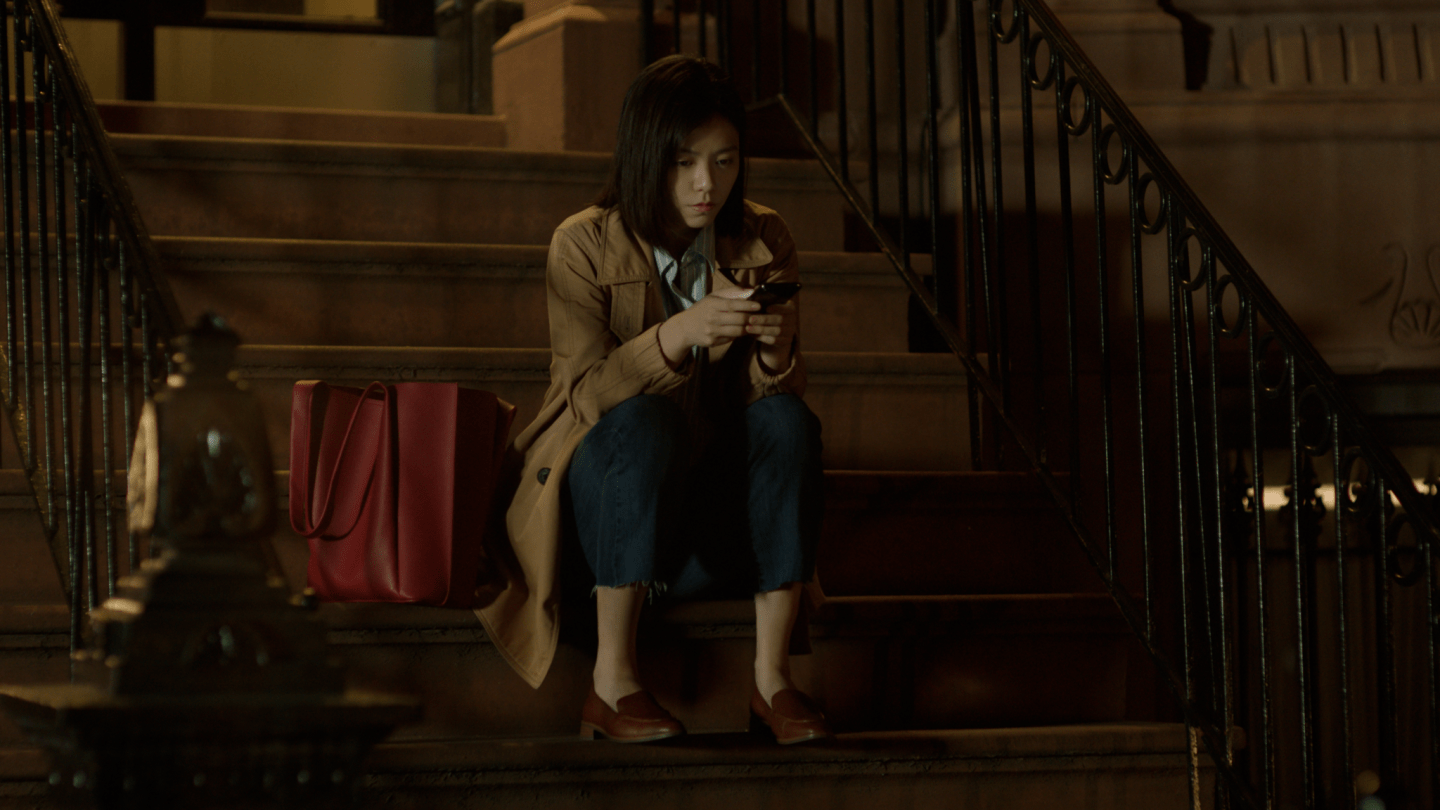
After taking a job as an interpreter working with the social and courts systems, overseas student Mavis (Vivian Sung) sits under a sign at centre for teens reading “you are not alone.” As she reveals to her client, alone is something she’s often felt while living in New York where everyone has “people to see, things to do, and homes to go to” while she feels herself in limbo with nothing and no one to turn to for support. Inspired by her own experiences, director Yu Sen-i’s My Heavenly City (我的天堂城市, wǒ de tiāntáng chéngshì) explores both the freedom and loneliness that can come with living abroad through the stories of three Taiwanese migrants who share unknown connections.
Mavis is nursing heartbreak and finding it difficult to concentrate on her studies while her money runs out and she feels as if she isn’t getting anywhere. When an opportunity teaching Mandarin to the son of a Taiwanese-American couple falls through, she applies for a job as an interpreter but soon discovers that it requires more than language skills not least because many of the cases she’s called in on are emotionally difficult. Though reminded that an interpreter should maintain a professional distance and avoid becoming friends with a client, she can’t help bonding with 16-year-old Xiao Jian. Suspected of having come to the US undocumented, Xiao Jian was found wandering around alone in Bryant Park and is refusing to speak.
What Mavis discovers is that she can’t really help him and no one wants to hear what he’s got to say anyway but in any case she comes to see him as a mirror for herself, another lost soul struggling to find a footing in the city. The same is true of street dancer Jack (Keung To) who is conned out of money by duplicitous locals but bonds with a young woman from Singapore, Lulu (Jessica Lee), who hoped that she’d find herself in New York but discovers only more lonely rootlessness and uncertainty. Even her connection with Jack is threatened by looming visa issues. Even so, in New York, Jack discovers greater freedom to be himself in embracing his love of dance if fulfilling parental expectation by continuing to study computer science.
Jack describes his mother’s micromanaging as oppressive, and is relieved to be if not freed from it that at least at a greater distance. These differing ideas of parenthood are also beginning to erode the relationship between successful architect Jason (Jack Yao), who came to the US 20 years previously, and his Taiwanese-American wife Clare (Mandy Wei) who struggles to deal with her own fiercely authoritarian father. The couple have a son, Jasper, who is autistic and also has emotional problems that have resulted in problematic violence that echoes a case that Mavis was brought in on of domestic abuse. Only nine years old, Jasper explains that he gets “very, very angry” when frustrated and it seems that he may not be well suited to busy city life. Clare’s father doesn’t believe in mental illness and assumes it’s discipline issue, believing that Clare and Jason are at fault for spoiling him rather than correcting his behaviour.
The conflict may echo a cultural divide between the authoritarian patriarchy of traditional culture and the aspirations of Clare who says she wants to try a new parenting style founded on love, but the fundamental problem for the family is in effect and absence of the father. The economic demands of living in an expensive city have forced Jason to abandon his family while he also seems unprepared to deal with Jasper’s complex needs and leaves everything to Clare who is then overburdened on the brink of burn out. Jasper’s increasing volatility and its effects on his mother finally convince Jason that he must find a way to rebalance his commitments and be emotionally, rather than just financially, present in the family and in his relationship with Clare.
A final visit to a lost and found office echoes the sense of displacement each of them feel but also what they discover in the city and the connections they make there whether they plan to stay or not. Though it may sound bleak in its exploration of the difficulties of living in an unfamiliar culture, the film discovers a sense of serenity in the improbably sunny city that cuts through its shadows and offers an unexpected of connection between its melancholy exiles.
My Heavenly City opens in UK cinemas on 10th November courtesy of CineAsia.
Original trailer (Traditional Chinese & English subtitles)
 Windows on Worlds