
 Written by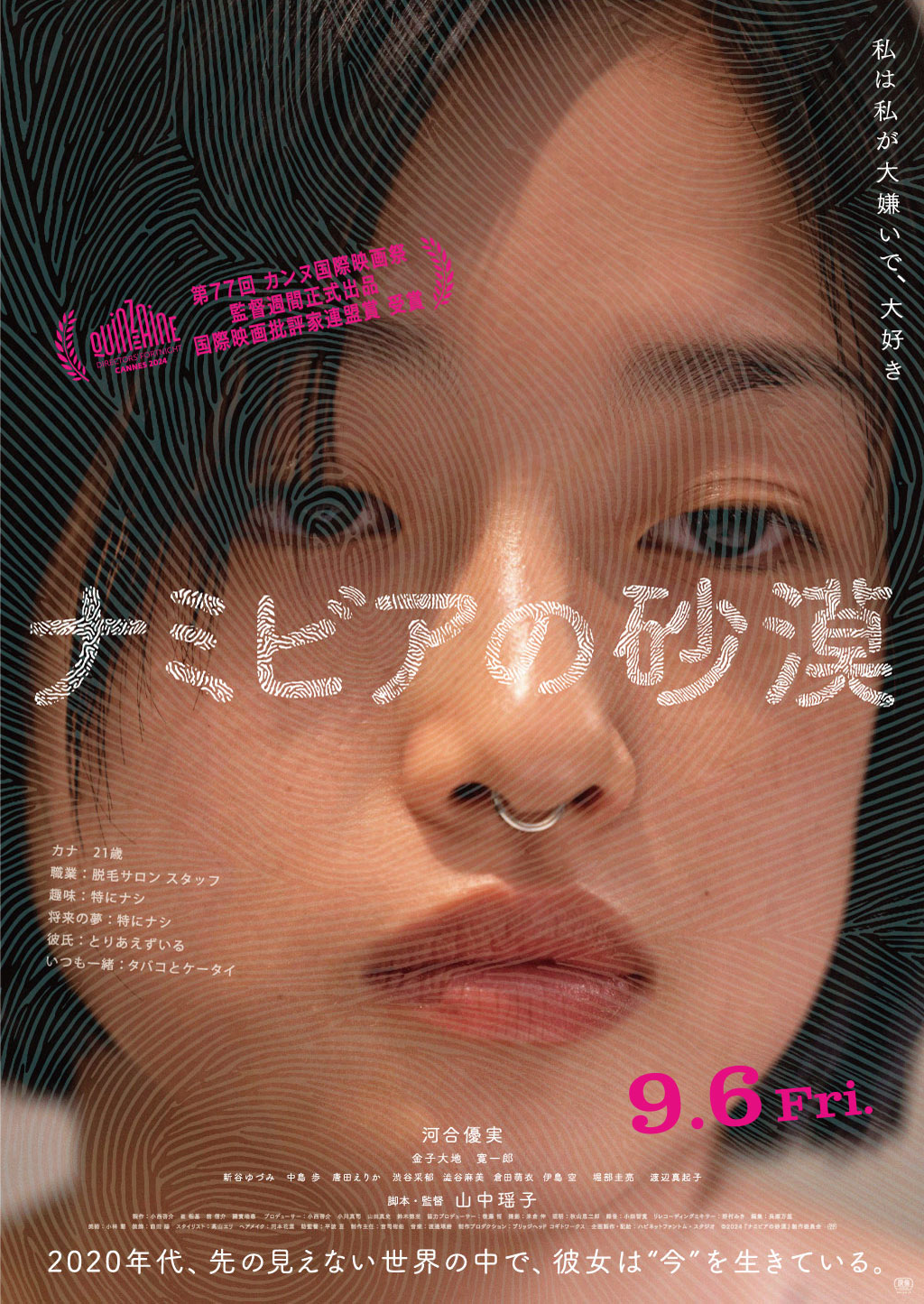
There’s a moment in Yoko Yamanaka’s quietly enraged character study Desert of Namibia (ナミビアの砂漠, Namibia no Sabaku) in which the heroine, Kana (Yuumi Kawai), finds herself stood at a crossroads. It might be tempting to read it as a symbol of her indecision, knowing she has to nix one of her two boyfriends but vacillating over which, but it’s more that she exists permanently between two states and as she later says may not really understand herself or the world around her.
We can see this in the opening sequence in which Kana fails to respond to her friend’s emotional distress when she tells her that a mutual acquaintance has taken their own life. She seems bored, indifferent, not really listening until suggesting that the pair hit a host club together in an attempt to cheer her friend up. But Kana soon leaves her friend behind, making excuses about an early start to meet a man we first think is her boyfriend but is actually the bit on the side. She cuddles up to him in a taxi and tells him that she wants to go visit his parents (right now, in the middle of the night) to see photo albums of his childhood but later returns home to the man she lives with who patiently holds her hair as she throws up into the toilet while asking politely how her friend is.
Perhaps the problem is that Honda (Kanichiro) is too nice, too respectable for the flighty Kana. He’s an estate agent with a cosy and well kept flat where he likes to make hamburgers from scratch and is otherwise very considerate of Kana’s needs little suspecting she’s seeing another man on the side. In Hayashi (Daichi Kaneko) she may see someone a little more exciting but is equally terrified when he asks her to break up with Honda and date him exclusively. She cheerfully bickers with Honda about his upcoming business trip, urging him to stand up to his boss if he tries to make him go to a sex club. Honda says he’ll just refuse, but of course doesn’t making a heartfelt confession on his return. The problem isn’t really that he slept with a sex worker or was unfaithful, but that he couldn’t stand up to his boss and allowed himself to be controlled by Japan’s overarching, hierarchal social structure, did something he thought was wrong and did not want to do to keep his boss happy and maintain his career prospects.
Kana doesn’t actually care about the sex, but it gives her an excuse to jump ship to Hayashi taking Honda’s fridge, and its frozen hamburgers, with her as she disappears completely from his life. But it’s at this point that her mental state begins to decline. She meets Hayashi’s well to do, upper middle class family who are actually very nice to her (even if randomly bringing up the fact her mother’s Chinese hints at latent prejudice) but feels out of place and inadequate especially on discovering that Hayashi had a previous girlfriend by the same name who may have aborted his child. Abortion seems to be a red button issue for Kana, possibly bringing up some long buried trauma of her own. She seems disconnected from her family and wanders restlessly around suburban areas while later hinting at resentment towards her father who may have in some way abused her. Her rage seems to escalate, culminating in physical abuse of Hayashi who resists but doesn’t really fight back. She craves his attention, but he wants to be left alone.
In her spare time, she watches videos of animals in the Namibian desert, suggesting that what she might actually crave is an unstimulating environment or a more peaceful solitude but at the same time yearns for male attention. Only 21, she seems somehow older but is also unbalanced by a new colleague at work who is like her spiky and rebellious and two years younger. An unsympathetic online psychiatrist tells her she may be bipolar or have borderline personality or something else completely but is dismissive assuming she can’t afford his fees so tells her her problems are too big to solve. She sees a more sympathetic female psychiatrist in person who helps her begin to understand something of herself, but exposes her loneliness when she tries to invite her out to dinner as if she were a friend. Abstracted from herself, she disassociates and has an out of body vision of watching herself and Hayashi wrestling as if she were watching animals in the Namibian desert, staring blankly as she often does unable to comprehend herself or the world around her.
Filming in a boxy 4:3, Yamanaka lends an air of constant tension and constraint to Kana’s world. The psychiatrist tells her that she imprisons herself in believing there’s a way she ought to feel but doesn’t when everyone is free within their minds redefining her Namibian dreamscape as the only place she is really free to be herself yet can only watch rather than directly access. “I don’t understand” she tells Hayashi when he asks her what “ting bu dong” means in a conversation with her family where her mother is apparently still somehow absent as if illuminating the entirety of her life and with it an ironic new understanding of herself.
Desert of Namibia screened as part of this year’s Camera Japan.
Trailer
 Windows on Worlds