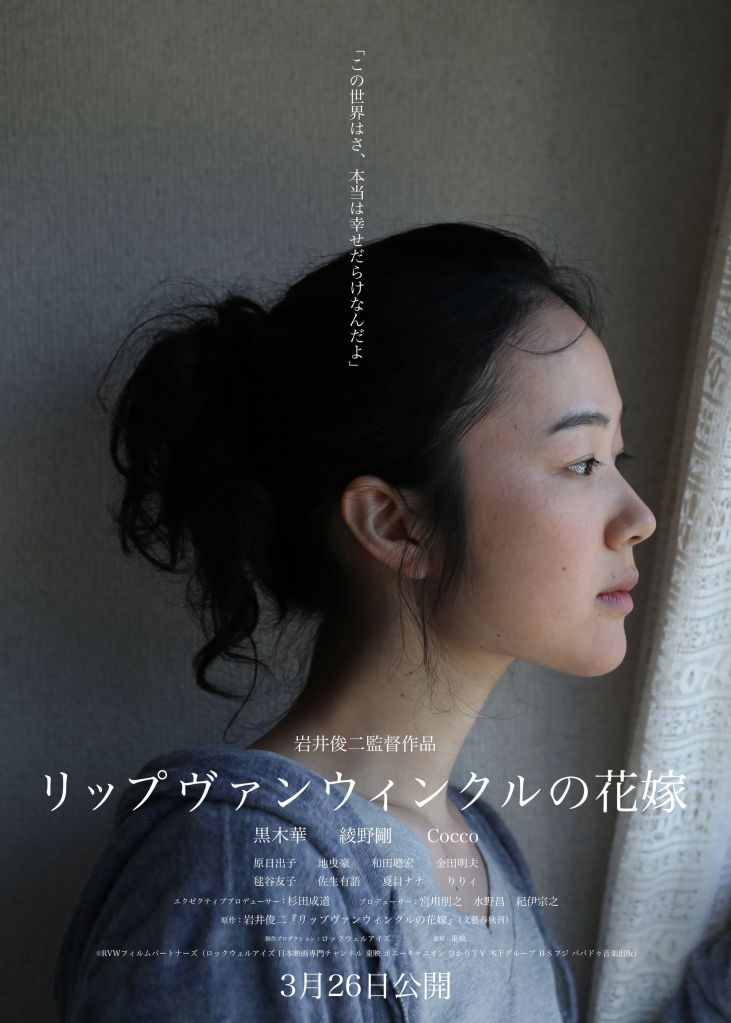
A Bride for Rip Van Winkle (リップヴァンウィンクルの花嫁, Shunji Iwai, 2016)

the_bride_of_rip_van_winkle“Being naked in front of people is embarrassing” says the drunken mother of a recently deceased major character in a bizarre yet pivotal scene towards the end of Shunji Iwai’s aptly titled A Bride for Rip Van Winkle (リップヴァンウィンクルの花嫁, Rip Van Winkle no Hanayome) in which the director himself wakes up from an extended cinematic slumber to discover that much is changed. This sequence, in a sense, makes plain one of the film’s essential themes – truth, and the appearance of truth, as mediated by human connection. The film’s timid heroine, Nanami (Haru Kuroki), bares all of herself online, recording each ugly thought and despairing notion before an audience of anonymous strangers, yet can barely look even those she knows well in the eye. Though Namami’s fear and insecurity are painfully obvious to all, not least to herself, she’s not alone in her fear of emotional nakedness as she discovers throughout her strange odyssey in which nothing is quite as it seems.

We first meet Nanami on an internet blind date with the man who will later become her husband. Looking lost and alone, she passively waits for her online suitor to find her in the busy city streets. Tetsuya (Go Jibiki) does indeed turn up and assume control of the situation, to which Nanami submits just as she has to everything else. Bonding over little more than their shared vocation of teaching the pair drift into a relationship and then later into a marriage, as is the natural order of things.

Though she seems happy enough, Nanami vents her frustrations in her caustic online blog. Isn’t this all just too easy? She asks herself. It’s almost like online shopping, she simply added a boyfriend to her basket and now she’s about to check out. A failure to win over Tetsuya’s mother adds to her sense of unease as does the fact she has no close friends or relatives (aside from her soon to be divorced parents) to invite to the wedding. Her decision to take the advice of an online friend and employ the shady fixer Amuro (Go Ayano) to hire a selection of professional party goers to bulk out her side of the hall will prove to be a disastrous one (though perhaps more in the short term), turning her entire life inside out.

Nanami’s essential personality trait is her passivity. Like Rip Van Winkle, she is largely asleep while things happen all around her. Though she dreamed of being a teacher, Nanami has only been able to find temporary supply roles with an agency but even this seems unlikely to last thanks to her softly spoken nature which makes classroom teaching a poor fit for her shy, attention avoidant personality. Discovered at her part time combini job by an old university friend, Nanami is embarrassed and has even been wearing a (useless but endearing) disguise in case any of her students come by despite the fact she chose a store far away from the school. Her friend now works at a hostess bar which Nanami finds a little bit shocking. That kind of unconventional way of living is not something she would contemplate, and so when offered the extremely dull but comfortable life alongside the dull but comforting Tetsuya, Nanami settles.

After Amuro spectacularly derails her non-happiness, Nanami is cast adrift which eventually leads her straight back into Amuro’s web of morally dubious activities. Taking a job as a maid at the cheap hotel she ends up in after leaving Tetsuya, Nanami also works part time as another of Amuro’s professional guests which is where she meets motivator no. 2 – Mashiro (Cocco), “actress” and all round live wire. Bonding over sad karaoke, Nanami and Mashiro later wind up working together as live in maids in a creepy, isolated mansion filled with poisonous animals. Enforced proximity leads to genuine friendship and then to more than that, but, ironically enough, Mashiro has not been entirely honest about her intentions and Nanami is soon adrift once again.

Undergoing a “fake” wedding that’s sort of real (in contrast with the “real” wedding which was sort of “fake”), at least in sentiment, Nanami looks much happier than in the extremely bizarre ceremony which bound her to Tetsuya. Nanami and Mashiro’s union was “engineered” yet mutually beneficial and ultimately genuine despite its artificial genesis. Making a last, heartbreaking speech, Mashiro attempts to explain herself and her life philosophy in a final act of nakedness. She prefers to pay for connection because, she says, the world is too full of kindness. There is so much happiness out there that it’s completely overwhelming. Sometimes there’s more truth in the lie than there is in the reality.

The resurfaced Iwai is both more cynical and more romantic than he has ever been before. He has serious things to say about constructed identities and disconnectedness, that the increasingly open nature of the anonymous online world only makes the real one seem less reliable and harder to navigate. We’ve all been wearing masks but we turned them round when we went online, and now perhaps we’re forgetting that we made them in the first place. Nanami may be adrift again at the film’s conclusion but she finds herself in a world of infinite possibilities. Emerging with more certainty and firmer sense of self, Nanami has retaken control and even if she doesn’t know where she’s going, the choice is entirely her own. Another beautifully nuanced, endlessly affecting character study from Iwai, A Bride for Rip van Winkle is a gloriously rich experience, filled with both hope and despair, but told with all the ethereal warmth and strangeness of the best of dreams.


This review refers to the 180 minute director’s cut, rather than the shorter international or four hour TV version.

Original trailer (English subtitles)

Bangkok Nites (バンコクナイツ, Katsuya Tomita, 2016)

bangkok-nites“Asia is a paradise for men” though not for anyone else, if Bangkok Nites (バンコクナイツ) is anything to go by. In Tomita’s previous film, Saudade, he explored the intercultural exchange between Thailand and Japan with one character having tried to escape there and failed, and another idly dreaming of running away with his Thai mistress. Five years later he revisits the same idea but from the other side as he weaves a meandering trail through the Japan-centric element of Bangkok’s red light district which eventually leads him on to other neighbouring nations whose landscapes still bear the scars of war and colonialism decades into a supposedly enlightened age.

We begin with Luck (Subenja Pongkorn), caught in reflection against a swanky hotel window overlooking her city. Her client is a Japanese man, clingy in the extreme though it’s unclear if his desire to avoid paying is out of consideration to his wallet or a genuine case of affection. Nevertheless, his whining is too much for Luck who eventually manages to escape the room and get back to work. Employed by a bar on Thaniya Road, an area of Bangkok’s red light district popular with Japanese tourists, Luck’s job involves sitting on a shelf in a large stable area where she and her colleagues wear colour coded badges so the customer can see their rates and services offered at a single glance.

Good friends with a Japanese man who works as a kind of procurer for the club, Luck ends up at a party where she runs into Ozawa (Katsuya Tomita) – a quasi-customer with whom she’d developed a deeper relationship around five years previously but subsequently lost contact. A former Self Defence Force soldier, Ozawa first came to Asia on a peacekeeping mission to Cambodia and has been back and fore ever since. During this most recent stay he’s begun to strike up a friendship with fellow Japanese guys working around the edges of the sex industry and related businesses including the drugs trade. After getting to know each other again, Luck takes Ozawa to her peaceful, rural, hometown beginning a journey which is to have a profound impact on his view of the continent.

There’s something a little sad about the small, sleazy world of the red light district and its collection of melancholy ex-pats eking out a living by exploiting desperate local women. Ozawa hovers on the fringes of this group, obviously a visitor to the brothels of Thaniya Road, but not quite a devotee. The other guys repeatedly refer to Thailand and other surrounding countries as “paradise” or a “utopia” where the women are “easy” and can be had at will and with few strings. One visitor remarks that he can have twenty nights of debauchery in Bangkok for the cost of one fancy night out in Roppongi. Yet for every one like him just trying to blow in and blow out with no fuss, there are a handful who can’t separate a transaction from a romance, becoming overly attached to women merely providing a service who, naturally, are not particularly seeking a long-term relationship with the sort of man who thinks a woman can be bought wholesale.

Luck is the number one on Thaniya Road, though she’s aware her time is limited. The work pays well and she’s been able to acquire an elegant Bangkok apartment as well as a house for her mother and siblings back in the country, but her heart is set on saving enough money to open an upscale European restaurant when she finally leaves the sex trade behind. Taking Ozawa back to her hometown, she explains to him that her life in Bangkok is just what happens to girls from the country. Children are raised by aunts while mothers live in the city, sending money back home, until they swap places and the children head to the city while the women return to raise the children of relatives. Most of her friends are also involved in the local sex trade, catering to foreign travellers with less than romantic ideas about the country and its “exotic” women.

Tomita paints this as another ongoing echo of the colonial past as foreign men come to Thailand for purposes of discreet pleasure, giving little thought to the interior lives of the real breathing women in front of them. Taking Ozawa around her home town, Luck shows him the beautiful European style mansion she grew up in with her mother’s second husband (her step-father and the only positive male input she ever mentions) who was an American working at a local air base. The bases are a relic of the Vietnam war, the legacy of which also rears its head once Ozawa makes his way into Laos where giant bomb craters still scar the landscape like pock marks on the face of the Earth more than forty years later. Ultimately these colonial wars trace themselves back to the first waves of colonisation but when Luck tries to look forwards she only sees the past – her desires are for the European, fancy restaurants and urban sophistication.

Ozawa looks at Luck’s hometown and (thinks he) sees a “paradise”, a calm and peaceful place where people drink and smoke their lives away with no worries. He thinks this ought to be enough, and perhaps he’s right, but women like Luck and her friends are still left with no other choice than to enter the sex industry in order to feed their families while the men bum around smoking, drinking, and whoring with other women. It could be a paradise for Ozawa, but it would only be supported by the private hell of the women all around him.

Tomita shoots in a straightforward style but also adds epic sweeping pastoral shots thanks to drone  camerawork and occasional touches of the surreal such as groups of shadowy figures in the forests who may be real or imagined, perhaps the ghostly spirits of past rebellions. Another figure encountered by Ozawa may also be a manifestation of these long-standing ghosts as he recites patriotic speeches and asks for money to help look after the refugees flooding into the forests thanks to the Vietnam war. Ozawa later meets the descendant groups of the guerrillas in Laos which includes disaffected Filipinos, Japanese, and Thais all looking for alternative ways of living.

Harnessing the power of popular song from classic ‘60s Thai pop to indie folk tunes about sold daughters and karaoke covers of The Carpenters, Tomita demonstrates how even music receives external influence but repurposes and exports it as a form of popular protest. Everyone is looking for an elusive form of paradise which does not exist, but their own actions and desires are often the very thing which prevents them from finding it. Tomita’s four years of research have been put to good use in creating a nuanced, thoughtful dissection of the ongoing effects of colonialism in a land still scarred by war and the painful wounds of the unexamined past.


Reviewed at the 2016 London East Asia Film Festival.

International trailer (dialogue free)

Harmonium (淵に立つ, Koji Fukada, 2016)

harmoniumKoji Fukada first ventured into the family drama arena with the darkly comic satire Hospitalité in 2010 in which frequent collaborator Kanji Furutachi played the decidedly odd “family friend” who quickly took over the household and exposed all of its weaknesses before departing as mysteriously as he arrived. This time Furutachi plays the man of the house, though like his counterpart in Hospitalité, has not been telling the whole truth. Unlike much of Fukada’s previous work, Harmonium (淵に立つ, Fuchi ni Tatsu) abandons the comedy overtones for a truly bleak and tragic atmosphere which seems to speak of the death of the family unit itself.

On a morning just like any other, Toshio (Kanji Furutachi), Akie (Mariko Tsutsui), and their small daughter Hotaru (Momone Shinokawa), take breakfast together around the kitchen table. Akie leads grace while Toshio reads his paper before Hotaru moves on to a story about the baby spiders in the garden and how they collectively eat their mother. After his wife and daughter have left for the day, Toshio lifts the shutter on his workshop only to see a familiar, if long forgotten, face standing behind it.

The two men talk and it’s clear they’re old friends but have not seen each other in a long time. Fresh out of prison, Yasaka (Tadanobu Asano) is dressed in an odd looking suit without a jacket, the top button of his pristine white shirt neatly buttoned up. Toshio offers Yasaka a job in his workshop and a room in his house – all without a word to Akie, but somehow there’s something other than an altruistic desire to help an old friend who’s fallen on hard times at play.

Yasaka moves in and is permanently on his best behaviour but it isn’t until it’s discovered that he has a talent for the harmonium and begins to help Hotaru improve her playing that Akie starts to warm to him. It also helps that he’s interested in her spiritual life at the local protestant church, unlike her husband, and is generally around and available to her. Learning how Yasaka ended up in prison and how he now feels about his crime, Akie comes to feel this melancholy man must be especially worthy to God, and sure enough a mutual attraction begins to arise between the pair.

There’s a kind of debt implied in the relationship between Yasaka and Toshio which has Toshio running scared, trying to keep his old friend sweet lest he call it in. Yasaka’s intentions remain unclear, has he come for revenge or for comfort, to restart his life or to rehash the past? There’s something inescapably odd about his presence with his identical black suit trousered, white shirted figure which simultaneously makes him look like someone who just came out of prison and has been given one outfit to help them get a job, and like a dodgy TV evangelist or cult leader – ever so slightly too buttoned down and contained. At one point he tells Toshio he’s starting to wonder why Toshio has all of this ordinary success and he doesn’t, he could take it if he wanted to. Toshio, it has to be said, is not trying very hard to protect his place at the head of the table.

Like Yoshimitsu Morita in that other landmark of the family drama turned inside out by an unscheduled visitor, The Family Game, Fukada also makes the dinner table the centre of the conversation. We can see right away that this is not a “harmonious” household through the unbalanced seating arrangements – Toshio on one side, barely speaking and reading his paper, while Akie and Hotaru sit together opposite him reciting grace before they eat. There’s an ugly, empty space at the expected fourth position which is soon to be filled by Yasaka, but his presence does little to alleviate the anxiety of three people sitting at a table meant for four. Notably, after an unexpected tragedy occurs in the second part of the film the table itself has been rotated ninety degrees and only half of it is ever used as the lower part is cut off with a small TV showing live footage from another room. The family no longer take meals together, the kitchen is no longer a warm and organised place but a cold and chaotic one.

The sins of the father are visited upon the child. Everyone thinks they’re guilty of something, and that someone else is paying for their wrongdoing (and by implication forcing them to suffer by proxy). The presence of the harmonium – a staple in small churches and parlours of the 19th century, has a strangely religious resonance that perfectly tallies with Akie’s adherence to her Protestant faith which infuses the house even in the absence of crosses or other forms of iconography. Yasaka carries with him a sense of malevolence, like a visiting demon tempting and provoking as he goes, though it ultimately remains unclear if he is even to blame for the tragedy which befalls the family or is simply another victim of it.

Retaining his elegantly composed, static camera, Fukada makes use of unusual and high impact cuts as well as a daring, unannounced jump forward in time. Red becomes a recurrent theme as it alarmingly cuts through the otherwise subdued colour scheme whether as a T-shirt hidden behind a calm white boiler suit, or the reflections of a car window as a particularly dark thought passes through a passenger’s mind. Filled with mismatched pairs and asymmetrical setups, the family find themselves locked into a wheel of repetitions until the final scene which sees them recreate a “happy” family photo in a kind of grim tableau as neglectful father Toshio desperately fights to revive his family. Darker in tone and filled with an almost supernatural malevolence, Harmonium is a tense and unpredictable drama probing at the status of the traditional family in an increasingly uncertain world.


Reviewed at the 2016 London East Asia Film Festival.

UK release trailer (English subtitles)

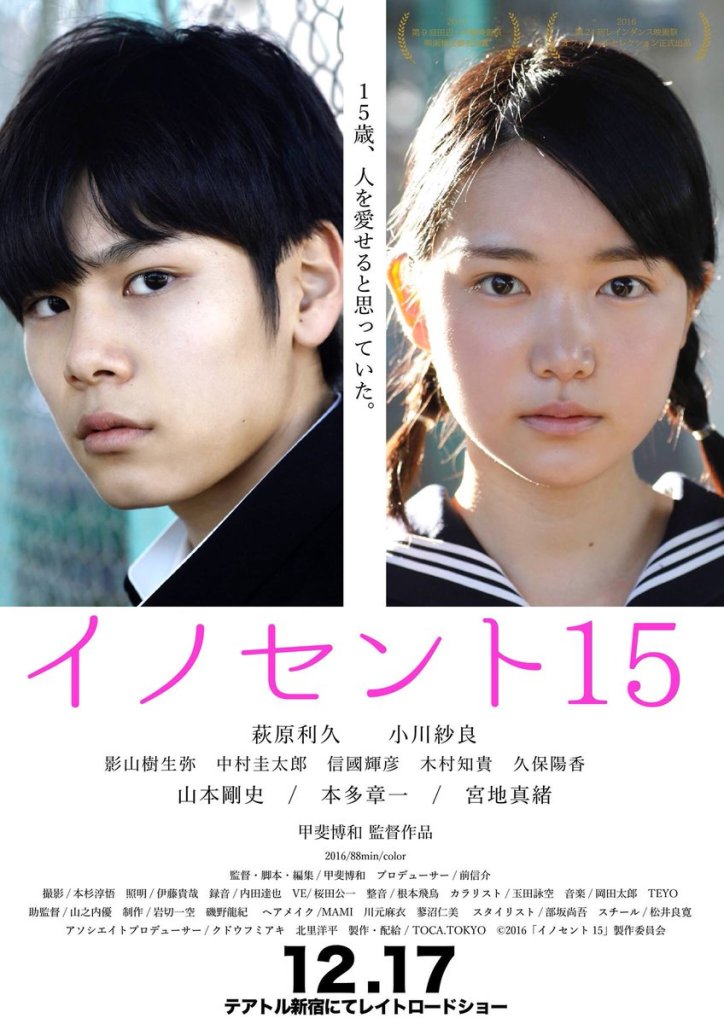
Innocent15 (イノセント15, Hirokazu Kai, 2016)

innocent-15Innocence is a fairly nebulous concept and one often misused but if you were expecting an “innocent” tale of youthful romance, Hirokazu Kai’s Innocent15 (イノセント15) is out to wrong foot you from the get go. Kai does not shy away from the darker sides of human nature in examining abusive parenting and forced prostitution as well as the damage done when a secret is broken after long years of being unable to be honest about who you really are. This is a bleak tale, but one with with hope shining round the edges, even if uncertainly.

Narumi (Sara Ogawa) and Gin (Riku Hagiwara) are ordinary middle school students living in small town not far from the capital. When Narumi plucks up the courage to confess her love to her friend, she receives the kindest of brush offs but Gin is left confused. His two drop out friends who spend their days skateboarding around the neighbourhood can’t understand his decision to turn down such a pretty girl though they remember that he’s done the same thing before. Gin himself doesn’t quite know why, but even if he feels sorry for not returning Narumi’s feelings, he is unable to accept them.

Though Narumi may seem like the perfect high school girl – quiet, studious, and refined, if a little sad, her home life is anything but ordinary. Saddled with an aggressive woman child for a mother who demands Narumi abandon her homework to cook her dinner while she plays on her gameboy, Narumi keeps her head down and makes the best of things. After putting up with her mother’s regular beatings, she finally decides to leave when she learns that her mother has sold her virginity to her boyfriend for 100,000 yen.

Meanwhile, Gin’s life is turned upside-down when he learns his father is in love with another man. Already in a state of confusion about his own adolescent feelings, Gin is unable to comprehend this sudden bombshell and lashes out at all around him. Therefore when Narumi arrives and tells him she’s leaving for Tokyo to look for her father he immediately says he’ll come with her. However, their youthful ideas of going it alone in the big city are quickly dashed.

Gin’s problems are of a more immediate kind but Narumi has endured long term suffering at the hands of her abusive mother. When she belittles Narumi’s studying and remarks that she’s no need to go to high school because the world always needs more hookers, it seems like an instance of cruel sarcasm but it turns out she really is intent on prostituting her own daughter to her no good boyfriend.

When her mother’s boyfriend viciously attacks Gin, Narumi is left with nowhere else to go. The tragedy is that intense social pressures and her already existing isolation make it impossible for Narumi to confide in someone about the abuse she’s suffering at home. Being only 15, even if she were to simply walk out of her mother’s house she would have no way to support herself, leaving her with little choice between possible starvation on the streets and allowing her mother to sell her to her cruel and violent boyfriend.

Narumi’s “innocent” love for Gin becomes her last lifeline and his rejection a crushing end to her dreams of being saved. By contrast, Gin’s problems are much easier to solve. His resentment towards his father is more likely driven by the shock of the revelation rather than directly because he has fallen in love with another man. Gin may have temporarily rejected his father, but his father has not rejected him. Guilt and embarrassment over his actions aside, Gin is always welcome to return home where his father would welcome him with open arms. All of Gin’s problems are internal as he struggles with his adolescent confusion. All of Narumi’s problems are external – when Gin spots the scars and bruises on her shoulder, she tells him that she was able to put up with her mother’s cruelty because it only hurt her body and never touched her soul. Narumi’s interior is solid, but she’s trapped in a desperate situation from which there is no obvious way to escape.

Mirroring each other, Gin and Narumi try to run away from their problems but are each unable to escape. Kai opts for a series of reverses towards the film’s conclusion which offer hope only to dash it again and the final scene with only the sound of a motorbike’s flooded engine and eventual kickstart adds a note of anxious ambivalence in which there is a chance for the pair to ride away together but no further evidence that this attempt will be any more successful than the last. The general tone is one of gritty realism though Kai also admits the existence of life’s strange coincidence’s such as in the repeated appearance of a “weird lady” on a pink mobility scooter whose eccentric driving style has disastrous consequences. A necessarily bleak tale highlighting the plight of children in danger in their own homes and left with nowhere else to go coupled with a tentative, innocent teenage love story, Innocent15 is a tense, often horrifying experience filled with outrage but is careful to leave at least the possibility of a better way out, however far off it may be.


Reviewed at Raindance 2016.

Original trailer (English subtitles)

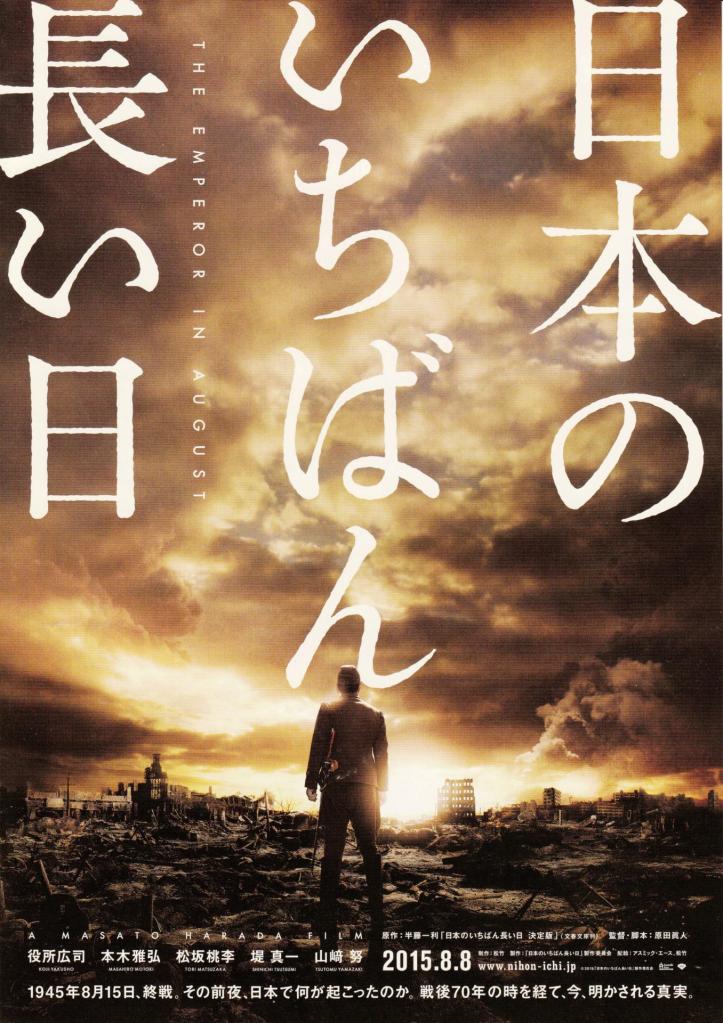
The Emperor in August (日本のいちばん長い日, Masato Harada, 2015)

bbc56b4fff657dfc4fcc0499f8be9741How exactly do you lose a war? It’s not as if you can simply telephone your opponents and say “so sorry, I’m a little busy today so perhaps we could agree not to kill each other for bit? Talk later, tata.” The Emperor in August examines the last few days in the summer of 1945 as Japan attempts to convince itself to end the conflict. Previously recounted by Kihachi Okamoto in 1967 under the title Japan’s Longest Day, The Emperor in August (日本のいちばん長い日, Nihon no Ichiban Nagai Hi) proves that stately events are not always as gracefully carried off as they may appear on the surface.

By the summer of 1945, it’s clear that the situation as deteriorated significantly and Japan can no longer cling to any kind of hope of victory in the wider scale. Tokyo has been firebombed almost out of existence leaving only the Imperial Palace untouched – even the Emperor and his wife have been reduced to eating gruel. Everyone knows it’s time for a solution, but no one is quite ready to say it. In the wake of the atomic bomb, the situation becomes ever more desperate and even if the Emperor himself advocates a surrender, he needs the approval of his advisors. The Prime Minister, Navy and other officials are in favour but the Army, represented by General Anami, is committed to fighting on to the last man. Eventually, Anami comes around to the Emperor’s point of view but some of his men prove much harder to convince…

It might seem like a strange time to make a film about grace in the face of defeat given the recent political troubles stemming back to Japan’s wartime activities, but director Masato Harada is not lamenting the course of the war or trying to advocate for any rightwing agenda so much as trying to make plain the final absurdity of recognising when the battle is over. The civilians and even the Navy might be in favour of accepting the terms of the Potsdam Declaration and ending the war as quickly as possible but a soldier is a soldier and the Army wants to go down fighting. They aren’t alone, of course, there are ordinary people who feel this way too but the writing is well and truly on the wall here.

The bulk of the film takes place within the palace, debating halls or army buildings all of which have escaped major damaged but every time we venture outside we’re shown a scene of utter desolation. A great, gaping hole where once there was a city. Anami’s wife undertakes a four hour walk to try and get in contact with a man who knew their son and can tell them how it was that he fell somewhere in Manchuria. She sees people fleeing, some thinking the enemy are about to descend any minute or that Tokyo will be the next target for an atomic bomb, and walks on through a barren, eerie landscape emerging soot covered and, finally, too late.

Closer to home, the situation among the soldiers is reaching boiling point. Originally committed to rejecting the terms of the treaty, Anami is now in favour of a surrender (with a few caveats) and is desperately working against the threat of an internal coup. Though the top brass have seen enough of warfare to know when it’s time to put down your weapons, the young hotheads have not yet learned the value of pragmatism. Seeing themselves as a second incarnation of the February 26th rebels, a cadre of young officers breaks ranks to try and stop the Emperor’s message of surrender from hitting the airwaves, hoping instead to spread the false message that the Russians have invaded and it’s all hands on deck. Needless to say, they don’t fare any better than the young officers of 1936 and if anything their bullheaded refusal to see sense becomes a microcosmic allegory for the years of militarism as a whole.

In the midst of all this chaos, the real heart of the film is Koji Yakusho’s conflicted general who feels his era passing right in front of him. Grieving for his fallen son yet also clinging to his military duty which dictates no surrender, no retreat he finally sees each of his ideals crumbling and comes to the realisation that the only way to save Japan is to abandon the military. Making a sacrifice of himself, he ensures the safe passage of his nation along a road on which he cannot travel.

The Emperor is a sympathetic figure here, gentle, soft, wanting the suffering to end for everyone but being more or less powerless to effect it despite his title. All he can do is advocate and try to convince his council that surrender is the right course of action as his country burns all around him.

Harada manages to keep the tension high even though a lot of the film comes down to a group of men discussing the proper wording for a treaty. A timely and beautifully photographed exploration of the last days of a war, The Emperor in August is another much needed reminder that decisions which will affect millions of lives are made by handfuls of men in tiny, closed up rooms that most people will never get to see.


The Japanese blu-ray/DVD release of The Emperor in August includes English subtitles.

Unsubtitled trailer: