

The first thing we see in Eiji Uchida’s elliptical crime thriller Night Flower (ナイトフラワー) is a sign reading “Paradise” that’s ironically positioned in the bathroom of a hostess bar staffed by middle-aged women that has the Japanese equivalent as its name. In a moment of dark foreshadowing, the sign tells us exactly where we’re headed while suggesting that the kind of familial utopia the heroine is seeking will always be just out of reach.
This is largely due to circumstances beyond Natsuki’s (Keiko Kitagawa) control. As hard as she tries to provide for her two young children, the fact is that the odds are stacked against her in this rather patriarchal society. The film opens with her boss shouting at her for having fallen asleep on the toilet, but it’s obvious that Natsuki exists in a permanent state of exhaustion. She’s already working multiple jobs and failing to make ends meet after having been abandoned by her husband who ran off after accruing massive debts. Even after moving from Osaka to Tokyo to try and escape them, she’s being hassled by loan sharks and is already at the end of her tether. It’s not surprising then that when she happens to come across a drug dealer who’s been mugged by his client she steals his remaining stash with the intention of selling it on.
The real villain is, of course, the society that fails to come to the aid of women like Natsuki and leaves them with little choice other than to turn to crime. None of her part-time jobs pay enough to live on and when she approaches the town hall, they tell her she can’t claim any more benefits for another month despite being down to her last few coins. The jobs Natuski does are those available to people with few qualifications where the pay is low and disproportionately done by women. There seems to be an implicit assumption still in place that a woman will to some degree have a man to rely on for financial security, though all of the men we see are unreliable from Tamae’s trainer (Ken Mitsuishi) whose gambling problem endangers the gym to Mrs Hoshizuki’s (Reina Tanaka) husband who refuses to take any responsibility for the domestic sphere and treats his wife as a glorified housekeeper.
To that extent, there is a direct line being drawn between wealthy housewife Mrs Hoshizuki, who is effectively a single mother because her husband is functionally absent from the domestic space yet provides financially, and Natsuki that suggests money is not the central issue. Natsuki’s young daughter Koharu is earnest and considerate. She well understands how difficult her mother’s life is and does her best to make it easier. Mrs Hoshizuki’s daughter, meanwhile, falls in with a bad crowd at school and begins using drugs. Her mother is powerless to help her and her father refuses to get involved. When she first hires a detective who discovers Natsuki and Tamae pushing drugs on the streets, Ms Hoshizuki asks if they have families too as if she understood on some level that they’re not necessarily bad people and were reluctant to get them into trouble, but also perhaps wondering how they can do this to someone else’s child if they have children of their own.
Natuski can’t really afford to think about the customers, and when earning more money through drugs continues her other part-time work and lives modestly wanting to provide for her children if something were to go wrong. She even asks her partner, aspiring MMA fighter Tamae, to look after them as if she were already resolved to pay the price if caught. Tamae is in this because she wanted to get out of sex work which she’d been doing to fund her career in the absence of a sponsor. It’s never quite clear if there is a romantic dimension to their relationship, but it’s certainly incredibly close as Tamae becomes an essential part of the family, dying her hair to match Natsuki’s and beginning to speak with an Osaka accent just like they do. For a time, they find the kind of paradise they’re looking for, but also seem to know that it can’t last.
It seems that Tamae was also abandoned by her mother, while the androgynous gang boss Ms Sato gives them a little leeway precisely because she admires the way Natsuki fights for her kids when theirs did not. Most of the other gangsters also report having bad or no relationships with their mothers, which circles round to a rather conservative viewpoint of blaming mothers for everything. But no matter how hard Natsuki and Tamae fight, the fact is they always lose and the odds are forever stacked against them. All they have is the solidarity they’ve found together as a family unit, but it’s not enough to protect them against the harshness of the world they’ve entered. Night flowers bloom when they feel like it, but it seems like this one only blossoms in an impossible paradise.
Night Flower screens as part of this year’s Nippon Connection.
Trailer (English subtitles)
Images: © 2025 “Night Flower” Film Partners


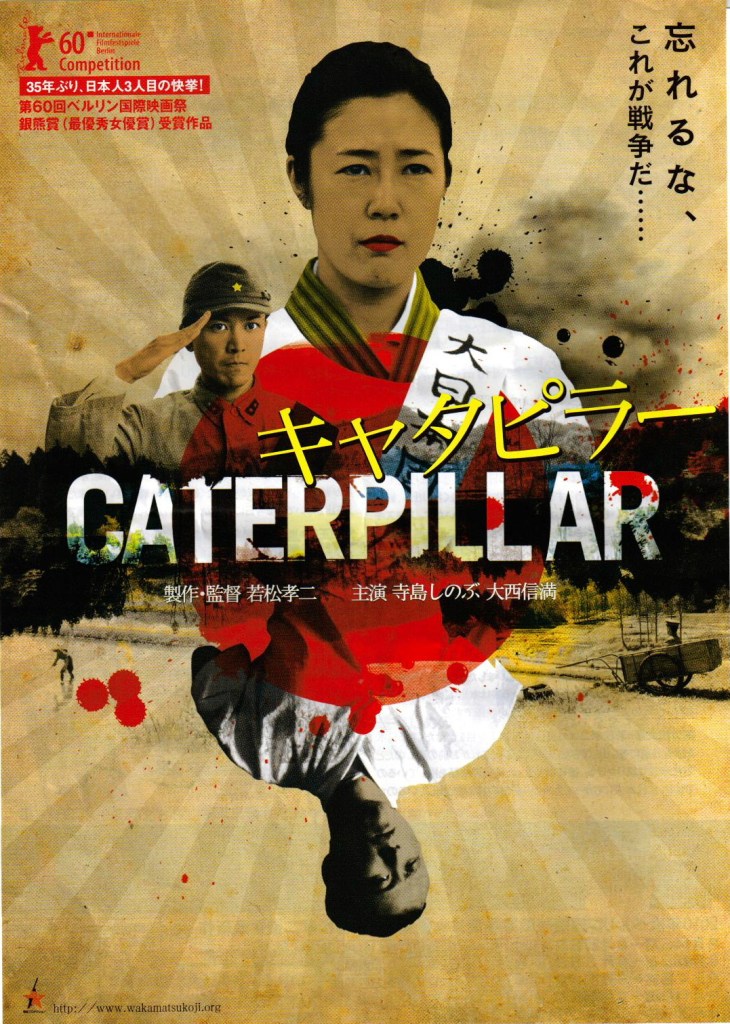 Koji Wakamatsu made his name in the pink genre where artistic flair and political messages mingled with softcore pornography and the rigorous formula of the genre. Wakamatsu rarely abandoned this aspect of his work but in adapting a well known story by Japan’s master of the grotesque Edogawa Rampo, Wakamatsu redefines his key concern as sex becomes currency, a kind of trade and power game between husband and wife. Caterpillar (キャタピラー), aside from its psychological questioning of marital relations, is a clear anti-war rallying call as a small Japanese village finds itself brainwashed into sacrificing its sons for the Emperor, never suspecting all their sacrifices will have been in vain when the war is lost and wounded men only a painful reminder of wartime folly.
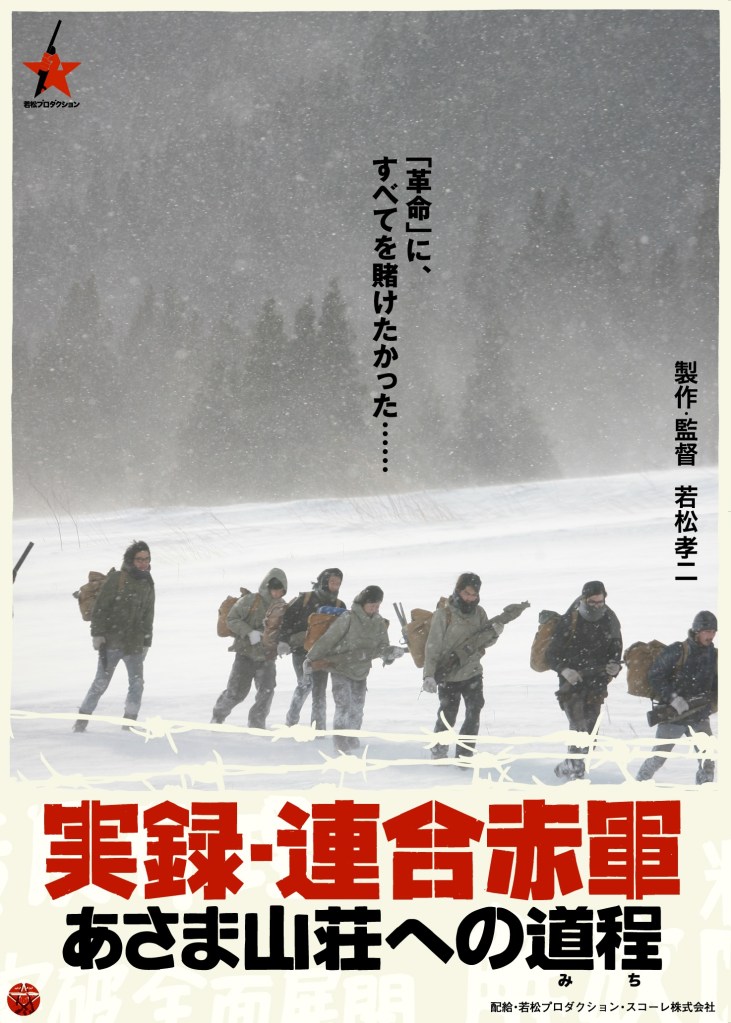 Koji Wakamtasu had a long and somewhat strange career, untimely ended by his death in a road traffic accident at the age of 76 with projects still in the pipeline destined never to be finished. 2008’s United Red Army (実録・連合赤軍 あさま山荘への道程, Jitsuroku Rengosekigun Asama-Sanso e no Michi) was far from his final film either in conception or actuality, but it does serve as a fitting epitaph for his oeuvre in its unflinching determination to tell the sad story of Japan’s leftist protest movement. Having been a member of the movement himself (though the extent to which he participated directly is unclear), Wakamatsu was perfectly placed to offer a subjective view of the scene, why and how it developed as it did and took the route it went on to take. This is not a story of revolution frustrated by the inevitability of defeat, there is no romance here – only the tragedy of young lives cut short by a war every bit as pointless as the one which they claimed to be in protest of. Young men and women who only wanted to create a better, fairer world found themselves indoctrinated into a fundamentalist political cult, misused by power hungry ideologues whose sole aims amounted to a war on their own souls, and finally martyred in an ongoing campaign of senseless death and violence.
 “Being naked in front of people is embarrassing” says the drunken mother of a recently deceased major character in a bizarre yet pivotal scene towards the end of Shunji Iwai’s aptly titled A Bride for Rip Van Winkle (リップヴァンウィンクルの花嫁, Rip Van Winkle no Hanayome) in which the director himself wakes up from an extended cinematic slumber to discover that much is changed. This sequence, in a sense, makes plain one of the film’s essential themes – truth, and the appearance of truth, as mediated by human connection. The film’s timid heroine, Nanami (Haru Kuroki), bares all of herself online, recording each ugly thought and despairing notion before an audience of anonymous strangers, yet can barely look even those she knows well in the eye. Though Namami’s fear and insecurity are painfully obvious to all, not least to herself, she’s not alone in her fear of emotional nakedness as she discovers throughout her strange odyssey in which nothing is quite as it seems.
 When examining the influences of classic European cinema on Japanese filmmaking, you rarely end up with Fellini. Nevertheless, Fellini looms large over the indie comedy Choklietta (チョコリエッタ) and the director, Shiori Kazama, even leaves a post-credits dedication to Italy’s master of the surreal as a thank you for inspiring the fifteen year old her to make movies. Full of knowing nods to the world of classic cinema, Chokolietta is a charming, if over long, coming of age drama which becomes a meditation on both personal and national notions of loss.
