
Randen: The Comings and Goings on a Kyoto Tram (嵐電, Takuji Suzuki, 2019)

Randen posterStill running over a century later, the Randen tram line is the only one in Kyoto and connects a series of Japan’s most popular tourist destinations in the famously “historical” city. It is also, of course, a key method of public transportation much loved by locals. Randen: The Comings and Goings on a Kyoto Tram (嵐電, Randen) fits neatly into that subgenere of Japanese films which might as well have been funded by the tourist board, but even so has real affection for its anachronistic street cars as they traffic a series of romantically troubled souls towards the places they need to be with a little help from the supernatural.

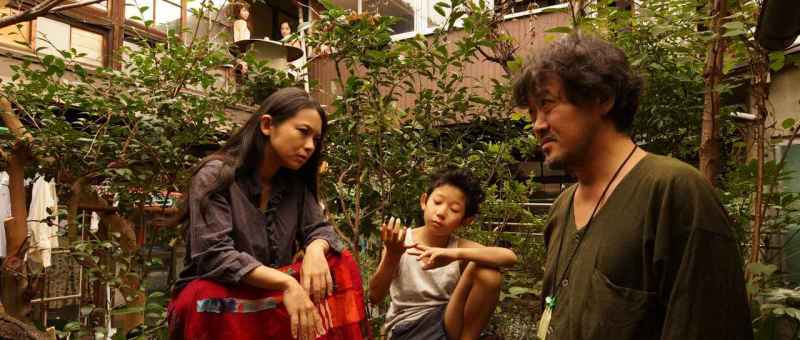
Chief among them, Eisuke (Arata Iura) is a blocked writer specialising in real life strange tales. He’s come to Kyoto, rich with culture and history, in search of local mystery but finds himself preoccupied with thoughts of home and the Kyoto-born wife from whom he fears he may have grown apart. Meanwhile, Kako (Ayaka Onishi), a painfully shy woman working in a bento shop finds herself unexpectedly sucked into the world of showbiz when she is persuaded to help a Tokyo actor, Fu (Hiroto Kanai), run lines in a Kyoto accent. Back on the platform, high school girl Nanten (Tamaki Kobuse), on a school trip from Aomori, falls for aloof high school boy Shigosen (much to the consternation of her friends) but unfortunately for her trains are “everything” for him.

Mimicking the linearity of the tramline, Randen takes us through three ages of love with three variously troubled lovers each trying to find the right stop. Teenagers Nanten and Shigosen struggle with their feelings in the normal way. She is certain, he (more romantic than he seems) is not – denying his feelings in the anxiety that requited love evaporates where the suffering of unreciprocated attraction does not. Kako, meanwhile, is struggling with quite different issues in that she lacks self confidence and has decided she’s no good with people. She rebuffs Fu’s straightforward attempts at romance out of shyness and confusion, unable to parse his non-committal replies and wondering if he finds her line of questioning irritating, in which case why is hanging around with her. Eisuke, meanwhile, does something much the same as he recalls a “failed” trip he took with his wife to Kyoto sometime ago and ponders the various ways each of them will change in the time they are apart.

Through it all, the rail station cafe owner (Ryushi Mizugami) is there to dispense his wisdom and knowledge of the city. Picturesque as it is, the tramline is also pregnant with local superstition – the teenagers believe catching sight of the “Yuko” train and its distinctive retro livery means a couple will stay together, while accidentally catching sight of a train staffed by kitsune and tanuki will lead a couple to part. Superstition is as superstition does, but there may indeed be some truth in it if only as a self-fulfilling prophecy. The presence of the contrary trains does, however, prompt true emotions to the surface if only to avoid a negative outcome born of getting on the wrong train at the wrong time and ending up in an unwelcome romantic destination.

Sometimes the train takes you where you want to go, and other times you need to get off and rethink. Shigesen bought his camera to film the things he likes, but worries now it’s more that he likes the stuff he films. There might be room in his heart for something other than trains, but he’ll have to put the camera down for a minute to find out. Nanten’s friends busy themselves the touristy stuff – the Jidaigeki movie theme park and putative trips to feed monkeys, but for her Kyoto is the city of love and she doesn’t want to leave it without fulfilling her romantic destiny. A loving tribute to the iconic, appropriately historical, method of mass transit and to the charmingly, picturesque town itself, Randen: The Comings and Goings on a Kyoto Tram exists at the intersection of past and present as its conflicted lovers make ghosts of themselves riding the tram into eternity and fading into the city as just another part of local history, running the lines forevermore.


Randen: The Comings and Goings on a Kyoto Tram was screened as part of Japan Cuts 2019.

Original trailer (English subtitles)
Mystery of the Night (Misterio de la Noche, Adolfo Borinaga Alix Jr, 2019) [Fantasia 2019]

Mystery of the Night poster“There is nothing mysterious about the forest”, a traumatised traveller tries to tell himself, “only darkness”. Darkness is indeed a major theme of Adolfo Borinaga Alix Jr’s adaptation of the Aswang origin stage play Ang Unang Aswang, only this is darkness born of “civilisation” rather than its absence. The forest is mysterious, but largely because it is home to essential truths few now wish to see and are perhaps afraid to face. The evils of colonialism retold as folktale, Mystery of the Night (Misterio de la Noche) spins a less than ancient genesis for the iconic Philippine monster but hints at its origins in the darkness of the human heart.

In the early 1900s the Philippines was still firmly in the grip of Spanish colonial rule in which the Catholic Church and entrenched aristocracy remained all powerful. The tale begins when a young woman raped by a priest is condemned to the forest as the barer of a “Devil’s Child”. Though she rails and curses all around her, Mayor Alselmo (Allan Paule) consents to drag her into the wilderness as part of his own rite of passage, during which one of his men is killed. The woman, abandoned to her fate, gives birth alone but the effort costs her her life. The baby, meanwhile, is adopted by the forest dwellers of whom the civilised city folk are all so afraid. She grows up and meets a handsome young man, Domingo (Benjamin Alves) – Alselmo’s son, himself intent on exploring the forest’s mysteries. Nature takes its course, but Domingo is a young aristocrat with a wife and future in the city. Like many men, he takes his pleasures lightly and coldly rebuffs his forest bride when she comes calling on him in the austerity of civilisation.

Alix begins with a cold open flashing forward to the film’s conclusion before pulling back to introduce us to the world of the forest spirits, now pushed to the margins by the encroachment of the Spanish. To the Spanish, the spirits of the forest are frightening, demonic apparitions which threaten the primacy of their religion, dangerously undermining their hopes for peaceful, integrated governance. The forest spirits, however, may see themselves as “protecting” something, less the forest than a kind of ancestral essence slowly being eroded by outside influence.

“Nothing hidden remains unrevealed, no secrets are kept forever” Anselmo mutters to himself as he contemplates what the forest has taught him. He has been complicit in his own downfall, covering up the clergy’s crimes by abandoning a “crazy” woman to the forest in an effort to avoid dealing with her accusations or their evidence. The forest will give up its secrets, or at least take its revenge, on those who thoughtlessly pollute its darkness with the light of civilisation. The spirits maybe may be primitive, but they are not cruel – the baby’s life is saved only through their kindness and grows to maturity thought their careful nurturing.

Then again, according to the conflicted Domingo, the forest has its own logic and a belief different from the civilised. He wants to keep the forest’s secrets and protect the essence of existence in the belief that the mystery will complete us. When confronted by that mystery on his own terrain, however, he coldly rejects it in service of his civility. He brings back only atavistic violence and internalised shame along with his longing for something more innocent than the sophistication of his aristocratic position.

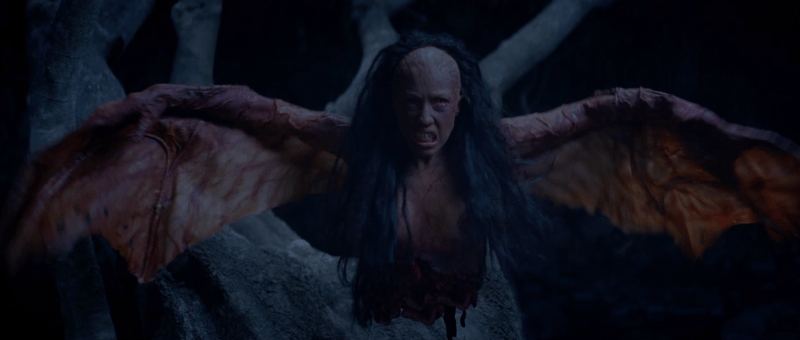
Scorned, “Maria” (Solenn Heussaff) as Domingo has named her, transforms into something else. A creature of rage and fear she screams into the night in grief for all she’s suffered at the hands of a fiercely patriarchal society which so cruelly killed her mother, broke her heart, and destroyed the safety of her world. The easy freedom of the forest has been corrupted by perverse civilisation which wields “morality” like a weapon and insists on authority that gives it the right to oppress. A grim parable of the destructive effects of entrenched colonialism, Mystery of the Night finds true horror in the most primitive of places – human weakness, greed, and hurt turned in on itself as a self-defeating act of protest against systemic cruelty. Beautifully dark, Alix’s shadow play spins a sad story of nature red in tooth and claw vs muted humanity, hauntingly ethereal and infinitely strange.


Mystery of the Night was screened as part of the 2019 Fantasia International Film Festival.

Teaser trailer (English captions)

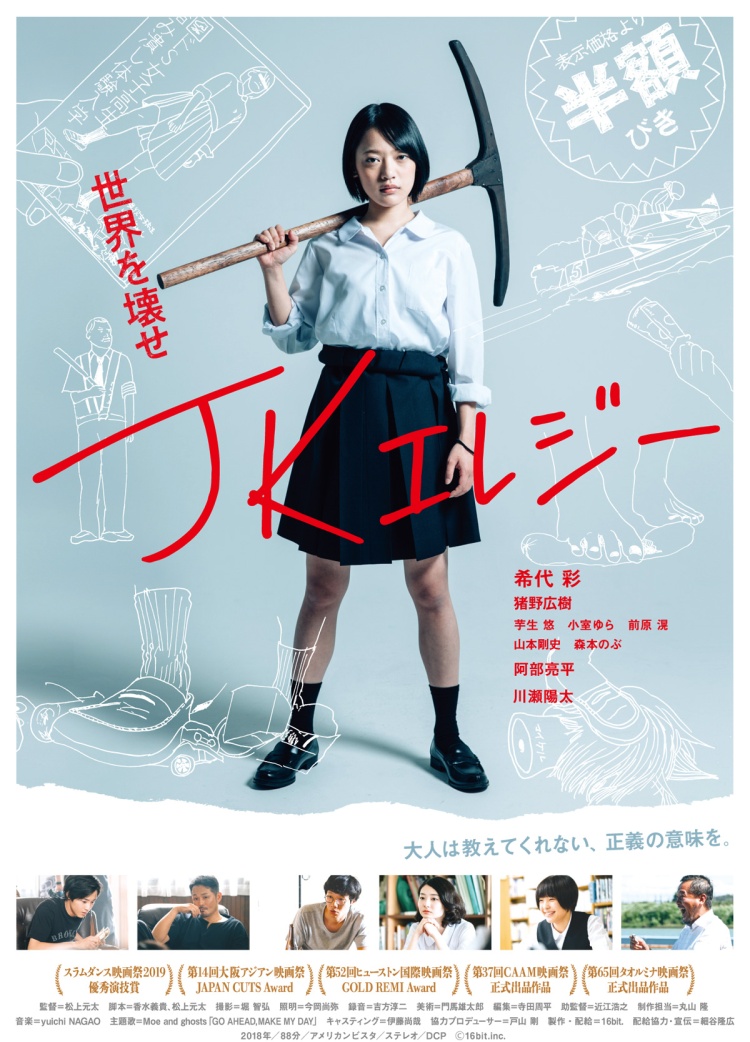
Demolition Girl (JKエレジー , Genta Matsugami, 2019)

Demolition Girl poster 1High school is tough for everyone, but some have it harder than most. Cocoa (Aya Kitai), the heroine of Genta Matsugami’s Demolition Girl (JKエレジー, JK Elegy), struggles to envisage a way out of her dead end existence in small town, rural Japan but begins to find a new sense of purpose when presented with unexpected opportunity. Circumstances, however, continue to conspire against her as she fights bravely for her right to define her own destiny while those around her all too often try to drag her down.

17 and in the last year of high school, Cocoa isn’t planning on going to uni like her friends because her family is poor. Cocoa’s mother died several years ago and her father (Yota Kawase) has been a feckless mess ever since. A gambling addict, he spends his days at the races frittering away the meagre stipend he gets through fraudulently claiming disability benefit. Meanwhile, Cocoa’s equally feckless 26-year-old brother Tokio (Ko Maehara) has come home from Tokyo after failing to make it as a comedian and spends his days lounging around at home. Cocoa is the only one working, providing for the entire family with her part-time job at a sausage stand at the amusement park. Just recently she’s started supplementing her income through starring in some “videos” her brother’s friend and former comedy double act partner Kazuo (Hiroki Ino) has been making with the hope of flogging them to the select group of people who might find footage of a girl in high school uniform stomping on things “satisfying”.

Symptomatic of the perils of small-town life, Kazuo offers the videos to an old friend who owns the local rental store, not quite realising that his old buddy Naoki (Ryohei Abe) is now what passes for a gang leader in these parts. Still, Kazuo is not a bad guy, just a naive one who realises he’s hit his wall and this small-town existence is all there is waiting for him. Knowing he’s in way over his head, he eventually tries to do the right thing and genuinely wants to see Cocoa succeed even when he knows that means his cash cow will be leaving town.

Cocoa, meanwhile, has become re-energised after a well-meaning teacher tells her she is probably bright enough to get into a national university (rather than just a private one) where the fees are much more manageable. Still unconvinced, she becomes determined when her aunt tells her that her late mother had been putting money away for her especially for university. Sadly, it turns out her wastrel father may have already burned through that, but her resolve is undampened. She’s seen a way out, and she’s going to take it no matter what it takes. As her aunt tells her, she needs to get out of that apartment otherwise she’ll be stuck there forever “caring” for her feckless family members while they sit idly by frittering her money away on easy pleasures.

Still, it won’t easy. Circumstances conspire against her from a stern school board suspicious about her extracurricular activities to the ominous presence of the petty thugs who’ve become quite interested in the potential of the videos. Cocoa’s 18th birthday (which her family didn’t even seem to really remember) turns out to be one of the saddest ever as she parties with her two friends in a karaoke box and is then forced into the realisation that they’re each standing a crossroads and likely taking different paths. Supportive as they are, her friends can’t seem to understand why she got involved with the videos in the first place. From much more comfortable backgrounds, they struggle to comprehend her desire for ready cash as a means of escape or her yearning for independence and to be free from her burdensome family who over rely on her for support but offer very little in return.

A subtle condemnation of systemic inequality and the innate unfairness of a world in which circumstances of birth determine almost everything, Demolition Girl revels in its heroine’s resilience as she decides not to be beaten down by those who tell her she cannot make it out. A beautifully lensed evocation of small-town life, Matsugami’s debut is a wonderfully observed coming of age tale in which its determined heroine learns that she can choose to do things “her own way” without compromising her sense of integrity or having to leave her friends behind.


Demolition Girl was screened as part of Japan Cuts 2019.

International trailer (English subtitles)

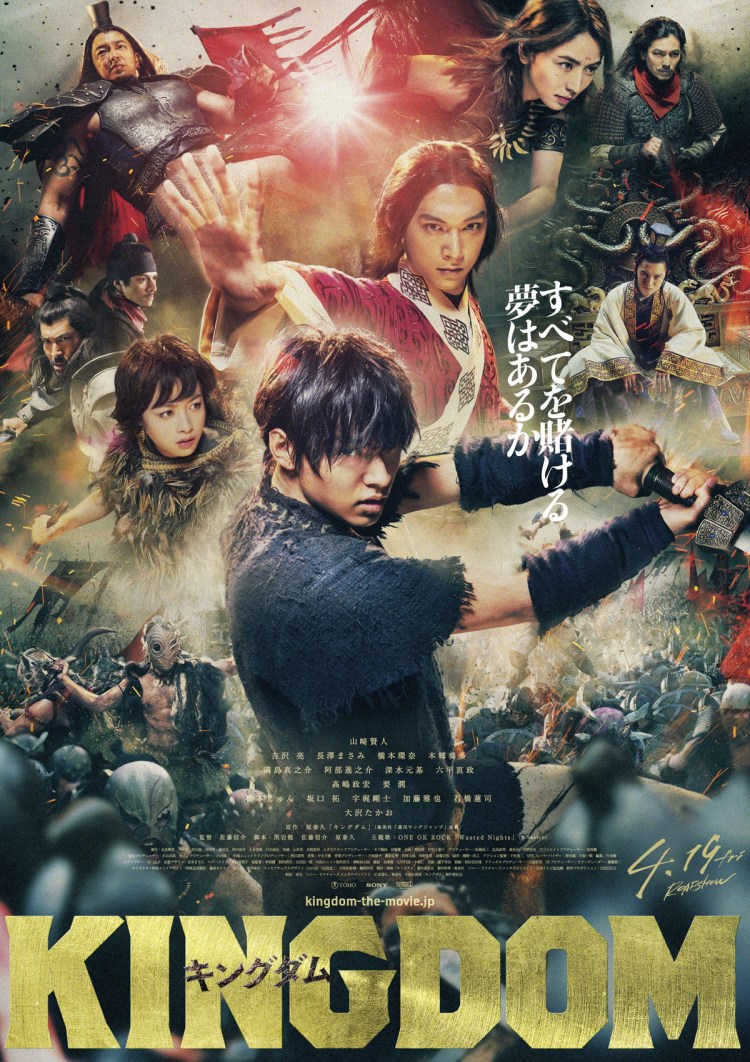
Kingdom (キングダム, Shinsuke Sato, 2019) [Fantasia 2019]

Kingdom poster 1The class war arrives in feudal China via modern Japan in Shinsuke Sato’s big budget adaptation of the wuxia-inspired manga by Yasuhisa Hara, Kingdom (キングダム). Set in China’s Warring States period, Kingdom offers a surprisingly progressive message, if mildly tempered by a failure to tackle the system in its entirety, in which the oppressed (which in this case includes the king) rise up against sneering aristocracy fuelled mostly by righteousness and fierce defence of the right to dream.

The tale begins with a fateful meeting between enslaved war orphans Piao (Ryo Yoshizawa) and Xin (Kento Yamazaki) on a small farm somewhere in rural China. The boys, realising there is no way out of their enslavement save the sword, commit themselves to perfecting their martial arts with the ultimate goal of becoming the world’s greatest generals. Their intense bond is broken when a mysterious man, Lord Chang . Wen Jun (Masahiro Takashima), appears and offers Piao a job at the palace. Though he agonises over leaving his brother behind, Piao seizes his destiny little knowing he has been hired not quite so much for his sword skills as for his resemblance to weakened king Ying Zheng (also played by Ryo Yoshizawa). Sometime later, Piao returns close to death, entrusting Xin with an important mission – go to Ying Zheng and seek his own destiny by restoring rightful rule.

The two boys are about as oppressed as it’s possible to be – orphaned slaves with no prospect of improving their condition save the one they’ve already decided on, fighting in a war. This doesn’t quite explain how they can release themselves from the farm, but Xin’s eventual flight, in which his master does not attempt to stop him, might suggest the first hurdle is not as big as it seems. In any case, Xin finds an unlikely ally in Ying Zheng who has been deposed from the throne by his younger brother for not being royal enough because his birth was illegitimate and his mother was a dancer.

Of course, Ying Zheng’s intention to regain his “rightful” throne is in defence of a necessarily unequal social order, but it’s also a blow against the kind of elitism which mark’s his brother Cheng Jiao’s (Kanata Hongo) philosophy. Cheng Jiao believes that he is the most rightful king because his blood is the most royal. He looks down on Ying Zheng as low born, and has no respect for his subjects or the lower orders. “A peasant in fine clothes is still a peasant” one of his minions intones to intimidate an opponent, but someone with a sword is still someone with a sword no matter their circumstances of birth and provided you have access to acquire one, perhaps swordsmanship is a truly egalitarian art given that it largely depends on how well you wield a blade. Eventually, Ying Zheng makes an ally of another oppressed people – the mountain dwellers subjugated, and previously betrayed, by the powers that be who lend their strength to toppling a corrupt power structure in order to restore something like peace and balance to the land.

Indeed, asked to give a brief manifesto speech, Ying Zheng cooly declares that he aims to create a unified China by eliminating borders and therefore the need for war. Insisting that when a king picks up a sword it ought to be in service of his people, he makes the case for a borderless world, little caring that, as his general points out, history may brand him a tyrant. Nevertheless, he remains a “puppet king” whose status is dependent on the loyalty of key general Wang Yi (Takao Ohsawa) with whom true power lies. Wang Yi, as we later find out seems to be a “good” person who used his troops to protect the innocent and ensure no civilians were harmed during the chaos of the insurrection but he does indeed wield dangerously vast power for just one man. Meanwhile, Ying Zheng may reject the primacy of blood, but does dare to claim his birthright as an oldest son and is of course acting in service of an inherently oppressive system even if he means to make minor improvements towards the kind of meritocracy that allows men like Xin to embrace the power of their dreams.

The power of dreams is indeed the key. Though Cheng Jiao’s hardline mercenary may sneer that “dreams are bullshit” and deny a slave like Xin’s right to have one at all, to men like Xin dreams are all they have. As he says, they get you back on your feet when everything else seems hopeless. Learning that Piao achieved his dream even if it was only for a few moments gives him the strength to pursue his own in service not just of himself but his brother, friends, and kingdom.

Appropriating the aesthetics of wuxia may prove problematic for some, but like many Japanese manga with international settings, Kingdom’s mechanics are essentially home grown which is perhaps why Sato heavily leans on Kurosawa’s legacy, possibly overusing the distinctive side wipe and giving his heroine a look echoing that from Hidden Fortress while other influences seem to feed back from Star Wars in the strangely cute masked mountain elders and gleaming golden armour of bad ass warrior queen Yang Duan He (Masami Nagasawa). A surprisingly positive, perhaps ironically bold plea for a borderless world and if not actual equality at least a friendly kind of egalitarian nobility, Kingdom hands victory to those who fight hardest for their right to dream while subtly advocating for their right to rebel against an inherently unjust social order in order to claim it. 


Kingdom was screened as part of the 2019 Fantasia International Film Festival. It will also be screened in US cinemas from Aug. 16 courtesy of Funimation.

International trailer (English subtitles)

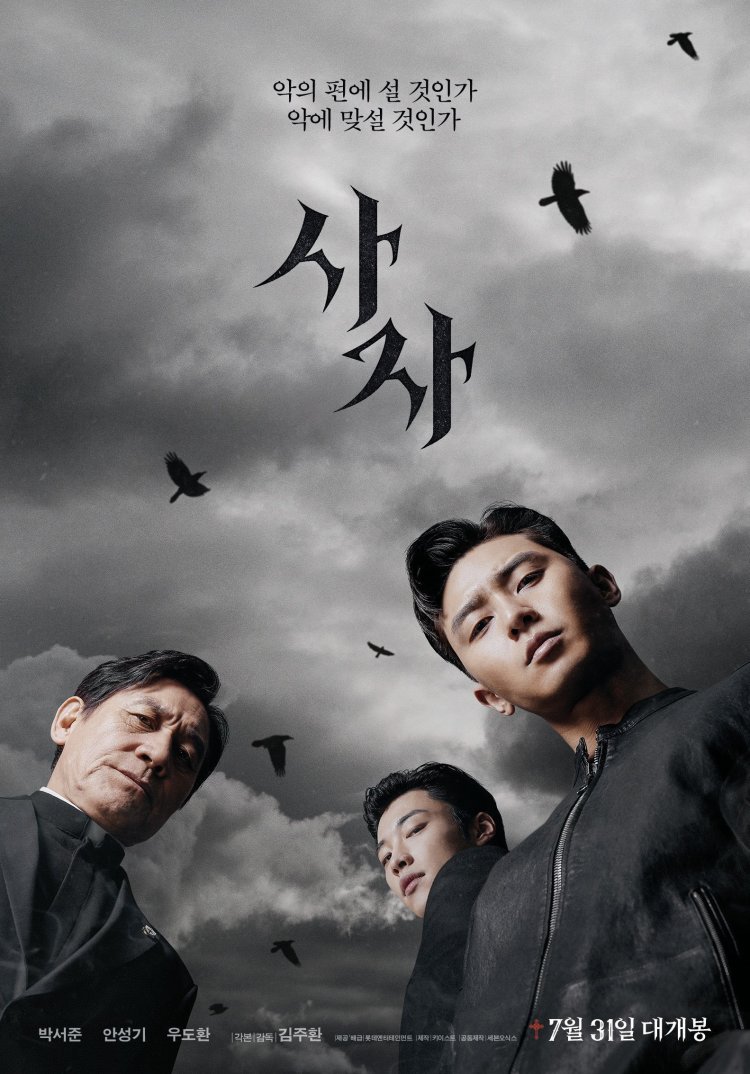
The Divine Fury (사자, Kim Joo-hwan, 2019) [Fantasia 2019]

Divine fury poster 1“If you have faith you have nothing to fear” the veteran priest explains to his protege in Kim Joo-hwan’s The Divine Fury (사자 Saja). The hero is not quite so sure. A tale of grief and resentment, The Divine Fury revels in supernatural dread, but makes plain that the origins of evil lie in the human heart and that it’s a failure to forgive that invites the darkness in.

A brief prologue introduces us to the young Yong-hu whose mother passed away shortly after he was born. His doting dad leaves him at home alone at nights while he works as a regular beat cop. Unfortunately Yong-hu’s earnest father is killed one evening by a rogue driver, leaving the boy orphaned and alone. Though his dad had been careful to take him to church and explain to him about the power of prayer, Yong-hu feels distraught and betrayed by a god who refused to listen and took his dad anyway even though he prayed as hard as he could. Vowing never to set foot in a church again, Yong-hu refuses to believe in anything at all.

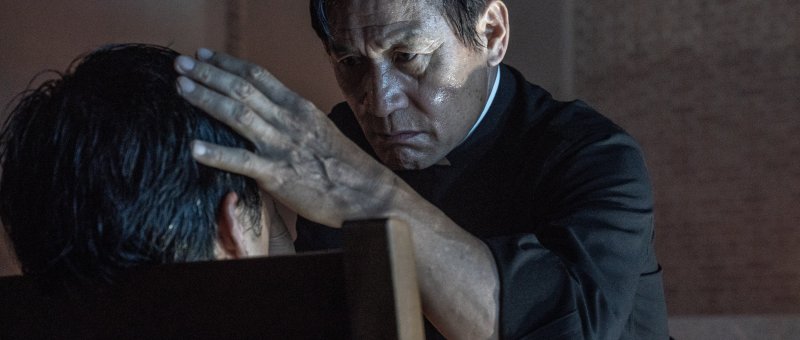
20 years later, he’s a world famous MMA star with vengeance on his mind. Plagued by voices telling him to go back and take revenge on the priest who told him everything would be OK, Yong-hu (Park Seo-joon) buries himself in violence and superficial pleasures. Everything changes on the flight back from an international bout when Yong-hu has a dream of his father in which he grabs a cross and wakes up with stigmata on his right hand. When doctors can’t explain his strange injury which refuses to heal, he turns to a shaman who tells him that he is rife with demonic energy and is only protected by the shining goodness of his father’s wedding ring which he still wears on a cord around his neck. Perhaps surprisingly, the shaman advises him to follow the cross and go to a church at a certain time where a man will help him. The man turns out to be father Ahn (Ahn Sung-ki) – a Vatican-based exorcist currently in the middle of a case so difficult it’s sent his assistant running for the hills in terror.

Anyone who knows anything about exorcism in the movies knows you need an old priest and a young priest. Ahn is more or less resigned to working alone, exorcism is no longer cool with the youngsters it seems, but nevertheless remains keen to court the enigmatic Yong-hu and his all powerful demon banishing hand. Yong-hu, however, remains reluctant. He doesn’t believe in God and resents the old priest as a symbol of all that’s betrayed him. Gradually he begins to warm to Ahn, seeing in him a kind of goodness as he selflessly battles the forces of evil and releases the tormented from their supernatural oppressors even if it might take longer to help them escape their darkness. Meanwhile he continues to hunt the “Dark Bishop” who feeds on fear and negativity in order to secure his own immortality.

Ahn is fond of saying that there’s a reason for every torment and that it’s all part of God’s grand plan. As far as the film goes, he may very well be correct at least in providing the mechanism for Yong-hu’s eventual path towards re-embracing his faith. Still missing his father and nurturing intense hurt and resentment, Yong-hu invited the darkness in, beginning to hate where he should have learned to forgive. As Ahn tells him, you can’t hate something you never loved which might explain why the darkness has never been able to fully consume him. Still battling his father’s absence, Yong-hu remains doubly conflicted, falling into an easy paternal rhythm with the older man yet also resenting him both as a potential father figure primed to betray and as a symbol of the Church in whom no he longer trusts.

Kim shifts away from the comedic banter which made Midnight Runners such an unexpected treat for something more melancholy as his heroes ponder the wages of grief and the demands of responsibility. Cynical, Yong-hu forgot his father’s ghostly instructions to him to grow up to be a good person who helps others and stands up to those who harm the weak (like demons) but eventually comes to reconnect with his dad’s essential goodness when realising that he’s been guided onto a unique path as an MMA star with a magic demon vanquishing fist. Having conquered the evil inside him and accepted his father’s legacy, Yong-hu is ready to take on the forces of darkness with a divine fury of his own while saving the souls of those in peril from threats both earthly and supernatural.


The Divine Fury was screened as part of the 2019 Fantasia International Film Festival. It will also be released in cinemas across the US and Canada courtesy of Well Go USA from Aug. 16.

International trailer (English subtitles)

A Step Forward (牧師といのちの崖, Atsushi Kasezawa, 2019)

bokushi_B5_01“It is very difficult to say what is right and what is not right” a conflicted pastor laments, reflecting on perceived past failings and the sad death of a man who eventually took his own life despite the best efforts of all to help him find a way to go on living. Atsushi Kasezawa’s documentary A Step Forward (牧師といのちの崖, Bokushi to Inochi no Gake) follows a small-town pastor who is on constant call near a series of rocky cliffs which attract both cheerful tourists and those looking for a way out of life’s suffering.

Pastor Yoichi Fujiyabu works with a local suicide prevention charity to try and rescue vulnerable people who might be thinking of taking their own lives. So common is suicide at the clifftop, that the society has erected a sign urging those in distress to reconsider with a number they can call for help. Of course, sometimes other people call too which seems to be the case with the first incident we see in which Fujiyabu spends two hours patiently trying to coax a middle-aged woman away from the cliff edge, eventually taking her back to the rectory and offering her a place to stay.

Suicide prevention does not just end at the clifftop. Fujiyabu also runs a rehabilitation centre which, as his wife later suggests, becomes a kind of “home” for those who feel they no longer have anywhere else to go. Though there may not be any one reason someone decides they have no option other than to end their life, it remains true that many of the people Fujiyabu saves have either lost or become estranged from their families and feel themselves to be alone in the world. The Fujiyabus aim to provide them with the safety net of a place they know they can always return to so that they can begin to rebuild their lives and ultimately return to mainstream society.

Then again, as Mrs. Fujiyabu also points out, they are not “suicide experts” or trained psychologists, just compassionate people trying to do their best to help those in need. Thus they are quite honest about the fact that their work is often emotionally difficult or frustrating, and that though they do their best to love and support everyone there will inevitably be people in life that you cannot like or get along with. Nevertheless, they do what they can with what they know in the hope that the people in their care will eventually be able to leave and become independent. To help in practical as well as emotional ways, they also run a small not for profit bento shop where they employ some of the people Fujiyabu has saved from the cliffs. Working brings many benefits aside from the ability to earn a wage, giving the rescued men and women a new sense of being useful while allowing them to learn new skills surrounded by people in a similar situation so they can perhaps begin to feel less lonely and alone.

It’s just that sense of existential loneliness that Mori, a young man to whom Kasezawa devotes special attention, is seeking to escape. Though he was surrounded by people and in regular contact with his family, Mori always felt at a painful distance from those around him – something which seems to have decreased thanks to the communal lifestyle of the rehabilitation station. When he tries to move on, however, he quickly encounters the same old difficulties as he feels himself disliked by his colleagues, unable to fit in to the point that his therapist eventually advises him to quit for the sake of his mental health. Meanwhile, Fujiyabu, to whom he returns, gently tries to explain to him that he’s living well beyond his means – something that he seems to understand on one level but is entirely unable to rectify.

Fujiyabu, well-meaning as he is, quickly becomes irritated by Mori’s inability, or he wonders lack of will, to change. This is perhaps a little unfair in that he fails to consider the various ways that Mori maybe be unable to conform to the standards he expects for a grown man in his society, thereby failing to find effective methods to help him with the areas of life he seems to have the most trouble with – appropriate social interactions, and executive functioning. Being berated for being selfish and irresponsible when he simply does not understand only adds to his sense of despair and conviction that he is unwanted by the world around him. Though many of the people arriving at the church have more obvious motives to end their lives – debt problems, marital breakdown, career ruin etc, there are also those like Mori who struggle to find acceptance in a fiercely conformist society which perhaps hasn’t yet woken up to the needs of those who “cannot read the air”.

As Fujiyabu says it’s difficult to know what to do for the best. That first lady we saw him save eventually decided to leave the centre and Fujiyabu, after all, has no real right to stop her only to make sure she knows what’s she’s doing. He has to wonder if suicide is a valid choice for those whose suffering is incurable and if, after all, it’s all a part of God’s plan. Nevertheless, he resolves to carry on doing what he can to help those in pain find the will to live again. Director Atsushi Kasezawa approaches the most sensitive of subjects with a compassionate, yet unflinching eye, hinting at the entrenched social problems which cause mass despair as well as the toll taken on those who are determined to help.


A Step Forward was screened as part of Japan Cuts 2019.

Original trailer (English subtitles)

Idol (우상, Lee Su-jin, 2019) [Fantasia 2019]

Idol poster 1“Getting others to trust something is more important, not what they choose to believe” advises a cynical politician a little way into Lee Su-jin’s Idol (우상, Woosang). Image is indeed everything. Who are you more likely to believe – the slick, seemingly upstanding politician who’s done everything “right”, or an ageing, inarticulate aircon repairman with bleach blond hair? Two fathers go to bat for their sons, if in very different ways, but only one can emerge “victorious” in their strangely symmetrical endeavours.

Lee opens with a voice-over taken from a speech later in the film belonging to bereaved father Yoo (Sol Kyung-gu) in which he confesses that as his son Bu-nam (Lee Woo-hyun), who had severe learning difficulties, grew older, he found himself having to masturbate him to prevent him harming himself trying to calm his sexual urges. Yoo’s words play over his opposite number’s return home from a research trip to Japan. Koo (Han Suk-kyu) is a politician and former herbalist with a special interest in nuclear power. Ambitious, he spends much of his time travelling for business while his wife (Kang Mal-geum) cares for their wayward adolescent son, Johan (Jo Byung-gyu). A panicked text message warning that Johan has got himself into trouble again gets ignored, but when he arrives home Koo knows he has to act. Johan has knocked someone over and rather than take them to hospital, he’s brought the body back home.

A series of quick calculations tells him that the “best” option is for Johan to turn himself in, despite his wife’s insistence that they simply get rid of the body. He drives the corpse back to the scene and dumps it, gets rid of the original car, and then drives his son to the police station before expressing contrition in front of the cameras. That would have been that if it weren’t for Yoo’s dogged determination to find out what happened to his boy, and the fact that Bu-nam’s “wife” Ryeon-hwa (Chun Woo-hee), an undocumented former sex worker from China, managed to escape meaning there are loose ends Koo knows he needs to tie up.

“This rotting smell” Ryeon-hwa exclaims on putting a number of things together. There is something undoubtedly corrupt in Koo’s superficially smooth world of neatly pressed suits and sharp haircuts. Stagnant water swells around him, along with a murky swirl of blood, as he contemplates the best way out of his present predicament. Everything here is stained, marked, or scarred as if hinting at the darkness beneath gradually seeping through.

Yoo, meanwhile, perhaps knows he lives in a “dirty” world and though he never claims to be completely clean himself, is fully aware of the implications of his actions. A widowed father, he tried to do the best for his disabled son. He offered him relief in ways others would find perverse in a strange gesture of fatherly love, finally deciding to get him a wife in the hope of putting an end to such degradation for them both only to regret his decision when he realises Bu-nam may not have died if he’d just stayed home. Koo, meanwhile, tries less to protect his son than himself, weighing up that the boy will most likely get a slap on the wrist and he’ll come out of it looking better because he behaved “honestly” and in line with the law. To get elected he will stop at nothing to preserve the image of properness, even if it means he must get his hands “dirty”.

In that essential ruthlessness, he may have something in common with the jaded Ryeon-hwa whose sister warns Yoo not to trust her because “her nature is different”. Like Koo, she has done terrible things but done them to survive rather than to prosper. Her marriage to Bu-nam might seem like no prize, but it was better than the life she was leaving behind and, crucially, a guaranteed path to Korean citizenship assuming Yoo eventually filled in the marriage papers properly.

Yoo just wants “justice”, but ruthless men like Koo who care about little other than image are not about to let him get it, which is why he finds himself trotted out as a superficial ally to bolster Koo’s appearance at the polls in return for Ryeon-hwa’s “assured” safety. In the end, all Koo’s scheming blows up in his face, but, Lee seems to say, the image always survives and men like Koo know how to spin it to their advantage while men like Yoo will always be at the mercy of the system. A bleak, often confusing, noirish thriller, Idol plunges a knife deep into the heart of societal corruption but finds that truth often matters less than the semblance of it in a society which idolises the superficial.


Idol was screened as part of the 2019 Fantasia International Film Festival.

International trailer (English subtitles)

The Kamagasaki Cauldron War (月夜釜合戦, Leo Sato, 2018)

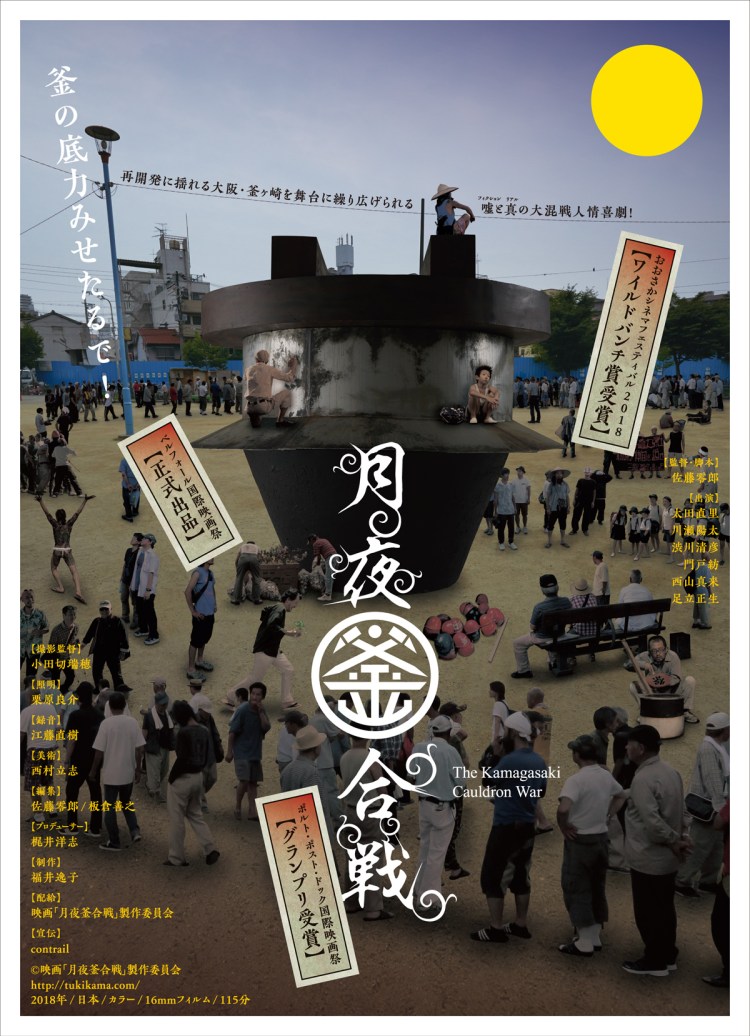
Kamagasaki couldron warAs far as Japanese cinema has been concerned, the city of Osaka is renowned for two very specific things – gangsters and comedy. The Kamagasaki Cauldron War (月夜釜合戦, Tsukiyo no Kamagassen), the debut narrative feature from Leo Sato, neatly brings them both together in an anarchic tale of social inequalities and the pettiness of organised crime. A warmhearted exploration of the eponymous “invisible slum”, Kamagasaki Cauldron War delights in everyday resistance as its ordinary citizens attempt to live their ordinary lives all but forgotten in a society intent on swallowing them whole.

The drama begins with drifter Henmi – a casual labourer with a young son, Kantaro (Tumugi Monko), who dreams of joining the local yakuza gang Kamitari but is rudely rejected by its foot soldiers. In revenge, he steals their precious “kama” sake bowl which is the symbol of their clan and essential for carrying out the succession ritual. This is all the more embarrassing because the elderly boss is thinking of retiring now that his son, Tamao (Kiyohiko Shibukawa), has been released from a 20-year prison stretch. Tamao, however, is secretly pleased because he doesn’t much fancy taking over while the petty yakuza who’s been running the show all this time is also quite happy because he doesn’t really want to give up control. Nevertheless, the precious Kama must be recovered at all costs or the gang will continue to face a significant loss of street cred.

Meanwhile, a bigger drama is underway. Kamagasaki is home to a significant proportion of “homeless” people, many of whom congregate around Sankaku Park where a regular soup kitchen runs next to the giant symbolic Kama cauldron in the park’s centre. It also the last remaining undeveloped post-war area and is therefore rich pickings for unscrupulous property developers such as Capital Beat who are primed to bulldoze the welfare centre to build more housing and therefore need to clear the park of the homeless in order to make the area seem attractive. Already trying to prevent the homeless from settling, the city has put up a series of insidious barriers including floral centrepieces and more obvious metal barriers but is nervous of taking direct action such as physical evictions. Which is where the yakuza come in. Working with Capital Beat and corrupt police, the yakuza take clubs to the soup kitchen and get vulnerable people to commit arson by setting fire to live rats and having them run into “derelict” buildings.

At the centre of events, orphan Nikichi (Yota Kawase) tries to keep himself afloat when the only gigs going are transfers to Turkish nuclear power plants by taking advantage of the Kama crisis and getting his hands on as many as possible little knowing that he is actually in possession of the Kamitari sake bowl thanks to little Kantaro whom he has been persuaded to adopt with his sex worker girlfriend Mei (Naori Ota) who grew up with him in the same orphanage. Coincidentally, the pair were also childhood friends with Tamao who has apparently been holding a torch for Mei all these years as well as grudge against Nikichi for an embarrassing injury caused during a sports contest at school. While they’re busy scrapping it out, the local area decides to fight back against Capital Beat by protesting the city’s treatment of the homeless leaving Nikichi an accidental figurehead for a campaign he doesn’t quite believe in and is only tangentially involved with.

Decrying that there is “no place to rest in the whole world” some enterprising homeless guys have built a tunnel under the giant Kama while others attempt to repurpose their penury by declaring that “garbage is the weapon of the people”. Recalling the anarchic spirit of the student protests (including a surprising cameo by Masao Adachi), the residents of Kamagasaki rise up against social intransigence by taking on the yakuza armed with pots and pans before the police stick their oar in and end up becoming a mutual point of irritation. Filmed on retro 16mm, Kamagasaki Cauldron War offers no real solutions to its various problems but delights in the everyday anarchism of its workaday world in which its scrappy residents do their best to get by in an often hostile environment, finding whatever ways they can to resist societal oppression while maintaining a sense of humour and world weary hope for the future.


The Kamagasaki Cauldron War was screened as part of Japan Cuts 2019.

Original trailer (English subtitles)

The Bravest (烈火英雄, Tony Chan, 2019)

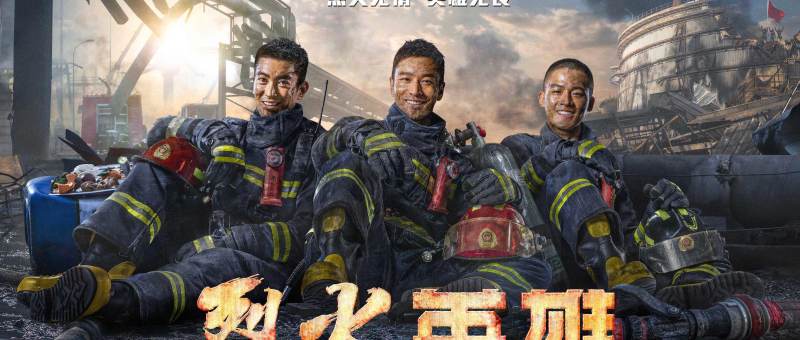
The Bravest poster 12019 is an important year for China’s Communist Party. Not only is it the 70th anniversary of the founding of the People’s Republic, but it’s also the centenary of the May 4th Movement which saw Chinese students protest against increasing foreign influence. To mark the occasion, Bona Film Group is set to produce what it calls the “China’s Pride Trilogy”, or as the less generously minded might see it, a trilogy of propaganda movies of which The Bravest (烈火英雄, Lhuǒ Yīngxióng) is the first. While China’s military has frequently taken centre stage in the nation’s increasingly jingoistic action movies, The Bravest is the first to focus on the heroic efforts of the fire service, which in China is operated by the army.

Inspired by a real life fire which broke out in Dalian, Liaoning Province in July 2010 and adapted from Mongolian author Bao’erji Yuanye’s book “Tears Are the Deepest Water”, The Bravest follows a collection of differing brigades who come together to battle a raging fire which has engulfed a coastal oil refinery. When we first meet our heroes, the Special Squadron, they’re in the middle of rescuing a little girl from a fire in hotpot restaurant. Though the operation is initially successful with the girl rescued and the fire extinguished, the owner has neglected to inform the fire fighting team that the back room is full of propane tanks, which is something he probably should have mentioned. One of the team is killed in the ensuing explosion while captain Liwei (Huang Xiaoming) is knocked out and thereafter removed from active duty while he deals with PTSD related to the incident.

Flashing forward, we’re told that if the wrong quantity of chemicals are added to the oil running through the refinery then it could catch fire, which it eventually does. The problem isn’t just the potential economic effects or even the possibility of a large scale explosion causing widespread infrastructure damage and loss of life, but that there is a possibility that the fire will release cyanide gas which has the potential to kill everything within the surrounding area. In the immediate aftermath of the fire breaking out, the harbour brigade, Special Squadron, and the tinpot rural team Liwei has been demoted to are all summoned to help but, unusually considering this is a propaganda film designed to praise the emergency services, are largely ill-equipped to deal with such a large and potentially hazardous incident.

Nevertheless, they live up to the movie’s name, bravely wading into harm’s way to minimise the damage. Meanwhile, mass panic is quickly overtaking the city as people begin to become aware of the potential danger through their smartphones or messages from someone connected to the refinery which is, after all, the economic centre of the area. Economics are partly what’s on the mind of the refinery’s chief who is often less than truthful with staff at the command centre, deliberately keeping information from them in an effort to control the situation and avoid being the guy who plunged an entire province into poverty. He does however give himself brownie points for sticking around when similar big wig villains in disaster movies usually get on their private jets and leave the emergency services to it. He’s joined by a selection of party officials who also break with cinematic tradition by standing next to the firefighters, a little way back from the frontline but very much still in harm’s way as they attempt to ensure a satisfactory outcome for all. In the hospitals too, doctors and nurses remain at their posts treating the injured rather than tending to their own wellbeing.

The focus is, however, the heroically altruistic actions of the firefighters who disregard their own safety in order to ensure that of others. Thankfully, in the real life incident no one was killed but in Movieland no one is that lucky and The Bravest remains remarkably unafraid to indulge in obvious foreshadowing such as poignant scenes of familial discord and even one pair of firefighters rushing to the scene still dressed in their outfits from getting their wedding pictures taken. Sad salutes and moments of silence are the order of the day while the firefighters divide up the hazardous duties by volunteering those with siblings so parents will be protected should the worst happen. Unashamedly melodramatic, there’s no denying the sheer spectacle of The Bravest’s cleverly crafted fire effects or its mammoth scale, even if it never manages to escape its nakedly propagandistic genesis. 


Currently on limited release in UK/US/Canada/Australia/NZ cinemas.

Original trailer (English subtitles)
I Go Gaga, My Dear (ぼけますから、よろしくお願いします。, Naoko Nobutomo, 2018)

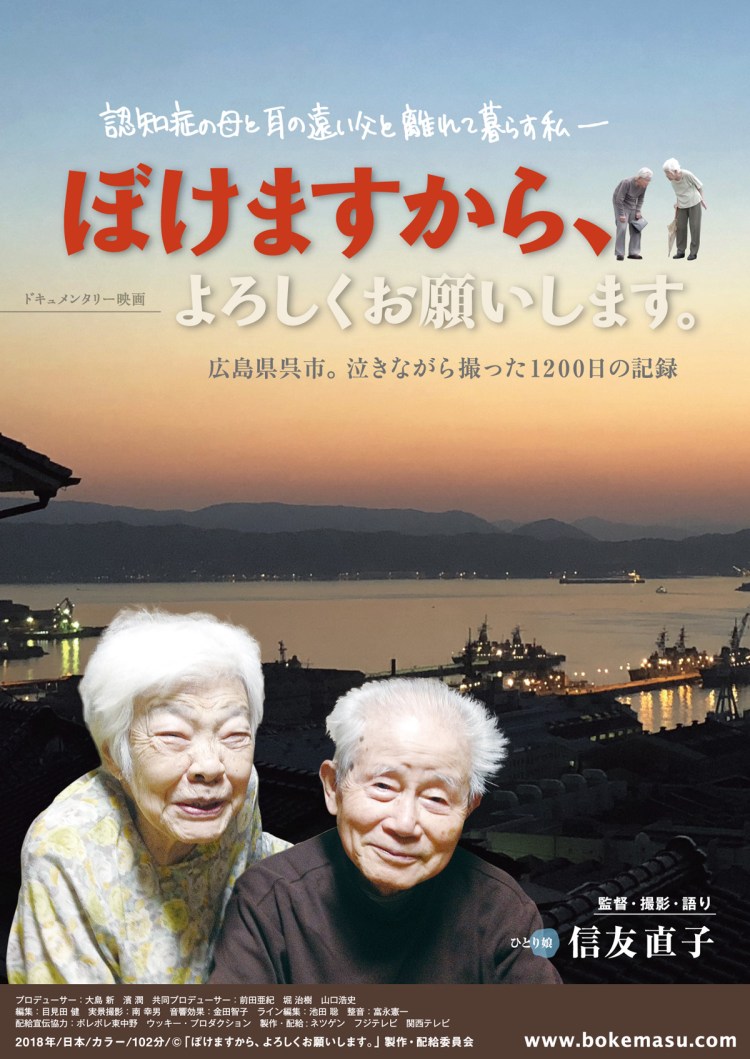
I go gaga posterWith the population ageing at unprecedented levels, Japanese society is facing a series of interconnected social issues as it contemplates the best way of caring for large numbers of elderly people often living away from family members who, in the past, might have been expected to bear responsibility. What sometimes gets forgotten, however, is the human dimension as older people go on living their everyday lives sometimes surrounded by family and sometimes not. Veteran TV director Naoko Nobutomo’s first feature I Go Gaga, My Dear (ぼけますから、よろしくお願いします。, Bokemasukara, Yoroshiku Onegaishimasu) follows her ageing parents from her own perspective as their daughter as they continue supporting each other into old age.

Nobutomo begins her story on New Year’s Day 2014 as she begins to notice a change in her sprightly, independent mother Fumiko and decides to take her to a doctor where they discover she is in the early stages of Alzheimer’s. Over the next three years, Fumiko’s condition intensifies while her husband of 60 years, Yoshinori, does his best to care for her though he himself is already over 90.

Flashing back to home video taken in earlier years, Nobutomo recalls her difficulty dealing with breast cancer at 45 throughout which her mother had been there to look after her. Having looked after her family for all of her life, there is an especial irony that now it’s Fumiko who needs looking after and it is perhaps these small moments of change that force her to acknowledge a gradual decline in her living standards even if she cannot clearly process them. Though Yoshinori bravely starts taking more domestic responsibility at 95, losing the ability to cook for herself is an obvious blow to Fumiko who nevertheless determines to keep her kitchen spotlessly clean.

Luckily, Fumiko and Yoshinori have a generous health insurance policy which entitles them to assistance in the home though that is something they obviously feel ambivalent about accessing. Fumiko, in particular, remains confused about the presence and role of their new helper, believing she is something to do with the insurance company, and is a little resentful of her offer to help with physically difficult housework such as cleaning the bath and emptying the washing machine. Likewise, she is originally reluctant to attend the daycare centre but noticeably perks up after being given a valuable opportunity to socialise rather than staying home all day with relatively little stimulation.

Seeing that her parents are struggling to manage on their own, Nobutomo wonders if she should give up her job in Tokyo and come home to Kure to look after them but is assured by her father that they’d prefer her to go on living her own life. Yoshinori, born in 1920, wanted to study literature at university but the war got in the way. Perhaps for this reason, he was determined that his daughter follow her dreams and is profoundly happy that she’s been able to make a career doing something she loves in the big city. Fumiko too, marrying at the comparatively late age of 30, had been a career woman, graduating from a woman’s school and working as an accountant before her marriage. A notably progressive pair, perhaps usually for the times in which they lived, they were content to let their daughter live the life she wanted to live and never placed any particular pressure on her to conform by getting married and having children.

Married for over 60 years, Fumiko and Yoshinori are determined to go on living independently and managing on their own as best they can. Fumiko, however, has brief painful moments of anxiety in which she is acutely aware of her declining condition and implications for her future. Some days she refuses to get out of bed, either resigned to the fact that “life isn’t always happy”, or lamenting that her life “miserable”. Neither of them want to be a “burden”, but find it increasingly difficult to continue managing on their own as much as they prefer to be as independent as possible. Nevertheless, they go on supporting each other much as they always have living together in hope and happiness while Nobutomo watches warmly from the sidelines supporting them in the same way they supported her, gently and with compassionate understanding.


I Go Gaga, My Dear was screened as part of Japan Cuts 2019.

Original trailer (English subtitles)