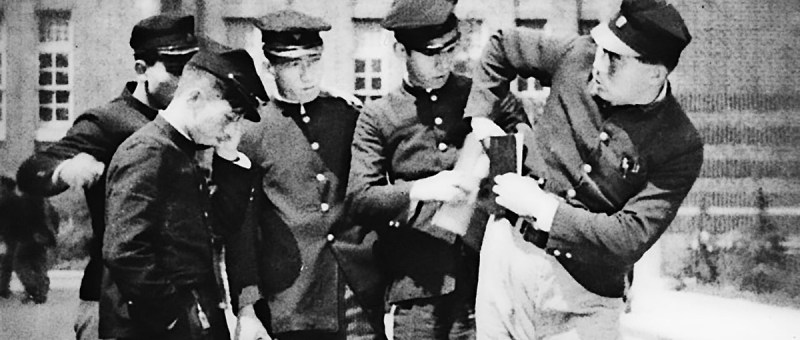
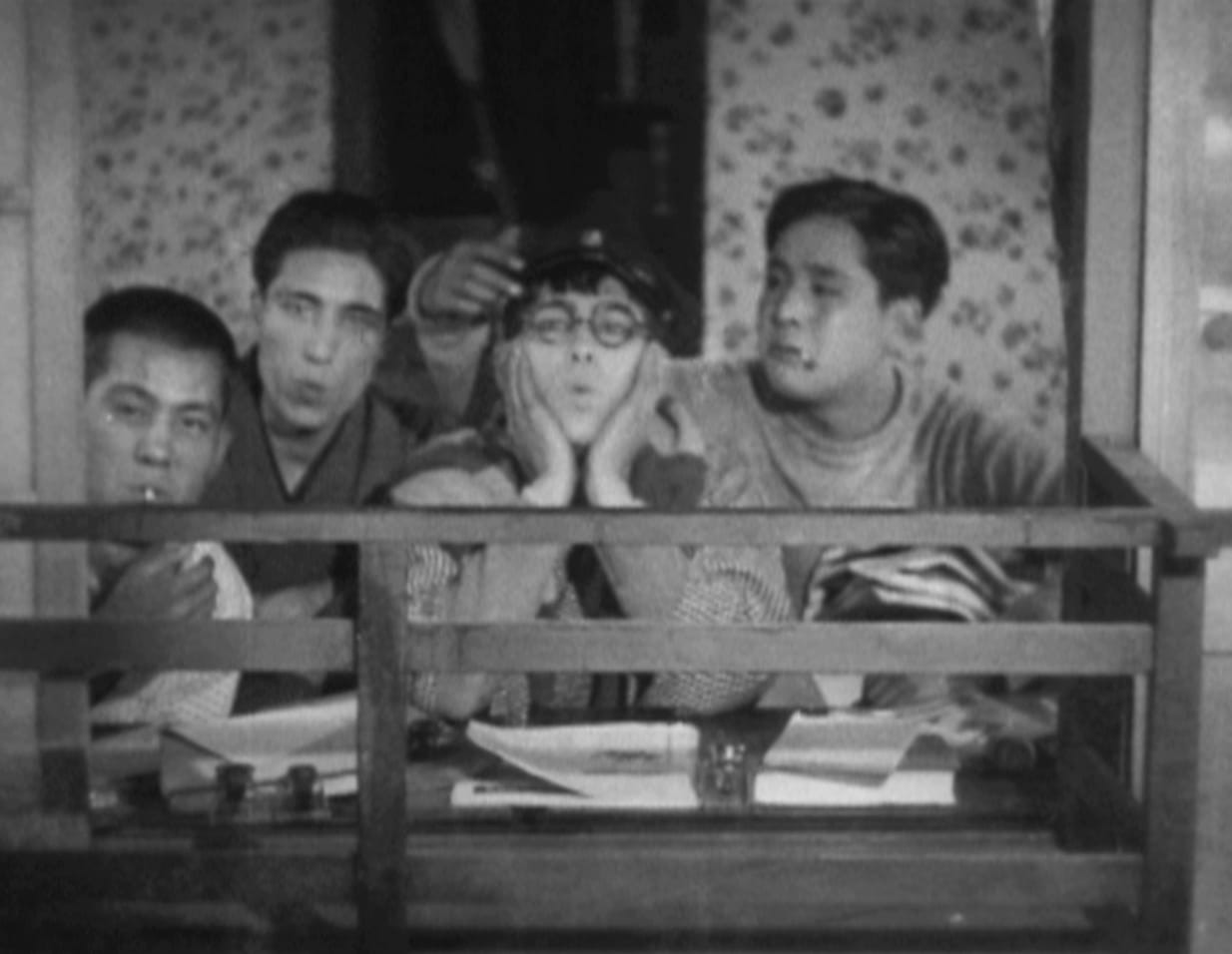
I Flunked, But… (落第はしたけれど, Yasujiro Ozu, 1930)

Yasujiro Ozu never went to college. By all accounts a poor student and rebellious young man, he took an early teaching position in a remote rural area precisely because it required no degree. Unsurprisingly, he didn’t last long in the job and eventually returned to Tokyo,  joining Shochiku as an assistant cameraman. Nevertheless, in his early career at the studio he found himself contributing to their popular brand of college comedies of which I Flunked But… (落第はしたけれど, Rakudai wa shitakeredo) is his third, directed when he was 26 years of age. 

Drawing inspiration from Hollywood campus movies and in particular Harold Lloyd’s The Freshman as we can see from the various US state college pennants seen hanging throughout the film, I Flunked But… follows a group of young men preparing for their final exams. They are all excited about the idea of graduating into the adult world as symbolised by the neat business suits they have each bought in preparation for their new lives and few seem burdened by anxiety about a potentially precarious future as members of a generation stepping into a world of reduced economic potential and growing political instability. 

In fact they live the last days of their student lives to the full, greeting each other with silly dances, playing turntable roulette to decide who pays for dinner, and spending more time figuring out how to cheat on the exam than studying to pass it. There may be truth in the idea that passing exams is all about the knack, but our boys are overly invested in kicking back against the system rather than playing by its rules to get ahead. As the film opens, two students are arguing because one supposedly betrayed the other in promising to help him cheat and then not following through. Takahashi (Tatsuo Saito) is supposed to help his friends by wearing a shirt which has a cheat sheet scrawled on the back, but he oversleeps and the landlady swipes it for the laundryman. The others manage to scrape through on their own while Takahashi alone fails. 

The remainder of the film becomes a more melancholy mediation on the changing fortunes of Takahashi and his friends. Overcome with shame and disappointment, Takahashi is left out of the others’ cheerful graduation celebrations, left with the choice to drop out or repeat the year (amusingly, one of his perpetual failure friends appears to be much older, even middle-aged, and one wonders if he is a serial repeater). The suit he had bought is now a grim reminder of his defeated hopes, as is the tie his girlfriend (Kinuyo Tanaka) who works in the bakery next-door was making for him as a graduation present. He now feels unworthy of wearing it, a fraudulent human trapped in adolescence by embarrassing failure. The girlfriend, however, already knows all about it and reassures him that even if he has not graduated, he still has the right to wear his graduation suit. 

As time moves on, however, Takahashi realises that he might actually be the more fortunate. Still wearing his student uniform, he lives a carefree student life and is still receiving money for his upkeep which makes him the rich man among his dorm mates who are still living in the same rooms with him and have all had to pawn their graduation suits because there are no jobs for them to go to. “I heard it’s hard to get a job these days”, the girlfriend laments, and it’s clear the depression continues to bite. The college world was safe and easy. Takahashi carries on goofing off, silly dances and cheerleading the order of the day. In this sense at least, a perpetual childhood might not be so bad a thing. The graduates wistfully play with a student’s cap, wishing they could return to their carefree college days rather than stuck in their old dorm receiving nothing but rejection letters and hand outs from a slightly smug Takahashi. “If I’d known it would be like this I wouldn’t have graduated so hastefully” they lament. Maybe flunking is actually the smart choice, riding out economic instability until something better comes along. You might as well enjoy yourself while you can, Ozu seems to say, you’ll never have it so good again.
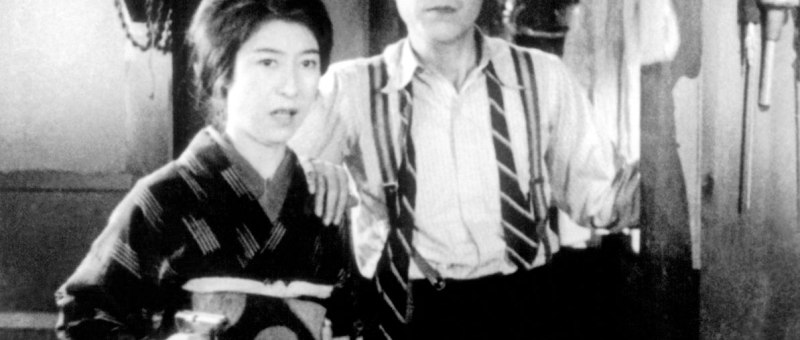
That Night’s Wife (その夜の妻, Yasujiro Ozu, 1930)

Most closely associated with his late career family dramas, Yasujiro Ozu has acquired a reputation for geniality which may in a sense be slightly unfair. He was always an astute chronicler of his times, often choosing to view them through the frame of family, and was never as blind to the issues of the day as some would have it. Ozu’s ‘30s work, that which survives at least, is in a sense fiercely political in its critique of the inequalities of the depression-era society. One of his early crime movies, the silent That Night’s Wife (その夜の妻, Sono yo no Tsuma) insists that justice must be done but does so with compassion in its full and total empathy for a man driven to extremes by the depth of his paternal love. 

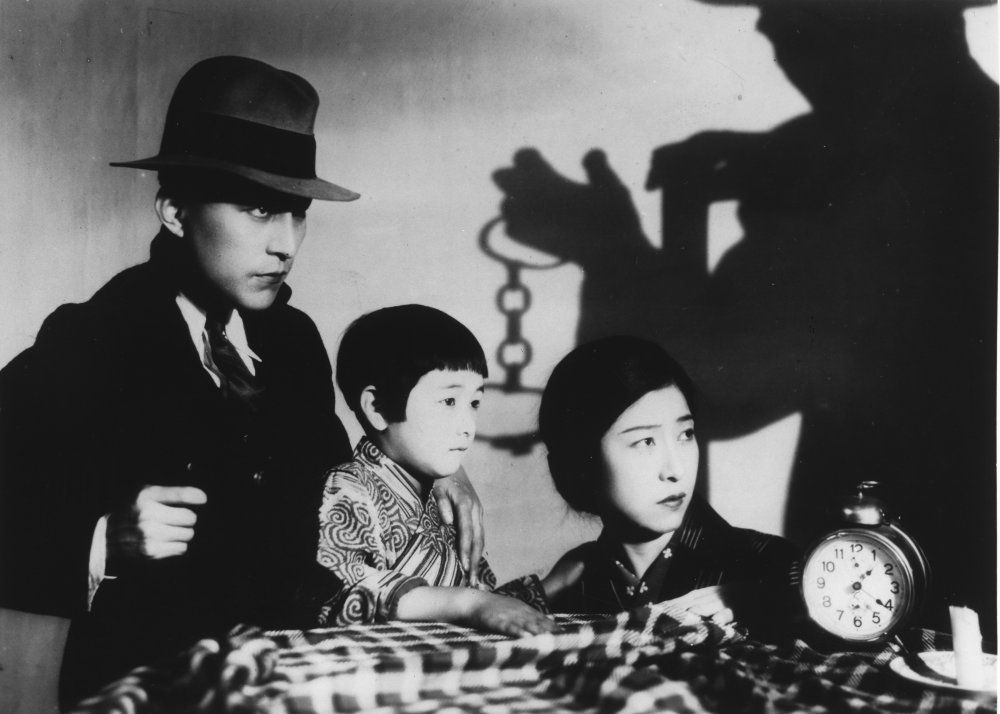
Indeed, the early part of the film is tense noir chase as the hero, desperate father Shuji (Tokihiko Okada), attempts to evade a police dragnet to make his way home after robbing a bank to get money to pay for his sick daughter Michiko’s (Mitsuko Ichimura) medical care. Meanwhile, loyal wife Mayumi (Emiko Yagumo) has been patiently waiting at home tending to the child who refuses to sleep because she only wants her father and constantly asks where he is. Shuji eventually makes it back and tells his horrified wife what he has done, agreeing that he will turn himself in to the police once Michiko is well, but he’s already out of luck. The taxi he darted into was being driven by an undercover cop (Chishu Ryu) who installs himself in the apartment but agrees to wait until the doctor comes in the morning before taking Shuji in. 

Out of keeping with the rest of Ozu’s career but very much in the vein of his depression-era silents, That Night’s Wife concerns a poor but happy family mustering what little resources they have in the face of despair. Filled with tension as the policeman waits impatiently, the camera pans around the one room apartment where the family live and finds it to be a homely, bohemian space, apparently an artist’s studio with foreign film posters and travel souvenirs hanging from the walls. By all indications a starving painter, Shuji is a poor man brought to ruin by accidental tragedy. His daughter is deathly ill and doctors cost money. We can see that, by the standards of the time, he is a very hands on father beloved by his little girl and is obviously willing to sacrifice himself and his future to ensure her survival

It’s Mayumi, however, to whom the film’s title refers and in her role as wife rather than mother. The doctor (Tatsuo Saito) worries that she has not slept in the last few days, how could she when her child is so ill, but it’s she who eventually picks up the gun to protect the family by disarming the policeman and, essentially, keeping him hostage until the morning when, she claims, Shuji will willingly go with him after confirming Michiko’s survival. The world is turned upside down, no one quite plays the role they’ve been assigned. The loving father, an effete artist, turns unconvincing master criminal, the loyal wife gangster’s moll, and the policeman a calm and compassionate guardian deeply moved by the family’s predicament but also knowing that the law must be served. 

In a typically Ozu touch, the policeman pretends to be asleep with the intention of letting Shuji escape, but he once again makes an atypical choice. He refuses to run, swearing off “crazy ideas” but unrepentant in his crime. Shuji determines to pay his debt to society so that he can return home as a redeemed father and hold his daughter as a man unburned by his transgression. The message isn’t so much that crime doesn’t pay as that crime must be paid for. Shuji is acquitted in the moral courts of the audience’s hearts and not even the policeman blames him for what he has done which is all he could do as a father in an oppressive and indifferent society. A strange complicity develops between the two men who are restored to their original roles, both acknowledging that of the other and sorry for what they each know must happen next but already resigned. The father saves his family only through accepting his exile from it, but unlike Ozu’s wandering fathers of the 1930s, seems destined to return after redeeming himself in the eyes of a society which had long since abandoned him. 


Currently streaming in the UK via BFI Player as part of Japan 2020. Also available to stream in the US via Criterion Channel.

What Made Her Do It? (何が彼女をそうさせたか, Shigeyoshi Suzuki, 1930)

what-made-her-do-itLike many other areas of the world in the first half of the 20th century, Japan also found itself at a dividing line of political thought with militarism on the rise from the late 1920s. Despite the onward march of right-wing ideology, the left was not necessarily silent. Ironically, the then voiceless cinema was able to speak for those who were its greatest consumers as an accidental genre was born detailing the everyday hardships faced by those at the bottom end of the ladder. These “proletarian films” or “tendency films” (keiko eiga) were increasingly suppressed as time went on yet, in contrast to the more politically overt cinema of the independent Proletarian Film League of Japan, continued to be produced by mainstream studios. Long thought lost, Shigeyoshi Suzuki’s What Made Her Do It? (何が彼女をそうさせたか, Nani ga Kanojo wo Sousaseta ka) was a major hit on its original release with some press reports even claiming the film provoked riots when audiences were passionately moved by the heroine’s tragic descent into madness and arson after suffering countless cruelties in an unfeeling world.

Though still only a child, Sumiko (Keiko Takatsu) has been sent alone to the house of her uncle in a distant village but has run out of money for travel and food. Luckily she meets a kindly cart driver, Doi, who feeds her and takes her most of the way to her uncle’s village but he will be the last “kind” person that she encounters on her long and sad journey. As it turns out, her father had not informed his brother of Sumiko’s arrival and actually had not even had any contact with him for many years. Consequently, Sumiko’s uncle is not exactly overjoyed to see her as he already has a house full of children he struggles to feed (not to mention a healthy appetite for drink). Eventually he sells her to a circus where she is cruelly treated by fellow performers and the sadistic ringmaster.

Things are looking up when Sumiko escapes with fellow performer Shintaro (Ryuujin Unno) but the pair are divided by fate landing Sumiko in trouble with the law after she falls in with a gang of thieves. A spell in the workhouse is followed by patronising treatment as a servant for a wealthy family, and later an otherwise successful tenure as a housekeeper for a leacherous biwa player, before a tiny window of happiness opens up only to immediately cloud over again. Ending up at the “Garden of Angels” Christian reform institution for “wayward women” Sumiko tries God on for size but finds him wanting.

Long thought lost, a partial print of What Made Her Do It? turned up in Russian archives in the ‘90s (presumably following its export as a suitably socialist film) and has since been restored with additional intertitles replacing the missing portions. The opening sequence of Sumiko beginning her journey by train and the presumably spectacular finale of Christ on fire as Sumiko dances madly in the flames of the burning church are both missing but even so the drama rams home the seriousness of Sumiko’s plight as she finds only hypocrisy and selfishness at every turn.

Keiko Takatsu perfectly plays Sumiko’s essential sadness as well as her growing resilience and barely suppressed resentment towards the constant cruelty she experiences. All pleading eyes and sorrowful looks, Sumiko suffers while others exploit her for their own ends. Betrayed by her uncle who pockets the money her father enclosed for Sumiko’s care and purposefully hides from her the fact that her father is likely dead, Sumiko is left adrift in a world in which it’s impossible to survive without family. The state surfaces in her life with the supposedly progressive environment of the workhouse which feeds and houses her whilst exploiting her forced labour. The well to do household in which she is offered opportunity is little better as the cruel mistress of the house constantly exerts her authority, stresses the differences in social status, and denies her maids even small pleasures such as soy sauce on pickles in order to maintain discipline.

Finally Sumiko ends up in the house of God though what she finds there is repression and forced religiosity rather than the love and support proudly displayed in the credo. The Garden of Angels is, presumably, filled with women who have somehow disappointed modern moral codes with Christian virtues expressly emphasised and contact with the outside world forbidden. Residents are allowed to leave once they’ve proved they’ve accepted Jesus into their hearts and are resolved to live in a more “proper” manner, though Sumiko falls foul of the rules after another woman talks her into writing a letter to a friend on the outside.

When the letter is discovered, the other woman is sent to solitary as the head of the establishment informs her that her sin “will never be forgiven”, while Sumiko is forced to make a public self criticism to atone for her selfish disregard for the rules. This backfires when Sumiko’s inner rage takes hold, leading her to take a stand by decrying the hypocrisy of the religious establishment which preaches that God is love and all will be forgiven but ultimately offers nothing other than fear and hate. When the church burns down the woman in charge is the first out the door with her valuables in hand leaving the other women to discover their own salvation amongst the ashes.

Suzuki’s technique is clearly informed by foreign cinema especially that of socialist films from the Soviet Union. Using frequent dissolves and montages, Suzuki throws in impressive set pieces such as scene in which the camera pulls away from Sumiko after she receives some bad news with a door closing across it and snow falling outside. A long lost left wing populist effort, What Made Her Do It? is also a classic melodrama of female suffering as the heroine experiences just about every degradation possible whilst remaining steadfastly defiant in the face of tragedy before the final irony of her eventual position drives her into madness. What made her do it? An intensely self-interested world. Some things don’t change.