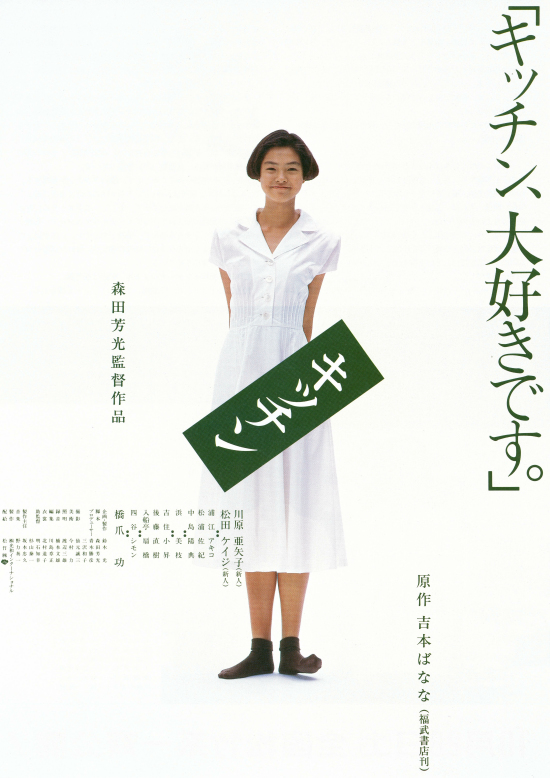
 Banana Yoshimoto’s debut novel Kitchen was first published in 1988 and instantly became a publishing phenomenon. The first film adaptation came not long after with the identically titled Kitchen (キッチン) directed by Yoshimitsu Morita in 1989. Like most of Yoshimoto’s work, Kitchen deals with people learning to live with grief and cope with the aftermath of tragedy. However, though Morita’s script sticks closely to the novel for the first half of its running time, he later deviates into a conventional romantic youth drama much like his more populist offerings of the time.
The film opens with a strange image of a young woman asleep in front of a fridge in an otherwise entirely darkened kitchen. The young woman is Mikage Sakurai – orphaned at a young age, Mikage (Ayako Kawahara) was raised by her grandmother who has recently also passed away leaving her entirely alone in the world. The one place Mikage has learned to feel at peace is in a kitchen and she has her sights set on a culinary career.
At the funeral, Mikage meets a young man who had apparently become good friends with her grandmother through his part-time job at a florist. After striking up a friendship with Mikage, Yuichi (Keiji Matsuda) invites her to the upscale apartment he shares with his mother, Eriko (Isao Hashizume). Mikage falls in love a little bit with their well appointed and spacious Western style kitchen which is filled to the brim with all the latest gadgets. Soon after, Mikage moves in with Yuichi and Eriko and begins to rebuild her life with a new family beside her.
It’s difficult to avoid spoilers in this respect but for anyone who is familiar with Yoshimoto’s novel, it’s important to note that one particular tragedy which informs the entirety of book has been completely eliminated in this adaptation. The biggest change Morita has made is in his depiction of Eriko who is a trans woman and the father of Yuichi having undergone gender reassignment after the death of Yuichi’s mother.
The film is actually very positive in dealing with Eriko’s character and doesn’t try to elide or make a joke out of her. However, whereas Eriko in the book is described as an extremely glamorous and beautiful woman to the extent that she may seem slightly intimidating at first despite her warm and loving nature, here she is played by a male actor with a man’s haircut and slightly frumpy fashion sense as well as being depicted more like a stereotypically gay male character. Likewise, though Eriko’s friend Chika-chan is still in the movie, we never see anything of Eriko’s life at the gay club she runs or much of her life away from Yuichi and Mikage. That said, the change in question does offer a little more hope and happiness for Eriko than her outcome in the novel.
Morita also gives the film more of the quirky, light hearted feel he adopted in many of his other populist films from the ‘80s. Yoshimoto’s work often successfully straggles a difficult tonal gap in which it’s filled with a kind of existential despair but simultaneously light and cheerful. Though Mikage is numbed with grief throughout the novel which prevents her from assessing what it is she really wants from life, the film is satisfied with depicting her as a fairly ordinary young woman whose problems stem more from trying to step out alone for the first time rather than trying to emerge from a life altering tragedy like the death of your last remaining family member.
However, Morita retains the magical realist qualities of the novel through his use of dream sequences and expressionist imagery. Juxtaposing bright colours of nature with the often extremely dark backgrounds, he creates an impressive sense of differing realities with Mikage’s cheerful on the surface yet depressed inner life recreated through iconography rather than through performance or dialogue. He also retains the use of the moon as symbol for life and happiness, presenting a source bright light in an otherwise dark world which can help to guide the way in times of trouble.
As a film in its own right, Morita’s Kitchen is certainly very much of its time though perhaps not unwatchable, but as an adaptation of Yoshimoto’s novel it ultimately fails on all counts. Veering way off tone in its second half, Kitchen takes on much more of a conventionally romantic narrative eschewing Yoshimoto’s major messages about the need to come to terms with a traumatic past in order to move on and the importance of understanding your true feelings while there’s still time to act on them. Yoshimoto is more concerned with showing that joy and sorrow are two sides of the same coin and you can’t have one without the other but Morita’s story creates a much smoother, more natural path for a romance between Mikage and Yuichi which ultimately robs it of much of its power. That said even if Kitchen disappoints as a literary adaptation it isn’t entirely without interest and does at least offer several examples of Morita’s idiosyncratic gift for composition.
Opening scenes of the film (dialogue free)
Kitchen was also adapted as film in Hong Kong directed by Ho Yim in 1997, starring Yasuko Tomita and Jordon Chan. Banana Yoshimoto’s source novel was first published in English in 1993 (translated by Megan Backus) and is still in print from Faber & Faber in the UK and Grove Press in the US.
 These days we think of Sion Sono as the recently prolific, slightly mellowed former enfant terrible of the Japanese indie cinema scene. Hitting the big time with his four hour tale of religion and rebellion Love Exposure before more recently making a case for ruined youth in the aftermath of a disaster in Himizu or lamenting the state of his nation in Land of Hope what we expect of him is an energetic, sometimes ironic assault on contemporary culture. However, his beginnings were equally as varied as his modern output and his first feature length film, Bicycle Sighs (自転車吐息, Jidensha Toiki), owes much more to new wave malaise than to post-punk rage.
 Windows on Worlds