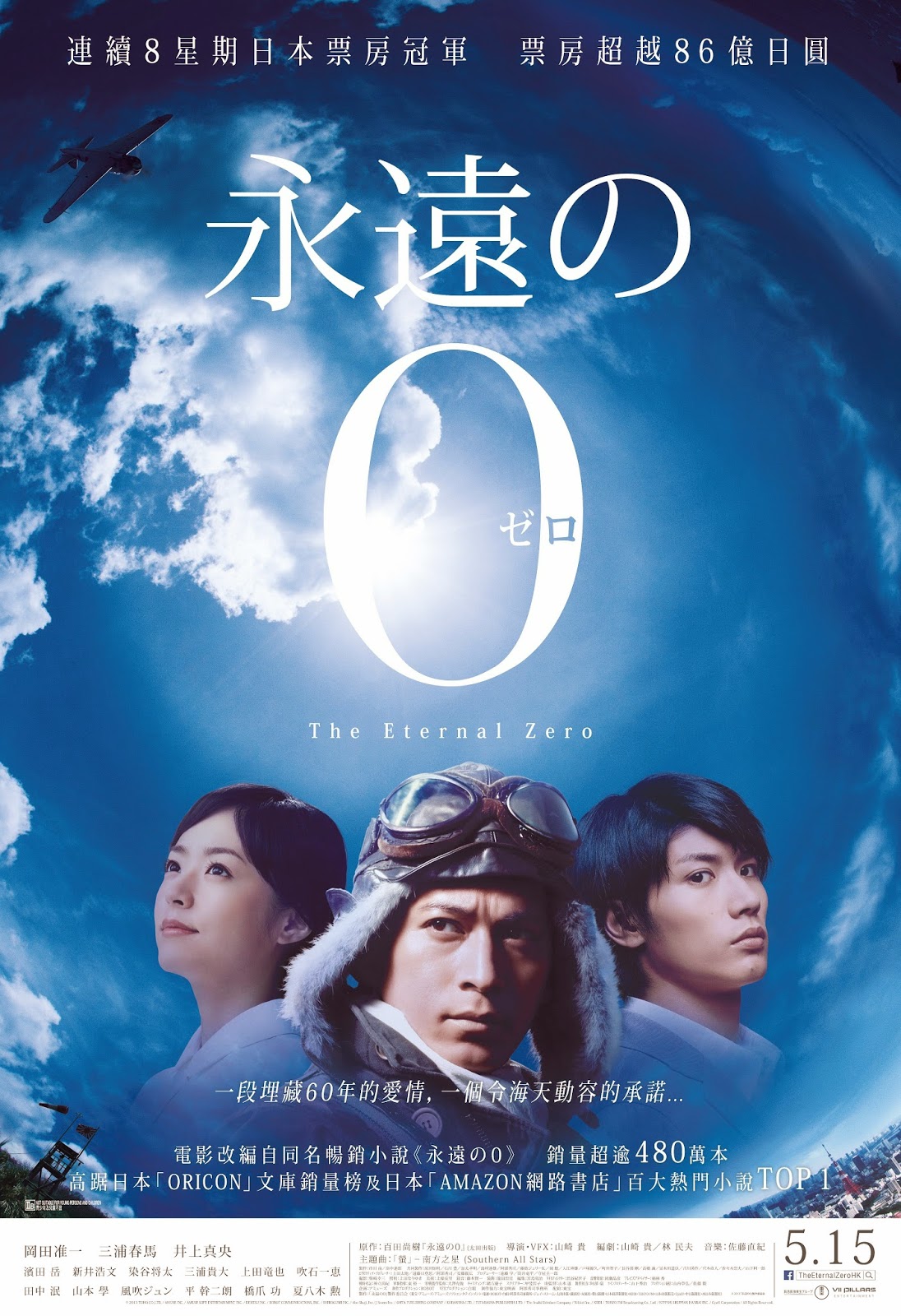
It’s difficult to think of a recent film that’s caused quite as much controversy as The Eternal Zero (save perhaps Hayao Miyazaki’s own World War II epic The Wind Rises). Written by a right wing pundit and close ally of current Japanese prime minister Shinzo Abe, Naoki Hyakuta, The Eternal Zero definitely has an ambiguous stance on several things that most people just don’t really want to talk about. However, it would also be fallacy to pretend that anybody else’s war movies are completely unbiased, or willing to look at the complexities of any given war beyond jingoistic drum beating which has often been the point of a war film. In truth, The Eternal Zero is actually more or less a-political for most of its running time save a possibly misjudged epilogue which does its best to undo the entirety of the film’s message up until right before the fatal flaw. Setting politics to one side, how does The Eternal Zero fare when it comes to taking this most American of subjects, in the most American of ways? Pretty OK, to be frank, not bad at all.
Like a lot of Japanese films tackling the recent past, the film starts in the present with little lost boy Kentaro (Haruma Miura) attending the funeral of his grandmother whereupon he discovers the heartbroken man he’d assumed to be his biological grandfather (Isao Natsuyagi) was in fact his grandmother’s second husband and not his mother’s true father at all. Mind truly blown, Kentaro is talked into further investigations by his older sister in which he discovers his biological grandfather was an air force pilot who died in a kamikaze mission during the war. On talking to some of his fellow officers, Kentaro and sister first hear that their grandfather was a coward, a supposedly skilled pilot who hid in the clouds during sorties and endangered the lives of his comrades through his negligence. Until that is, they chance upon those closest to him who tell a different story – that Kyuzo Miyabe (Junichi Okada) was the bravest of men. A man who knew the war was pointless and wasn’t afraid to say so, who simply wanted to survive and get back to protecting what was most important to him – his wife and child. Why then, would this man who was so desperate to survive finally give his life in a suicide mission for something he did not believe in?
To deal with the most obvious question first – no, The Eternal Zero is not “a propaganda film” in the truest sense of the term. Yes, it ignores the external context because it simply wants to focus on the nature of war and what it does to those who conduct it (as well as those who only stand and wait) which *is* a form of propaganda in a sense because of all the things that it refuses to acknowledge. However, for 90% of the running time, the film has a thoroughly modern sensibility where the overriding feeling is absurdity, that this war is a crazy waste of youth that no one should have to have gone through. The original group of pilots that brand Miyabe a “coward” are shown up for a group of brainwashed idiots and Miyabe portrayed as the soul prophet who sees things as they are and has the courage to speak his mind. Later, there are other headstrong boys who think they’re men and don’t understand what they’re getting themselves into but the main thing is just how stupid all of these ideas of honour and sacrifice really are when all it will likely mean is leaving destitute women crying and starving at a home you’ve failed to protect. However, all of these more “liberal” ideas are totally undercut in the last five minutes of the film which seeks to glorify an act that the previous two hours have branded an idiotic waste of life. Politically confused, Eternal Zero doesn’t quite know where to put itself when acknowledging the tremendous sacrifice that was made by an entire generation without quite wanting to see just what those sacrifices were in name of.
To be fair to it, it isn’t as if most most Hollywood war movies don’t also do the same thing to a similar extent – present the heroism and perhaps the personal conflict without acknowledging all that goes with it. In truth, what The Eternal Zero most resembles is a classic Hollywood war film which is quite invested in remorse for the loss of life (and sometimes even for that on all sides) but also in not wanting feel any lives were lost in vain. Thus there is a feeling towards the end of the film that young people of today still owe a debt to these men, that they owe it to them in return for the sacrifice that was made to live their lives freely and to the utmost. To spend so long saying that war is a cruel game that makes pawns of young men’s lives only to turn around and say it’s the job of the youngsters of today to make those pawns kings is a little perverse, but understandable on a human level.
The Eternal Zero is blockbuster movie in every sense, the budget and shooting style are also aping your typical Hollywood epic though doing it fairly well. The script is clunky with its inelegant switching between time periods and to be frank the entire “modern” section feels a little superfluous and underwritten. It’s a little long at over two and a half hours and does occasionally fall into a televisual rhythm – there is a great deal of talking and explaining which probably would have had more impact if it were done in a less bald way. Nevertheless, what The Eternal Zero sets out to do, it does pretty well. It may speak to something dangerous, but it is not dangerous in and of itself. For the most part excellently filmed with its fair share of stand out sequences, The Eternal Zero will appeal most to fans of old-fashioned (and uncomplicated unless you want to really think about it) war films but may struggle to maintain the interest of more jaded viewers.

 Windows on Worlds