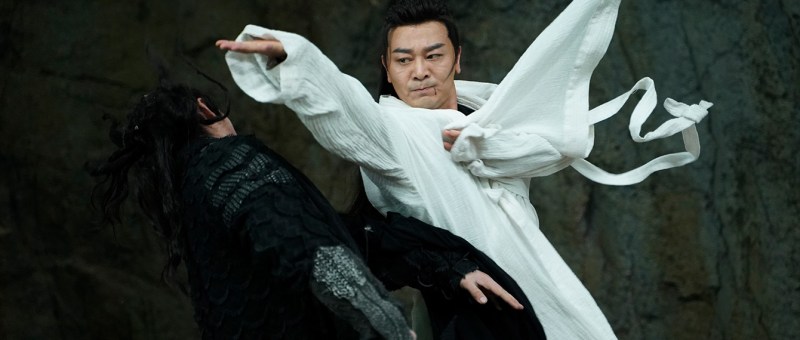
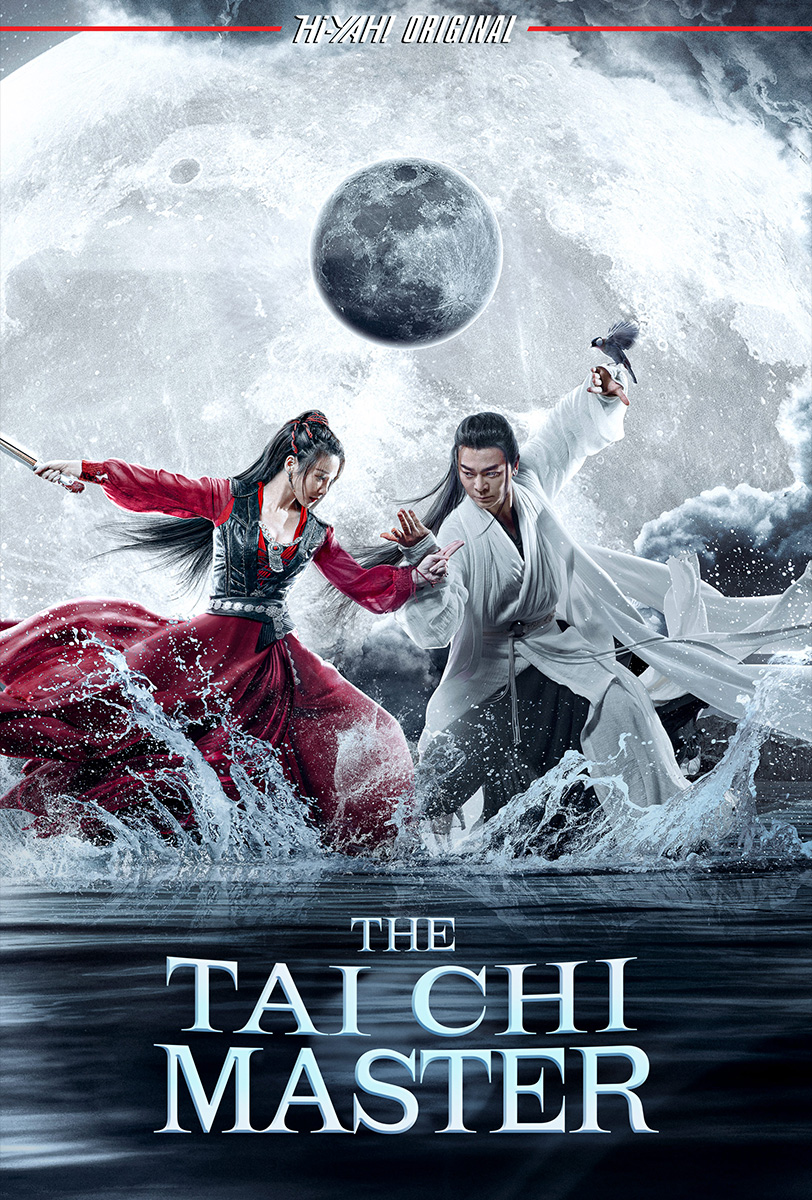
The funny thing is that, in contrast to contemporary Chinese cinema, Lin Zhenzhao & Cheng Siyu’s The Tai Chi Master casts those who stand up to corruption as the villains. Of course, their insurrection threatens the social order and their subsequent to overthrow the Song Dynasty may be too revolutionary to find much a approval but it’s surprising all the same even if the film also finds fault with officials too focused on the “big picture” rather than the citizens in the townships they’re supposed to be overseeing.
In any case, though it should not be confused with the Jet Li film from 1993 with which it shares both English and Chinese titles, this Tai Chi Master is once again an origin story for the renowned Taoist scholar Zhang Sanfeng which is the name the hero takes at the film’s conclusion having achieved a degree of enlightenment through experiencing near death and tragedy at the hands of the Netherworld Cult. For the most part, he goes by his courtesy name Junbao and is something of a libertine, spending most of his time enjoying fine liquor and trying to craft immortality pills as a member of the Wuji Sect. 12 years previously when the Imperial Court increased taxes to a unreasonable degree, the Netherworld Cult slaughtered the corrupt officials but were condemned by the rest of society for their actions. Junbao has a habit of drinking with Kui Tianxing, the former head of the Netherworld Cult who has been imprisoned in the Wuji’s Sect’s gloomy basement for the last 12 years and in fact transgressively learns from him “evil” techniques claiming that there is no good or bad in martial arts for all depends on the righteous heart of the practitioner.
But there is unrest brewing and it seems some can no longer bear the corruption and indifference of the noblemen supposedly managing their interests on behalf of the court. After taking a liking to a mysterious forest woman who rides a giant silkworm she charms with a flute, Junbao is taken to task for his solipsistic hedonism. She asks him how he can ignore suffering in the world and continue to remain apart from it, but he doesn’t truly gain the desire to oppose injustice until the Wuji Sect is targeted and his master is killed. Even then, his opposition is awkwardly positioned given that the new Netherworld Cult is also motivated by the desire to throw off the authority of corrupt officials, which means in a sense that Junbao is defending that same corrupt social order which he does not otherwise challenge.
In keeping with the teachings of the real Sanfeng, he instead preaches righteousness and harmony but otherwise removes himself from the martial arts and wider worlds, while his brief romance with the mysterious silkworm woman seems to fall by the wayside in his ongoing quest for spiritual enlightenment. Meanwhile, it has to be said that his relationship with the little girl who seems to be in his care is a little uncomfortable at times. In what is presumably supposed to be a sweet and innocent piece of childish banter, she frequently flirts with him, makes statements about becoming his girlfriend, and expresses jealousy towards the silkworm woman all of which seems very inappropriate for a child of no more than 11 or 12.
Nevertheless, the fight choreography is often interesting if sometimes marred by imperfect CGI and mid-level production values for a streaming film. The injection of fantasy-style lore with its demons and underground, cave-like bases gives the film’s internal universe a degree of consistency in reflecting the yin/yang philosophy espoused by the Netherworld Cult in the white-clad, surface-living Wuji Clan and the dark, anarchic world of the often masked rebels. The mysterious silkworm and the flute-playing woman meanwhile seem to occupy a liminal space caught between each world and whatever she says like Junbao not really a part of either until pulled into the final battle. Perhaps troubling or at times contradictory in some of its implications, the film does at least have a degree of charm in its likeable characters and fleshed-out backstories that hint at the possibilities of an ongoing franchise.
The Tai Chi Master is available digitally in the US courtesy of Well Go USA.
Trailer















 Windows on Worlds