Howling (遠吠え, M Haris Sheikh, 2022)

“What do you want from the world?” the sad sack hero of M Harris Sheikh’s noirish drama Howling (遠吠え, Tooboe) is asked on three separate occasions giving first a non-answer, then the answer he’d like to give, then the real one which is far less heroic or edifying but at least honest. Like everyone else, he too is howling into a void putting a brave face on his inner insecurity while longing to play the hero in his own life only to discover that no matter how many chances he’s given he may not be up to the mark. 

A self-professed nice guy, we first meet Ryuji (Ichiro Hashimoto) trying to help a young woman at the karaoke bar where he works escape sexual harassment in the workplace promising that he can protect her while pledging to kick the other guy’s ass, only as it turns out the other guy is her boyfriend and it’s Ryuji who’s been harassing her. Quite clearly uncomfortable, the young woman informs Ryuji she’s already reported him to HR and he’ll probably be fired today which is exactly what happens but rather than take this as an opportunity to learn Ryuji goes around telling everyone it was all a misunderstanding and he’s fallen victim to a needlessly judgmental society. “The world is tough for middle-aged men” he adds, lamenting that even having a “friendly discussion” with a younger woman has somehow become inappropriate. 

It’s these twin facets of his personality that go on to precipitate his downfall in his intense desire to conform to the masculine ideal as a protector when coming into contact with two women who are each in need of his help. Apparently never having had a girlfriend, Ryuji is overexcited when a 20-year-old college student, Akane (Yukino Takahashi), contacts him, a 40-year-old man, on a dating app never really considering that there might be something untoward going on right until the moment she explains that she’s trying to hire a randomer to kill her abusive father who happens to be the chief of police which is why she can’t hire a professional. Meanwhile, a school reunion grants him the opportunity of reuniting with middle-school crush Chisato (Sonae Kotani) only to discover that she has since married the bully, Tsuchida, who made their lives miserable and is trapped in an abusive relationship. Ryuji had been unable to protect her when they were children but claims to be different now. Then again Tsuchida said the same the thing and clearly hasn’t changed at all. Hoping to solve all his problems by getting a sudden windfall and proving that he can be the hero, Ryuji agrees to Akane’s plan but of course eventually disappoints himself realising that his fantasy of being a saviour is just that. 

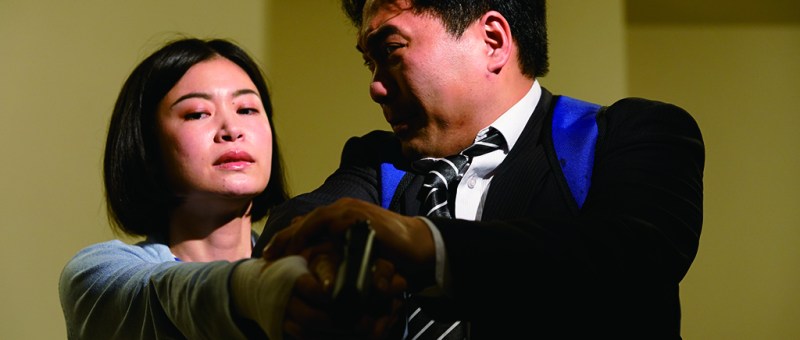
Meanwhile the two women, who happen to be neighbours in a swanky high rise apartment block, begin by believing that they cannot escape their situations alone but need a male saviour each placing their hopes in the overeager Ryuji but finally freeing themselves perhaps spurred on by Ryuji’s male failure but otherwise rendering him an irrelevance. By the final confrontation each of the trio has sustained a wound to the hand to which Akane and Chisato jokingly refer as an eye of truth just like the hero from a manga yet with its own degree of truthfulness in that the women begin to see that their freedom is theirs for the taking while Ryuji is finally forced to accept that his presence is unnecessary proving his mettle only with a gesture of nihilistic futility. 

On the other hand we can also see the hand of a highly pressurised society on his fragile masculinity as he accidentally bonds with a pair of weird street preachers crying out for revolution but with an ironic bent. The first is a former Todai graduate who lost a good job in advertising because of all his unhealthy coping mechanisms. He preaches about a creating a truly fair society free of inequality brought about through a deadly virus claiming that his guru, the Master, is the origin not only of the coronavirus pandemic but every other dangerous pathogen known to man. Somewhat contradictorily, the Master reveals that he once lived in a swanky high rise apartment and would like to do so again which sounds somewhat incompatible with the goals of his revolution assuming he’s not planning to build so many that everyone who wants one can have one. The contradiction is further borne out in Ryuji’s answers about what it is he wants from the world, firstly stating ordinary requests such as a decent job, home, wife, children etc before admitting he’d actually prefer a really big house, lots of women, and respect from other people the last emphasising his internalised sense of belittlement and failure. 

The world that Ryuji inhabits does indeed seem to be oppressive and ominous, the strange overgrown alleyway below an overpass where he first encounters the revolutionaries reflecting the dark path of his soul while in the film’s complex production design the sterile space of the upscale tower block becomes a kind of trauma room where truths are aired leading to the final confrontation whimsically scored with circus music in which the women literally take matters into their own hands, and even the diner where Ryuji meets Akane takes on a Lynchian sense of the uncanny. Darkly humorous with its deadpan gags of giant spaghetti and the completely random entrance of an unrelated older woman also with a glove on her right hand ranting about her daughter’s hairdresser boyfriend and his koala neck tattoo, Sheikh’s absurdist drama quietly builds to its theatrical conclusion bringing down the curtain on a bloody tableaux the world as prophesied turned upside-down.  


Howling screened as part of Osaka Asian Film Festival 2022

International trailer (English subtitles)

My Brother, the Android and Me (弟とアンドロイドと僕, Junji Sakamoto, 2022)

“You’re a real weirdo, aren’t you?” the lonely hero of Junji Sakamoto’s existential psychodrama My Brother, the Android and Me (弟とアンドロイドと僕, Ototo to Android to Boku) is constantly told not least by his exasperated and unsympathetic boss but on another level may be the most human of them all longing for a sense of connection in a world which seems to have rejected him to the point that he is no longer sure whether or not he actually exists. Quite clearly drawing inspiration from Mary Shelly’s Frankenstein, the Modern Prometheus as well as its many film adaptations though most obviously the 1931 Universal Horror classic, Sakamoto’s oblique chronicle of crippling loneliness presents a man estranged from himself but looking for comfort in his reflected image. 

Sakamoto opens the film in true gothic fashion, his hero Kaoru (Etsushi Toyokawa) a dark and mysterious figure obscured by an oilskin coat amid the ever falling rain illuminated only by the light of an ominous moon. As we discover he works as a university professor but says nothing to his students other than making an apology for his poor handwriting, sometimes writing with both hands at once as he recreates complex algorithms on an old-fashioned chalkboard. The students all mock him, not least because of a curious neurological condition which prevents him from fully controlling his right leg with the consequence that he is often compelled into strange, jerking movements or else to hop on one foot from place to place. In truth, his errant right leg is a symptom of Kaoru’s sense of displacement in that he does not quite feel it to be his own and experiences only pain when his right heel is in contact with the floor. 

It’s this problem with his leg that seems to most irk his boss who later invasively barges in to the gothic western-style mansion/disused hospital where he lives in the company of his nephew, a psychiatrist, who probably means well but offers little more than platitudes in insisting that Kaoru’s leg has simply been left off his internal schematics so all they need to do is mentally reconnect it. His boss meanwhile bizarrely states that Kaoru needs to get well “so that cracked roads can be fixed”, ironically treating his body like a machine that needs to be repaired so that it is optimised for work rather than out of care for another human being who may be in pain. Having barged into Kaoru’s office, he’d discovered his secret project in a highly complex, lifelike robotic arm which was a problem for him because he was supposed to be working on a robot that fixes potholes which seems almost ironic in its banality. In any case, Kaoru also has the rather unfortunate habit of entirely ignoring the person talking to him as if they weren’t even there which is in itself an ironic inversion of the way others see, or more to the point don’t see, him. Kaoru’s boss describes him as creepy because he has no presence, you’re never sure if he’s there or not, but can immediately sense the “giant” presence of his other self, the lifelike android he’s building in his spare time. 

The android is in its way his Frankenstein’s monster, an ironic attempt to rebirth himself constructed in the ruins of his family’s abandoned obstetrics hospital. By chance, he meets a young woman (Yuki Katayama) who closely resembles himself and carries her into his laboratory like the Bride of Frankenstein but treats her only with tenderness and sympathy while attempting to fend off his estranged half-brother (Masanobu Ando) constantly hassling him for money to pay for medical care for the father who abandoned him. His mother had instructed him to find his other self which is perhaps what he’s been doing if caught between the Id and Superego of his brother and father. Constant fire imagery including the repeated motif of a burning body in a conventional fireplace keys us in to Kaoru’s positioning as a “modern Prometheus” whose duty it is to keep the fire in while giving birth to himself as manifested in a perfect manmade creation that others may find frightening or uncanny though the android itself has done nothing wrong because it is in essence the embodiment of Kaoru’s frustrated humanity. Featuring sumptuous gothic production design with sci-fi sheen, Sakamoto’s steely, fragmentary drama finds a man in search of himself while also a perpetual exile but discovering a sense of warmth in the uncanniness of a reflected image. 


My Brother, the Android and Me streams in the US until March 27 as part of the 14th season of Asian Pop-up Cinema

International trailer (English subtitles)

To Be Killed by a High School Girl (女子高生に殺されたい, Hideo Jojo, 2022)

Are there some desires so taboo that they can never be spoken of even if they cause no harm to others? Adapted from the manga by Usamaru Furuya, Hideo Jojo’s To Be Killed by a High School Girl (女子高生に殺されたい, Joshikosei ni Korosaretai) is indeed about a man fixated with the idea of being strangled by a teenage girl but one who also embodies the inspirational teacher stereotype planning to leave behind him a kind of manifesto instructing his pupils to live their lives to the full while remaining true to their authentic selves in the knowledge that their lives will be defined by the manner of their deaths. 

Subverting a trope from shojo manga, Higashiyama (Kei Tanaka) is the hot new teacher at school proving an instant hit with most of the girls in his class but he’s come with an ulterior motive in that his ultimate fetish is being murdered by a high school girl. Even so, he claims to feel no attraction to his teenage pupils and is sickened by teachers who abuse their position later revealing he orchestrated his predecessor’s downfall by accelerating a complaint that had already been registered against him for inappropriate contact with students. His fetish lies solely in being overpowered by someone he would ordinarily perceive as being weaker than himself after fighting for his life with all his strength. 

Then again, as Satsuki (Yuko Oshima), a councillor brought into the school following a traumatic incident who also happens to be Higashiyama’s uni ex, points out his techniques for manipulating the girls are little different than those of a predatory sex offender grooming their prey. He figures out their weaknesses and goes out of his way to make each of them feel special while simultaneously provoking a sense of jealousy so he can bend them to his will in enacting a plan that will eventually lead to his murder in the middle of the school cultural festival. On the other hand, he crafts his plan in such a way as to protect his killer, his fetish won’t be fulfilled unless it’s a perfect crime, and because of the nature of the girl he’s selected he’s confident she won’t even remember having killed him and therefore will remain largely unaffected. 

Higashiyama doesn’t give much an explanation for his fetish save an allusion to having been born with the cord around his neck, a sensation he claims to remember only later admitting that he “recovered” a memory of it after his mother described the event to him. He later says something similar to Satsuki after suffering with amnesia, claiming to remember how he ended up in the hospital but then confessing that Satsuki had explained it to him on a previous occasion. He claims that he’s not suicidal but continues to fixate on death as force which gives life meaning, paradoxically insisting on living with all his might while otherwise drawn towards mortal extremity and fearing a “bad” ending such as being pushed off a cliff or poisoned with carbon monoxide neither of which would satisfy his fetish in their distinct lack of romance.  

Even so as another pupil suggests is he just a regular “pervert” after all despite his rather high minded-view of his proclivities? Despite all his manipulations, the various girls which he targets all seem to begin making progress in their lives, an angry judo enthusiast kicking back against a boy who’d long been bullying her, a shy theatre kid turning popular girl, and a young woman beginning to overcome her trauma thanks to the power of unconditional friendship. His replacement, a middle-aged man with a bad wig, is completely ignored by his pupils hinting perhaps that Higashiyama’s teaching practice was effective no matter now uncomfortable if not quite inappropriate some of his conduct may have turned out to be. After all he argues, he’s not a “pervert” just someone who wanted to be murdered by a teenage girl insisting that his fetish is essentially harmless because he has no sexual interest in the girl herself yet as we later see it does indeed involve inflicting violence on her. 

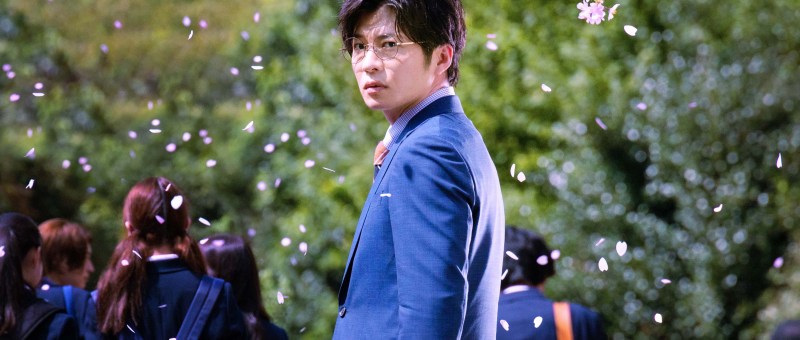
Playing with a series of B-movie tropes aside from Higashiyama’s taboo fetish from multiple personality disorder to premonition, traumatic memory, and fatalistic obsession, Jojo’s approach is arch in the extreme fully embracing the outlandishness of the material while both lending the troubled Higashiyama a degree of sympathy and hinting at the buried darkness beneath his handsome facade even as that darkness is essentially directed within, his death dictated by the circumstances of his birth as he “remembers” them. Occasionally shifting into the realms of giallo with creepy spiders and ominous red lighting, To Be Killed by a High School Girl never takes itself too seriously but revels in the inherent absurdity of its premise while remaining strangely respectful not only of the hero’s unique dilemma but of the ordinary problems among the otherwise besotted teens. 


To Be Killed by a High School Girl screened as part of Osaka Asian Film Festival 2022

Original trailer (no subtitles)

Angry Son (世界は僕らに気づかない, Kasho Iizuka, 2022)

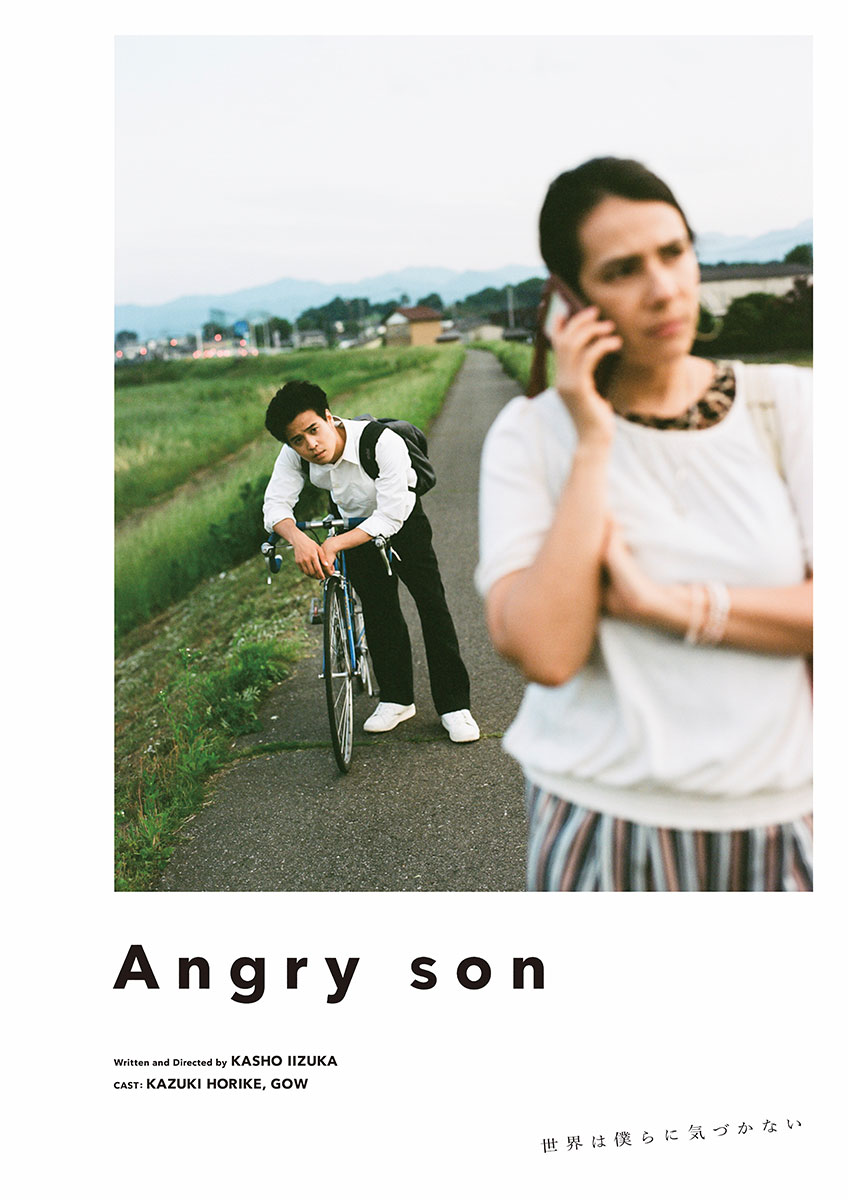
A resentful young man struggles to orient himself amid constant xenophobia and social prejudice in Kasho Iizuka’s sympathetic coming-of-drama Angry Son (世界は僕らに気づかない, Sekai wa Bokura ni Kizukanai). At a difficult age, he flails around lashing out at all around him without fully comprehending the consequences of his actions, but eventually comes to understand a little more about his mother’s past, his place in Japan, his relationships with his extended family, and his possibilities for the future while searching for the father he has never really known save for a name on his maintenance payments. 

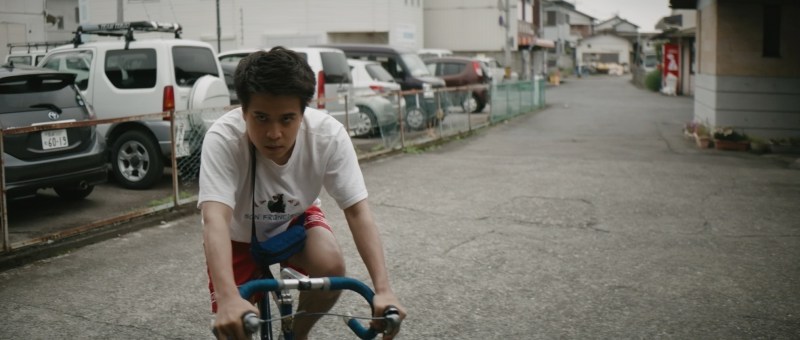
Jun’s (Kazuki Horike) main source of resentment is towards his mother, Reina (GOW), a Filipina bar hostess by whom he feels emotionally neglected while unfairly blaming her for the discrimination he faces for being mixed ethnicity. The pair live incredibly modestly as Reina sends all her money back to her family in the Philippines even telling Jun to use his child support payments to get the electric turned back on if it bothers him that much, leaving Jun feeling as if he isn’t really included her definition of “family” or that perhaps she resents him as a burden that causes her to hold back even more of her pay. That’s one reason that he becomes so irate on coming home one day and unexpectedly finding an unfamiliar man in his pants in their living room only to be told he’s his mum’s new boyfriend, Mr. Morishita, who will be moving in the week after next because they’re getting married. Granted, this is not an ideal way to find out about such a drastic change in his living circumstances but Jun just can’t accept it, fearing firstly that Reina is after his money only to discover to his further bemusement that Morishita is also unemployed.  

News of his mother’s impending wedding has Jun feeling even more pushed out than before, especially when Reina confirms that if he’s forcing her to choose she’s going to choose Morishita and he’ll have to fend for himself. Meanwhile, his high school boyfriend Yosuke is already talking up the possibilities of marriage seeing as their prefecture has recently brought in a same sex partnership scheme. Though Yosuke excitedly talks it over with his supportive parents, Jun is noticeably sullen replying honestly that he really isn’t sure if it’s a such a good idea mostly because he doesn’t want Yosuke to get “dragged” into his ever increasing financial responsibilities to his extended Filipino family. Like many of the other kids, Jun has left his careers survey blank and it’s his refusal to think seriously about his future that eventually disrupts his relationship with Yosuke. 

In response to all of these crises, he decides to try tracking down his birth father whom he has never met a quest which takes him through a series of Filipino hostess bars across their largely rural area and eventually to a man, Watanabe, who was once married to “Loopy Lisa” as she was then but is not actually his dad. Even so, Watanabe begins to open his eyes and change his perspective on his mother’s occupation for which he had previously looked down her beginning to understand the sacrifices she is making not only for her family back home but for him too and that while her love may be difficult for him to understand it is not absent. Meanwhile, she too faces prejudice and discrimination on more than one level, a co-worker at a part-time job at a bowling alley she took while laid off from a bar struggling in the post-corona economy expressing openly racist sentiment even in front of their boss, and from the local council when she tries to apply for rent relief which she is denied on the grounds that those working in the “adult entertainment” industry are not eligible for benefits. 

Reina gives as good as she gets and refuses to let discrimination slide, but Jun finds it all quite embarrassing and is carrying a degree of internalised shame which later leads her challenge him on his fragile sense of identity that he too looks down on her as an inherently dishonest foreigner just like any other prejudiced Japanese person no different from her unpleasant colleague or the kids at school who’d bullied him for being half-Filipino, gay, and the son of a bar hostess. Confronted with his own bad behaviour and gaining a new perspective thanks both to Mr Watanabe and Morishita whom he realises is sensitive, kind, and genuinely cares for his mother he begins to envisage a future for himself only to have his horizons broadened once again when Yosuke introduces him to a young woman at the school, Mina, who is asexual but wants to raise a family and is looking for another kind of partnership that hints at a new evolution of the family unit. 

A willingness to embrace the idea of family and of being a part of one himself marks Jun’s passage into adulthood, coming to an understanding of his mother and her relationship with her family in the Philippines and willing to take on the responsibilities of a committed relationship in mutual solidarity and support. A highly empathetic coming-of-age tale, Angry Son never shies away from societal issues such as widespread xenophobia, homophobia, bullying, prejudice, and discrimination but eventually allows its enraged hero to discover a new sense of confidence in his identity in order to forge his own future in a sometimes hostile environment. 


Angry Son screened as part of Osaka Asian Film Festival 2022

International trailer (dialogue free)

Images: ©2022「世界は僕らに気づかない」製作委員会