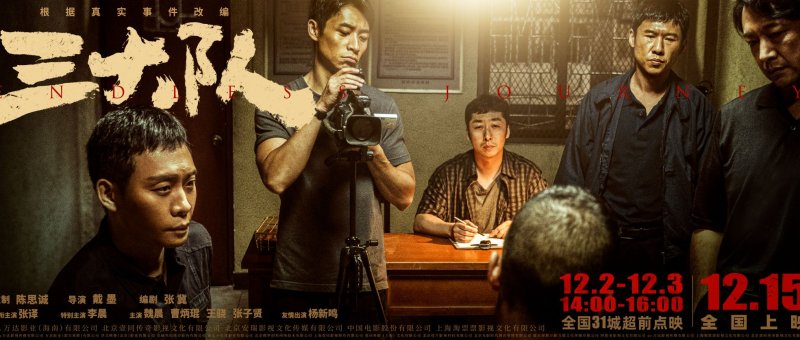
Endless Journey (三大队, Dai Mo, 2023)

The police officers at the centre of Dai Mo’s Endless Journey (三大队, Sān Dàduì) are soon stripped of their badges, accused of excessive force contravening laws existing since the medieval era to prevent vigilante justice. Yet in someways that’s essentially what they end up doing, extra-judicial investigators with a personal vendetta rather than a pure-hearted interest in justice even if the victim of the crime weighs heavily on their conscience. 

Though the film plays into the recent trend in Sino-noir and popularity of mystery thrillers at the Chinese box office, it is surprising that a film that is at least subtly critical of the justice system, featuring police who break the rules and are sent to prison, was approved by the censors board even if the central message is one of heroism as Captain Cheng (Zhang Yi) doggedly chases his suspect all over China for several years. Then again, the hero of this true life case turns out to be China itself as Cheng is reminded that his search is unnecessary given that the fugitive, Eryong (Zheng Benyu), is sure to be captured by the burgeoning surveillance network of CCTV cameras then being rolled out across the country. Years later, it’s the system that allows Cheng to identify Eryong as his DNA and fingerprints throw up positive matches within seconds of samples being taken thanks to the nation’s DNA database. 

Even so, as the veteran officer, Zhang (Yang Xinming), reminds the rookie behind every major case there’s a ruined family broken by their loss which is one reason why he doesn’t relish the prospect of investigating one so late in his career. This particular crime is so heinous that it’s become front page news which means that they’ve also got their boss breathing down their necks to get it solved as soon as possible with the existence of Division 3 itself on the line. Cheng pops home for a matter of minutes to check on his wife and daughter, shutting down his wife’s suggestion that they get a security system for their windows on the grounds that it would be an embarrassing thing for a detective’s home to have. The reason she wants one is that the victim in this case had been a little girl of around their daughter’s age unexpectedly home alone when thieves broke in by climbing over their aircon unit and smashing a window. Finding nothing of value they raped and killed the daughter. 

After a police officer dies as a result of the investigation, the squad take things too far questioning the first suspect leading to his death which is how they end up disgraced and sent to prison. After his release, Cheng has lost his family, his home, his job and identity as a protector of justice yet his determination to catch Eryong is born more of his desire to avenge a friend than it is to prevent further crime. His fellow officers join him in the beginning, but during the endless searching each make the decision to move on for easily understandable reasons such as their marriages, children, and illness but Cheng cannot let go even when prompted by an old friend from the force who tells him they have this in hand though there is perhaps a subtle implication that the police force isn’t really doing enough otherwise Cheng wouldn’t have to be chasing Eryong all over the country. 

But haunted by reflections of his own face, ageing, at times dishevelled and hopeless, Cheng is also searching for himself and a means to reclaim the self he once was by vindicating himself as a policeman along with Division 3 in finally completing their mission. The ominous score by Peng Fei with its stinging strings adds to the noirish feel as does the perpetual inevitability of Cheng’s forward motion in the dogged pursuit of his prey, unable to rest until Eryong has been brought to ground. His quest robs him of his life, but there is an undeniable poignancy to it in Cheng’s inability to find himself outside of the chase only to be left with a moment of uncertainty no longer sure who he is or where he goes now, left alone and with no sense of direction in the absence of his quarry.


Endless Journey is in UK cinemas now courtesy of CMC.

International trailer (English subtitles)

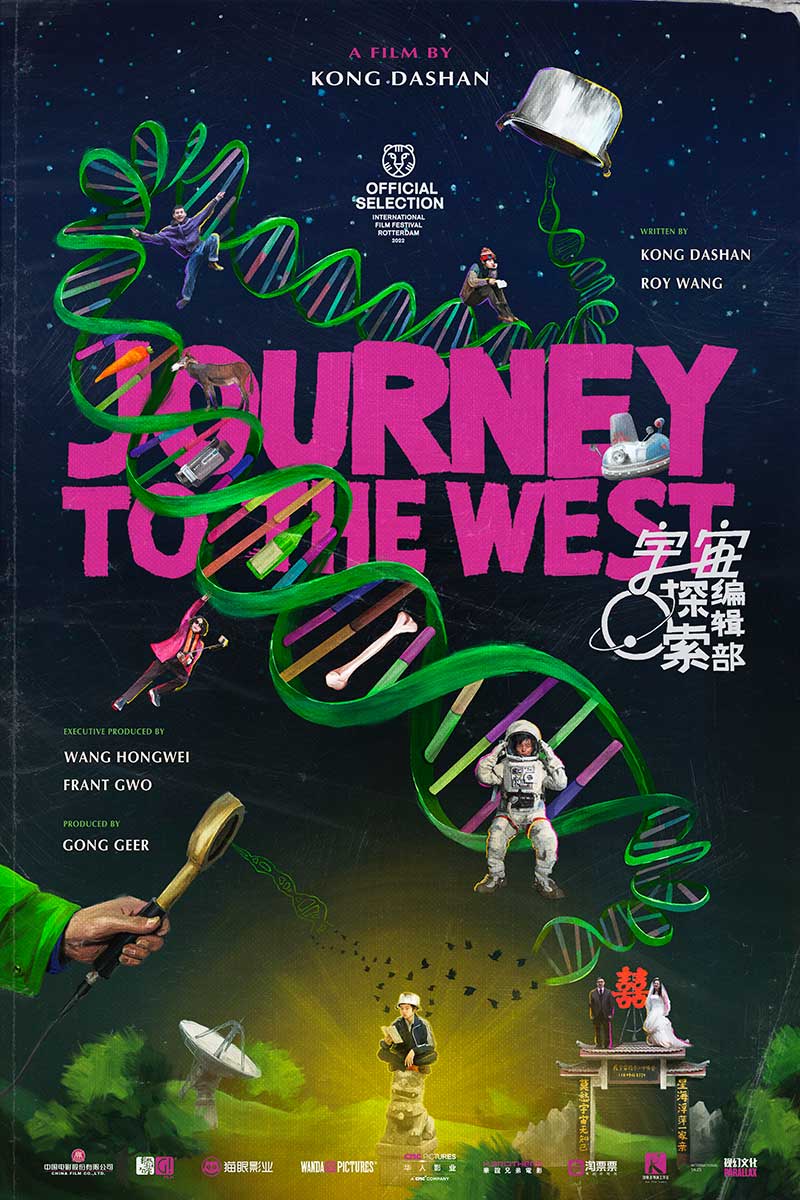
Journey to the West (宇宙探索编辑部, Kong Dashan, 2021)

An eccentric middle-aged man’s search for alien contact sends him on a quest for enlightenment in Kong Dashan’s deadpan epic Journey to the West (宇宙探索编辑部, Yǔzhòu Tànsuǒ Biānjí Bù). Inspired by the classic Chinese tale of the monk Tang Sanzang who journeyed west in order to bring true Buddhism to China in the company of the anarchic monkey king Sun Wukong, Kong’s comical adventure finds its awkward hero longing for connection in contemporary China his search for the extraterrestrial a means of provoking the next great human evolution in the belief that on the discovery of alien life humanity would immediately abandon its petty disagreements and live in perpetual harmony. 

Kong opens however with some VHS footage from 1990 in which UFO-obsessive Tang (Yang Haoyu) is interviewed for a documentary before flashing forward 30 years to the present day in which Tang has made little progress. The magazine which he edits, Universe Exploration, is on the brink of bankruptcy with his exasperated boss Mrs Qin (Ai Liya) already holding tours for prospective sponsors none of which go particularly well. As we later discover, Tang’s obsession has dominated his life resulting in the breakdown of his marriage while his daughter later died by her own hand it seems in part because of the same despair he too feels in his inability to understand the purpose of human existence. His quest is partly one for answers, though his theories often sound unhinged as he patiently explains about messages in the white snow of a detuned analogue television or pays visits to psychiatric institutions believing that psychopaths whose brains are wired differently may be better able to receive extraterrestrial signals. 

On the other hand, his way of life is not perhaps that different to that of his namesake Tang Sanzang in his wilful aestheticism insisting that the desire for better food along with sex for reasons other than procreation is merely a consumerist trap actively blocking the path towards human evolution which he believes he will discover in contacting extraterrestrial life. In his theory, if the Earth is like a grain of sand in the desert of the universe then it’s illogical to assume there are not other beings out there whom he assumes will be far advanced not only in technological terms but also in morality. But then, as a poet he later meets on his journey west into the mountains eventually asks him what if the aliens don’t have any answers either and have in fact come to Earth in order to ask the exact same question for which Tang seeks the solution?   

Inevitably, the conclusion that he comes to is that the answer lies within, that humanity is the universe and each person a single word in a great poem centuries in the making that might in its conclusion allow us to understand why we live if only we can go on connecting with each other to form new sentences in the great unfinished journey towards enlightenment. Then again, Mrs Qin hints at the mean spiritedness of the contemporary society in her conviction that if there are aliens out there who want to come to Earth it’s probably to rob it, while out on the road Tang is taken in by a bizarre scam involving the body of an alien in a freezer you can only see if you are the chosen one which requires the willingness to pay $99.99 to man running the alien embassy on Earth though it does at least result in Tang receiving a mysterious bone which does seem to be crucial to his quest once he runs into monkey king stand in Sun Tiyong (Wang Yitong) who wears a saucepan on his head and claims to have received a mission to retrieve a stone ball stolen from a lion statue’s mouth from a mysterious alien entity. 

Ever mindful of the contemporary realities, Kong throws in several ironic nods to the censors board Tang repeatedly reminded that he must always find a “scientific” explanation for bizarre phenomena rather than succumbing to “superstition”. Travelling west with Sun and a small team including his drunken friend and a young woman the same age as his daughter would have been if she’d lived, Tang does indeed undergo a kind of vision quest culminating in the apotheosis of Sun into Wukong while a strange man in a red hat riding a tiny UFO-like cart always seems to be one step ahead of them. Shot in a faux documentary style complete with direct to camera interviews and occasional breaking of the fourth wall, Kong’s hilariously deadpan, absurdist epic sees Tang journeying west in search of the meaning of life only to be confronted by the vastness of the universe and discover himself, and the answer he seeks, already in its embrace. 


Journey to the West screened as part of Osaka Asian Film Festival 2022

Clip (English subtitles)

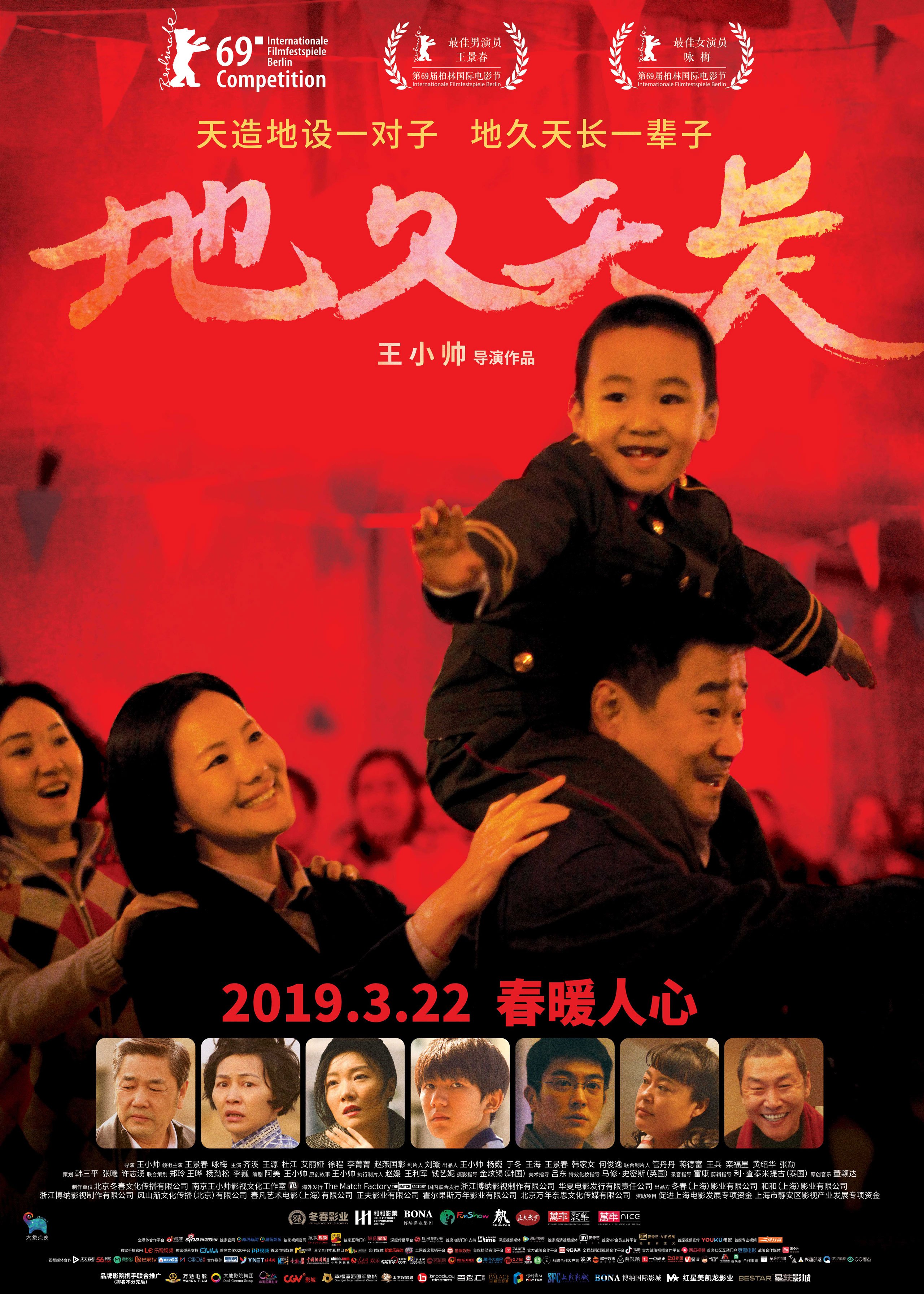
So Long, My Son (地久天长, Wang Xiaoshuai, 2019)

So long my son poster 1“Time stopped moving for us a long time ago” the hero of Wang Xiaoshuai’s So Long, My Son (地久天长, Dì Jiǔ Tiān Cháng) sadly intones, a melancholy relic of another era lightyears away from the gleaming spires of the new China. Following two families over thirty years at the close of the 20th century, Wang’s film, perhaps unlike those of his contemporaries, is not so much quietly angry as filled with tremendous sadness and an unquiet grief for the things which were taken from those who found themselves betrayed by an unforgiving, rigidly oppressive regime.

In the early 1980s, two boys, brothers in all but blood, sit by a river. One is too timid to go in because he cannot swim, while the other, irritated, tries to coax his friend with the promise that they will stay by the shore and he will be there to protect him. Sometime later, we see that a boy has drowned, his parents running fast towards the hospital with the body in their arms but all to no avail. This single event, just one of many ordinary tragedies, is the fracturing point in lives of six previously close friends whose easy, familial relationship is instantly shattered by unspeakable guilt and irresolvable shame.

Liu Yaojun (Wang Jingchun) and his wife Wang Liyun (Yong Mei) have lost their only son, Xingxing, but as someone later points out he needn’t have been their only son if weren’t for the oppressive and needlessly draconian One Child Policy. Haiyan (Ai Liya), the mother of the other boy Haohao and wife of Yaojun’s best friend Yingming (Xu Cheng), rose quickly in the party hierarchy following the end of the Cultural Revolution, becoming ambitious and seduced by her own sense of power. On learning that Liyun had become pregnant with a second child, she marched her friend to the hospital and forced her to undergo an abortion during which Liyun almost died and was left infertile.

The couple lose both their children in the same room, passing underneath the single character for “quiet” that tries to silence even their grief in the face of such cruelty. Silence comes to define their relationships with their former friends who are by turns unsure how to speak to them in the wake of intense tragedy, and fully aware of their complicity. Yaojun and Liyun forgive all. Having lost their own son they only want the best for Haohao, hoping that he is young enough to simply forget the incident and go on with his life, but as the older Haohao later says the guilt became like a tree inside of him that grew as he grew. The silence, more than the guilt or the sorrow, destroys their friendship and makes reconciliation impossible.

Betrayed again, Yaojun and Liyun are two of many laid off from their previously guaranteed government factory jobs following the market reforms of the late ‘80s. To escape their grief they exile themselves to Fujian where they know no one and do not speak the dialect. We discover that they live with a rebellious teenager named Xingxing and wonder if somehow their son survived only to realise later that they have adopted an orphaned boy in a misguided attempt to replace the child they lost. Divided by their grief and frustrated hopes, Yaojun and Liyun grow apart. He drinks to escape his intense resentment towards his powerlessness in an oppressive society, while she yearns to repair their broken family but fears that Yaojun has already moved away from her.

Meanwhile, the modern China leaves them behind. Yingming starts a business and becomes a wealthy man, while Yaojun struggles on with a small repair shop. The couple return to their hometown and the flat they once lived in to find it exactly as it was when they left, improbably surviving while the rest of the factory complex has long been torn down. The statue of Chairman Mao is still there, but now he stands incongruously outside a giant shopping mall offering ironic comment on China’s rapid progress towards rampant capitalist consumerism. Haiyan, filled with shame and remorse, seeks reconciliation near the end of her life, but as others point out no one blames her for doing her job – she was a victim of the system too, if perhaps a willingly complicit one who allowed fear and need for approval to overrule her sense of humanity. Those were dark days in which one might be arrested and perhaps killed just for dancing. Following emotional rather than temporal logic, Wang’s non-linear tale bounces through 30 years of history as its stoic protagonists attempt to endure the cruelty of their times, but eventually lands on a note of hopeful restitution in which the “Everlasting Friendship” is finally restored and the family repaired, the silence broken and time in motion once again.


So Long, My Son was screened as part of the 2019 BFI London Film Festival.

International trailer (English subtitles)