A Balloon’s Landing (我在這裡等你, Angel Teng I-Han, 2024)

A dejected Hong Kong writer longs to find the path back to paradise if in the most ironic of ways, but finds something quite different after accidentally being befriended by a young street tough in Teng I-Han’s lowkey queer romance A Balloon’s Landing (我在這裡等你, wǒ zài zhèlǐ děng nǐ). Seemingly inspired by the boy’s love genre, the film is chaste in the extreme and overly subtle in its central love story which seems to borrow heavily from other similarly themed East Asian romances such as Il Mare and Comrades, Almost a Love Story.

Director Peter Chan is in fact name checked several times, while Taipei street tough A-Xiang (Fandy Fan) has a poster of Patrick Tam’s Nomad on his wall which of course features the face of Leslie Cheung who occupies a similar space to that of Teresa Teng in Comrades in connecting the would-be lovers. Cheung tragically took his own life in 2003, the same year writer Tian Yu’s (Terrance Lau) parents were killed, while Tian Yu himself seems to have suicidal thoughts and intends to end his life at a place called The Bay of Vanishing Whales he thought he’d made up for his novel but is informed is real in a letter from a little boy in Taiwan he continues writing to as a kind of pen pal older brother. 

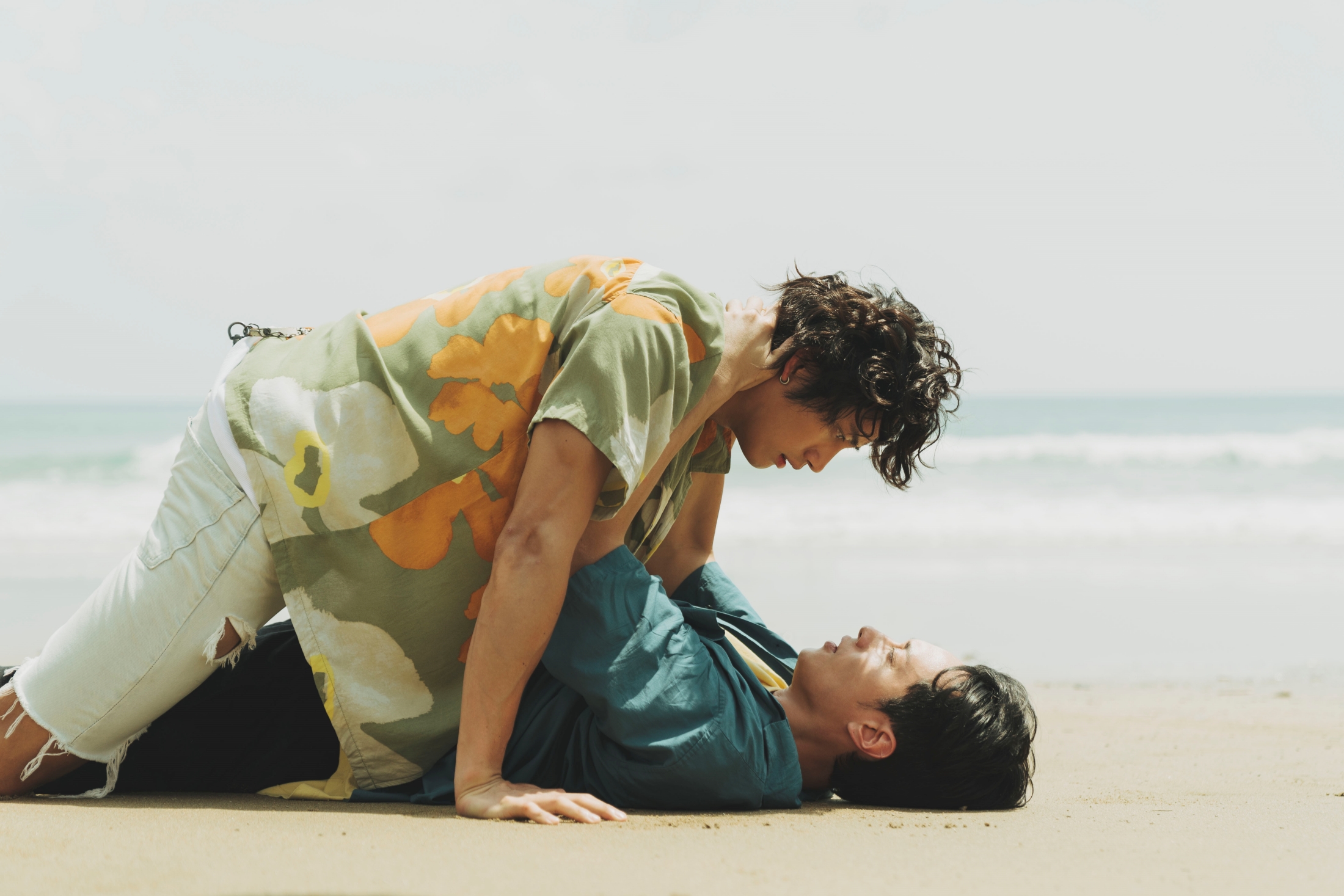
In a way, A-Xiang represents his desire for life, fond saying that there’s “always a solution” and begging him not to die just like one of the letters he received urging him to carry on living because the sender would be waiting for him at the Bay of Vanishing Whales. A-Xiang is also his literal saviour in that they meet when he rescues him from a group of conmen after he got very drunk bar but though their first meeting is sexually charged with both men wandering round in their pants their romance is slow-burn to the point of non-existence. While on road trip to find the mythical bay, the pair grow closer with Tian Yu slowly giving up on the idea of finding it along with the death it represents only for fate to intervene.

At this point the film changes direction in allowing Tian Yu to rewrite his present, no longer in search of death but of love and a way to save A-Xiang in the same way A-Xiang has saved him. At least, A-Xiang becomes a kind of symbolic other self as hinted at in his stories of men as lonely islands casting messages in bottles out into the sea in longing for connection. This sense of isolation may stem from a feeling of otherness born of his sexuality, though the film never clearly defines it, along with the more literal orphanhood and existential loneliness he shares with A-Xiang. 

As expected there is a fated connection between the two men which is more than a little contrived if perfectly in keeping with the genre of romantic melodrama as Tian Yu begins to chase a future rather than the past even while actively rewriting it to engineer a better outcome. It might be tempting to read something more into the connections between these two men each orphaned, floating islands seeking new futures together though the central theme seems to be less romance than desire for life in which Tian Yu is able to overcome his depression and desire for death through his connection with A-Xiang who gives him a new reason for living. 

A-Xiang’s symbolic value as Tian Yu’s desire for life might explain why the relationship between them never sufficiently ignites in what is at least billed as a queer romance though could easily be taken for simple friendship or platonic brotherhood with the only expression of desire longing looks and tentative motions from A-Xiang. In any case, Teng lends the beautiful Taiwanese landscape a note of wistful melancholy, a place of infinite nostalgia in Tian Yu’s mind and an evocation of the paradise he’s seeking that’s simultaneously past and future waiting for parallel lines to cross. The lyricism cannot however overcome the coyness of the central romance that for its potential poeticism remains somewhat obscure, an unrealised desire awaiting its season but also a shift in the times born of a new desire for life rather than the melancholy loneliness of past emptiness.


A Balloon’s Landing screened as part of this year’s New York Asian Film Festival.

Original trailer (Traditional Chinese / English subtitles)

Han Dan (寒單, Huang Chao-liang, 2019)

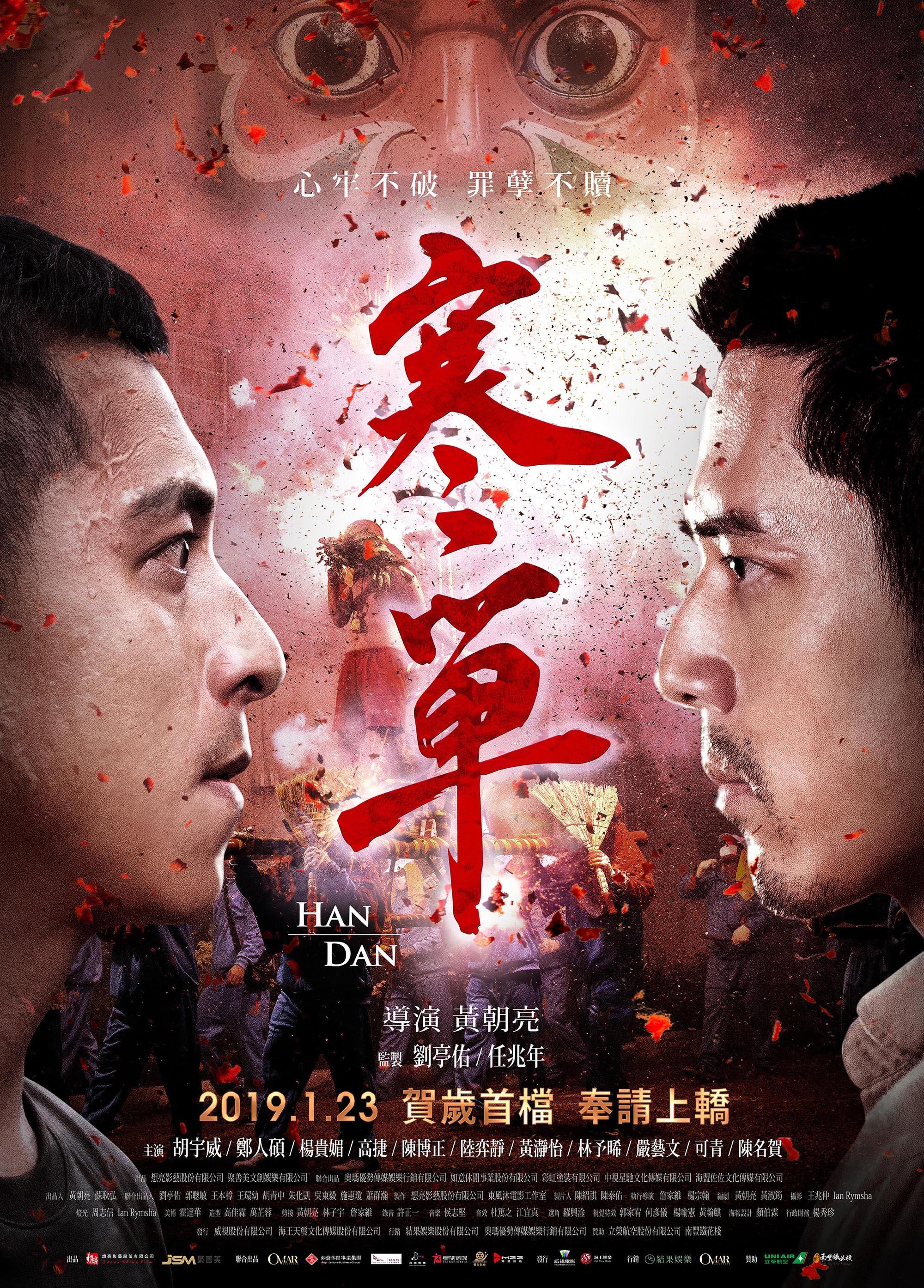
Han Dan poster 1Military deity of wealth “Han Dan” is said to be afraid of the cold, so those who worship at his altar try to keep him warm with firecrackers during a ritual still practiced in the Eastern cities of Taiwan in which young men embody the god and brave the fiery assault in a daring show of their masculinity. Some volunteer to play the god for money, others for pride, and a few for atonement but there are some crimes you can’t simply burn away either with fire or by hate. The heroes of Huang Chao-liang’s Han Dan (寒單) bond through tragedy and try push past their pain through brotherhood but only one of them is aware their present relationship is founded on twisted hate fuelled revenge even as a genuine connection forms underneath.

Nerdy, earnest school-teacher-to-be Zheng-kun (George Hu Yuwei) has been fostering a lifelong crush on the girl next door, Xuan (Allison Lin), who went away to Taipei and only rarely returns home. Too shy to declare himself, he is enraged and hurt to discover that she has been secretly dating a guy they went to high school with – popular kid Ming-yi (Cheng Jen-shuo) who used to bully him for being only a trash collector’s son. Ming-yi is set to play Han Dan at this year’s Lantern Festival and his show of manly bravado is almost more than Zheng-kun can bear. In a moment of madness, he throws his lighter into a pile of firecrackers hoping to injure his rival, but Xuan runs to warn him and is caught in the crossfire. She dies from her injuries, leaving both men feeling guilty and bereft though no one else knows that it was Zheng-kun who started the fire. 

While Zheng-kun gives up on his teaching career and retreats into gloomy introspection, Ming-yi, who lost his hearing and the use of his hand in the accident, has become a drug addict and petty criminal. Riddled with guilt, Zheng-kun commits to “saving” his former enemy – locking him up while he goes cold turkey and then bringing him into the recycling business he’s started on his father’s land, but still harbours hate in his heart both for himself and for the man Ming-yi used to be.

“If only we were real friends” Zheng-kun mutters under his breath during an otherwise idyllic moment at the river. Learning more about his “blood brother”, Zheng-kun discovers that a toxic family situation is what made him such a terrible person in high school which might ordinarily have fostered compassionate forgiveness but only makes things worse for Zheng-kun who continues to hate Ming-yi to avoid having to think about how much he hates himself for what he did to Xuan. In an effort to atone, he forces himself through the Han Dan ritual year after year, scorching his body with firecrackers but finding little in the way of cathartic release.

“Feeling the pain means I’m alive” he tells a melancholy woman who seems to have had a thing for him ever since he was a shy student with a part-time job in the sleazy snack bar where she works. Now violent and angry, he’s not such a sensitive soul anymore but she loves him all the same and resents the intrusion of the late Xuan into their awkward relationship. Like the lovelorn hostess and the song they find themselves listening to, Zheng-kun too has a secret in his schoolbag that’s becoming impossible to keep but speaking it threatens to upset the carefully balanced semblance of a life that he’s forged with an oblivious, wounded Ming-yi.

Both men struggle to move on from the past, unable to forgive themselves not only for what happened to Xuan but for the choices they did or didn’t make in their youths that leave them afraid to move forward and locked into an awkward brotherhood bonded by love and hate in equal measure. A final cathartic explosion may provide a path towards a new life but only through shattering the fragile bond born of shared tragedy and irretrievable loss. A beautifully lensed morality tale, Han Dan is an acutely observed portrait of the corrosive effects of guilt and trauma but also a tragedy of misplaced male friendship as two lost souls find each other only in losing themselves as they battle the inescapable shadows of the past.


Han Dan screens as part of the 2019 New York Asian Film Festival on June 30.

Original trailer (English subtitles)