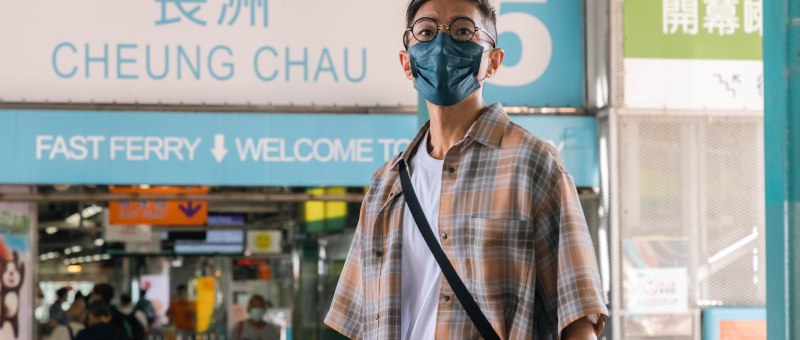

Everyphone Everywhere (全個世界都有電話, Amos Why, 2023)

Have we become too dependent on our phones, allowing them to divide rather than connect us? For those at the centre of Amos Why’s zeitgeisty comedy Everyphone Everywhere (全個世界都有電話), they do seem to have become a double-edged sword. Yet in the end, it’s a series of handsets that reconnect them with their youth if only to remind them of the disappointed hopes of a defeated middle-age given additional an weight by subtle hints of post-Handover despair. 

Asked why he’s decided to move to the UK, Raymond (Peter Chan Charm-Man) replies that everybody’s doing it even if he resented being sent away to study in Aberdeen, Scotland as a teenager in the wake of the Handover. The real reason is that he’s got himself involved in a lot of shady stuff and has just had his phone hacked so he fears blackmail or arrest. He’s organised a farewell dinner with old high school friends Chit (Endy Chow Kwok-Yin) and An (Rosa Maria Velasco), but nothing quite goes to plan in the curious ways the lives of three former friends remain entwined even if they’ve all been in some sense corrupted by the changes in their society. “All is well as long as we never change” reads a teenage message to a future self, but of course it’s a promise that can’t be kept even if in the end, “life must go on anyway.”

Still, the society itself is fairly corrupt given the prevalence of scams many of them connected to our phones. Raymond failed to get his hacked phone fixed and opted for a new number instead, but Ana in particular keeps getting weird calls from him she later realises must be an attempt to scam her out of money by someone posing as Raymond and explaining that he needs money desperately. But Ana is also the victim of another “scam” in the form of Chit’s new business strategy of getting a “monthly fee” from clients rather than be reliant on work for hire arrangements. Even the restaurant itself along with its “Japanese” chef seems to be fraudulent, while An remains preoccupied with her husband’s womanising and Raymond ironically with his series of bad decisions that culminate in tax fraud. Meanwhile Raymond’s daughter Yanki (Amy Tang Lai-Ying) is also indulging in a kind of scamming selling intimate pictures to nerdy guys via telegram and smartphone apps and ironically remarking that she doesn’t want to get scammed again when discussing ever increasing payment options with her hapless targets.

Yet as Chit discovers when he leaves his phone at home, everything seems inconvenient when you’re phoneless. In a running gag, he repeatedly tries to borrow someone’s landline but is refused leaving him wandering around the city looking for a “restaurant” in one of three very similarly named redeveloped blocks. His wife’s is the only number he remembers by heart, but she remains resentful of his meeting up with Ana, his first love, whom he previously described as a “gullible” auntie and is on some level “scamming” by convincing her to keep him on a monthly retainer. Raymond’s phone threatens to expose him, Ana uses hers to spy on her husband and stepson, and Chit’s in a sense incapacitates him, leaving him alone and disorientated in his own city no longer certain how to travel around it amid the rapidly changing landscape and seemingly identical redevelopment projects.

Life hasn’t turned out the way any of them thought it would, recalling their carefree days 25 years previously in pre-Handover Hong Kong. Banners advertise a “New Era”, but the trio are trapped in the past with which they are eventually reconnected thanks to the retro handsets that unlike the technology of today still work and contain a series of time capsule messages to their future selves. History in a sense repeats itself as Raymond prepares to leave, but each is able to come to terms with their unfinished business and begin making concrete decisions about their futures. Suddenly “can we meet on Saturday?” takes on a new sense of poignancy when everyone seems to be leaving but then again, perhaps our phones really do connect us even if they sometimes connect us to scammers or people we don’t really want to talk to. Subtly hinting a sense of disappointment which runs a little deeper than middle-age malaise, Why looks back to the carefree days of 1997 allying the broken dreams of youth with the “New Era” of today but nevertheless grants his heroes a sense of new sense of possibility even the face of their despair. 


Everyphone Everywhere screens July 20 as part of this year’s New York Asian Film Festival.

Original trailer (Traditional Chinese / English subtitles)

Images: © 2023 Dot 2 Dot Creation Limited. All Rights Reserved.
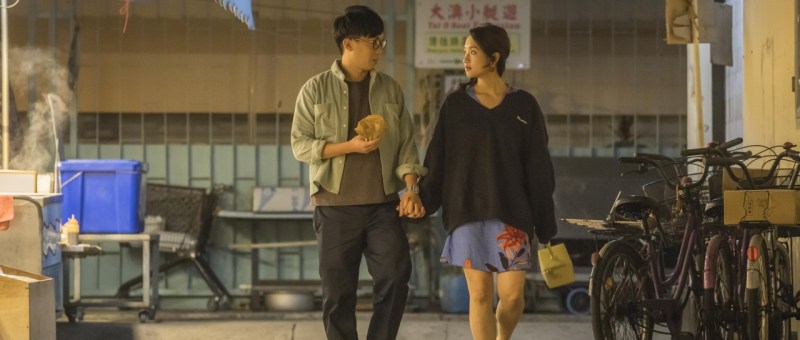
Far Far Away (緣路山旮旯, Amos Why, 2021)

An introverted IT specialist gets a crash course in romance when he accidentally ends up dating a series of women from the far flung corners of the land in Amos Why’s charming romantic comedy, Far Far Away (緣路山旮旯). An occasionally subversive love letter to a disappearing Hong Kong, Why’s elegantly scripted romance also presents a snapshot of the contemporary society in exploring the various reasons each of the women has rejected the high status, consumerist lifestyle of the cities in favour of a more bespoke happiness elsewhere. 

At 28, Hau (Kaki Shum) has had only one relationship and is still unsure why his previous girlfriend, a former co-worker, broke up with him. His sympathetic hometown friends are forever trying to set him up while he nurses a gentle crush on another woman from the office, A Lee, but is too shy to say anything and worried that her reluctance when colleagues suggest he drive her home after a night out implies that she finds his company uncomfortable. That is not as it turns out quite the case, the reason she didn’t want him to drive her home is that she’d moved from an upscale, prestigious area to a small rural town far out of the city because she broke up with her boyfriend and couldn’t afford the rent but didn’t want anyone to know. 

The constant obsession with men driving women home becomes a minor plot point with several of the women actively questioning why it’s necessary and occasionally even offended while forcing Hau to admit that in most cases he’s offering because he wants to spend more time with them rather than out of a general concern for their safety or simple convenience. Having abandoned the dating app he was working on at work to concentrate on a delivery/map service, he ends up bouncing all around Hong Kong visiting various women even venturing to places so far out he needs to apply for a separate permit to enter while beginning to rethink his life choices realising that the reason he’s so set on stubbornly occupying his family’s flat in the city is rooted in his childhood trauma of having lost his mother to illness and his father to the Mainland in a symbolic orphanhood that hints at the anxieties of contemporary Hong Kong. Hau’s recently married friends discuss the possibility of having children but admit that they don’t really want to do it unless they can move abroad, Hau later speculating they will go to Taiwan while his friend who goes by the ironic name “Jude Law” has a British National (Overseas) Passport. Hau himself admits that he’d never really given it much thought until recently when a prospective partner asks him if he’d ever considered moving abroad mostly to confirm he won’t suddenly announce he’s leaving once they start dating seriously because almost no one can see a future for themselves in a changing Hong Kong.

Meanwhile, each of the women has made a decision to prioritise something else rather than join the city rat race from a youthful young woman living in an idyllic coastal town while determined to marry at 29 to Hau’s college friend Melanie (Jennifer Yu Heung-Ying) who chose to work for an NGO because of the better work/life balance that meant she wouldn’t be pressured into endless overtime. Then again another of Hau’s suitors appears to be just as ambitious as any other city dweller while viewing herself superior because her family bought a flat in a provincial area 25 years previously at a preferential rate and then sold it to her at below market value but more than they paid originally which strikes Hau as an odd arrangement between parent and child but speaks to the penny pinching mean spiritedness that leads her to blow up at him because he left a nice tip at a restaurant where service was included in the bill. An artist friend is willing to put up with primitive conditions in a remote mountain village because she’d rather have the stars than city lights, while each of the women also worry that any attempt at romance is always doomed to failure because no matter how keen they are or claim to be sooner or later the guys all ask them to move back to the city prioritising their own convenience while ignoring all of the reasons they chose to live in these very specific places. 

Eventually Hau becomes the exception, realising that the where isn’t the most important question acknowledging that perhaps he’s the one who ought to move in deciding to let go of the childhood trauma in his family home in order to make a new one of his own having figured out what he wants out of life and who he wants to spend it with which in the end dictates the where. Sometimes, love is just around the corner if you’re willing to go and have a look. A gentle celebration of a disappearing Hong Kong both literally and metaphorically, Why’s charming rom-com sends its hero on a roundtrip to love figuring out his place in the world in finding that home really is where the heart is. 


Far Far Away screened as part of Osaka Asian Film Festival 2022

Original trailer (English subtitles)

Images: (C)2021 DOT 2 DOT CREATION LIMITED