Strangers (Kenta Ikeda, 2024)

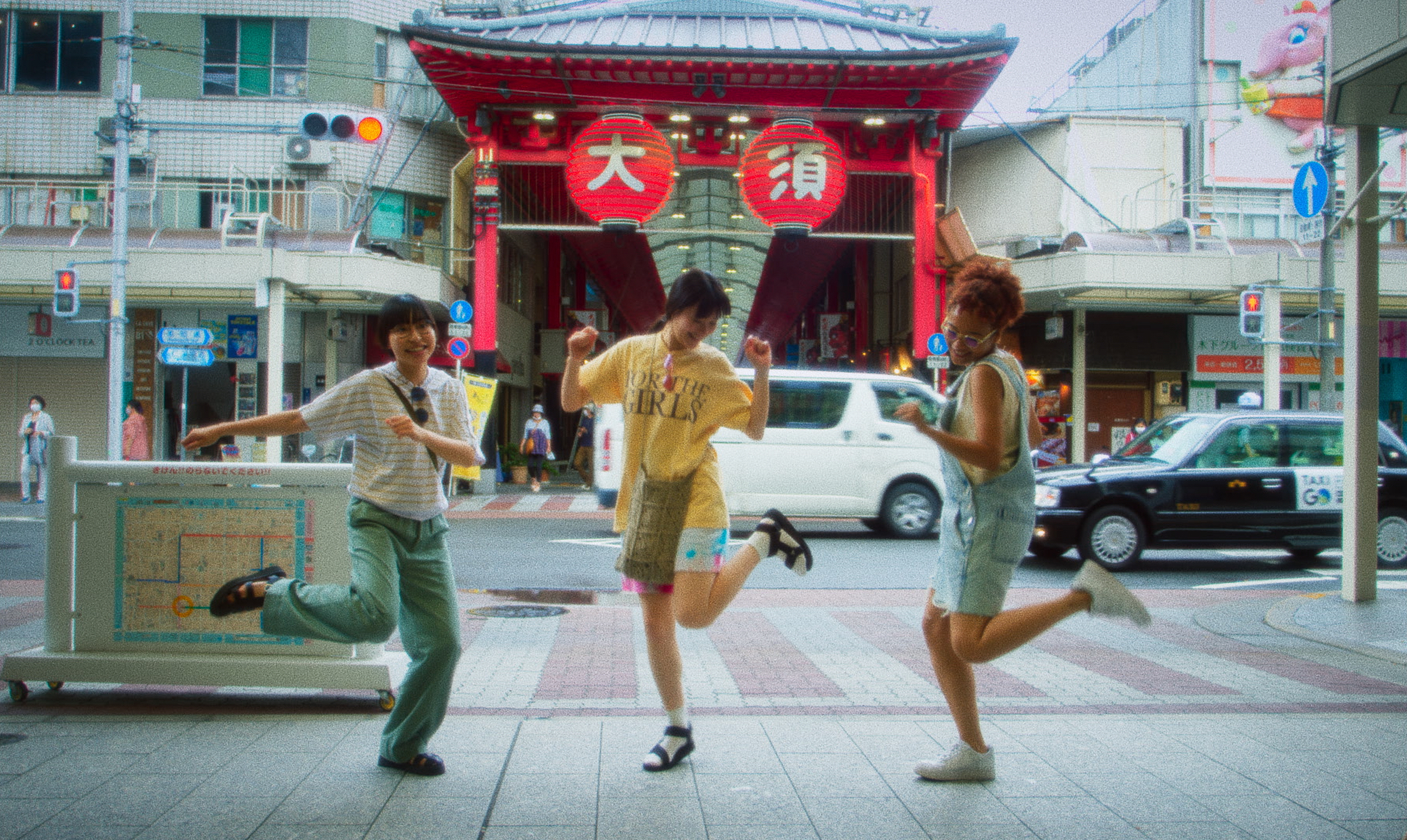
Naoko, the heroine of Kenta Ikeda’s Strangers, says she’s been pretending all her life. She’s been pretending to be what everyone wanted her to without really knowing or thinking about what it was she wanted to be or who she really is. On a baseline level, Ikeda suggests that we are and remain strangers to ourselves while equally confused about those around us, seeing what we want or expect to see rather than who they really are.

In part that may explain why Naoko has stayed with her unfaithful fiancé Takeo who got a colleague pregnant and then seemingly abandoned her. Shimizu then began harassing Naoko, stalking her and making silent calls. To make matters worse, Takeo is often away on “business trips”. He’s not currently responding to her phone calls or messages and has just embarrassed her by not turning up to a family event. Naoko’s sister thinks she should leave him and doesn’t understand why she hasn’t already. But Naoko just sighs that she’s decided not to expect too much from life and seems prepared to put up with this degradation because she doesn’t think she deserves anything better. 

That might be why she’s so drawn to her enigmatic colleague Yamaguchi who waltzes in past noon wearing a distinctive blue dress that floats in the air behind her. The other ladies at work gossip that their bullying boss Satome, who is married with two children, got her the job after picking her up on a dating app and the reason why she can get away with such unprofessional behaviour is because she’s sleeping with him. But Naoko later discovers that Yamaguchi’s dating app activities are a kind of side hustle in which she participates in idealised dating scenarios pretending to be the lover of lonely men who pay her handsomely for a few hours of fantasy romance.

Or as Yamaguchi describes it, the opportunity to experience only the good parts of love before you get sick of each other and run out of things to say. It sounds more than a little like the logic of someone who’s decided not to expect too much from life, and while it seems Yamaguchi may be trying to avoid her own grief and loneliness, it’s true that she otherwise remains a cypher. After losing contact with Yamaguchi and being left with her smartphone, Naoko receives a call from her handler who tells her that it doesn’t matter who she is or why she has “Yamaguchi’s” phone, all that matters is turning up at the appointment and never letting it slip that it’s all just role-play.

On her dating app profile, Yamaguchi’s face is blurred so that you only really see the image of her in her distinctive blue dress which Naoko too later starts wearing. The people around Naoko are often shot in soft focus so that we can’t really be sure of their identity beyond using their clothing to infer who they are. Men in particular are often shot from behind or with their faces out of frame as if they were all just a much of a muchness. We never even meet Takeo, who apparently does not return from his “business trip”. In any case, in agreeing to the fantasy date, Naoko is gradually taken over by the Yamaguchi persona. The spread of the graze she sustained at the beginning of the film seems to indicate the gradual erasure of her identity, yet in another sense becoming Yamaguchi also gives Naoko an excuse to stop pretending and accept herself or at least to start expecting more from life. She becomes more assertive, flirtatious, and confident in confronting Shimizu only to realise that she may not have been the mysterious force she felt watching her after all. 

In her Yamaguchi persona, Shimizu describes Naoko as a like a colourless and doorless detergent, but she replies she’s been hiding all her life. She ran ran away from her problems, refused confronting Takeo or Shimizu, avoided being honest with her family and simply played up to the image they had of her of a shy and obedient woman. There might be something in the fact that Yamaguchi kisses her suggesting that Naoko may have been running away from her sexuality, but equally it could just be that this is how the Yamaguchi curse is passed from woman to woman. Having once assumed it, Naoko now must try to shake it off but that too might not be as easy as she might assume. Meanwhile, those around her also have their own secret lives and faces they keep hidden from others. Ikeda creates a atmosphere of eeriness and hovering violence amid the faceless city where it doesn’t matter who you are so long as you show up and everyone is to some extent participating in a temporary fantasy in order to overcome the disappointment of life in which as Naoko had told herself it seems better not to expect too much.
Plastic (Daisuke Miyazaki, 2023)

A young couple bond over their shared love of an obscure 70s glam rock band, but soon find their youthful romance eroded by the realities of impending adulthood in Daisuke Miyazaki’s warmhearted coming-of-age tale, Plastic. Emotional distance becomes a persistent theme as mediated through a message into space that might take light years to arrive not to mention the reply, which seems to echo the couple’s inability to communicate despite their star-crossed connection.

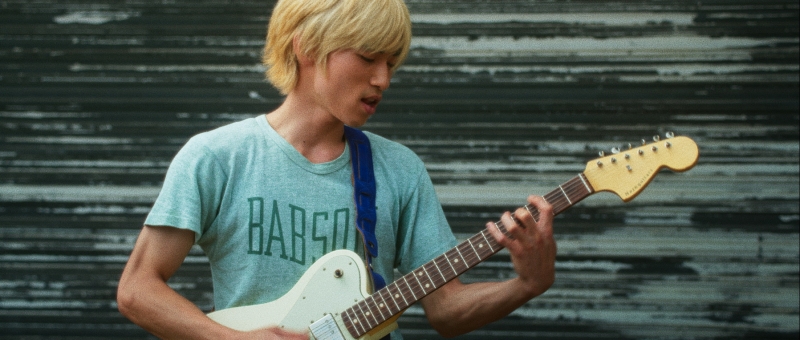
Jun (Takuma Fujie) and Ibuki (An Ogawa) bond after realising they are both fans of 70s band Exne Kedy, talking for hours at a small cafe only leaving when the place closes. Having recently relocated to Nagoya from Tokyo, Jun enrols at Ibuki’s high school and joins her after school club much to the chagrin of her two friends. The pair eventually become a couple going on a series of wholesome dates including a trip to watch Sad Vacation in a cinema and are apparently very much in love but a year later the novelty has begun to wear off. Ibuki is studying for university exams and bound for a top institution in Tokyo while Jun is planning to drop out and pursue music full-time. 

Perhaps slightly more conventional, Ibuki berates Jun for his impracticality asking how likely it is he’ll be able to support himself with the kind of music he makes. Later she has some kind of flash forward in which she imagines herself supporting him financially while he’s not even playing guitar anymore and they’re arguing about responsibilities for rent and living costs. She breaks up with him in the carpark of a convenience store but perhaps regrets it, keeping up a half-hearted friendship while he remains lost and lovelorn pursuing music on the side while working part-time. “Plastic” becomes a kind of metaphor for their relationship, something which should have lasted forever but has been subtly undermined by the microorganisms of conventionality and contemporary capitalism until it eventually broke apart. 

The distance between them is likened to that of the space radio broadcast which might not reach its target for 25,000 light years. The message was sent the same year that Exne Kedy broke up, and may well be delivered a little more than 50 years later at their reunion concert only as the narratorial voice over explains, that’s largely up to chance. Swapping notes on studying in the same way Jun’s mother and grandfather had talked about seeing Exne Kedy in concert, Ibuki’s parents had compared their flashcards to modern apps and joked that maybe someday education would all be online as in fact happened during the pandemic. Having swapped her rural home for the bright lights of Tokyo, all her classes are online which ironically gives her more time to spend with her friends but also leaves her exhausted and distant. 

When Jun wonders if his music is like the broadcast, destined not to arrive for thousands of years so he’ll never know who got it. Another school friend, Ayumu, asks him if he’s sure he hasn’t just missed a reply 25,000 years in the making which is sort of ironic because he’s clearly missed that she’s been trying to answer his message only he’s too hung up on his ex to notice. Later she asks him to move in with her, pointing out that she’s right there not 25,000 light years away like Ibuki who is now living with a DJ who doesn’t even know who Exne Kedy are. The two of them are far apart but somehow still connected, not least by their love for the band which may eventually reunite them. 

Exne Kedy is modern day creation by Ide Kensuke who had previously released the album Kensuke Ide With His Mothership ― Contact From Exne Kedy and the Poltergeists and makes a self-cameo in the film in a surreal scene featuring the band whom Ibuki and Jun unexpectedly run into doing an impromptu performance in the middle of a forest singing a song that echoes the state of the couple’s relationship in which a lighthouse no longer illuminates and cannot light the way. Yet there is always a sense of the couple as a pair of flashing beacons waiting to pass close enough to each other to be able to convey a message. Featuring cameo appearances from (former pop star) Kyoko Koizumi and Machiko Ono, Miyazaki’s strangely charming youth movie is surprisingly sincere in its romanticism but equally in its critique of the world that frustrates it while suggesting that music may once again save the day.


Plastic screened as part of this year’s JAPAN CUTS.

Original trailer (no subtitles)

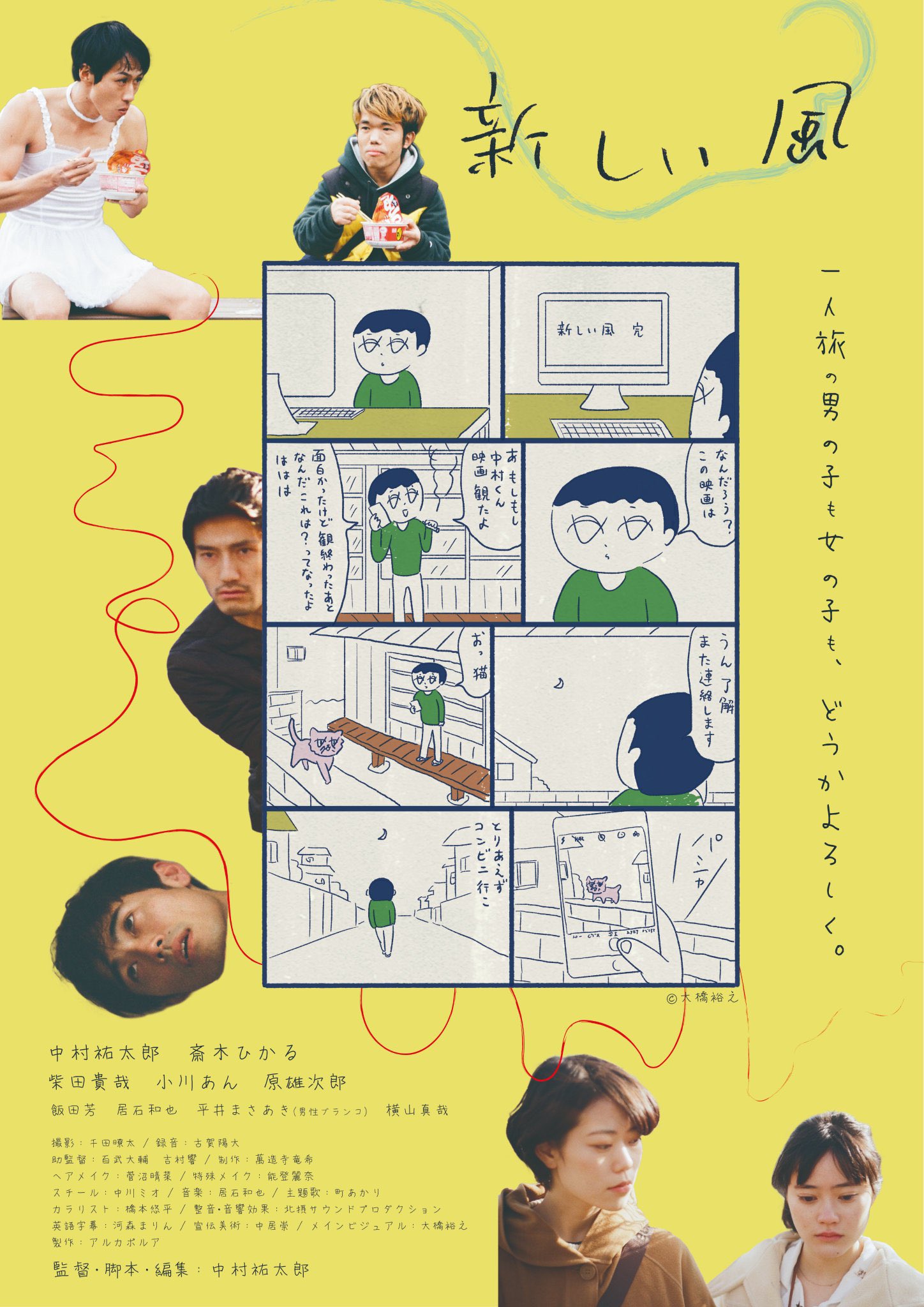
A New Wind Blows (新しい風, Yutaro Nakamura, 2021)

Seemingly brought together by fate, a collection of lovelorn Tokyoites have a very weird New Year in Yutaro Nakamura’s absurdist farce, A New Wind Blows (新しい風, Atarashii Kaze). A collection of interesting, sometimes contradictory vignettes, Nakamura’s various tales of frustrated love and interpersonal tension are perhaps variations on a theme illustrated, sometimes literally, with an ethereal logic in which events repeat themselves from differing angles or familiar faces recur in slightly different roles. “What kind of future, if any at all, can we picture?” the opening title asks us, suggesting that this strange night might be imagined but in the end at least filled with a kind of possibility.

Opening in long shot, the first scene follows a pair of teenage friends who forcibly begin trying to play football with a boy who quite clearly wants to play on his own. Eventually, they give him his ball back, and he cries. In an apparent flash forward we find ourselves in contemporary Tokyo as Hikari (Hikaru Saiki), the young woman, goes on a non-date with a friend, Kotaro (Yutaro Nakamura), who confesses his feelings to her at the end of the evening and immediately apologises but gets no real reply. In any case, the moment is later interrupted as Hikari runs into an old friend, Yujiro (Yujiro Hara), the young man, who now works as an Uber Eats driver. Realising they’ve missed the last train, Hikari decides to hit up an old friend, Anzu (An Ogawa), to see if they can stay with her. Anzu is not very welcoming, it is New Year’s Eve after all, but eventually lets them in which is when we realise there is tension in the house. It turns out that Hikari used to live with Anzu until a couple of weeks previously when she kicked her out, presumably to move in the boyfriend, Takaya (Takaya Shibata), who wastes no time at all behaving like a complete tool firstly irritated to have guests at all and then apparently challenged by the double masculine presence of the extremely tall Yujiro and the smaller Kotaro who, equally, is somewhat inappropriately fussed over and infantilised by Anzu who asks him a series of insensitive questions and later brands him a “fairy”. 

Before the evening’s out, Takaya, the lonely solo footballer, has burst into tears once again after trying to start several fights, threatening to kill people, demanding that someone kill him and then making an unexpected declaration of love to a surprise third party. Taking to the streets in a random angel costume he ups the hyper-masculine act, turning up shortly after another street harasser to harass Hikari as a song plays describing her, presumably, as a “princess running away from desire and dominance”. Kotaro and Hikari had been continuing their non-date with typical New Year activities such as visiting a shrine, yet he is the only one willing to sit with the obviously distressed Takaya and attempt to talk him down with the aid of some instant udon and gentle wisdom. “The sky is blue today. The sun is warm. But we shouldn’t take it for granted. Such quiet days can often bring happiness.”

That is perhaps in a sense the lesson. The weird New Year crisis eventually begins to fade, a kind of calm finally returning and then giving way to a second possible flashback or merely a waking up returning to the opening scenes as the teens, slightly changed, attempt to heal the gaping wound while Takaya cries into his sleeve. Is this present a dream of the past or vice versa? In any case, romantic crises apparently pass and some find their feelings are returned after all, assuming it is not also a dream. Making frequent use of music accompanied by fun karaoke-style onscreen lyrics as well as stylish graphics and illustrations, Nakamura’s quiet indie dramedy revels in everyday strangeness and the pathos of frustrated dreams be they going to London to play guitar, making a friend, or having your feelings returned. Quiet days can indeed bring happiness if of a quiet kind despite the madness of everyday life allowing a new wind to blow carrying new possibility for a hopefully happier future. 


A New Wind Blows screened as part of the 2021 Osaka Asian Film Festival

Original trailer (no subtitles)

For Rei (レイのために, Yukari Sakamoto, 2019)

(C)Yukari Sakamoto

Going to university is a prime opportunity to start figuring yourself out, but if you feel a little hollow inside it can often be an uphill battle. The heroine of Yukari Sakamoto’s For Rei (レイのために, Rei no Tame ni) is intensely anxious, somewhat distanced from herself in the unresolved trauma of her parents’ divorce and subsequent loss of contact with her father. University can also be a prime opportunity to reach towards independence, but that necessarily means learning to “let go of the things you don’t like” to chase the things you do while figuring out what the difference between those two things might be. 

Philosophy student Rei finds herself at odds with her classmates, some of whom actively belittle her off the wall contributions for being off the point while the TA offers only the reassurance that she found her words “poetic”, which given the environment she finds herself in might not exactly be high praise. Meanwhile, she’s in a loose relationship with fellow student Nakamura who has a part-time job as a driver he doesn’t much like. As she reveals to her mother, however what’s really bothering her is that she’d like to reconnect with her estranged birth father whom she hasn’t seen since her parents divorced when she was small. Despite her mother’s warnings that her father may only cause her pain, Rei presses ahead and writes a letter, eventually meeting up with him for dinner in a swanky Western restaurant where he orders wine and she coke. 

That comment that so riled her classmate was to do with the nature of perception and its mutual effect on the perceiver. Rei offers that she thinks being looked at is something inherently uncomfortable, that when someone looks at her she wants to look away while looking at someone else can be a cold, abstracted experience. Later, after meeting her father, she returns to the same topic with additional insight, admitting that she was always afraid of being perceived, feeling as if someone was continually watching and waiting for her to mess something up. As much as she feared the gaze, she also felt its pity and wanted to be embraced by it but as she grew she could no longer fit inside as it seemed to grow smaller and recede from her. The sense of loss and distance made her sad, but she is perhaps coming to the realisation that that feeling of disconnection is also a part of growing up as she outsteps the parental gaze to claim her own independent space. That process may necessarily be painful, but it’s her father’s hand on her shoulder that keeps her from moving fully forward as she struggles to separate herself from a half-felt presence. 

Rei’s father, apparently remarried, tries his best to reconnect with his now grown-up daughter but the encounter is unavoidably awkward, belonging both to the past and future as she realises she’s no longer a woman who needs a paternal presence just as she’s made the decision to find one. They chat awkwardly about the intervening years – her feelings of disconnection from her mother’s second family with a step-father and half-sister, and his remarriage, while eventually returning to the past. He never explains why he didn’t keep in contact (though this is sadly normal for divorced fathers in Japan) but is keen to explain that he didn’t leave because of her, only that he and her mother were very young and eventually discovered that they were incompatible, their views on money and family matters apparently entirely different. He didn’t understand her and the distance between them bothered him. 

Like Rei, he couldn’t feel himself inside the gaze and eventually absented himself from it. The reunion seems to have gone well, her father offering to take her mountain climbing, but we somehow feel that they might not meet again. What Rei learns is the power to perceive herself with pity and perhaps let go of the image of her father, a little disappointed in herself to have taken a throwaway comment to heart and remembered it all these years only to garner no reaction on recalling it. Freed from the overbearing gaze, Rei learns to centre her own perception, forgiving both herself and the past, as she steps boldly into a new adult space and sets off into a future of her own choosing.


 For Rei was screened as part of this year’s Osaka Asian Film Festival.

Original trailer (English subtitles)

Poetry Angel (ポエトリーエンジェル, Toshimitsu Iizuka, 2017)

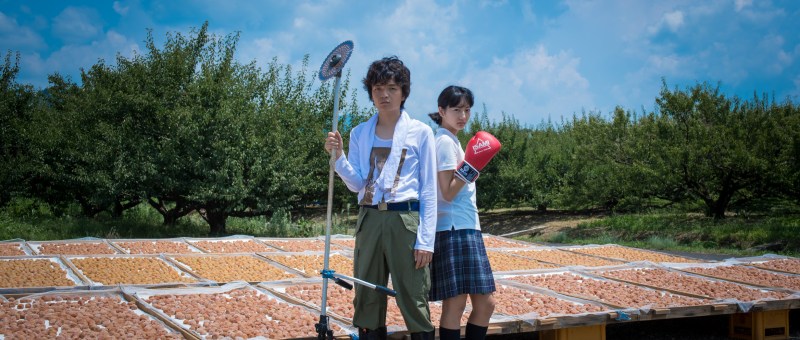
poetry angel posterLife is confusing. You think you know what you want, only to realise it wasn’t what you wanted at all. What you really wanted was the very thing you convinced yourself you didn’t want so that you could want something else. The characters at the centre of Toshimitsu Iizuka’s Poetry Angel (ポエトリーエンジェル) are all suffers of this particular delusion, lost and alone in a small town in rural Japan without hope or direction. That is, until they discover the strange sport of “poetry boxing”.

Our hero, Tsutomu (Amane Okayama), is a 21-year-old farm boy with dreams of becoming an author. His illusions are, however, shattered when he checks the board in the community centre and discovers he hasn’t even placed in a local history essay writing contest which appears to have been won by a child. In this delicate state, a pretty girl suddenly approaches him and begs for his help but then drags him into a seminar room where he is forced to listen to a lecture on “poetry boxing”. Almost everyone else leaves straight away but Tsutomu is intrigued – after all, semi-aggressive literary sport might be just the thing to get an aspiring author’s creative juices flowing.

Tsutomu’s problems are the same as many a young man’s in Japanese cinema – he resents having his future dictated to him by an accident of birth. His father owns a large orchard and is a well respected producer of salt pickled plums. As the only child, Tsutomu is expected to take over but he hates “boring” country life and the repetitive business of farming, his thinly veiled jealousy all too plain when an old friend returns from Tokyo on a visit home between university graduation and a new job in the capital. Tsutomu thinks of himself as special, as an artist, but no one seems to be recognising his genius.

This might partly be because his only “poem” is an alarming performance art piece in which he laments his tendency to destroy the things he loves with his “weed whacker”. The sport of poetry boxing has no physical requirements but it has no limits either. It’s more or less like performance poetry or a less directly confrontational kind of slam, but participants are encouraged to step into the boxing ring and express themselves in whichever way they see fit. Once both participants have concluded their “poems” a panel of judges votes on the winner. Like Tsutomu, the other members of the poetry boxing team are dreaming of other things or claiming to be something they’re not. Rappers who really work in cabaret bars, lonely girls who fear they’re plain and long to be “cute”, civil servants longing to kick back at inconsiderate citizens, and old men who really do just want to write poetry and appreciate the time they have left.

Yet through the endlessly wacky tasks set by Hayashi (Akihiro Kakuta), the leader of the group, each of the participants begins to gain a deeper understanding of who they are and what they really want. Not least among them An (Rena Takeda), a gloomy young girl who spends her life scowling at people and refusing to speak. She’d been into boxing for real and first met Tsutomu when she punched him in the face because his unexpectedly sexist friend from Tokyo was harassing her in the street. Poetry, however, begins to unlock even her deepest held desires which can finally be voiced from the ironically safe space of the poetry boxing ring.

There may be nothing particularly original about Iizuka’s delayed coming of age tale, but it has genuine warmth for its confused no hopers as they look for connection through formalised language and ritual play, discovering new depths to themselves as they do so. As it turns out mostly what you want was there all along, only you didn’t want to look. Annoyingly, other people may have figured it out before you but that can’t be helped and is, after all, only to be expected. Poetry is a doorway to the soul but it’s also one that might need a good kicking to get it open. Maybe the boxing ring is a better place to start than one might think.


Original trailer (no subtitles)