
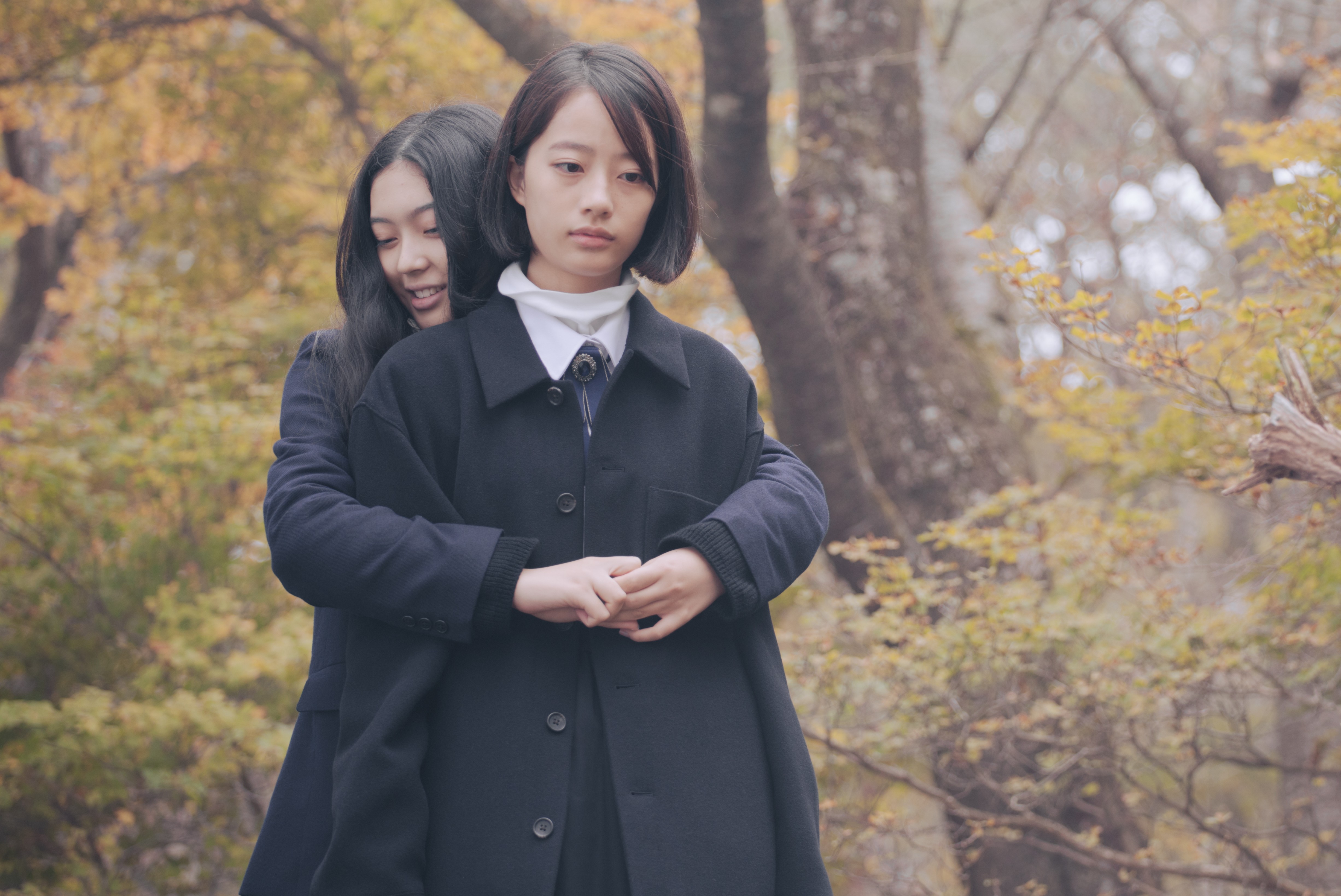
The abrupt suicide of a young woman at a protestant Christian boarding school causes those around her to reassess their reality in Yukari Sakamoto’s poetic drama White Flowers and Fruits (白の花実, Shiro no Kajitsu). Perhaps done a disservice by the literalness of its English language title, the film is on one level as the Japanese title implies about the disconnect between form and content, or the extent to which we project ourselves onto others and see only what we want or expect to see.
Anna (Miro) is someone who says she can see “what others can’t”. This most obviously refers to her ability to see ghosts, though of course we can’t be sure whether she is telling the truth or hallucinating reflections of her own anxieties. In any case, she has a rebellious streak which is why her mother has transferred her to a Christian boarding school. “It’s your last chance,” she tells her, implying that Anna has already been expelled from several other institutions for her refusal to conform. Anna, however, promptly discovers an angry ghost hovering directly behind her new roommate Rika (Nico Aoto) and thereafter refuses to the “pointless” rules of the school including wearing her ribbon necktie.
She and “lovely” Rika are then contrasted as model student and its reverse. It’s Rika who remarks that being at odds with everyone all the time must be exhausting and her life might be easier if she made more of an effort to get along with people, but Anna claims that she is simply unlike Rika and this is something she is unable to do even if she wanted to. “Why don’t you try being me?” Rika asks after putting her own ribbon around Anna’s neck, as if she were lifting a burden from herself and placing it onto Anna in a moment of forced conformity if also a well-meaning rather than oppressive gesture. When Rika takes her own life by jumping from the bell tower not long after, it provokes a degree of soul-searching among everyone at the school but most especially Anna and Rika’s best friend Shiori (Anji Ikehata).
After reading Rika’s diary, Anna begins seeing a blue orb she believes to be Rika’s spirit which eventually settles in her chest and begins to alter her personality to become a little more malleable and conformist as expressed by the Edwardian-style high collars of her uniform and newly deferent personality. It’s never quite clear if this is “real”, Anna’s delusion, a manifestation of her attempt to come to terms with grief, or deliberate subterfuge as she begins to develop a friendship with Shiori in part based on the notion that she has been possessed by Rika. The pair are both trying in one sense to get a handle on the sides of Rika that they didn’t have access to in order to understand why she died.
But Rika’s diary is full of insecurity. She feels herself under pressure training to train for the school’s traditional dance show and is paranoid that she makes those around her worry when she doesn’t perform well enough. The dance itself is strangely sensual and witchy, earthy and rooted in nature in contrast to the religious setting of the school. On reading the diary, Shiori realises that shortly before she died Rika tried to confess her feelings for her, but Shiori simply didn’t understand and worries this accidental and insensitive rejection may have contributed to her desire to take her own life. It is not especially the religiosity of the school that is repressive, however, so much so as the enforced conformity of their social class.
Aside from their association with “Class S” lesbian romance literature, these kinds of boarding schools are associated most closely with upper-class women who are being trained to become wives of important men. As such it is important that they learn to be, unlike Anna, meek and obedient. On a return home, Shiori attends a dinner party at which only her sister is dressed in red and seated across from a man to whom she has evidently been betrothed for an arranged marriage. Shiori is mildly horrified, but her sister just seems to stare on vacantly as if resigned to her fate. But it’s also this image of properness that may have prevented Rika getting the help she needed before she died as her animosity towards her family and fear of her father were ignored because of their social standing. Rika’s apparently distraught father is determined to retrieve the diary presumably because he fears what might be written inside it. Rika’s role as a model student might then have been a persona that marked her attachment to alternate familial home and a desire to escape sexual abuse at the hands of her father.
A video is leaked showing a young girl smoking in one of the school’s bedrooms with many believing it to be Rika, though it isn’t really clear who is it just as it is often unclear whether Anna is Rika or a version of herself. A final moment of rebellion, Anna challenges the enquiry into Rika’s death accusing them of using Rika’s death for their own ends to explore questions about themselves rather than directly confronting their own realities, though perhaps this is what she too has been doing. In an ironic way, it’s through letting Rika go that Anna and Shiori are able to move forward with their lives, but in other ways they take her with them as if she really had settled somewhere in Anna’s chest. Anna has learned how to dance for herself and come to some kind of accommodation with the world, while Shiori has been presented with a picture of herself that is also a picture of Rika in its reflected gaze. Sakamoto leans into J-horror territory in capturing the gothic atmosphere of the school, though as Anna later says, the ghosts themselves are not really frightening so much as an expression of that which remains unknown an acceptance of which defines adult enlightenment.
White Flowers and Fruits screened as part of this year’s JAPAN CUTS.
Trailer (no subtitles)


